All-Star

All-Star
Showing posts with label affinity. Show all posts

Wednesday, February 5, 2014

Different Perspectives


Quitely and Grant

Since I've posted quite a bit about All-Star Superman in the past, I thought I'd do so again.

Here's a link to a long article about the ray bradbury reference in the first issue.

 The writers at Hooded Utilitarian didn't buy into the general praise of the series, and they offer a series of insightful articles about why. This first one by Noah Berlatsky discusses how All-Star feels decadent, a retread of the silver age stories that never quite captures their true feeling. Here's another he wrote on the same subject.

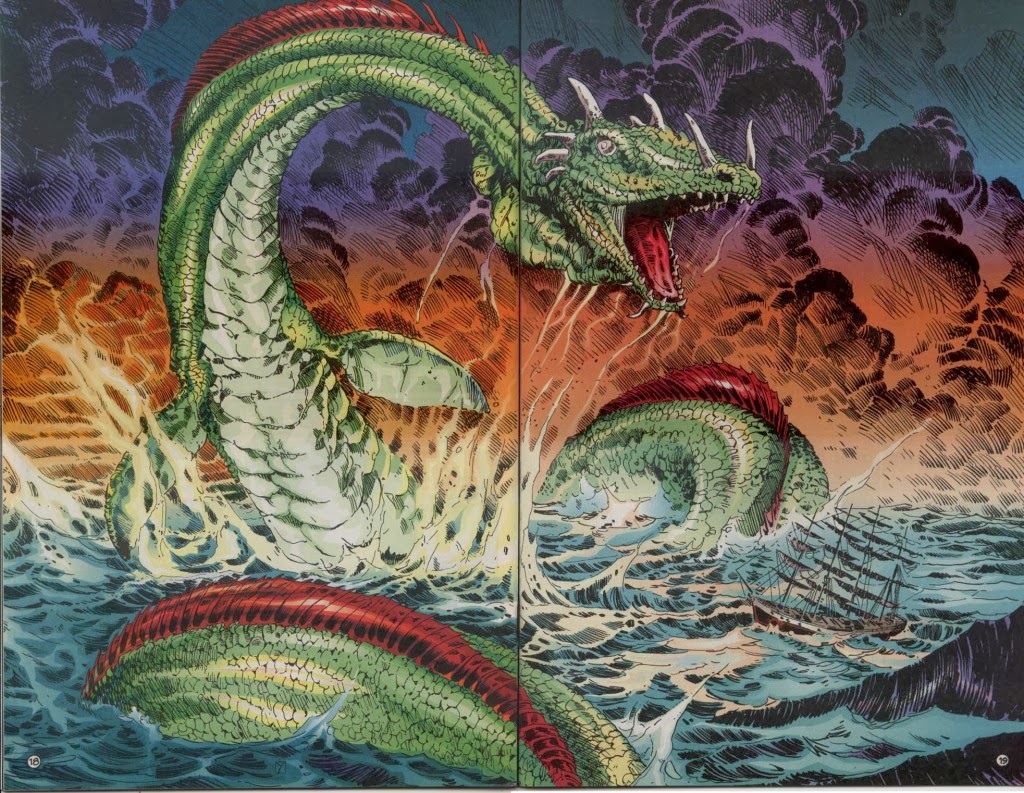
I borrowed Berlatsky's scan of the sea dragon, art by Marley for the Korean comic Dokebi Bride. Looks amazing.

This next one by Berlatsky is a comparison of two images, one of Superman and the other of a big dragon. Here's a follow-up. I wanted to post these stories in part to give an alternate perspective on All-Star Superman, and the art of Frank Quitely. The writer shows the images in part to point out how the superhero image suffers by comparison. There's something worth quoting here:


The point here is that super-hero comics very rarely have a strong sense of wonder. With all the spectacular feats, you’d think they would—but somehow they all end up as tricks; they’re fun and goofy, or I guess more recently bloody, but they don’t actually inspire awe. And I think it’s because of something Tom said, “Superman keeps the universe our size.” Super-heroes are there to make things more manageable. Awe—a sense of vastness, of human insignificance or vulnerability—is antagonistic to everything they stand for. If Superman saw that dragon, he wouldn’t be scared or impressed—he’d just punch it in the snout. (As Wonder Woman did in a similar situation..) There’d be big explosions! There’d be excitement! There’d be action! But there wouldn’t be a moment where you said, “oh my god,” and felt rooted to one particular spot, and overwhelmed.

The point here is that super-hero comics very rarely have a strong sense of wonder. With all the spectacular feats, you’d think they would — but somehow they all end up as tricks; they’re fun and goofy, or I guess more recently bloody, but they don’t actually inspire awe. And I think it’s because of something Tom said, “Superman keeps the universe our size.” Super-heroes are there to make things more manageable. Awe — a sense of vastness, of human insignificance or vulnerability — is antagonistic to everything they stand for. If Superman saw that dragon, he wouldn’t be scared or impressed — he’d just punch it in the snout. (As Wonder Woman did in a similar situation..) There’d be big explosions! There’d be excitement! There’d be action! But there wouldn’t be a moment where you said, “oh my god,” and felt rooted to one particular spot, and overwhelmed. - See more at: http://www.hoodedutilitarian.com/2009/04/nowhere-man-somewhere-dragon/#sthash.OQBMq6hq.dpuf

The point here is that super-hero comics very rarely have a strong sense of wonder. With all the spectacular feats, you’d think they would — but somehow they all end up as tricks; they’re fun and goofy, or I guess more recently bloody, but they don’t actually inspire awe. And I think it’s because of something Tom said, “Superman keeps the universe our size.” Super-heroes are there to make things more manageable. Awe — a sense of vastness, of human insignificance or vulnerability — is antagonistic to everything they stand for. If Superman saw that dragon, he wouldn’t be scared or impressed — he’d just punch it in the snout. (As Wonder Woman did in a similar situation..) There’d be big explosions! There’d be excitement! There’d be action! But there wouldn’t be a moment where you said, “oh my god,” and felt rooted to one particular spot, and overwhelmed. - See more at: http://www.hoodedutilitarian.com/2009/04/nowhere-man-somewhere-dragon/#sthash.OQBMq6hq.dpuf
It's certainly an interesting perspective on superhero comics. On the same website, Tom Crippen discusses Superman at length. He warns that it's a idiosyncratic perspective, and everything I've found in my own study of what people do with the character sort of works differently. Crippen wonders about the religious connections, the mythical nature of Superman, and I deal with that a lot (though not exhaustively--I pulled everything about Superman and the hero myth out of my book, though that seems really weird; it may be an article some day, if I can pare it down from the 70 pages it currently takes up). Anyway, here's a key point of Crippen's article:


There’s my Superman. He’s modernity. It’s what he stands for, and he grows directly out of it. He’s the odd doodle our collective mind drew when the second-by-second experience of modern existence, the way modernity feels, became impossible to ignore. “Super,” the category he embodies, represents the new dimension added to existence by technological development. The most extreme transformations in our physical environment are now produced by means we find unreal and abstract, that feel like they have nothing to do with us; he’s there to bridge the gap.

He also writes: When I was reading Superman, I was getting ready for a lifetime of user manuals and tax forms. All right, I'm bitter.

This is all interesting stuff, and worth thinking about. For Crippen, Superman is all about modernity. For both these writers, Superman isn't enough. He doesn't work in a beneficial way. For Berlatsky, there's no inspiration, no sense of wonder. One result of my own research, which involved interviewing people about what they do with Superman, is that I found Superman to be the inspiration these writers don't find. That's an awkward sentence, but the point is that plenty of people work to make the world a better place, modeled on their interpretation of Superman. The scholar Ben Saunders, in his book Do the Gods Wear Capes?, finds in Superman an evolving meditation on the nature of virtue, something that everyone I interviewed also indicated in one way or another. What Superman does is much less important than what we do with Superman in mind.

Cover by Mike Allred


Now, I talked to Superman fans, so they are predisposed to find useful things in Superman stories. When Berlatsky discusses the sense of awe, he's really getting at something religious, Rudolph Otto's sense of the numinous. That's not what Superman does. He's secular. I'm not saying that this makes Quitely's image of Superman in the sun any more valuable (in fact, nobody I talked to mentioned this image as being particularly meaningful to them); what I'm saying is that these writers don't find Superman valuable in the way that other people do. And that's fine. Personally, I like reading all the different perspectives, and both Berlatsky and Crippen make some really interesting points. Well worth reading.

While we're on the subject of Morrison's Superman, here are a few articles on his Action Comics run from a little while a go. From the Mindless Ones. And more. And on Morrison.

And while we're on the subject of awe-inducing images of sea monsters, I've always like this one, from the World's End volume of Sandman, by penciller Michael Zulli, inker Dick Giordano, and colorist Daniel Vozzo:


Friday, February 22, 2013

Card's Superman

Let's dig a little bit deeper into the controversy surrounding DC's choice to hire sf writer Orson Scott Card to create some Superman stories.

First, here's a USAToday article that sums up the issue:

DC Comics ignited a firestorm last week by announcing that Card, who has been criticized over the years for his vocal anti-gay political stance, would be one of a stable of writers contributing to a new digital-first anthology, Adventures of Superman. The series, launching in April (a print version will be sold in stores starting in May), features the iconic hero who has long been associated with the phrase "truth, justice and the American way.''
The Lesbian, Gay, Bisexual, Transgender activist website AllOut.org has collected more than 11,000 signatures on an online petition asking DC to drop Card from the project....

In addition to being the author of the 1985 science-fiction novel Ender's Game and many other sci-fi works, Card is on the board of directors for the National Organization for Marriage, which is outspoken in its denouncement of same-sex marriage.

Here's another summary, from The Daily Beast. And one from The Guardian.


DC's response has been to brush it off:

As content creators we steadfastly support freedom of expression, however the personal views of individuals associated with DC Comics are just that — personal views — and not those of the company itself.

Beyond the petition, several shops have decided not to carry the print version of the comic.

At issue are both Card's beliefs and his actions. He's not merely someone who believes that certain people should be denied marriage, he sits on the board of an organization devoted to stopping it, and has stated that, should gay marriage become a federal right, people should rise up against the government. Michael Hartney has written on just this point:

If this was a holocaust denier or a white supremacist, there would be no question. Hiring that writer would be an embarrassment to your company. Well, Card is an embarrassment to your company, DC. This is the same. The LGBTQ community will no longer take this lying down. Our civil rights are no longer up for debate or discussion.
Ugh. And of all the characters Card could have been hired to write, you give him Superman? The character that taught me to lead by example? To do the right thing, even when it was hard? To keep going, even when it seemed hopeless? What an insult. Kids are killing themselves. They are killing themselves in a climate of intolerance and homophobia publicly fostered by people like Orson Scott Card. You don’t have to contribute to this. You shouldn’t. You mustn’t.

Christopher Butcher takes it further:

Orson Scott Card is a dangerous bigot. If he will not even attempt to atone for his dangerous bigotry (including: hate-filled screeds, lies, and incitements to violence), then I don’t care if he never gets another job again. Let alone writing a beloved icon of children and adults.

Here's a thoughtful response from Wired, about how the writer is disappointed by Card's views, but doesn't agree that he should be pulled from the story:

Let him write the story, and let DC publish it. You can then choose to buy the comic or not. You can then choose to protest the message in the actual story if you are offended by it. But silencing a voice — even one with as intolerant a message as his — is not the answer. It’s better to hold that intolerance up to the light of day and show it for what it truly is: fear. Fear of the alien. Fear of the other and the strange. A fear that, ironically, it was Orson Scott Card who helped me confront and vanquish at an early age, whether he meant to or not.

Mark Millar has apparently tweeted that calling for the firing of Card based on his views is nothing short of fascism.

But others have been prompted to more reflective statements about their view of the character:

Superman may not live in the real world, but I’d like to think that if he were a real being he would be on the side of justice for LGBT community members.


It's important to point out that the issue is coming to a head because of the character. Nobody seems to have complained much when Card wrote Iron Man stories, as many of the above links make clear. Because Superman is involved, people suddenly have strong opinions. Following on a point from Butcher above, Tom Spurgeon wonders about this:

Butcher's line about Superman having power as an icon above and beyond his role as a corporate-owned character attached to a dubious history of exploitation and issue-alignment, and that this matters, is well-taken. That is very much a blind spot for me. For me, Superman is an empty suit. One of my first Internet fiascoes was a mid-1990s declaration that no adult person actually considered Superman a role-model and being lectured by an array of adults on CompuServe that told me that they very much considered Big Blue a role-model and how dare I suggest otherwise. Live and learn. I'm still always a little confused that the ideal outweighs the uglier aspects for folks that are routinely exposed to both. This expression of that notion here, that being assigned to Superman means something more than if Card were given, say, his own entire comics line, comes from hardcore comics fans, not from like my Mom or from my friends growing up or their kids. It's sort of like if the press corps and Secret Service that dealt with JFK on a daily basis had a more hardcore idealized version of the president than Catholic households in Boston with his picture above the television had, although maybe that doesn't explain it well, and maybe those men and women did hold Kennedy in higher regard.

It's legitimately fascinating that Superman seems to me to have been traditionally claimed by conservatives as having ideals in that direction, and here is claimed for what we tend to think of as American liberal values such as inclusiveness. In fact, the irony from the perspective of this being a headache for DC Comics is that they've sold and sold and sold this viewpoint where they are in shared custody with generations of fans of an important set of ideas and principles wearing a cape, and in this instance they have to deal with the fact that people are going to hold them to that. Good
.


So there's all that stuff wrapped up in this issue. The general sentiment above is that Card is wrong in his opinions, and that he is in the minority. Some people think that Superman shouldn't be written by a person who feels the way Card feels, who advocates the things he advocates. As I see it, it all comes down to the idea that some people think that Superman should represent inclusivity--he saves everyone. They extend this idea beyond the character and the stories told about him to the complex of events surrounding the creation of those stories, including the people involved in the creation.


Tuesday, January 15, 2013

Man of Steel Trailer

Here's a link to an interesting piece on Robot 6. What's even more interesting is the discussion that follows it. It all kicks off with a quote from J. Michael Straczynski, followed by some commentary from the columnist Michael May, the trailer for Man of Steel. It's all about the idea of what sort of character Superman should be. The comments below it feature some interesting remarks by Straczynski and by Mark Waid. It's also got a link to another article that I'll probably bring up again some day.


The discussion goes in some interesting directions, particularly its focus on the comment in the trailer that Jonathan Kent makes about how 'maybe' Clark shouldn't have saved a bunch of kids from drowning, so he could protect his secret. It's interesting, but I think I'll wait until the movie comes out and I can see the whole scene before I comment on that.

What was especially interesting was the occasional criticism of Straczynski's Earth One stories. The specifics aren't important here. The important part is that Straczynski himself felt it necessary to chime in with a lengthy defense of his stories. My feelings about Earth One aside (it's utter tripe), I think the fact that the writer had to explain what he was trying to do says loads about how well he did it. Meaning he didn't get his point across very well in the story he told.

The discussion made me think of the types of stories being told today, in movies, television, and comic books. We live in an era where fandoms are becoming the dominant audiences courted by media storytellers and executives, in part because fans spend lots of money on things. So there needs to be lots of things for them to spend their money on. The result of this is that stories are told at great length, with the details fleshed out in sometimes excruciating detail. Star Wars is the perfect example of this. What was essentially one paragraph's worth of information in the original movie became more than six hours of film time (not to mention the animated series, novels, comic books, etc). Some people wanted that story told. Not me. Though I was excited to see them, I liked the spark in my imagination, lit by the hints in that one paragraph of information. The Clone Wars in my head are so much more interesting than what the movies revealed them to be.

Anyway, I think that Superman is most compelling as a fully formed hero, not as a hero-in-the-making. Siegel and Shuster got it right in the first place: limit the back story, get right to the adventures in Metropolis. I don't need to see how he came to the decision to be a hero. In fact, I'd say it diminishes him. It makes it contingent on events, tells us that if something had gone just a little bit different when he was 15, or 16, or 18, or 20, he would be a villain, or a different kind of hero. There are plenty of characters whose stories already do that. For Superman, I'd rather have a lot left to my imagination. But that's just me.

The thing is, I know that telling the story of how Superman made the choice to be a hero can be a valuable story. I have interviewed people for whom that story has made a difference in life, has led them to make their own choices, has given them inspiration: an "If Superman could make the right choice, could figure out the best way to live his life, then so can I" sort of thing. I just hope they don't look to Earth One for this inspiration.

Tuesday, August 11, 2009

Sports

I've stayed away from sports related supermen lately, but this one is interesting. It's about a football player who was injured in a car crash. Corey Wilson now gets around in a wheelchair.

[H]e has a large Superman symbol tattooed on his chest. He said it's mostly about the concept of overcoming any obstacle as opposed to Clark Kent's alter-ego.
Wilson's girlfriend, Pamela Telliz, suggested the idea of rubber bracelets for the players, fittingly in Superman blue.
"I really feel like he has a little bit of Superman in him to go through what he's gone through and still have high spirits," Clayton said.


The two bits I find curious are the way Superman is referred to as "Clark Kent's alter-ego" for no reason and that Wilson has a little bit of Superman in him.

Obama

I've posted plenty of pictures of Obama as Superman on this site, but this is the first time I've encountered Obama as the Joker. Interesting.

Smallville

The show Smallville is soon to begin its ninth season. I watched it long ago (I suppose I'm supposed to refer to the seasons I watched, but I don't remember which ones they were), but stopped because the show went from mildly amusing to uninteresting. Since then, I've checked it out on occasion, and always found it not to my tastes. Still, it's got quite a following nowadays.

When I was in Metropolis for the Superman Celebration, I saw a line forming outside a building. Not knowing what it was all about, I just joined it. It was a good move on my part, because the guy who stood in front of me wanted to chat. He started telling me about how he had just come to town from Cincinatti for the morning so he could get tickets for the autographing lines for his grandchildren, whom he would pick up that evening and bring back the next day. They were all fans of Smallville--they didn't care for the recent movie, didn't read the comics, etc. But they watched the show together. And this guy, Terry was his name, liked to find out all about the show and the actors on the Internets.

He'd told me also that he'd been a big fan of Superman until about the age of 5, when he discovered baseball. He's a Reds fan, of course.

So he went on, revealing that the producers of the show were allowing the lead actor, Tom Welling, to determine whether or not Superman would fly in the show. It hadn't occurred to me that they'd gone eight years without letting Superman fly.

Kevin Smith, writer and director of Clerks and Mallrats, was once employed to write a Superman film. This never came to fruition, but he tells an interesting story about it. Evidently, the produceer of that never-made film wanted this particular incarnation of Superman not to fly and not to wear a cape. Smith points out that these are perhaps the two most important aspects of the character ("The suit and flying defines Superman" in Smith's words).

In conversation with a friend round about fourth of July, this same story came up. Mike Minter (sometimes called Ian) pointed out that the producers of this show Smallville had done the very thing the producer does in Kevin Smith's story: they take away the cape and the flying (that part's about 8 minutes into the video). Interesting to see that it's in part the actor's choice.

Also, evidently in the newest season of Smallville, there will be some sort of suit: "Clark's new look is black with a silver logo and a black cape trenchcoat. But it does sport the Superman logo (in silver)."

I have no idea what to make of all of this. Except key to the suit are the colors. Red, yellow, blue. In Steven Seagle and Teddy Kristiansen's "It's a Bird," the writer devotes several pages to the importance of the colors. Primary colors. It's vital to the character.

That, and Superman ice cream is red, yellow, and blue. You can't go against the ice cream.