Here's an interesting perspective on the recent DC films, especially on how Superman operates as "the other." This article, by Dennis R. Upkins, is making me rethink the DCEU. For instance:
The arrival of both Superman and Obama changed the power landscape of
America, of the entire planet. White humans were irate because in both
cases, Obama/Superman threatened the existing power structures and now
whites were getting a taste of the fear PoCs have had to endure daily
for centuries. And even though both men fought tirelessly for truth,
justice, and the American way, they were met with outright bigotry. The
ones leading the hate-mongering were Lex Luthor and Donald Trump.
The Superman/Obama parallels were noted a while back. I haven't seen it put this way before. It's worth reading in full, on The Nerds of Color.
All-Star

Showing posts with label obama. Show all posts
Showing posts with label obama. Show all posts
Thursday, March 30, 2017


Monday, May 2, 2011
controversy
Well, there's a back-up story (The Incident) in this week's Action Comics #900 that's caused a stir. In it, Superman states his intention to renounce his U.S. citizenship so that his international actions may not be construed as American policy. He does so after the Iranian government gets angry because he showed up to nonviolently support some protesters in Tehran. Here are some relevant links.
First, from comic book resources' robot 6. This one's a pretty good summation of the internet reaction.
There's comics alliance, which has a huge discussion in the comments.
Here's an example of the outside (outside of comics fandom, that is), reactionary response.
As for my feeling on the controversy, Douglas Wolk says it pretty well: 'Plenty of stories, from Paul Dini and Alex Ross's Superman: Peace on Earth to the beginning of "Grounded,"have addressed why Superman doesn't simply solve the world's geniune problems. The real answer is that that's not what Superman stories are about. The point of Superman stories is to wildly distort the world as we know it: to provide a huge, fun perspective on alienation, on leading a double life, on the struggle to understand what truth and justice are before one starts fighting for them. And anyone who purports to be offended at "The Incident" should remember that this happens in the same universe where, in 2000, Lex Luthor was elected President of the United States.'
At heart, this is a controversy inherent to the genre. It's one of the things that made a mess of Superman IV: The Quest for Peace. Any time you try to insert real world problems into superhero stories, you run the risk of exposing the genre for what it is: fiction. No genre can stand up to the real world.
The most interesting aspect of the whole thing is the frequent equation of Superman and Obama, which arises from the bafflingly persistent "birther" movement that demands further proof of Obama's US citizenship. People are making lots of jokes about needing to see Superman's birth certificate or something of the kind.
First, from comic book resources' robot 6. This one's a pretty good summation of the internet reaction.
There's comics alliance, which has a huge discussion in the comments.
Here's an example of the outside (outside of comics fandom, that is), reactionary response.
Thus far, I've been unable to find any genuine praise for the element of controversy, aside from the stray comment to news stories or blogs. As a story, regardless of what Superman intends to do, it's really not very good. It's only 9 pages, and lacks a real ending. It's told mostly in flashbacks, and of those 9 pages the entirety of the first is devoted to a guy standing around, checking his watch, and waiting for Superman to arrive. Narrative economy is not on the menu today. It also ends with a pretty lame attempt at demonstrating Superman's inspirational effect on the conflict in Tehran that draws him to Iran in the first place.
As for my feeling on the controversy, Douglas Wolk says it pretty well: 'Plenty of stories, from Paul Dini and Alex Ross's Superman: Peace on Earth to the beginning of "Grounded,"have addressed why Superman doesn't simply solve the world's geniune problems. The real answer is that that's not what Superman stories are about. The point of Superman stories is to wildly distort the world as we know it: to provide a huge, fun perspective on alienation, on leading a double life, on the struggle to understand what truth and justice are before one starts fighting for them. And anyone who purports to be offended at "The Incident" should remember that this happens in the same universe where, in 2000, Lex Luthor was elected President of the United States.'
At heart, this is a controversy inherent to the genre. It's one of the things that made a mess of Superman IV: The Quest for Peace. Any time you try to insert real world problems into superhero stories, you run the risk of exposing the genre for what it is: fiction. No genre can stand up to the real world.
The most interesting aspect of the whole thing is the frequent equation of Superman and Obama, which arises from the bafflingly persistent "birther" movement that demands further proof of Obama's US citizenship. People are making lots of jokes about needing to see Superman's birth certificate or something of the kind.
Monday, January 25, 2010
September 11
There's a book called The Terror Dream, by Susan Faludi. It's a book about what the American responses to 9/11 revealed about us as a nation. It's also largely about the myths we tell to get us through crisis. These myths aren't always healthy, as Faludi demonstrates with overwhelming evidence. It's fascinating.
A while back I posted some fan art of Superman grimmacing in pain because of his impotence in the face of the attacks on the world trade center. Here's some more.

It's called 'And Where the Hell Was Superman?' by Hardy Ecke. It seems to be on display in DC somewhere, but my information may be out of date.
Ecke explains the picture on his website: What causes me to fix the catastrophe in a painting is not that an attack on the civilized world is surrounded by unanswered questions, but insted that the saviour of the world became too tired to protect America from evil anymore....A Rambo and a McClane with all the other Hollywood comics cannot rescue the world because if they cannot reach victory with the brain they cannot succeed with the sword.
It's an interesting image, though I don't think it conveys the ideas (at least to me) that he wanted it to convey. I see in this painting an image of a symbol of heroism that is dated and tire, one that can no longer save us, which is evidently what he wanted to paint. But maybe my concept of Superman is different from his. Superman is different that Rambo and John McClane--both reference in his explanation. These guys are all muscle and tactics. Superman is violent, to be sure, but he stands for something more.
This is from Gregoy McNeill, writing on the Superman Homepage: Since then [9/11], our concept of what a hero is has changed. Living with the fear of future terrorist attacks and uncertainity has made us ask "Where's Superman?" The truth is he does exist. It's not the powers nor costume that defines Superman, it's the morals. Superman has evolved from the embodiment of America to what we as human beings can strive to become if we can constructively use our talents and potential in a positve light....All of us are superheroes when we take a stand against injustice. All it requires us to have is courage and faith. Superman is within us, it's our choice to decide whether or not we want to use it.
I think Superman as a moral exemplar is a more common conception than Superman as a brute. There's a therapeutic technique named for him, "What Would Superman Do?"; an English professor counsels the same thought exercise, There's Valerie D'Orazio's blog, Occasional Superheroine, where she titles a post, "Why Superman not Telling a Lie Had Such an Impact on My Life." She ends the post with the question, what would Superman do? (it's at the bottom of the page here). A Google search of "What would superman do" reveals over 5000 hits, though not all of those are immediately relevant, they're interesting.
And I return, as so often, to All Star Superman. A running theme is Brain Vs. Brawn, Luthor vs. Superman. In Issue 12, Morrison reverses it, when a weakened and dying Superman outsmarts Luthor and says, "Brain beats brawn every time," a line Luthor uttered several issues earlier (Issue 1, maybe). Of course, Superman is punching Luthor when he says it.
but back to Terror Dream...Faludi titles a chapter "The Return of Superman." This book would have been published about a year after the film Superman Returns. There's a lot to the book, about how 9/11 affected women in particular. The chapter relevant here is about how we had to search for heroes after the attacks. When none presented themselves in an obvious manner, we (meaning, largely, the media and government) had to invent them. We invented them in a mold that we had long held to be valuable and glorious, a mold cast on cowboys and superheroes. Into that mold stepped Bush and his cabinet, Giuliani, and others.
Also cast in that mold were the men on United 93. We sought evidence that the mold fit, and we found it in statements such as this one, spoken of Lou Nacke on Dateline: "When he was a little boy, he love Superman. And he'd actually had a cape on and went through a glass window pretending to be Superman." He also had a tattoo on his shoulder. So he must have been a hero.
I do not question Nacke's heroism. Nobody really knows what happened on that plane. When Congress tried to award medals to four of the men, whom the media had decided were the heroes who overthrew the highjackers, others protested. Eventually, all the passengers on the flight were given posthumous medals. Lots of other people, too.
Faluid writes that this search for heroes and the apotheosization of them reveals "a deep cultural unease beneath the hero worship." We were constantly looking for new heroes after attacks that "left us with little in the way of ongoing chronicle or ennobling narrative. So a narrative was created and populated with pasteboard protagonists whose exploits would exist almost entirely within the realm of American archetype and American fantasy. There was a danger to being honored with such manufactured laurels, particularly for the tragedy's survivors; for the fantasy to hold, citizens would have to stay in character, never mind that their roles were constrained and deforming, never mind that the command performance prevented them from expressing what they really had witnessed and suffered that day."
There's a danger in casting real people as imaginary characters. They can never deliver fully on the promise of the role. None of these people is Superman (neither, seven years later, was Obama), who would have saved the day. That's why the moral example is so much more important than the warrior. Faluid calls superhero stories the fantasies of adolescent boys, but that only refers to the power the character possesses. If the Superman who returned after 9/11 had been the embodiment of morality instead of the misguided muscle of the governmental reaction, things would have been different indeed.
Tuesday, September 8, 2009
Who Owns Superman?
There's a legal battle being fought for the copyright to Superman, and there's a concomitant internet debate about who should have the copyright.
Here's a basic statment of the issue. here's another.
This writer thinks a Superman in the public domain is a good thing, for "culture." He continues his argument here, the foundation of which can be summed up as follows:
Creative endeavours ultimately are the property of the commons, the public.
A great many things are wrong with that sentence. But, moving on...
There's no new information in this article, but the title is telling: "Writing and Ownership, Why Superman has Abandoned us."
And one final article, which sums up the status of the current legal situation, gives a nice timeline (though it's from Wikipedia, it seems ok), and has a strange prediction: Marvel will publish Superman.
Copyright is currently one of the more compelling issues in folklore. Who owns traditional culture? Who can determine what's done with it? Who gets the money from its display?
There seems to be three opinions to the matter.
1. Superman belongs to Time/Warner, who own DC Comics, who, under a different name, bought the character from Siegel and Shuster in 1938 and have renewed their ownership ever since. This is the corporate stance.
2. Superman belongs to the creators and their heirs, despite having sold the character long ago and being paid the contracted amount. They have tried to regain the character at several time since. This is the creator stance.
3. Superman belongs to everybody. This is the, um, public good stance.
Mark Twain argued in favor of eternal copyright, extending unto the descendants of writers. In his formulation, a business created by an individual could be run in perpetuity by that individuals descendants, so why on earth would the creations of a writer be any different? I'm sure other writers have chimed in on this stuff.
Let's talk about mythology.
If Superman is a myth, then everybody already owns the character. The most recent ruling has to do with the particulars of the origin story, which is perhaps the most often told story of the last century. I'm not talking about just the movies and the comics, but also about public discourse. Think of Obama's joking speech of last year, where he denied being christ but insisted that instead he was rocketed to earth from Krypton. That sort of retelling goes on all the time, in every medium as well as in everday conversation. Telling the story in that manner does not infringe upon copyright, as no one's making money from it. And parody is, of course, protected. Then there's the pastiche, such as Alan Moore's Supreme stories. Or Kurt Busiek's Samaratan. Or about a thousand other comic book characters.
There are academic retellings, there are political retellings, there are comedic retellings. And it's all fine. Thus making the third position both correct and irelevant. Unless somebody wants to publish their own Superman comic, or make their own Superman movie, to turn a profit.
As for positions
Here's a basic statment of the issue. here's another.
This writer thinks a Superman in the public domain is a good thing, for "culture." He continues his argument here, the foundation of which can be summed up as follows:
Creative endeavours ultimately are the property of the commons, the public.
A great many things are wrong with that sentence. But, moving on...
There's no new information in this article, but the title is telling: "Writing and Ownership, Why Superman has Abandoned us."
And one final article, which sums up the status of the current legal situation, gives a nice timeline (though it's from Wikipedia, it seems ok), and has a strange prediction: Marvel will publish Superman.
Copyright is currently one of the more compelling issues in folklore. Who owns traditional culture? Who can determine what's done with it? Who gets the money from its display?
There seems to be three opinions to the matter.
1. Superman belongs to Time/Warner, who own DC Comics, who, under a different name, bought the character from Siegel and Shuster in 1938 and have renewed their ownership ever since. This is the corporate stance.
2. Superman belongs to the creators and their heirs, despite having sold the character long ago and being paid the contracted amount. They have tried to regain the character at several time since. This is the creator stance.
3. Superman belongs to everybody. This is the, um, public good stance.
Mark Twain argued in favor of eternal copyright, extending unto the descendants of writers. In his formulation, a business created by an individual could be run in perpetuity by that individuals descendants, so why on earth would the creations of a writer be any different? I'm sure other writers have chimed in on this stuff.
Let's talk about mythology.
If Superman is a myth, then everybody already owns the character. The most recent ruling has to do with the particulars of the origin story, which is perhaps the most often told story of the last century. I'm not talking about just the movies and the comics, but also about public discourse. Think of Obama's joking speech of last year, where he denied being christ but insisted that instead he was rocketed to earth from Krypton. That sort of retelling goes on all the time, in every medium as well as in everday conversation. Telling the story in that manner does not infringe upon copyright, as no one's making money from it. And parody is, of course, protected. Then there's the pastiche, such as Alan Moore's Supreme stories. Or Kurt Busiek's Samaratan. Or about a thousand other comic book characters.
There are academic retellings, there are political retellings, there are comedic retellings. And it's all fine. Thus making the third position both correct and irelevant. Unless somebody wants to publish their own Superman comic, or make their own Superman movie, to turn a profit.
As for positions
Tuesday, August 11, 2009
Sports
I've stayed away from sports related supermen lately, but this one is interesting. It's about a football player who was injured in a car crash. Corey Wilson now gets around in a wheelchair.
[H]e has a large Superman symbol tattooed on his chest. He said it's mostly about the concept of overcoming any obstacle as opposed to Clark Kent's alter-ego.
Wilson's girlfriend, Pamela Telliz, suggested the idea of rubber bracelets for the players, fittingly in Superman blue.
"I really feel like he has a little bit of Superman in him to go through what he's gone through and still have high spirits," Clayton said.
The two bits I find curious are the way Superman is referred to as "Clark Kent's alter-ego" for no reason and that Wilson has a little bit of Superman in him.
Obama
I've posted plenty of pictures of Obama as Superman on this site, but this is the first time I've encountered Obama as the Joker. Interesting.
Smallville
The show Smallville is soon to begin its ninth season. I watched it long ago (I suppose I'm supposed to refer to the seasons I watched, but I don't remember which ones they were), but stopped because the show went from mildly amusing to uninteresting. Since then, I've checked it out on occasion, and always found it not to my tastes. Still, it's got quite a following nowadays.
When I was in Metropolis for the Superman Celebration, I saw a line forming outside a building. Not knowing what it was all about, I just joined it. It was a good move on my part, because the guy who stood in front of me wanted to chat. He started telling me about how he had just come to town from Cincinatti for the morning so he could get tickets for the autographing lines for his grandchildren, whom he would pick up that evening and bring back the next day. They were all fans of Smallville--they didn't care for the recent movie, didn't read the comics, etc. But they watched the show together. And this guy, Terry was his name, liked to find out all about the show and the actors on the Internets.
He'd told me also that he'd been a big fan of Superman until about the age of 5, when he discovered baseball. He's a Reds fan, of course.
So he went on, revealing that the producers of the show were allowing the lead actor, Tom Welling, to determine whether or not Superman would fly in the show. It hadn't occurred to me that they'd gone eight years without letting Superman fly.
Kevin Smith, writer and director of Clerks and Mallrats, was once employed to write a Superman film. This never came to fruition, but he tells an interesting story about it. Evidently, the produceer of that never-made film wanted this particular incarnation of Superman not to fly and not to wear a cape. Smith points out that these are perhaps the two most important aspects of the character ("The suit and flying defines Superman" in Smith's words).
In conversation with a friend round about fourth of July, this same story came up. Mike Minter (sometimes called Ian) pointed out that the producers of this show Smallville had done the very thing the producer does in Kevin Smith's story: they take away the cape and the flying (that part's about 8 minutes into the video). Interesting to see that it's in part the actor's choice.
Also, evidently in the newest season of Smallville, there will be some sort of suit: "Clark's new look is black with a silver logo and a black cape trenchcoat. But it does sport the Superman logo (in silver)."
I have no idea what to make of all of this. Except key to the suit are the colors. Red, yellow, blue. In Steven Seagle and Teddy Kristiansen's "It's a Bird," the writer devotes several pages to the importance of the colors. Primary colors. It's vital to the character.
That, and Superman ice cream is red, yellow, and blue. You can't go against the ice cream.
I've stayed away from sports related supermen lately, but this one is interesting. It's about a football player who was injured in a car crash. Corey Wilson now gets around in a wheelchair.
[H]e has a large Superman symbol tattooed on his chest. He said it's mostly about the concept of overcoming any obstacle as opposed to Clark Kent's alter-ego.
Wilson's girlfriend, Pamela Telliz, suggested the idea of rubber bracelets for the players, fittingly in Superman blue.
"I really feel like he has a little bit of Superman in him to go through what he's gone through and still have high spirits," Clayton said.
The two bits I find curious are the way Superman is referred to as "Clark Kent's alter-ego" for no reason and that Wilson has a little bit of Superman in him.
Obama
I've posted plenty of pictures of Obama as Superman on this site, but this is the first time I've encountered Obama as the Joker. Interesting.
Smallville
The show Smallville is soon to begin its ninth season. I watched it long ago (I suppose I'm supposed to refer to the seasons I watched, but I don't remember which ones they were), but stopped because the show went from mildly amusing to uninteresting. Since then, I've checked it out on occasion, and always found it not to my tastes. Still, it's got quite a following nowadays.
When I was in Metropolis for the Superman Celebration, I saw a line forming outside a building. Not knowing what it was all about, I just joined it. It was a good move on my part, because the guy who stood in front of me wanted to chat. He started telling me about how he had just come to town from Cincinatti for the morning so he could get tickets for the autographing lines for his grandchildren, whom he would pick up that evening and bring back the next day. They were all fans of Smallville--they didn't care for the recent movie, didn't read the comics, etc. But they watched the show together. And this guy, Terry was his name, liked to find out all about the show and the actors on the Internets.
He'd told me also that he'd been a big fan of Superman until about the age of 5, when he discovered baseball. He's a Reds fan, of course.
So he went on, revealing that the producers of the show were allowing the lead actor, Tom Welling, to determine whether or not Superman would fly in the show. It hadn't occurred to me that they'd gone eight years without letting Superman fly.
Kevin Smith, writer and director of Clerks and Mallrats, was once employed to write a Superman film. This never came to fruition, but he tells an interesting story about it. Evidently, the produceer of that never-made film wanted this particular incarnation of Superman not to fly and not to wear a cape. Smith points out that these are perhaps the two most important aspects of the character ("The suit and flying defines Superman" in Smith's words).
In conversation with a friend round about fourth of July, this same story came up. Mike Minter (sometimes called Ian) pointed out that the producers of this show Smallville had done the very thing the producer does in Kevin Smith's story: they take away the cape and the flying (that part's about 8 minutes into the video). Interesting to see that it's in part the actor's choice.
Also, evidently in the newest season of Smallville, there will be some sort of suit: "Clark's new look is black with a silver logo and a black cape trenchcoat. But it does sport the Superman logo (in silver)."
I have no idea what to make of all of this. Except key to the suit are the colors. Red, yellow, blue. In Steven Seagle and Teddy Kristiansen's "It's a Bird," the writer devotes several pages to the importance of the colors. Primary colors. It's vital to the character.
That, and Superman ice cream is red, yellow, and blue. You can't go against the ice cream.
Friday, July 31, 2009
This is a good thing
I keep finding more and more news stories with passages about Obama such as this one:
"We've found out he's not Superman," said Nora Seeley, 54, when asked what she had learned about the president during his first six months on the job. Still, she said, "things are starting to turn around."
It's no surprise that his reputation among Americans is deflating. Nothing else could have happened in the wake of his popularity upon taking office. People may come to realize that there is absolutely nothing that anyone could have done to fix everything in this short a time. I honestly have no idea how he's doing, but I see more and more local businesses hiring, and that's a good thing.
In related news, here are more of Jennifer Silverberg's photos from the Superman Celebration, this time focusing on food. Here's one from the main story, which I should have posted sooner.
"We've found out he's not Superman," said Nora Seeley, 54, when asked what she had learned about the president during his first six months on the job. Still, she said, "things are starting to turn around."
It's no surprise that his reputation among Americans is deflating. Nothing else could have happened in the wake of his popularity upon taking office. People may come to realize that there is absolutely nothing that anyone could have done to fix everything in this short a time. I honestly have no idea how he's doing, but I see more and more local businesses hiring, and that's a good thing.
In related news, here are more of Jennifer Silverberg's photos from the Superman Celebration, this time focusing on food. Here's one from the main story, which I should have posted sooner.
Awe and Wonder.
One of the ideas Joseph Campbell is famous for is his four functions of mythology: metaphysical, cosmological, social, and gastronomic. I may have gotten that last one wrong. But why wouldn't mythology help you digest food properly?
Anyway, the metaphysical function, according to campbell, is all about demonstrating to humanity that life is worth living, that creation is a beautiful thing, and all that. Then we get Dave Gibbons, artist who drew Watchmen, most famously, but also a little Superman story called "For the Man who Has Everything." Both written by Alan Moore. In an interview he said,
"Again, my personal view is that they should make it lighter, with that sense of wonder that Superman has always had. Not to make it childish or puerile but to make it something that has a bright sense of adventure and possibility."
He's talking about what a new Superman movie should feel like. He's not the only one. The internets are awash with fans speculating, hoping, decrying, and dismissing a movie that has no script, director, actor, or even basic idea. It's interesting. Part of this is the age we live in, an age of endless discussion not only of what might be and what might have been but what should be, in everyone's own opinion.
While every work has its fanatics and devotees, I wonder if there's something in particular about Superman that makes this speculation appropriate. I won't bother linking to every quotation in which Superman is called a myth, but doesn't that status mean it's different from a lot of other "properties" out there?
It's particularly appropriate to film versions of the character. Film, more than television or comic books, has the ability to instill that sense of awe and wonder. It's bigger than life, and until a couple of decades ago it had to be viewed in something resembling, if not a religious ritual, then at least a public dream. Everyone sitting quietly in a darkened room, slightly leaned back, dazzled by images of things they previously could only imagine. Compare that to sitting at home, phone ringing, neighbors screaming, cars driving by, etc...It's why the rudeness of modern theater goers is such a sad state of affairs.
Where'd that rant come from? I don't even go to the movies more than once a year anymore.
Wednesday, July 29, 2009
Links
First up, Jennifer Silverberg created a sort of photo essay about the Metropolis, Ill., Superman Celebration. You can check out the published work here, here, or some other photos on her website. Thanks, Jennifer!
Then there's this blog entry, wondering why anyone would want to be Superman, based on a recent viewing of Superman II. The writer, unfamiliar with the many versions of Superman's story, is unfortunately stuck with the "Christ Mission" that the films impose on the character. Other versions have Superman choosing his own fate. I dont' know how that would alter the argument she makes.
In a similar vein, this blog entry wonders about whether or not Superman can get drunk.
Haven't posted anything about Obama lately. Here's someone's reality check: "He's not Superman, right?" I like the "right" at the end. And because the idea is floating around in the ether, here's a cartoon that makes the same point (I would post the image, but for reasons unknown to me it won't work).
A common use of Superman in conversation and writing is to point out to someone "You're not Superman." This is meant to indicate that the person--or persons, or everybody--isn't perfect, can't do everything, and should expect it. In this case, it refers to struggling with alcoholism.
There's this novel, by Rich Cohen:
“David Alroy was the first superhero,” Cohen writes of a false messiah known as “King of the Jews” in 12th-century Persia. “He offered a picture of strength to a people lousy with weakness.” Cohen regards Alroy as a model for the figure created in 1938 — “another dark age for the Jews” — by two Jewish teenagers from Cleveland. “Superman is a writer; Superman is brainy in his glasses; Superman is in exile from an ancient nation destroyed by fire; Superman has two names, a fake WASP-y name (Clark Kent) and a secret name in an ancient tongue, Kal-El; . . . Superman, whose cape is a tallis; Superman, whose logo, the “S” emblazoned on his chest, marks him as a freakish stranger as the yellow Star of David marks the ghetto Jew.”
Finally, this is the first I've heard of the movie "A Man who Was Superman."
Then there's this blog entry, wondering why anyone would want to be Superman, based on a recent viewing of Superman II. The writer, unfamiliar with the many versions of Superman's story, is unfortunately stuck with the "Christ Mission" that the films impose on the character. Other versions have Superman choosing his own fate. I dont' know how that would alter the argument she makes.
In a similar vein, this blog entry wonders about whether or not Superman can get drunk.
Haven't posted anything about Obama lately. Here's someone's reality check: "He's not Superman, right?" I like the "right" at the end. And because the idea is floating around in the ether, here's a cartoon that makes the same point (I would post the image, but for reasons unknown to me it won't work).
A common use of Superman in conversation and writing is to point out to someone "You're not Superman." This is meant to indicate that the person--or persons, or everybody--isn't perfect, can't do everything, and should expect it. In this case, it refers to struggling with alcoholism.
There's this novel, by Rich Cohen:
“David Alroy was the first superhero,” Cohen writes of a false messiah known as “King of the Jews” in 12th-century Persia. “He offered a picture of strength to a people lousy with weakness.” Cohen regards Alroy as a model for the figure created in 1938 — “another dark age for the Jews” — by two Jewish teenagers from Cleveland. “Superman is a writer; Superman is brainy in his glasses; Superman is in exile from an ancient nation destroyed by fire; Superman has two names, a fake WASP-y name (Clark Kent) and a secret name in an ancient tongue, Kal-El; . . . Superman, whose cape is a tallis; Superman, whose logo, the “S” emblazoned on his chest, marks him as a freakish stranger as the yellow Star of David marks the ghetto Jew.”
Finally, this is the first I've heard of the movie "A Man who Was Superman."
Tuesday, July 14, 2009
Great, now I have to go to Cleveland.
Gods Among Men
Another in a series of essays that compare Superman and Jesus--this time with Heracles thrown into the mix.
And here's a blog that unfavorably looks upon the comparison of Obama and Superman.
A New Site of Pilgrimage
I'm wondering how the restoration of the Siegel home in Cleveland will affect this project. The wording in this article has a religious slant, but the real reason to take a look is the photography:
Since Superman was born in Cleveland seven decades ago, visitors from around the world have made pilgrimages to what they consider holy ground. Above, the childhood home of Jerry Siegel, who, along with his friend Joe Shuster, created Superman, in the Glenville neighborhood of Cleveland.
Also from the Wall Street Journal.
Here's one from the town of Cleveland itself, so to speak, that gives actually useful information, such as the fact that the house is still a private residence, its address, and the ribbon cutting that occurred this past weekend.

It's a curious thing, the way these article are constructed. When I was writing about Prometheus, I took a look at reviews of the recent biography of Robert Oppenheimer (American Prometheus) to see the differences in the way people tell a story second or third hand. What I found was enlightening. I saw that the reviewers skewed the story of Prometheus to fit their own ideas of Oppenheimer. With these articles, the Wall Street Journal plays up the fact that Siegel's father died soon after a robbery to imply that Superman was created as a power fantasy of a fatherless teenage boy. Superman as an absent father, highlighting his role as a protector. The cleveland blog begins with references to Siegel as "lovesick," which highlights the love "triangle" with Lois Lane and, further, the fact that Siegel wanted people (especially girls) to look deeper than his nerdy exterior.
I found this same reading of Clark Kent being put forward by one of the people I interviewed at the Superman Celebration. Brian Morris, sometime contributor to TwoMorrows, saw Clark Kent as a challenge: Superman saying to the world see me for everything that I am, not just for my pledge to help you. Kent is a statement that we're all more complex, deep, and interesting that the surface would indicate.
Other interpretations abound, of course. Here's an article by Richard Roeper that includes a transcript of David Carradine's monologue about Superman from Kill Bill (the beginning is about parking meters, but it's in there, I assure you).
"Now, a staple of the superhero mythology is there's the superhero and the alter ego. Batman is actually Bruce Wayne, Spider-Man is actually Peter Parker. When that character wakes up in the morning, he's Peter Parker. He has to put on a costume to become Spider-Man.
"Superman didn't become Superman, Superman was born Superman. When Superman wakes up in the morning, he's Superman. His alter ego is Clark Kent. His outfit with the big red 'S'. . . those are his clothes. What Kent wears -- the glasses, the business suit -- THAT'S the costume Superman wears.
"Clark Kent is how Superman views us. And what are the characteristics of Clark Kent? He's weak, he's unsure of himself, he's a coward. Clark Kent is Superman's critique on the whole human race."
Another in a series of essays that compare Superman and Jesus--this time with Heracles thrown into the mix.
And here's a blog that unfavorably looks upon the comparison of Obama and Superman.
A New Site of Pilgrimage
I'm wondering how the restoration of the Siegel home in Cleveland will affect this project. The wording in this article has a religious slant, but the real reason to take a look is the photography:
Since Superman was born in Cleveland seven decades ago, visitors from around the world have made pilgrimages to what they consider holy ground. Above, the childhood home of Jerry Siegel, who, along with his friend Joe Shuster, created Superman, in the Glenville neighborhood of Cleveland.
Also from the Wall Street Journal.
Here's one from the town of Cleveland itself, so to speak, that gives actually useful information, such as the fact that the house is still a private residence, its address, and the ribbon cutting that occurred this past weekend.
It's a curious thing, the way these article are constructed. When I was writing about Prometheus, I took a look at reviews of the recent biography of Robert Oppenheimer (American Prometheus) to see the differences in the way people tell a story second or third hand. What I found was enlightening. I saw that the reviewers skewed the story of Prometheus to fit their own ideas of Oppenheimer. With these articles, the Wall Street Journal plays up the fact that Siegel's father died soon after a robbery to imply that Superman was created as a power fantasy of a fatherless teenage boy. Superman as an absent father, highlighting his role as a protector. The cleveland blog begins with references to Siegel as "lovesick," which highlights the love "triangle" with Lois Lane and, further, the fact that Siegel wanted people (especially girls) to look deeper than his nerdy exterior.
I found this same reading of Clark Kent being put forward by one of the people I interviewed at the Superman Celebration. Brian Morris, sometime contributor to TwoMorrows, saw Clark Kent as a challenge: Superman saying to the world see me for everything that I am, not just for my pledge to help you. Kent is a statement that we're all more complex, deep, and interesting that the surface would indicate.
Other interpretations abound, of course. Here's an article by Richard Roeper that includes a transcript of David Carradine's monologue about Superman from Kill Bill (the beginning is about parking meters, but it's in there, I assure you).
"Now, a staple of the superhero mythology is there's the superhero and the alter ego. Batman is actually Bruce Wayne, Spider-Man is actually Peter Parker. When that character wakes up in the morning, he's Peter Parker. He has to put on a costume to become Spider-Man.
"Superman didn't become Superman, Superman was born Superman. When Superman wakes up in the morning, he's Superman. His alter ego is Clark Kent. His outfit with the big red 'S'. . . those are his clothes. What Kent wears -- the glasses, the business suit -- THAT'S the costume Superman wears.
"Clark Kent is how Superman views us. And what are the characteristics of Clark Kent? He's weak, he's unsure of himself, he's a coward. Clark Kent is Superman's critique on the whole human race."
Thursday, June 18, 2009
Celebration
This past weekend, I went to Metropolis, Illinois, for the Superman Celebration. I spent the weekend conducting interviews, recording events, and watching stuff.
The Celebration is organized by a committee of citizens of Metropolis who are devoted to their jobs. They're friendly and amazingly organized. Everything went smoothly, and they answered all my questions. I talked to some of them for half an hour or more, and they were gracious and excited about everything going on, even my book. They're led by Lisa Gower and Karla Ogle, who are sisters.
The events were spread out across the town, but many of the activities happened on Market Stree, which runs northeast from the 15' tall Superman statue, famous most recently for a picture of Barack Obama standing in front of it with arms akimbo. Here's the strip of food and vendors looking northeast toward some ominous clouds. About five minutes after I took this, it poured.

And here we are looking southwest, toward the Statue and the courthouse that sits beyond it.

The local businesses, which are located behind the tents in these pictures, use the occasion to try to sell more stuff. Superman gets an endorsement, whether he likes it or not. Here he is, in a collage that includes Obama and a better picture of the statue, advertising for a store. The Skin Shop has super deals (The Skin Shop is a mini day spa, by the way).

Here you can get an idea of the statue's size. These people are standing on the pedement, which is shaped like the Superman s-shield.

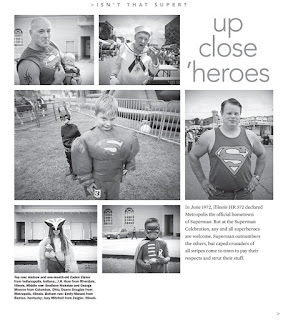
There were many people in costume, but only on officially sanctioned Superman, who's name is Josh Boltinghouse. He won the Search for Superman context and a five year deal to play Superman at the Celebration. Here he is, with my son Jacob.

Jacob, by the way, turned 2 this past Monday.
Inside the chamber of Commerce. There are tons of Superman souvenirs there, in case the vendors outside and the Super Museum shop didn't provide enough. (there's also, incongruously, a poster of the Wesley Snipes/Tommy Lee Jones film US Marshalls--which I came to learn was filmed partly in Metropolis). For some reason, I thought this section of the Commerce gift shop worth photographing.

I got lots of good stuff for a book here. If I was ever in doubt that this book will be about something important to people, that doubt was put to rest by this trip. People really make Superman an importatnt part of their lives, and not always for the same reasons. The Superman Celebration crystallizes that into one weekend. For some, it serves the same function that Halloween costuming serves: a chance to put on another face for a day or two, to let loose. I interviewed a pair of brothers, Alex and John Rinaldi, who do not put on costumes but are devoted Superman fans. They said that to dress up like that is to become interesting to others, like becoming a god for a weekend. An interesting observation.
For the town, it's an economic goldmine. They have other things that help this, a casino, a revolutionary war fort (with its own festival and re-enactment), and a harley davidson ralley. But many of them, while not necessarily fans, really get behind Superman and the Celebration. they love the work and the result. They love meeting the people. Karla, one of the chairs of the committee, compared it to a cross between Disneyland and a small town Festival. I'd replace Disneyland with a comic convention, but that might just be because I haven't been to disneyland. But my reason for the convention is the sense of community, which I doubt exists at Disneyland. Do many of the people who run the theme park know the guests by name? Perhaps, but do they incorporate the guests into the opening ceremony, allow them to run a trivia game? My interview with Karla included several moments when attendees would come up to her to chat for a bit. She knew them all by name.
All told, some 40,000 people attended the four day event. There were costume contests, a soft ball game, a car show, and scores of other events. I can't even list them all here, but they spread all over the town. I'm not that adept at fieldwork, having had little practice but a lot of theoretical instruction. I think I may have to go back next year.
Tuesday, June 9, 2009
A bit of this, a bit of that.
I suppose that the recent passing of David Carradine makes his speech in Kill Bill a sensible link at the moment. It is a good speech, so good that it was more or less written in 1968 by Jules Pfeiffer in The Great Comic Book Heroes, reissued by Fantagraphics Press not too long ago. Tarrantino often borrows liberally from other movies (so much that it's even commented on in other movies--Swingers, for example [Swingers...haven't thought about that movie in a while]), which makes me wonder if he's read Pfeiffer's book.
I'm not sure what to make of the St. Cloud Superman. Evidently he's all about free speech.
Again with Flickr. The makeup artist says it's inspired by Superman. Red, yellow, blue. Are there flickr people out there who come up with new make up designs (is that the right word) and post them regularly? Interesting. (sorry, the picture won't post.)
This review of Irredeemable is as good a reason as any to bring up the Superman pastiche. It's pretty common in comics to have a character who's not Superman, but is really Superman in all the important ways. This way creators can tell Superman stories that couldn't otherwise be told. It's akin to the Imaginary Stories, which I think have given way to Elseworlds (if those are still around, my comics information isn't the most current), which is similar to the Earth 2 stuff from a while back. In this version, the Plutonian is more or less an evil Superman. I think. Haven't read it yet, but I intend to. It's written by Mark Waid, who claims to be the only person on the planet to have read, watched, or listened to every Superman story ever told (in Superheroes and Philosophy).
Speaking of which, here's a blog entry Waid wrote earlier this year, which cover one of the reasons why he loves the character so much. Here's a passage:
It didn’t matter that he wasn’t real. What mattered was that he cared about everyone in the world, without exception, without judgment.
Everyone.
Everyone.
Waid has become one of the superstar writers in comics, and he's moved from a regular gig writing for DC comics, where he got to retell Superman's origin in a series called Birthright, to Boom! Studios, where he's now the editor in chief.
I’d walked into that theater with a very short future ahead of me, and I’d walked out feeling safe and inspired in Superman’s orbit. Without that, I can promise you I would not be here today.
That's a good note on which to end. Well, not as good as this:

Thursday, May 28, 2009
I don't know why I never tire of seeing Obama as Superman. It's always interesting to me. this one is stencilled graffiti, looks like it's on pavement somewhere.

Then there's the cover for this Taiwanese magazine. Flickr is absolutely wonderful for this project.

For a mere 29.95, you too can own your own Superman Obama bobblehead.

Friday, May 8, 2009
Back
Since I discovered that someone is actually reading this (see the comment for the last post--by a real guy!), I figure I should remark on what I've been doing in my absence. First of all, I went to Los Angeles to deliver a portion of this project as a paper for the Western States Folklore Society annual meeting. The reception was enthusiastic, and there was a good discussion afterwards. It prompted one scholar--the incomparable Wolfgang Meider--to give me a book, which was nice. I got some nice feedback, notably from Elliott Oring, a humor scholar of much renown. The paper, by the way, was on a joke:
A guy walks into a bar on the top of a very tall building. He sits down, orders a huge beer, chugs it, walks over to the window, and jumps out. Five minutes later, the guy walks into the bar again, orders another huge beer, chugs it, walks over to the window, and jumps out again. Five minutes later, he re-appears and repeats the whole thing. About half an hour later, another guy at the bar stops the first guy and says, "hey, how the heck are you doing that?!" The first guy responds, "Oh, it's really simple physics. When you chug the beer, it makes you all warm inside and since warm air rises, if you just hold your breath you become lighter than air and float down to the sidewalk." "WOW!" exclaims the second man, "I gotta try that!" So he orders a huge beer, chugs it, goes over to the window, jumps out, and splats on the sidewalk below. The bartender looks over to the first man and says, "Superman, you're a jerk when you're drunk."
It's the same joke I posted a link to (in video version) in the first post. I must say, it got a good laugh when I told it to the crowd of folklorists. The meeting--and my talk in particular--were well attended, which was really nice. It was a good group of people, most of whom I'd never met before.
The other reason for the lack of posts is that I've been writing the next chapter. It's called "The Apotheosis of Our Former Selves" because why wouldn't I use the most ridiculous-sounding chapter title ever? It makes me laugh to think that I may be delivering a paper with this title at the next American Folklore Socity conference. It's in Boise. I've never been to idaho before.
This next chapter is about a joke as well:
At his request, each morning 3-year-old Ray's mother pinned a bath towel to the back shoulders of his size two T-shirt. Immediately in his young imaginative mind, the towel became a magic blue and red cape. And he became Superman. Outfitted each day in his "cape," Ray's days were packed with adventure and daring escapades. He was Superman. This fact was clearly pointed out last fall when his mother enrolled him in kindergarten class. During the course of the interview, the teacher asked Ray his name. "Superman," he answered politely and without hesitation. The teacher smiled, cast an appreciative glance at his mother, and asked again, "Your real name, please." Again, Ray answered, "Superman." Realizing the situation demanded more authority, or maybe to hide amusement, the teacher closed her eyes for a moment, then in a stern voice said, "I will have to have your real name for my records." Sensing he'd have to play straight with the teacher, Ray slid his eyes around the room, hunched closer to her, and answered in a voice hushed with conspiracy, "Clark Kent."
This one has gotten a few laughs as well. I've found it, verbatim, on five different websites. in the process of studying this joke, I've come to invent a whole biography for Ray. he and I don't get along very well.
While we're on the subject of fashion: It seems as if this warrants mentioning:
The "Superman" is what we work-hard-play-hard ladies named our semi-public wardrobe change ... where we wiggle out of the boring business suit and throw on a halter or the cocktail dress that's been smashed in the bottom of a work tote all day.
I'm not sure if this is an example of a journalist inventing a term, or it's real. Either way...
Finally, because there hasn't been a picture of Obama as Superman here in a while:

Thursday, April 9, 2009
Recently, I've noticed a more populist view of Superman. I sense it lurking underneath All Star Superman, by Grant Morrison, and in a whole lot of articles. Here's one about Superman, Obama, and Warren Buffett.
Speaking of Obama, the Guardian calls him, President Barack Hussain Obama, the multicultural Superman for the globalised world. And i don't think I've posted this picture yet:

Then there's Indonesia. Apparently, Superman and other pop culture heroes have become icons for the ballot, with at least five aspiring legislators superimposing their faces on the bodies of superheroes and using the images on their campaign posters, according to CNN. They neglect to show pictures of these, unfortunately. The article I've linked to is fascinating, actually. It's largely about visual imagery and democracy--how candidates are employing pictures to win votes. It's light on the details of Indonesian democracy, which has only been around since 1998, but the few facts are interesting. I guess I just never expect for there to be other systems of democracy, which seems as if it's taught in schools as a monolithic thing: there's democracy, as opposed to monarchy, or despotism, or oligarchy or Felocracy. But there are forms of democracy. In Indonesia, until recently, voters could only vote for parties. And there is an election to determine which parties get on the ballots.
I guess the most surprising thing is how diverse the topics become when doing a search for Superman.
Tuesday, March 31, 2009
Very extensive site
Here's a link to the Superman Homepage. It's a vast website, which I have barely begun to explore. It's got an image gallery that I go back to again and again. Really great and useful stuff. A quick glance reveals that there's something called the Superman Web Ring. Have to check that out further.
it's also got a very brief thread about Obama as Superman, including a picture I hadn't come across yet (also including one of Obama as Green Lantern).

Monday, March 23, 2009
Links
In case you were wondering, Nic Cage really did name one of his kids after Superman.
Superman is also a handy way to describe and promote carbon nano-tubes.
Evidently in India, Superman spends most of his time dancing and singing. Seems about right to me. Have you ever seen an Indian film? This is particularly notable for the completely incomprehensible line "The grasslands have invited us to come to them./And when we went there they laughed asking us about the bed." Maybe it makes sense if you're more familiar with India. Or maybe the subtitles are badly translated. Or something.
Hmmm...not sure what to make of this one. It's a news article describing the Penn Libraries' superhero program, which presently includes an exhibit about superheroes and the ancient world. It's kind of vague, but kids seem to like it.
And then there's the Pakistan Observer. I leave interpretation up to you:
I watched as a rather thin Obama in Superman’s uniform threw a rope around the Empire State building then attempted to pull. Nothing happened as the American President, heaved and puffed away, till I heard the lady next to me shout, “Dive into the river Obama and push America up!”Obama seemed to have heard as he took a flying leap into the Hudson and didn’t surface for sometime as the crowd waited impatiently on the riverbank.
Superman is also a handy way to describe and promote carbon nano-tubes.
Evidently in India, Superman spends most of his time dancing and singing. Seems about right to me. Have you ever seen an Indian film? This is particularly notable for the completely incomprehensible line "The grasslands have invited us to come to them./And when we went there they laughed asking us about the bed." Maybe it makes sense if you're more familiar with India. Or maybe the subtitles are badly translated. Or something.
Hmmm...not sure what to make of this one. It's a news article describing the Penn Libraries' superhero program, which presently includes an exhibit about superheroes and the ancient world. It's kind of vague, but kids seem to like it.
And then there's the Pakistan Observer. I leave interpretation up to you:
I watched as a rather thin Obama in Superman’s uniform threw a rope around the Empire State building then attempted to pull. Nothing happened as the American President, heaved and puffed away, till I heard the lady next to me shout, “Dive into the river Obama and push America up!”Obama seemed to have heard as he took a flying leap into the Hudson and didn’t surface for sometime as the crowd waited impatiently on the riverbank.
Thursday, March 19, 2009
No real link between the different links.
One of the reasons I became interested in Superman, intellectually speaking, is the way kids respond to the character. I'm working on compiling a bibliography for this site, in which I'll have sections devoted to all sorts of topics--one of which will be the way kids pretend to be Superman. This post, from the Examiner.com, is sort of related to that. It's about heroism.
Heroism is perhaps the most important aspect of the Superman theme. Or meme. Or mythos. I'm working on the right term to describe the stories and thoughts that surround the character. I guess it's a mythology, in which there are subversive strains, and in which grow several memes that manifest themselves in oral tradition and popular culture as well as mass-mediated art. I'm thinking of the "superman isn't perfect" meme that has been the subject of most of my writing on Superman so far.
Anyway, one of the things that writers like to do is compare Superman to human heroes. Like this, from the article I linked to above:
We all try to aspire towards our heroes. 'I wanna be like Superman' is usually the types of phrases that we hear. Our children always want to be the cool, superhero types. What if I were to tell you that a modest 'superhero' type of person lived in New York City and did the most unselfish thing in the world? He saved a man's life from the nasty subway tracks.
This is an interesting fan site, Superman Fan Podcast. It's a lot of comics history, very thorough, from all appearances.
Doing all this research reveals something new all the time, little bits of information that may or may not become useful. For example, there are Canadian awards for comics work called The Joe Shuster Awards. Recently, they posted the final interview with Shuster, who, you should recall, was the man who drew Superman. Here's a bit of it, with another interesting slice of information.
Superman, with his heroic physique and glowing optimism, was patterned largely after Douglas Fairbanks Sr. And Clark Kent his name derived from movie stars Clark Gable and Kent Taylor was a combination of timorous, bespectacled Harold Lloyd and pale, mild-mannered Joe Shuster himself.
And I just have to post more about Obama being Superman. Here's a link to a video. I think my favorite part is the Joker.
Heroism is perhaps the most important aspect of the Superman theme. Or meme. Or mythos. I'm working on the right term to describe the stories and thoughts that surround the character. I guess it's a mythology, in which there are subversive strains, and in which grow several memes that manifest themselves in oral tradition and popular culture as well as mass-mediated art. I'm thinking of the "superman isn't perfect" meme that has been the subject of most of my writing on Superman so far.
Anyway, one of the things that writers like to do is compare Superman to human heroes. Like this, from the article I linked to above:
We all try to aspire towards our heroes. 'I wanna be like Superman' is usually the types of phrases that we hear. Our children always want to be the cool, superhero types. What if I were to tell you that a modest 'superhero' type of person lived in New York City and did the most unselfish thing in the world? He saved a man's life from the nasty subway tracks.
This is an interesting fan site, Superman Fan Podcast. It's a lot of comics history, very thorough, from all appearances.
Doing all this research reveals something new all the time, little bits of information that may or may not become useful. For example, there are Canadian awards for comics work called The Joe Shuster Awards. Recently, they posted the final interview with Shuster, who, you should recall, was the man who drew Superman. Here's a bit of it, with another interesting slice of information.
Superman, with his heroic physique and glowing optimism, was patterned largely after Douglas Fairbanks Sr. And Clark Kent his name derived from movie stars Clark Gable and Kent Taylor was a combination of timorous, bespectacled Harold Lloyd and pale, mild-mannered Joe Shuster himself.
And I just have to post more about Obama being Superman. Here's a link to a video. I think my favorite part is the Joker.
Wednesday, March 18, 2009
A couple of old ones.
This is an interesting site, Identity Crisis: The Many Faces of the Man of Steel. It was put together by three American Studies students at the University of Virginia. I haven't been able to find a firm date, but it looks like it's from 2000. It's sort of an academic take on Superman in website form, including some cultural implications, historical studies, and whatnot. It seems light on content, to tell you the truth, but I haven't gotten through all of it yet.
This one's from last year, but it's funny nonetheless. At a dinner, Obama joked about the many comments at the time that cast him as Jesus. According to News.Scotsman.com (because why wouldn't I link to a Scottish paper for a story about Obama as Superman?):
"Contrary to the rumours you have heard, I was not born in a manger," Mr Obama said."I was actually born on Krypton and sent here by my father, Jor-el, to save the planet Earth."
This one's from last year, but it's funny nonetheless. At a dinner, Obama joked about the many comments at the time that cast him as Jesus. According to News.Scotsman.com (because why wouldn't I link to a Scottish paper for a story about Obama as Superman?):
"Contrary to the rumours you have heard, I was not born in a manger," Mr Obama said."I was actually born on Krypton and sent here by my father, Jor-el, to save the planet Earth."
Monday, March 16, 2009
So my Superman Project relies on folklore for its starting point--jokes, to be specific. But Superman is everywhere, and he's quite prominent in songs. There's one by Five for Fighting called Superman (it's not easy).
I think it's interesting that the first comment on the YouTube page I've linked to is by somebody who doesn't like Superman but does like the song.
Most of the news about Superman right now has to do with a recent auction, at which the first appearance sold for $317,000. Here's a story about it from Australia, just to be different.
Because there's just not enough about Obama being Superman, here's a newspaper article from a while back about the need for heroes.
Here's another about Obama, this time I think there's a lot of sarcasm at work. Hard to tell, though.
And finally, what would this blog be without another picture of Obama as Superman? From Ms magazine, via the 944.com blog:

I like how the shape of the shirt as it's pulled open resembles the shape of the s-shield. Is Superman a feminist? There's been some comment on Lois Lane in this regard. I think there's an article in the book Superman in Philosophy. I'll have to dig it up.
Friday, March 13, 2009
This one deserves its own post.

I don't even know if there's anything I can say. First of all, this comes from a website called Obamapwns.com. Second, it's not just Obama as Superman. It's Obama as Dwight Howard as Superman. Third, just look at how white those shoes are. I hope my friend Mike Butterworth at The Agon has something to say about this.
More Obama
I had no idea there were so many images like this.


There seem to be a couple of variations on the s-shield. One of them is just the S, as Superman wears it. Another is an O, and the final one is the whole name, Obama. it seems to depend on the preference of whoever makes the image. And, of course, you can get the shield as a t-shirt.

Another t-shirt.
And the wonders of photoshop.
How about a button?
There seem to be a couple of variations on the s-shield. One of them is just the S, as Superman wears it. Another is an O, and the final one is the whole name, Obama. it seems to depend on the preference of whoever makes the image. And, of course, you can get the shield as a t-shirt.
And finally...It could all be true. Or a White House cover-up that will never allow us to know all the facts. You decide:
The White House has rigorously denied any involvement in the alteration of official photographs of the US president Barack Obama, which appeared to remove evidence that President Obama was wearing a Superman T-Shirt inder his white shirt. (courtesy of Newsifact)

I promise I'll get over my Superman-Obama obsession soon.
Subscribe to:
Posts (Atom)