All-Star Superman has been getting some scholarly attention recently. Here's "Making and Breaking the Superhero Quotidian," by Frank Bramlett. It was published by ImageText, an online journal of interdisciplinary comics studies. It's a pretty good journal. They also published an article on Alan Moore's Superman a while back as part of an entire issue on Moore's work.
Then there's this four-part examination of Morrison's Superman that spans decades' worth of stories. Very thorough, by Jim Dandeneau.
All-Star

Showing posts with label morrison. Show all posts
Showing posts with label morrison. Show all posts
Tuesday, May 10, 2016


Friday, April 15, 2016
Batman versus Superman
Here's a topic that will probably always get me to link to it: That page in All-Star Superman 10.
Then there's this thing, claiming that nobody cares about people disliking BvS. I'm willing to look past the title, even though I very much do care what people think about this movie.
And here's an example of why I care.
And another example: discussions about superheroes don't get more interesting than this one, from Panels.net--a site I've come to like quite a bit. Yeah, it's got that Morrison/Quitely page from All-Star Superman 10 once more. Still inspiring people. If you're reading along, make sure to check out the comments on that article, since they make a counter-argument that's also worthwhile.
Still haven't seen Dawn of Justice. But that preview of Rogue One looks cool.
Then there's this thing, claiming that nobody cares about people disliking BvS. I'm willing to look past the title, even though I very much do care what people think about this movie.
And here's an example of why I care.
And another example: discussions about superheroes don't get more interesting than this one, from Panels.net--a site I've come to like quite a bit. Yeah, it's got that Morrison/Quitely page from All-Star Superman 10 once more. Still inspiring people. If you're reading along, make sure to check out the comments on that article, since they make a counter-argument that's also worthwhile.
Still haven't seen Dawn of Justice. But that preview of Rogue One looks cool.
Wednesday, February 5, 2014
Different Perspectives
 |
| Quitely and Grant |
Since I've posted quite a bit about All-Star Superman in the past, I thought I'd do so again.
Here's a link to a long article about the ray bradbury reference in the first issue.
The writers at Hooded Utilitarian didn't buy into the general praise of the series, and they offer a series of insightful articles about why. This first one by Noah Berlatsky discusses how All-Star feels decadent, a retread of the silver age stories that never quite captures their true feeling. Here's another he wrote on the same subject.
 |
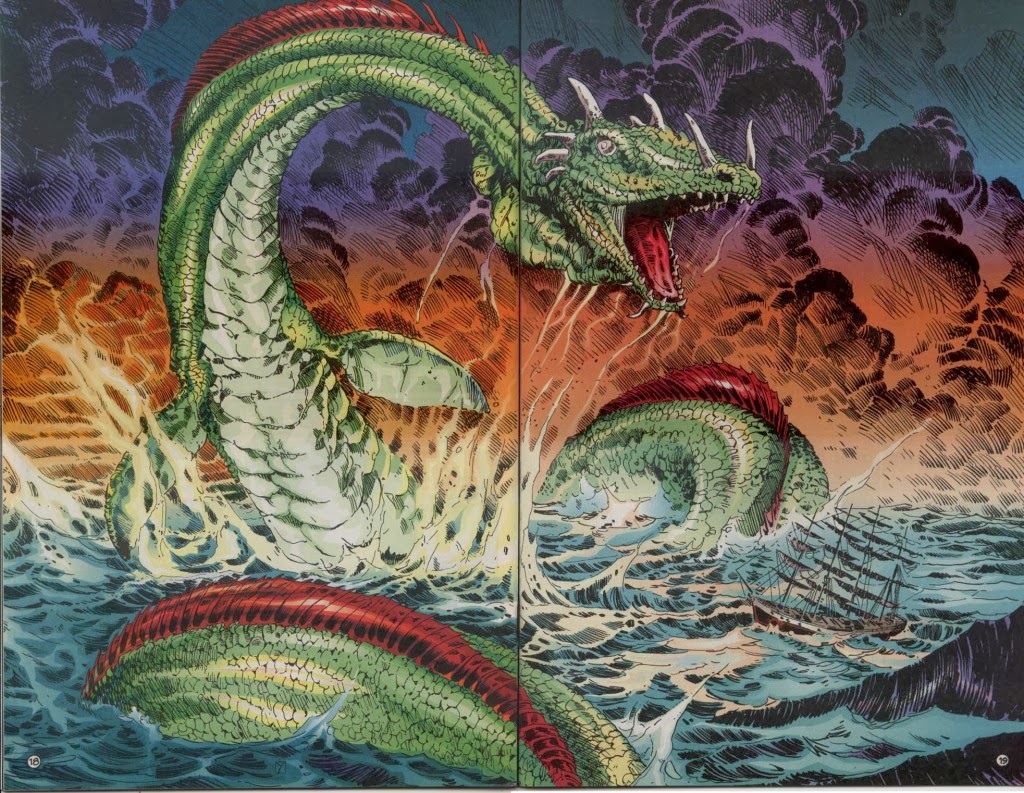
| I borrowed Berlatsky's scan of the sea dragon, art by Marley for the Korean comic Dokebi Bride. Looks amazing. |
This next one by Berlatsky is a comparison of two images, one of Superman and the other of a big dragon. Here's a follow-up. I wanted to post these stories in part to give an alternate perspective on All-Star Superman, and the art of Frank Quitely. The writer shows the images in part to point out how the superhero image suffers by comparison. There's something worth quoting here:
The point here is that super-hero comics very rarely have a
strong sense of wonder. With all the spectacular feats, you’d think they would—but
somehow they all end up as tricks; they’re fun and goofy, or I guess more recently
bloody, but they don’t actually inspire awe. And I think it’s because of
something Tom said, “Superman keeps the universe our size.” Super-heroes are
there to make things more manageable. Awe—a sense of vastness, of human
insignificance or vulnerability—is antagonistic to everything they stand for.
If Superman saw that dragon, he wouldn’t be scared or impressed—he’d just punch
it in the snout. (As Wonder Woman did in a similar situation..) There’d be big
explosions! There’d be excitement! There’d be action! But there wouldn’t be a
moment where you said, “oh my god,” and felt rooted to one particular spot, and
overwhelmed.
The
point here is that super-hero comics very rarely have a strong sense of
wonder. With all the spectacular feats, you’d think they would — but
somehow they all end up as tricks; they’re fun and goofy, or I guess
more recently bloody, but they don’t actually inspire awe. And I think
it’s because of something Tom said, “Superman keeps the universe our
size.” Super-heroes are there to make things more manageable. Awe — a
sense of vastness, of human insignificance or vulnerability — is
antagonistic to everything they stand for. If Superman saw that dragon,
he wouldn’t be scared or impressed — he’d just punch it in the snout.
(As Wonder Woman did in a similar situation..) There’d be big
explosions! There’d be excitement! There’d be action! But there wouldn’t
be a moment where you said, “oh my god,” and felt rooted to one
particular spot, and overwhelmed. - See more at:
http://www.hoodedutilitarian.com/2009/04/nowhere-man-somewhere-dragon/#sthash.OQBMq6hq.dpuf
The
point here is that super-hero comics very rarely have a strong sense of
wonder. With all the spectacular feats, you’d think they would — but
somehow they all end up as tricks; they’re fun and goofy, or I guess
more recently bloody, but they don’t actually inspire awe. And I think
it’s because of something Tom said, “Superman keeps the universe our
size.” Super-heroes are there to make things more manageable. Awe — a
sense of vastness, of human insignificance or vulnerability — is
antagonistic to everything they stand for. If Superman saw that dragon,
he wouldn’t be scared or impressed — he’d just punch it in the snout.
(As Wonder Woman did in a similar situation..) There’d be big
explosions! There’d be excitement! There’d be action! But there wouldn’t
be a moment where you said, “oh my god,” and felt rooted to one
particular spot, and overwhelmed. - See more at:
http://www.hoodedutilitarian.com/2009/04/nowhere-man-somewhere-dragon/#sthash.OQBMq6hq.dpuf
It's certainly an interesting perspective on superhero comics. On the same website, Tom Crippen discusses Superman at length. He warns that it's a idiosyncratic perspective, and everything I've found in my own study of what people do with the character sort of works differently. Crippen wonders about the religious connections, the mythical nature of Superman, and I deal with that a lot (though not exhaustively--I pulled everything about Superman and the hero myth out of my book, though that seems really weird; it may be an article some day, if I can pare it down from the 70 pages it currently takes up). Anyway, here's a key point of Crippen's article:
The
point here is that super-hero comics very rarely have a strong sense of
wonder. With all the spectacular feats, you’d think they would — but
somehow they all end up as tricks; they’re fun and goofy, or I guess
more recently bloody, but they don’t actually inspire awe. And I think
it’s because of something Tom said, “Superman keeps the universe our
size.” Super-heroes are there to make things more manageable. Awe — a
sense of vastness, of human insignificance or vulnerability — is
antagonistic to everything they stand for. If Superman saw that dragon,
he wouldn’t be scared or impressed — he’d just punch it in the snout.
(As Wonder Woman did in a similar situation..) There’d be big
explosions! There’d be excitement! There’d be action! But there wouldn’t
be a moment where you said, “oh my god,” and felt rooted to one
particular spot, and overwhelmed. - See more at:
http://www.hoodedutilitarian.com/2009/04/nowhere-man-somewhere-dragon/#sthash.OQBMq6hq.dpuf
The
point here is that super-hero comics very rarely have a strong sense of
wonder. With all the spectacular feats, you’d think they would — but
somehow they all end up as tricks; they’re fun and goofy, or I guess
more recently bloody, but they don’t actually inspire awe. And I think
it’s because of something Tom said, “Superman keeps the universe our
size.” Super-heroes are there to make things more manageable. Awe — a
sense of vastness, of human insignificance or vulnerability — is
antagonistic to everything they stand for. If Superman saw that dragon,
he wouldn’t be scared or impressed — he’d just punch it in the snout.
(As Wonder Woman did in a similar situation..) There’d be big
explosions! There’d be excitement! There’d be action! But there wouldn’t
be a moment where you said, “oh my god,” and felt rooted to one
particular spot, and overwhelmed. - See more at:
http://www.hoodedutilitarian.com/2009/04/nowhere-man-somewhere-dragon/#sthash.OQBMq6hq.dpuf
There’s my Superman. He’s modernity. It’s what he stands for, and he grows directly out of it. He’s the odd doodle our collective mind drew when the second-by-second experience of modern existence, the way modernity feels, became impossible to ignore. “Super,” the category he embodies, represents the new dimension added to existence by technological development. The most extreme transformations in our physical environment are now produced by means we find unreal and abstract, that feel like they have nothing to do with us; he’s there to bridge the gap.
He also writes: When I was reading Superman, I was getting ready for a lifetime of user manuals and tax forms. All right, I'm bitter.
This is all interesting stuff, and worth thinking about. For Crippen, Superman is all about modernity. For both these writers, Superman isn't enough. He doesn't work in a beneficial way. For Berlatsky, there's no inspiration, no sense of wonder. One result of my own research, which involved interviewing people about what they do with Superman, is that I found Superman to be the inspiration these writers don't find. That's an awkward sentence, but the point is that plenty of people work to make the world a better place, modeled on their interpretation of Superman. The scholar Ben Saunders, in his book Do the Gods Wear Capes?, finds in Superman an evolving meditation on the nature of virtue, something that everyone I interviewed also indicated in one way or another. What Superman does is much less important than what we do with Superman in mind.
 |
| Cover by Mike Allred |
Now, I talked to Superman fans, so they are predisposed to find useful things in Superman stories. When Berlatsky discusses the sense of awe, he's really getting at something religious, Rudolph Otto's sense of the numinous. That's not what Superman does. He's secular. I'm not saying that this makes Quitely's image of Superman in the sun any more valuable (in fact, nobody I talked to mentioned this image as being particularly meaningful to them); what I'm saying is that these writers don't find Superman valuable in the way that other people do. And that's fine. Personally, I like reading all the different perspectives, and both Berlatsky and Crippen make some really interesting points. Well worth reading.
While we're on the subject of Morrison's Superman, here are a few articles on his Action Comics run from a little while a go. From the Mindless Ones. And more. And on Morrison.
And while we're on the subject of awe-inducing images of sea monsters, I've always like this one, from the World's End volume of Sandman, by penciller Michael Zulli, inker Dick Giordano, and colorist Daniel Vozzo:
Monday, November 26, 2012
Prometheus
I wrote my dissertation on Prometheus, specifically on the ways this Greek figure has been used in modern America. I finished a few years ago, so when the movie of that name came out earlier this year, I wasn't in a rush to see it. I watched it at home a few weeks ago.
I liked it. At first, I was a bit frustrated that so many things were left unexplained. After a few days, I began to like this more and more. I know that there's some plan for a sequel, but I won't get excited about that until it's released.
I find the idea behind the film compelling, with or without the ties to Alien. And by 'the idea', I'm referring to the ancient alien hypothesis--that a long time ago aliens came to earth and in some way either created humanity or at least tweaked life's evolutionary path toward us. It's part of the story of 2001: A Space Odyssey, and lurks in David Brin's Uplift Series. And not so long ago The 'History' Channel got a lot of mileage out of it. They started mainly from Erich Von Danniken's book The Chariots of the Gods, and the literature that sprouted in its wake. I wrote a bit about this in my article for Strange Horizons, Superman as Science Fiction.
Prometheus works pretty well as a set-up. I do hope the payoff is up to par. But what I liked about it most were the images and how they explored the themes of the plot. We've got a story about an expedition to the stars ostensibly undertaken to find our origins (and the twist that it's also about finding out how to live longer). It's about our birth as a species, and so it seems appropriate that the film's most potent image and most potent sequence reflect this. The sequence, the one most often praised and singled out, is the robotic c-section.

Yes, it's tough to watch, terrifying and electrifying. But think about it for a second. This is a movie about the relationship of a creator to its creation; it goes out of its way to point out that people not only create other people, but robots as well. Then, the robot David (Michael Fassbender) tries an experiment on a Holloway (Logan Marshall-Green) by putting a drop of the black liquid in his drink (a strange analogy of insemination?), which results in a Shaw (Noomi Rapace) getting pregnant. Horrified, she gets a medical robot to remove the offspring from her body. Crazy stuff.
Then, the image: I think this was the most frequently used promotional image:
David holding a hologram of the earth. It's interesting how this movie almost insists that light has weight. But most interesting is the fact that David, the robot who kinda sorta inseminated Shaw with the alien baby, has the whole world in his hands. And doesn't he say, at one point, "Doesn't everyone want their parents dead?"
Anyway, I'll close with one more image.

I liked it. At first, I was a bit frustrated that so many things were left unexplained. After a few days, I began to like this more and more. I know that there's some plan for a sequel, but I won't get excited about that until it's released.
I find the idea behind the film compelling, with or without the ties to Alien. And by 'the idea', I'm referring to the ancient alien hypothesis--that a long time ago aliens came to earth and in some way either created humanity or at least tweaked life's evolutionary path toward us. It's part of the story of 2001: A Space Odyssey, and lurks in David Brin's Uplift Series. And not so long ago The 'History' Channel got a lot of mileage out of it. They started mainly from Erich Von Danniken's book The Chariots of the Gods, and the literature that sprouted in its wake. I wrote a bit about this in my article for Strange Horizons, Superman as Science Fiction.
Prometheus works pretty well as a set-up. I do hope the payoff is up to par. But what I liked about it most were the images and how they explored the themes of the plot. We've got a story about an expedition to the stars ostensibly undertaken to find our origins (and the twist that it's also about finding out how to live longer). It's about our birth as a species, and so it seems appropriate that the film's most potent image and most potent sequence reflect this. The sequence, the one most often praised and singled out, is the robotic c-section.

Yes, it's tough to watch, terrifying and electrifying. But think about it for a second. This is a movie about the relationship of a creator to its creation; it goes out of its way to point out that people not only create other people, but robots as well. Then, the robot David (Michael Fassbender) tries an experiment on a Holloway (Logan Marshall-Green) by putting a drop of the black liquid in his drink (a strange analogy of insemination?), which results in a Shaw (Noomi Rapace) getting pregnant. Horrified, she gets a medical robot to remove the offspring from her body. Crazy stuff.
Then, the image: I think this was the most frequently used promotional image:
 |
| "Sometimes to create, one must first destroy." |
Anyway, I'll close with one more image.

Tuesday, May 22, 2012
Luthor-Quintum Update
So I write about All-Star Superman a lot. I like it. It makes people think interesting thoughts. One guy told me that people who don't like All-Star Superman don't have souls. Another guy (actually, several people) seem to think that the character Leo Quintum--invented for the series by author Grant Morrison--is actually Lex Luthor, come back from the future to atone for his crimes by making the world a better place through Science. I wrote about this theory a while back.
 |
| What is with this cover? |
Interestingly, it showed up in the book Critical Approaches to Comics: Theories and Methods as part of Peter Coogan's essay "Genre: Reconstructing the Superhero in All Star Superman." There's a bit about structuralism, a bit about genres, and he goes through the various proofs that Leo is Lex. He even cites some of the comment threads in which the idea appeared online, originally by Cole Moore Odell. (Coogan wrote Superhero: The Secret Origin of a Genre, a book which I have seen cited a whole lot. It's got an Oedipal analysis of Superman and Luthor, and I have a thing or two to say about that interpretation of the character in my own book--which I hope everyone in the world will get to read some day.)
 |
| Denny O'Neil must make a full time job of writing intros now. |
People are fascinated by the fact that Morrison himself does not say an unequivocal 'yes' or 'no'. The whole thing is summed up here. Lurking behind all of this is the notion that Morrison gets the final word on the matter. But does he? People can interpret the stories in whatever manner suits them, even bending the narrative to fit their interpretations, often without realizing they are doing so. Artists tell a story, and people do what they will once they read it.
 |
| I'm kind of obsessed with the art of Frank Quitely. |
More about redemption, though not about Superman, next time.
*It's interesting to note that, while the comic book version of All-Star offers in an off-hand manner the fact that "Even Luthor seemed to find some closure in the face of renewed global calls for his execution", the animated movie of it has Luthor play a more prominent role at the end. The fact that he gives Quintum the formula for Superman that leads to Project and the Superman dynasty suggests a more fully realized redemption, in spiritual if not in legal terms.
Friday, May 18, 2012
So we chose not to deconstruct the superhero but to take him at face value, as a fiction that was trying to tell us something wonderful about ourselves. Somewhere, in our darkest night, we made up the story of a man who will never let us down and that seemed worth investigating.
--Grant Morrison, talking about All Star Superman in Wired.

That interview was from a few years ago now, but it's an interesting thought. He wants to investigate what it means to 'never let us down.' It's not always intuitive. It's not always obvious. What's the right way to help people? What's the right way to be a hero? What does it mean to be good? In interviews I've read and conducted, people say time and time again that we always know what Superman would do in any situation.
There's a pretty good recent book called Do the Gods Wear Capes? by Ben Saunders. There's a chapter on Superman, and it's pretty much about this question. In his view, Superman is basically a way for writers, from Jerry Siegel onward, to explore this very notion of 'the good.' And it's got a nice Mike Allred cover.

I guess this is why the Supermen (Supermans?) of so many recent incarnations are so troubling to me (I'm looking at you, Earth One--sort of you, too, Smallville, though I haven't read the new comic version of that). If Superman represents what we think of as someone who is the definition of good, why do those guys stand around so much, waiting for there to be no choice but to act?
Thursday, January 27, 2011
Some new links
At Too Busy Thinking About My Comics, Colin Smith wrote a four part exploration of All Star Superman and Superman: Earth One. It's really, really good. Part 1; Part 2; Part 3; Part 4. In-depth, clear, and insightful.
Here's an article about superman's ethics.
This one's from the Superman Homepage: (Not) Believing Again: Superman Returns--From Postmodernism to Faith (and Failure) by Ben Murane. It's an academic approach.
Speaking of an academic approach, here's Brent Allred's thesis from Melbourne College of Divinity, it's about the use of movies and literature in Christian Education of kids, it's got some stuff about Superman.
And another thesis, this time about Superman and America, by Michael Mautner.
That's enough of that for now.
Here's an article about superman's ethics.
This one's from the Superman Homepage: (Not) Believing Again: Superman Returns--From Postmodernism to Faith (and Failure) by Ben Murane. It's an academic approach.
Speaking of an academic approach, here's Brent Allred's thesis from Melbourne College of Divinity, it's about the use of movies and literature in Christian Education of kids, it's got some stuff about Superman.
And another thesis, this time about Superman and America, by Michael Mautner.
That's enough of that for now.
Wednesday, January 13, 2010
all star puzzle: is leo quintum really lex luthor?
I've got to keep these handy. It's the idea that the character Leo Quintum in All-Star Superman is actually Lex Luthor, who has come back from the future after having seen the error of his ways as a result of seeing the world as Superman does.
Not-The-BeastMaster posted this one last year. Also, this one.
From the Savage Critics. Also relevant are the comments, as it's the first place I've seen theorizing that Quintum is Luthor. Let's see if I can find another...here...and here...we'll throw this one in there, too, though the part on Superman's a bit down the page...and here...and this one is relevant...and so's this, more or less...
I hadn't even thought of this, and after examining the evidence...I have no comment to make either way.
Not-The-BeastMaster posted this one last year. Also, this one.
From the Savage Critics. Also relevant are the comments, as it's the first place I've seen theorizing that Quintum is Luthor. Let's see if I can find another...here...and here...we'll throw this one in there, too, though the part on Superman's a bit down the page...and here...and this one is relevant...and so's this, more or less...
I hadn't even thought of this, and after examining the evidence...I have no comment to make either way.
Tuesday, November 17, 2009
Untold Tales
Thanks to the internet, it's possible to acquire and read scripts for films that will never be shot, plots for novels that will never be written, and ideas for comics that will never be drawn. This is both good and bad, I suppose.
For one thing, it's often funny, as we have seen with the recent revelation of the Nick Cage/Tim Burton Superman Lives movie that never was.
For another, it's often tragic, as with the Superman 2000 proposal by Grant Morrison, Mark Waid, Mark Millar, and Tom Peyer. This Superman, by these writers, would likely have been magnificent. Alas, we'll never know if they could have pulled it off together. Actually, we have clues, as all of these writers have worked with Superman since then. Waid's Birthright was powerful. Millar's Red Son is one of the best-selling superman collections to this day (and one that every comic shop owner has pointed to as a constant favorite of customers), and Morrison's All Star Superman has been called "perfect" by a great many writers and reviewers.
So Superman 2000 didn't happen, but you can read about it. And lots of people like to write about it.
And I'm sure some people have incorporated this into their own idea of who Superman is, the residual image formed from all of their exposure to stories about him.
For one thing, it's often funny, as we have seen with the recent revelation of the Nick Cage/Tim Burton Superman Lives movie that never was.
For another, it's often tragic, as with the Superman 2000 proposal by Grant Morrison, Mark Waid, Mark Millar, and Tom Peyer. This Superman, by these writers, would likely have been magnificent. Alas, we'll never know if they could have pulled it off together. Actually, we have clues, as all of these writers have worked with Superman since then. Waid's Birthright was powerful. Millar's Red Son is one of the best-selling superman collections to this day (and one that every comic shop owner has pointed to as a constant favorite of customers), and Morrison's All Star Superman has been called "perfect" by a great many writers and reviewers.
So Superman 2000 didn't happen, but you can read about it. And lots of people like to write about it.
And I'm sure some people have incorporated this into their own idea of who Superman is, the residual image formed from all of their exposure to stories about him.
Subscribe to:
Posts (Atom)