All-Star

All-Star
Showing posts with label archetypes. Show all posts

Tuesday, June 18, 2013

Time to Talk about Man of Steel


Spoilers in pretty much everything below.


Man of Steel is the first movie I've seen on opening weekend in nearly seven years. It is one of maybe half a dozen I've seen in a theater during that time frame. I went in expecting something mediocre, based on my opinion of the talents of the creative team putting this film together. What I got was not mediocre, but something else entirely.

At first, I kind of liked it. I was bothered by the camera work (I abhor the shaking camera when it's used to film mundane activity, such as somebody walking around). But other than that I left feeling like it was a decent film, better than Superman Returns at least. The only thing that really struck me was that it didn't feel like a Superman movie. It was a pretty typical superhero movie smashed together with something resembling science fiction in cinema, but that was about it. All in all, an ok movie, but not for me.

Then I had to figure out why it wasn't for me. And the answer has to do with the end of the film, when Superman kills Zod.

This act points to an evolution of Superman over the course of the film and its prospective sequels: he will eventually realize that he made the wrong choice, and when he's confronted with a similar situation, he'll finally make the right one. It makes the story about The Hero's Journey. And I just don't care about the hero's journey, except in an academic way. And I already wrote my book on Superman. I don't want to have to do more research at this point.

You see, one thing I love about Superman's early years in publication is that the origin was precisely one page long and then pretty much forgotten for a while. You had the slight expansion in the first Superman ongoing series, and in the comic strips, but that's to be expected. Sure, they added a few pages worth of material, but that was it. In the Fleischer animated shorts, in the serials, in Adventures of Superman on radio and TV, the origin takes a few minutes of screen time and then it becomes completely irrelevant to the story. The storytellers are saying, "OK, now you know how he got his powers. Let's move on."

The comics in recent years, and the Smallville tv show and now in Man of Steel, there's an obsession with Krypton and Superman's origin that does not resonate with me. It has everything to do with where I am in life, the fact that I'm not searching for some essence of my identity, that I am comfortable with myself. In other words, I'm not engaged in my own personal hero's journey, so I can't muster a lot of interest in watching somebody else's over and over again--this may also be related to the fact that I have read, watched, and listened to every single one of the retellings of Superman's origin during the past two years. Man of Steel goes out of his way to tell us that Superman is 33 when he dons the cape, and then he still doesn't really know who he is enough to know that it's bad to kill, and there's always a better way. (Don't give me that junk about Zod presenting him with a situation in which there's no other possible solution. He's Superman--there's always another solution.)

In other words, the Superman I want to read about and watch isn't somebody who's groping for his role in the world, trying to reach maturity. This is why Smallville just didn't work for me, and why Man of Steel doesn't. I'd much rather read about a character who is already confident, comfortable in his suit, and ready to face the challenges of his chosen role.

When I was digging deep into the body of stories that comprise Superman, I discovered "The Challenge of Superman." I thought of this as the set of oddities presented by the early years of Action Comics, Superman, and Adventures of Superman that any writers of a new version, starting from scratch, have to reconcile. I thought of the challenge of Superman as the union of his secret identity, his fascination with Lois Lane, his choice to be a reporter, and his unwavering moral code. We might also toss in the source of his powers (were all Kryptonians originally 'super'? or is it the yellow sun or the low gravity or something else), but that seems to be fairly well-set these days and not much of a challenge anymore

I like to think that Jerry Siegel and Joe Shuster left The Challenge of Superman to all those who came after them. They were saying, "Here, deal with these apparently nonsensical parts of the story. Make them make sense and you'll achieve greatness. It's a puzzle with many possible solutions." Ok, they didn't say anything of the kind, but the Challenge of Superman has been taken up by pretty much everybody in the ensuing years. And in solving the challenge of Superman, writers are forced to make statements about career, romance, the relationship of the individual to the group, and what makes us the complex, multifaceted people we are. It's an excellent way to approach storytelling.

There are lots of different ways that writers and editors have solved The Challenge of Superman. I think that I might explore some of these solutions in future blog posts, in large part because I have all these thoughts floating around in my head and they had no place in my book. Today, what I will say is that the creative team who produced Man of Steel didn't seem to give a lot of thought to his interest in Lois Lane or to his choice to be a reporter. They really focused on his secret identity, and seem to have set up a way to explore this moral code in another movie.

You see what they did there? They took a simple comment in Superman #1, in which his adoptive father (not yet Jonathan Kent by name) tells Clark he's got to keep his powers a secret, and they made it the focus of the father-son relationship. Sure, Kevin Costner tells Clark that he's been sent here for some reason, but he doesn't follow it up with anything about how Clark should use his powers to help people.

The core of Superman's morality, since Superman #1, has come from his adoptive parents. That's part of why he has such an appeal in the United States: "Baseball, apple pie, and Superman, that's America," John Hambrick told me. He owns the SuperMuseum in Metropolis, Il. It's a good point. The Kents' agrarian midwestern worldview forms half the argument in Gary Engle's foundational essay, "What's So Darned American about Superman?" from the excellent collection Superman at 50 (the other half is that he's an immigrant, according to Engle). So the only lesson Man of Steel allows the Kents to impart is that Clark has to hide his extraordinary abilities, which leads to a number of secret identities before he settles on Clark Kent again and becomes a reporter.

The thing was, I thought they'd already gotten there. There's that moment when Superman turns himself over the the American military, letting them decide whether or not he should be given to Zod. To me, this was a plain rebuke to J. Michael Straczynski and Superman: Earth 1, which had virtually the same situation with a completely different decision on Superman's part. In Earth 1, when an alien (named Tyrell, not a Kryptonian) shows up looking for the last son of Krypton and demands he be handed over, Superman does absolutely nothing for a long time, while Tyrell wreaks havoc and kills lots of people. Eventually, after an agonizing amount of time and long after Tyrell's grace period has elapsed, he puts on his suit and flies out to fight all by himself.

In Man of Steel, Clark Kent has a moments of indecision, during which he goes to a church to ask a random priest what he should do, then doesn't wait around to get advice and chooses to turn himself over to the military. He's asking them to make the decision for him, but he's really already made a decision. He has rejected Zod by giving himself over to the US. He's really making the choice to trust, which the movie tells us, which is Superman saying that he's not wise enough to make the choice himself. It's a noble thing to do, leading to dialogue; even though Superman distrusts Zod, he's willing to work for a nonviolent solution. So while Straczynski's Superman allows countless deaths through his inaction, the Man of Steel doesn't do so--at least not until the fighting begins. Then he doesn't try to save anybody in particular for a while so he can focus on punching and whatnot.

I hope I'm making my point clear. Man of Steel shows us a moral code produced by experience. Nothing explicitly wrong with that, unless you're writing Superman, who's supposed to don the suit with a firmly embodied sense of altruism that values life in all its manifestations above all else. Because with life comes possibility, the true value of the story of Superman. Death robs us of possibility, whether it be the death of a planet or the death of a villain. With death there can be no rehabilitation. Sure, Zod wanted to die, but then again so did the girl on this page:


All-Star Superman 10, by Morrison, Quitely, and Grant.


Superman's job is to give us strength, to remind us of the strength we already have, to inspire us. He can't do that by killing people. The greatest crime Man of Steel committed was that it did not even attempt to inspire anybody. The one scene where it approached this, when Superman learns to fly (honestly, I hadn't even noticed that he couldn't fly at this point in the movie) tonally clashes with every other scene. It attempted to show his joy in flight. There's no joy in any other shot in this film, except maybe at the end, when we get the flash back showing us Jonathan and Martha watching a young Clark run around in the back yard with a towel clothespinned to his t-shirt. I was trying to think of movies that had inspired me, had included real joy. I recalled the  scene in Metropolis of Superman '78, when Superman is just flying around town, rescuing cats and foiling crooks. That was joy in being Superman.

You know what else: The Incredibles. When Dash is running as fast as he can for the first time, fleeing the bad guys, and discovers that he can run on water (which is basically the same as flying, but that's a discussion for another day). Dash lets out this gleeful laugh, the music kicks it up a notch, and we see him weaving through rock formations, dodging his enemies, and enjoying himself fully for the first time in his life. It makes me want to do that.

I didn't want to do anything that Superman does in Man of Steel. He didn't enjoy having his powers--Jonathan Kent made sure of that.


Tuesday, January 15, 2013

Man of Steel Trailer

Here's a link to an interesting piece on Robot 6. What's even more interesting is the discussion that follows it. It all kicks off with a quote from J. Michael Straczynski, followed by some commentary from the columnist Michael May, the trailer for Man of Steel. It's all about the idea of what sort of character Superman should be. The comments below it feature some interesting remarks by Straczynski and by Mark Waid. It's also got a link to another article that I'll probably bring up again some day.


The discussion goes in some interesting directions, particularly its focus on the comment in the trailer that Jonathan Kent makes about how 'maybe' Clark shouldn't have saved a bunch of kids from drowning, so he could protect his secret. It's interesting, but I think I'll wait until the movie comes out and I can see the whole scene before I comment on that.

What was especially interesting was the occasional criticism of Straczynski's Earth One stories. The specifics aren't important here. The important part is that Straczynski himself felt it necessary to chime in with a lengthy defense of his stories. My feelings about Earth One aside (it's utter tripe), I think the fact that the writer had to explain what he was trying to do says loads about how well he did it. Meaning he didn't get his point across very well in the story he told.

The discussion made me think of the types of stories being told today, in movies, television, and comic books. We live in an era where fandoms are becoming the dominant audiences courted by media storytellers and executives, in part because fans spend lots of money on things. So there needs to be lots of things for them to spend their money on. The result of this is that stories are told at great length, with the details fleshed out in sometimes excruciating detail. Star Wars is the perfect example of this. What was essentially one paragraph's worth of information in the original movie became more than six hours of film time (not to mention the animated series, novels, comic books, etc). Some people wanted that story told. Not me. Though I was excited to see them, I liked the spark in my imagination, lit by the hints in that one paragraph of information. The Clone Wars in my head are so much more interesting than what the movies revealed them to be.

Anyway, I think that Superman is most compelling as a fully formed hero, not as a hero-in-the-making. Siegel and Shuster got it right in the first place: limit the back story, get right to the adventures in Metropolis. I don't need to see how he came to the decision to be a hero. In fact, I'd say it diminishes him. It makes it contingent on events, tells us that if something had gone just a little bit different when he was 15, or 16, or 18, or 20, he would be a villain, or a different kind of hero. There are plenty of characters whose stories already do that. For Superman, I'd rather have a lot left to my imagination. But that's just me.

The thing is, I know that telling the story of how Superman made the choice to be a hero can be a valuable story. I have interviewed people for whom that story has made a difference in life, has led them to make their own choices, has given them inspiration: an "If Superman could make the right choice, could figure out the best way to live his life, then so can I" sort of thing. I just hope they don't look to Earth One for this inspiration.

Monday, October 1, 2012

Beast and SuperBeast: Superman and Folktales part 3, Beauty and the Beast

by Arthur Rackham


So far, I've described the tales of "Cupid and Psyche" and "East of the Sun, West of the Moon." Together with "Beauty and the Beast," these stories make up what folklorists call Tale Type 425. It's essentially the story of the animal bridegroom. It's related to "Cinderella." The Grimms' version is called "The Singing Springing Lark." There's a good English version called "The Small-Toothed Dog," too.

Sometimes the beast is a weird warthog thing. By Walter Crane
That brings us to " Beauty and the Beast." It's a tale as old as time, according to the Disney film. So evidently time began in 1740, because that's when the story with that name was first published, in France. It shares a lot of the traits that we saw with "Cupid and Psyche" and "East o' the Sun." A good American version from the late 1800s is called "Rose," and it starts with a widower and his daughter. The man marries a woman with two daughters, who force Rose to do all the work while they play all day. The father goes on a trip, and asks each what they want as a present when he returns. The first two want the usual dresses and jewelry, but Rose wants nothing more than a rose. He promises to bring one. On his way home, he finds a splendid castle, empty of people but strangely with food laid out for him.

by Mercer Mayer
He makes his way to the garden, where he finds the most beautiful rose he's ever seen. He plucks it, and on the way out meets a great lion, who promises to kill him for taking the rose. The man agrees to his fate, but asks to be able to say goodbye to his daughter. The beast allows it. He returns, and when Rose learns of what has happened, she goes to the castle to plead for his pardon. When she arrives, everything in the castle bears the words "Welcome, Beauty, here!" The beast agrees to pardon the father, if she'll stay as its wife. She refuses to wed, but stays with him to keep her father alive anyway. It gives her a ring that allows her to visit her father whenever she wants, so long as she stays only a week. She does so, but her step-sisters conspire to keep her there too long. When she returns, she finds the lion sick. Not wanting it to die, she declares that she will be its wife. This, of course, transforms the beast back into a prince. She then makes her cruel step-sisters her servants in the castle, and all the people are happy.

by Katy Bratun
Again: secret identity revealed by transformation. Many versions, including the Disney film, have the woman violating an interdiction of some sort (in the film, she goes into the castle's west wing, where she finds the rose that counts the time until the enchantment is made permanent, thus learning something about him that he had to keep a secret). Tale Type 425 emphasizes the recurring motif of the search for the lost husband--which is absent from both Disney and from Superman. Instead, we get the rival for Belle's affections in Gaston. And in the superhero story, Superman can pretty much solve his own problems a lot of the time. Again, other than dealing with Kryptonite, Lois Lane doesn't do a lot of rescuing.

What does all this tell us about Superman? Well, that depends on what we want to see, to some extent. I see that Superman is really a story about marriage. Lois is always trying to marry him, or anyways she was until not too long ago. Sometimes they do get married, though in the comics version right now they're not.

Action Comics 243, by Otto Binder and Wayne Boring
Superman stories are often about transformation. That moment when he changes from Kent to Superman is frequently highlighted. The early Fleischer cartoons emphasized it, showing it in pretty much every one of them. The comics love to show it, using speed lines to show him doffing his suit and flying in his costume. The movies find all sorts of ways to put it on the screen, often just showing him running toward the camera and pulling his shirt open to reveal the shield (Smallville spent ten years building to that moment). A lot of memorable images show us that moment. The transformation is important.

Superman 165 by Robert Bernstein and Curt Swan
I place of the step-mother's (or witch's) curse, Superman is sometimes told by his adoptive parents to keep his identity secret. Sometimes he puts the curse on himself, thinking that he needs to keep his friends and family safe from villains. People speculate on it, coming up with their own rationale . But whatever the reason, he doesn't reveal who he is.
 
A lot of these folktales reflect the anxieties that women several centuries ago felt about marriage (and childbirth). They show us a time when women could be bought and sold, to men who might very well murder them, when bearing children was less a choice and more of a life-threatening obligation. They were stories about fearing men because men held all the power. Stories like "Bluebeard" told of the dangers (in that story, a woman is married off to a man who keeps a closet full of the bodies of his previous wives). But Superman stories have rarely reflected the Bluebeard story (except for All-Star Superman issue 2, which shows it to us through Lois Lane's paranoia, which we later learn was the result of exposure to some weird chemicals). The old stories are very much about women coming to terms with their marital situations. In "The Small-Toothed Dog," the girl has to learn manners. In the stories, she has to make up for doing the very things the beast tells her not to do (like looking into the wrong room, or seeing him for what he truly is, even when he is benevolent). There are consequences to Beauty's violation of the interdiction. In the same sense, Lois Lane is often mildly punished for her attempts to prove that Superman is Clark Kent and get him to marry her.


Gender politics and brutality has changed somewhat since the seventeenth century, but "Beauty and the Beast" is still about the same issue. Disney sort of made the story about accepting the animalistic aspects of the man. Consider the fact that on her first night in the castle, Belle does precisely what the beast tells her not to do, yet there is no real consequence for her behavior. He's the one who needs to learn the lesson, not her.

In Action Comics 243, the story is sort of about the same thing. Superman is turned into a beast, and at one point Lois even tries to turn him back by kissing him. But she assures him that she still loves him ("What do outward appearances mean?" she says at one point. "You're still the same wonderful man inside.") But he's awfully depressed about this transformation.


From Action 243
The story, spread through the three versions I've been writing about in this series of posts, seems to be about human and god interactions. There's an equation of god and animal here that's interesting to think about. The beast begins as a normal man or prince who has been transformed. But in the similar story of Cupid and Psyche, he's always a god. "East of the Sun" feels almost like a mediator or transitional tale between the two. In the end of a large number of versions, the women have to prove themselves worthy of the god.

Reading through the Showcase Presents collections of Silver Age Superman stories is fun for spotting folktale motifs. It would be hard to find any of this sort of folktale style in the more recent stories, I think. I recall the first time Clark Kent meets Lois Lane in Birthright, for example; his reaction is quite simply "Wow." She's already worthy of him. But of course, everything is different in the comics now. And there's a new movie series to rewrite their relationship for us again.

Friday, September 28, 2012

Beast and SuperBeast: Superman and Folktales part 2, East o' the Sun, West o' the Moon


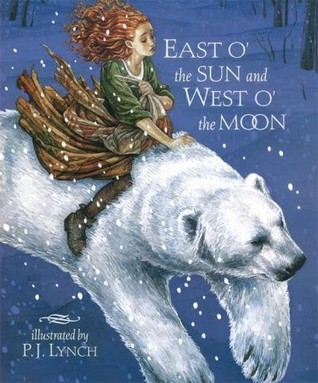
Here's a story related to Cupid and Psyche. It's Norse, and it's called East o' the Sun and West o' the Moon.

A poor man had the prettiest daughter in all the land, but couldn't feed his family. So when a great white bear came to his cottage one day and offered to make him rich if he'd marry that daughter to the bear, the man agreed. The girl didn't want to go, but she had no choice. The bear took her to a castle where all her needs were met as if by magic. And every night a man came in the darkness to her bed and lay with her. Soon the girl missed her family, and the bear agreed to let her go if she agreed not to talk to her mother about what happens in the castle. She said yes, but at home her mother cornered her and got the whole story. The mother convinced her that she was married to a troll, and told her to take a candle to bed with her to find out the truth. The girl did so, but when she saw how handsome her husband really was, she couldn't resist kissing him. Leaning over, three drops of candle wax fell onto the man, and he awoke. Furious, he told her that his step-mother had cursed him to be a bear by day and man by night, and the spell would have been broken if they'd been married a year. But now he had to return home to the troll castle east o' the sun and west o' the moon to be married to a troll-witch with a frightfully long nose. Off he went.

The girl followed, and along the way got help from three old women, who gave her golden trinkets. And the four winds guided her to the troll castle. There, she gives the troll-witch with the long nose her trinkets for three nights with the bear. The bear is sleeping for the first two nights, but we soon learn that the trolls are in the habit of kidnapping Christians and keeping them in the castle. Some of these good folks hear what's going on, and they tell the bear. The bear realizes he's being drugged, and so avoids it on the third night. He and his true bride make a plan: the next day, when he is to be wed to the troll-witch, he will insist that he will only marry the woman who can clean his shirt with the candle wax stains. Apparently, this sort of thing can only be done by a good Christian. So the troll-witch and all her family fail, but the pretty girl succeeds, and the trolls burst from the anger of it all. The bear becomes a man again, and he and the girl are married. They and all the good Christians leave the troll castle behind forever.


I first encountered it in a collection of the same name edited by George Webbe Dasent, based on the collection of Peter Asbjornsen and Jorgen Moe.

This story has been rewritten for kids a lot.

So again, we've got the secret identity, the woman seeking the truth, but this time we've also got the transformation of the bear man. Cupid may have been invisible when he visited Psyche, but he didn't undergo a transformation. Some of the differences are interesting, such as the fact that the bear is cursed by a stepmother, will have to marry a troll, etc. Superman has sometimes been the target in a devious marriage plot, often by trollish women (aliens, if I'm recalling correctly...Maxima?). In this version, the bear prince is saved by the girl, whereas Cupid was never in any danger.

We need more stories where Lois saves Superman.


Pullman invents excellent names for his characters in this series.


You know, until I did an image search for East o' the Sun, I never once made the connection to a certain other popular story about a girl and a bear. The literary resonances are much more Milton than folktale, but it might be interesting to revisit this series with East o' the Sun in mind.


Anyway, East o' the Sun is one of my favorite folk tales. The similarities to Superman are less obvious than we saw in Cupid and Psyche, but they're interesting nonetheless. And I think Frank Quitely's Superman is something of a big bear.


And there's that image of the girl on the bear. It's not explicitly Superman flying with Lois Lane, but I think the same emotions underlie them both.

I love this picture, but can't find any indication who the artist is.
Here's a link to the previous post about Superman and Folktales, and next time...beauty and the beast.

Thursday, September 27, 2012

Beast and Superbeast: Superman and Folktales part 1, Cupid and Psyche


Psyche Revived by Cupid's Kiss, by Antonio Canova

Well, this idea was going to be an academic article. But I realized that it didn't have any sort of argument. All I was saying was that the folk tale closest to the story of Superman is "Beauty and the Beast." That might be an interesting thing to think about for a few minutes, but it's not a terribly tasty academic subject. At least, not so far as I have been able to figure.

So, I'll put my thoughts on it in this blog. But not all at once. I'll begin by summarizing the relevant folk tales. The first one is from a long time ago.

I became interested in this connection when I was reading all the silver age Superman stories in which Lois incessantly tries to prove that Superman is Clark Kent. It reminded me of the ancient Roman novel The Golden Ass, by Apuleius. It's about a guy who does something to get a witch mad at him, so she turns him into a donkey, and he wanders around the Mediterranean trying to find a way to become human again. I like it ok.


Psyche at the throne of Apohrodite, by Edward Hale
In the midst of this story, the donkey man overhears an old woman telling a young woman the story of Cupid and Psyche. The young woman may or may not have been captured by brigands and was going to have to marry one of them or something. I haven't read the book in a long time. Anyway, the Psyche story goes something like this...

Psyche is beautiful, and this angers the goddess Venus because people are paying Psyche the homage due only the goddess of love. She sends her son Cupid to make Psyche fall in love with a hobo or something, but Cupid falls in love with her. Interestingly, he doesn't just take her with him, but for some reason nobody wants to marry the prettiest girl in town. So her family consults an oracle, which tells them that she has to go up to the top of a mountain and marry a monster. Cupid has arranged an enchanted castle where Psyche can come live with her, but she's not allowed to see him. Every night, he visits her in bed, and because she can't see him in the dark she thinks he's a monster. She's allowed to go home to visit her sisters, who aren't exactly nice girls. They convince her that she has to get a look at him, so Psyche sneaks a lamp into bed. After Cupid falls asleep, she lights the lamp and sees his true beauty, but some lamp oil drips onto Cupid and he wakes up. Seeing what has happened, he spreads his white wings and flies away. The castle vanishes, and Psyche, pregnant with Cupid's child, returns to her sisters.  (The sisters, by the way, go to the mountain where the castle was and try to find them, but they fall off the mountain and die.) The story here becomes the tale of Psyche fulfilling tasks set by Venus, who forces her to sort a mound of grains (ants help her), collect wool from various sheep (a river god gives her advice), and journey to the underworld to ask Proserpina for a bit of her beauty (the complication here is that Psyche isn't supposed to look in the box, but she does, is put in a deep sleep, and is rescued by Cupid). Then Cupid petitions Jupiter to interceded on his behalf, and Jupiter convinces Venus to relent. Psyche drinks ambrosia and becomes Cupid's immortal bride.

Psyche opening the Golden Box, by John William Waterhouse
I'm including that summary largely because of two things. First, the god who hides his identity (in this story, by arriving in the darkness) and second, the woman who tries to discover that identity. For lots of images of this story, and a lengthier summary, try here. Cupid's reasons for not revealing his face are fairly clear in Apuleius. He seems to want her to trust him. Cupid says things like, "I would rather you would love me as an equal than adore me as a god." And "Love cannot dwell with suspicion." Here's an online version of the whole story, by the way.

So, has there ever been a clearer precedent for Clark Kent's relationship with Lois Lane than the line "I would rather you love me as an equal than adore me as a god"?

Sure, it doesn't quite line up with the bumbling Kent that so many versions of the story give us, but it's pretty good as a statement of Superman's motivations in maintaining the Kent identity.

The mythological context here also reminds me that the mixture of humanity and divinity usually doesn't go so well for the human in the story. Take Semele, for instance. She was a human in whom Zeus took an interest. Zeus' wife Hera found out about it and, in disguise, persuaded the poor girl to ask Zeus to appear to her as he appeared when he makes love to his wife Hera. Semele got him to swear by the river Styx to grant her one favor, and she asked him to appear in all his heavenly glory, so to speak. Zeus had to do it, because swearing by the Styx is an unbreakable oath for the Olympians. When he revealed his true glory to her, she disintegrated.

Should I just link to Larry Niven's "Man of Steel, Woman of Kleenex" at this point?

Next time...we travel east of the sun, west of the moon. Followed by a visit with the beauty and the beast.


Wednesday, February 10, 2010

Random Stuff

The Elephant in the Room spends a livejournal post talking about things that don't make sense when it comes to Superman. His reasons: (1) He can't die, thus no tension (2) Kryptonite makes no sense (3) The costume is silly (4) He doesn't solve real world problems (5) the disguise as Clark Kent is flimsy at bst. The comments indicate that he's not alone.

There's an essay in The Man from Krypton (ed. Glenn Yeffeth) called "Six Things that Plain Don't Make Sense about Superman," published in 2005. That essay lists (1) The Pathetic Inferiority complex of the Kandorians, (2) The Frightening Destructive Potential of Superbaby (3) The Odd Construction of buildings in Metropolsi (4) The odd favoritism demonstrated by Jimmy Olson's signal watch (5) Street level thugs who honestly believe they stand a chance, and (6) The absence of any real world limitations to superhearing.

In other links, here's the solution to the mystery of Superman and the Cyclops.

This one's pretty interesting. It's about how Superman can be boiled down to the description: A police reporter affects the outcome of the crimes he covers, then writes about them, hiding his involvement. (from the same website: who should write superman)

I've seen the story of Superman boiled down to one theme on several occasions. Josepha Sherman distills it to either the moses story (baby set adrift, found and rasied, becomes hero) or the story of a hero learning his heritage--these both in her book Once Upon a Galaxy.

Then there's the discussion between Tim Callahan and Steven Withrow in Callahan's column When Worlds Collide. They go over superheroes as "archetypes". This bit by Callahan is interesting, in response to Withrow calling Batman "the dark knight detective" as if it sums up his character.

But doesn't Batman represent something more primal? The "dark knight detective" aspect is something that comes out of Batman's pulp roots perhaps, but isn't he more like "the god of problem solving"? And he mostly ends up solving the problems by punching them in the face, no matter how much his intellect, planning, or Bat-computer might help him get to that point.

Superman, in many ways the opposite, doesn't have any problems, except those which he manufactures for himself. He could correct any injustice almost instantly, and even the social problems writers saddled him with for years were mostly the result of his attempt to pretend at humanity. To pretend to have those very problems. Had this mythic character never adopted the guise of an awkward newspaper man, he wouldn't have had to trick Lois Lane all those times. And he wouldn't have had any of those dual-identity struggles. Batman punches problems in the face to become superhuman, while Superman creates problems for himself to become human.

Does that mean that it's not just Superman that was necessary to birth the superhero genre, but the duality between Superman and Batman?

Withrow doesn't agree with that last point: But I still think the Batman archetype is a reaction against the Superman archetype. Not simply because Superman came first, but because I believe the world view that underlies Superman is more fundamental to human nature than the world view underlying Batman. We are born with a yearning for Superman as our ideal and must learn (if we ever do) to accept Batman as our reality.

I'd like to draw the parallel here with a comment I quoted not long ago, made by Josh Walgenbach: Batman is a man trying to be a god. Superman is a god trying to be a man.

In the 1970's, writer Denny O'Neil produced a new take on Superman, one that was significantly less powerful and more connected to humanity. Here's a lengthy overview, with lots of scanned pages, of that run.

That about does it for now.

Tuesday, January 12, 2010

Some links:

Archetypes

Here's an interesting discussion of superheroes as archetypes from comic book resources. It's evidently ongoing, so it's not over. It's part of the column When Worlds Collide. Here's a relevant passage:

Superman, in many ways the opposite, doesn't have any problems, except those which he manufactures for himself. He could correct any injustice almost instantly, and even the social problems writers saddled him with for years were mostly the result of his attempt to pretend at humanity. To pretend to have those very problems. Had this mythic character never adopted the guise of an awkward newspaper man, he wouldn't have had to trick Lois Lane all those times. And he wouldn't have had any of those dual-identity struggles. Batman punches problems in the face to become superhuman, while Superman creates problems for himself to become human.

The discussion suffers from a sketchy definition of the concept of the archetype, which is a sketchy concept in the first place that I don't think really benefits anybody. Also a sketchy grasp of comparative mythology. But still pretty good analysis of Superman and Batman and the Fantastic Four.

Original Graphic Novels

This is something that I might not normall discuss here: a retelling of Superman's origin--and presumably leading into a serialized adventures--in a longer, less frequent format than the monthly comic. I mention it because the discussion surrounding it is interesting. This one, by a Grumpy Old Fan, particularly. It goes into the history of Superman and the changes the character goes through. Fans know of the change and have accepted it as an aspect of Superman. It's perhaps one of the character's defining qualities--his mutability.

Bizarro

Here's the Huffington Post using Bizarro as a way to characterize how Washintong does business. Funny.

This sort of thing is really useful. I wish it were easy to record in conversation, but the easiest way to get it is in popular culture, news, etc. By "this sort of thing" I mean people using phrases, ideas, characters, etc., from Superman in other contexts. Such as the article: "Washington often seems like Superman's Bizarro World where "Us is opposite." They even link to the Wikipedia for Bizarro in case the reader can't figure it out from the context clues. Actually, it feels like the quote should be "Us do opposite." Doesn't it?

This is folk speech, and it shows the extent to which Superman has pervaded public life. We can say "faster than a speeding bullet," "Truth, justice, and the American Way," "Up, up, and away," It's a bird, it's a plane..." " kryptonite, and everybody will have an idea what we're talking about. Or pretty much everybody. Are there other phrases? Bizarro is one of them. Batman's got a few of those, too.

Superman Comes Out of the Phone Booth

This is funny. It's a video.

Literacy

This one's kind of old, but interesting. Comics were used in the army to help troops improve their literacy.

That'll do for now.