|
| Quitely and Grant |
Since I've posted quite a bit about
All-Star Superman in the past, I thought I'd do so again.
Here's a link to a long article about the
ray bradbury reference in the first issue.
The writers at Hooded Utilitarian didn't buy into the general praise of the series, and they offer a series of insightful articles about why.
This first one by Noah Berlatsky discusses how
All-Star feels decadent, a retread of the silver age stories that never quite captures their true feeling. Here's another
he wrote on the same subject.
 |
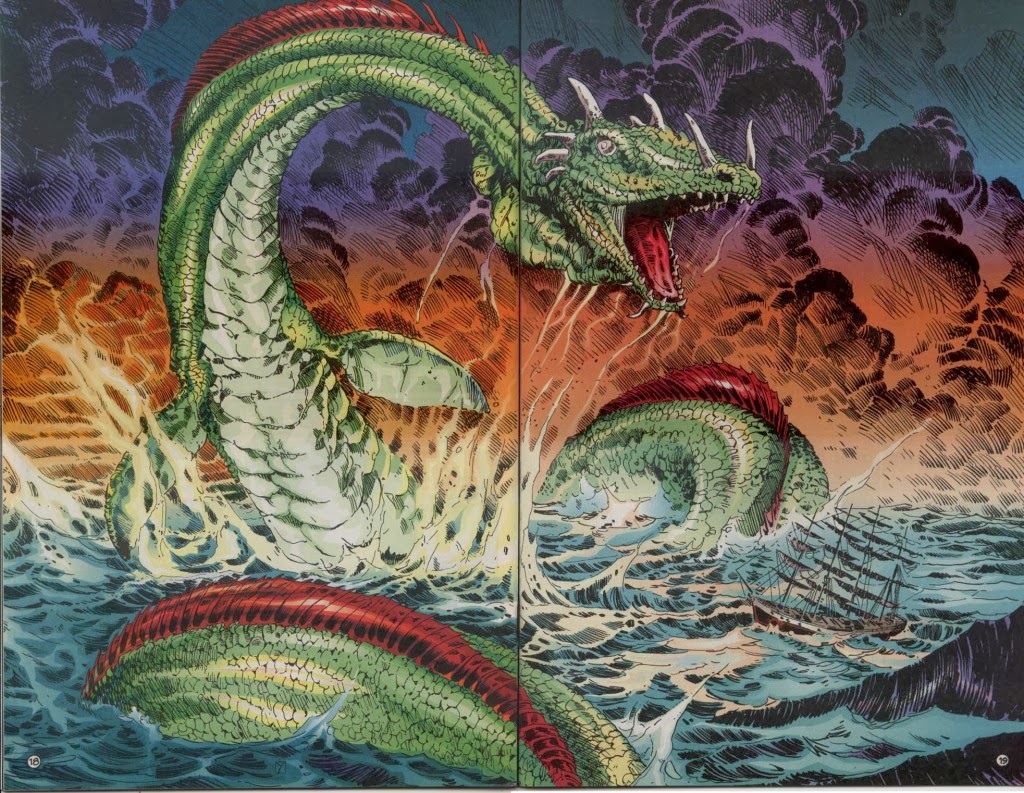
| I borrowed Berlatsky's scan of the sea dragon, art by Marley for the Korean comic Dokebi Bride. Looks amazing. |
This next one by Berlatsky is a comparison of two images, one of Superman and the other of a big dragon.
Here's a follow-up. I wanted to post these stories in part to give an alternate perspective on All-Star Superman, and the art of Frank Quitely. The writer shows the images in part to point out how the superhero image suffers by comparison. There's something worth quoting here:
The point here is that super-hero comics very rarely have a
strong sense of wonder. With all the spectacular feats, you’d think they would—but
somehow they all end up as tricks; they’re fun and goofy, or I guess more recently
bloody, but they don’t actually inspire awe. And I think it’s because of
something Tom said, “Superman keeps the universe our size.” Super-heroes are
there to make things more manageable. Awe—a sense of vastness, of human
insignificance or vulnerability—is antagonistic to everything they stand for.
If Superman saw that dragon, he wouldn’t be scared or impressed—he’d just punch
it in the snout. (As Wonder Woman did in a similar situation..) There’d be big
explosions! There’d be excitement! There’d be action! But there wouldn’t be a
moment where you said, “oh my god,” and felt rooted to one particular spot, and
overwhelmed.
The
point here is that super-hero comics very rarely have a strong sense of
wonder. With all the spectacular feats, you’d think they would — but
somehow they all end up as tricks; they’re fun and goofy, or I guess
more recently bloody, but they don’t actually inspire awe. And I think
it’s because of something Tom said, “Superman keeps the universe our
size.” Super-heroes are there to make things more manageable. Awe — a
sense of vastness, of human insignificance or vulnerability — is
antagonistic to everything they stand for. If Superman saw that dragon,
he wouldn’t be scared or impressed — he’d just punch it in the snout.
(As Wonder Woman did in a similar situation..) There’d be big
explosions! There’d be excitement! There’d be action! But there wouldn’t
be a moment where you said, “oh my god,” and felt rooted to one
particular spot, and overwhelmed. - See more at:
http://www.hoodedutilitarian.com/2009/04/nowhere-man-somewhere-dragon/#sthash.OQBMq6hq.dpuf
The
point here is that super-hero comics very rarely have a strong sense of
wonder. With all the spectacular feats, you’d think they would — but
somehow they all end up as tricks; they’re fun and goofy, or I guess
more recently bloody, but they don’t actually inspire awe. And I think
it’s because of something Tom said, “Superman keeps the universe our
size.” Super-heroes are there to make things more manageable. Awe — a
sense of vastness, of human insignificance or vulnerability — is
antagonistic to everything they stand for. If Superman saw that dragon,
he wouldn’t be scared or impressed — he’d just punch it in the snout.
(As Wonder Woman did in a similar situation..) There’d be big
explosions! There’d be excitement! There’d be action! But there wouldn’t
be a moment where you said, “oh my god,” and felt rooted to one
particular spot, and overwhelmed. - See more at:
http://www.hoodedutilitarian.com/2009/04/nowhere-man-somewhere-dragon/#sthash.OQBMq6hq.dpuf
The
point here is that super-hero comics very rarely have a strong sense of
wonder. With all the spectacular feats, you’d think they would — but
somehow they all end up as tricks; they’re fun and goofy, or I guess
more recently bloody, but they don’t actually inspire awe. And I think
it’s because of something Tom said, “Superman keeps the universe our
size.” Super-heroes are there to make things more manageable. Awe — a
sense of vastness, of human insignificance or vulnerability — is
antagonistic to everything they stand for. If Superman saw that dragon,
he wouldn’t be scared or impressed — he’d just punch it in the snout.
(As Wonder Woman did in a similar situation..) There’d be big
explosions! There’d be excitement! There’d be action! But there wouldn’t
be a moment where you said, “oh my god,” and felt rooted to one
particular spot, and overwhelmed. - See more at:
http://www.hoodedutilitarian.com/2009/04/nowhere-man-somewhere-dragon/#sthash.OQBMq6hq.dpuf
The
point here is that super-hero comics very rarely have a strong sense of
wonder. With all the spectacular feats, you’d think they would — but
somehow they all end up as tricks; they’re fun and goofy, or I guess
more recently bloody, but they don’t actually inspire awe. And I think
it’s because of something Tom said, “Superman keeps the universe our
size.” Super-heroes are there to make things more manageable. Awe — a
sense of vastness, of human insignificance or vulnerability — is
antagonistic to everything they stand for. If Superman saw that dragon,
he wouldn’t be scared or impressed — he’d just punch it in the snout.
(As Wonder Woman did in a similar situation..) There’d be big
explosions! There’d be excitement! There’d be action! But there wouldn’t
be a moment where you said, “oh my god,” and felt rooted to one
particular spot, and overwhelmed. - See more at:
http://www.hoodedutilitarian.com/2009/04/nowhere-man-somewhere-dragon/#sthash.OQBMq6hq.dpuf
It's certainly an interesting perspective on superhero comics. On the same website,
Tom Crippen discusses Superman at length. He warns that it's a idiosyncratic perspective, and everything I've found in my own study of what people do with the character sort of works differently. Crippen wonders about the religious connections, the mythical nature of Superman, and I deal with that a lot (though not exhaustively--I pulled everything about Superman and the hero myth out of my book, though that seems really weird; it may be an article some day, if I can pare it down from the 70 pages it currently takes up). Anyway, here's a key point of Crippen's article:
There’s
my Superman. He’s modernity. It’s what he stands for, and he grows
directly out of it. He’s the odd doodle our collective mind drew when
the second-by-second experience of modern existence, the way modernity
feels, became impossible to ignore. “Super,” the category he embodies,
represents the new dimension added to existence by technological
development. The most extreme transformations in our physical
environment are now produced by means we find unreal and abstract, that
feel like they have nothing to do with us; he’s there to bridge the gap.
He also writes:
When I was reading Superman, I was getting ready for a lifetime of user manuals and tax forms. All right, I'm bitter.
This is all interesting stuff, and worth thinking about. For Crippen, Superman is all about modernity. For both these writers, Superman isn't enough. He doesn't work in a beneficial way. For Berlatsky, there's no inspiration, no sense of wonder. One result of my own research, which involved interviewing people about what they do with Superman, is that I found Superman to be the inspiration these writers don't find. That's an awkward sentence, but the point is that plenty of people work to make the world a better place, modeled on their interpretation of Superman. The scholar Ben Saunders, in his book Do the Gods Wear Capes?, finds in Superman an evolving meditation on the nature of virtue, something that everyone I interviewed also indicated in one way or another. What Superman does is much less important than what we do with Superman in mind.
 |
| Cover by Mike Allred |
Now, I talked to Superman fans, so they are predisposed to find useful things in Superman stories. When Berlatsky discusses the sense of awe, he's really getting at something religious, Rudolph Otto's sense of the numinous. That's not what Superman does. He's secular. I'm not saying that this makes Quitely's image of Superman in the sun any more valuable (in fact, nobody I talked to mentioned this image as being particularly meaningful to them); what I'm saying is that these writers don't find Superman valuable in the way that other people do. And that's fine. Personally, I like reading all the different perspectives, and both Berlatsky and Crippen make some really interesting points. Well worth reading.
While we're on the subject of Morrison's Superman, here are a few articles on his Action Comics run from a little while a go. From
the Mindless Ones.
And more.
And on Morrison.
And while we're on the subject of awe-inducing images of sea monsters, I've always like this one, from the
World's End volume of
Sandman, by penciller Michael Zulli, inker Dick Giordano, and colorist Daniel Vozzo:

 With us, positive knowledge so greatly overflows our
imaginative powers that our imagination, unable to apprehend the world that is
revealed to it, has no other alternative than to run to myth again.
With us, positive knowledge so greatly overflows our
imaginative powers that our imagination, unable to apprehend the world that is
revealed to it, has no other alternative than to run to myth again.


 You know, I like to think that I am general enough and
common enough so that I have some empathetic approach to nearly every human
emotion and feeling and thought. Of course it is only that I like to think
this. It does not make it true but if it were true I would be a better writer
for it. There is one field of feeling, however, in which either I am different
from most people or they do not tell the truth—perhaps not knowing it or not
daring to face it or perhaps feeling that it is a monstrous thing which should
not be brought to light. I don’t know that this is so. I simply offer these as
reasons why people do not seem to feel as I do. I refer to the will to live. I
have very little of it. This must not be confused with a death wish. I have no
will to die but I can remember no time from earliest childhood until this
morning when I would not have preferred never to have existed. No moment of joy
or excitement or sharp experience of pain or sorrow has even made me want to be
alive if the opposite were possible. You see it is no longing for death but a kind
of hunger never to have lived. The few times I have stated this I have been
attacked with everything from straight disbelief to a kind of hatred as though
I were a traitor to life. And perhaps I am.
You know, I like to think that I am general enough and
common enough so that I have some empathetic approach to nearly every human
emotion and feeling and thought. Of course it is only that I like to think
this. It does not make it true but if it were true I would be a better writer
for it. There is one field of feeling, however, in which either I am different
from most people or they do not tell the truth—perhaps not knowing it or not
daring to face it or perhaps feeling that it is a monstrous thing which should
not be brought to light. I don’t know that this is so. I simply offer these as
reasons why people do not seem to feel as I do. I refer to the will to live. I
have very little of it. This must not be confused with a death wish. I have no
will to die but I can remember no time from earliest childhood until this
morning when I would not have preferred never to have existed. No moment of joy
or excitement or sharp experience of pain or sorrow has even made me want to be
alive if the opposite were possible. You see it is no longing for death but a kind
of hunger never to have lived. The few times I have stated this I have been
attacked with everything from straight disbelief to a kind of hatred as though
I were a traitor to life. And perhaps I am.