All-Star
Showing posts with label Lois Lane. Show all posts
Wednesday, April 5, 2017
Lois Lane: Fallout
Anybody read these novels about Lois Lane by Gwenda Bond? I've gotten through the first one, and I liked it quite a bit, despite being about as far from the target market as you can be.
Fallout starts with Lois, sixteen years old, arriving for her first day of school in Metropolis. Since her father's a general, she's moved around a lot up to this point. She feels a lot of pressure in this new situation since she wants to fit in, but she can't help being herself--someone who does her thing regardless of consequences because her thing is what she believes is right. Now that's an awkward sentence, but being sixteen is an awkward time.
Lois gets into trouble almost immediately upon entering her new school. She finds someone who needs help and helps her, thereby putting herself and a few others in all sorts of danger. This book had the odd effect of making me worried about the characters on every page, even when that page lacked impending danger. Sure, the stakes were high in the plot, but that almost wasn't the point. The point, I guess, is that Lois is figuring out how to become the character we all know and love, the kind of woman whom gods would fall in love with.
One of the reasons I picked up this book is because of the Mark Waid/Leinil Yu version in Brithright. See, one of the challenges of Superman is for a writer to convince us that Superman and Lois Lane would fall in love. Perhaps the biggest flaw in All-Star Superman is the way Grant Morrison dodged this question. Why Lois? Well, according to Morrison, Superman just can't help it. Not a lot of substance there. Waid, on the other hand, shows us a Lois whose personality dominates the panel, the page, the whole twelve issue series. Her words and demeanor elicit a "Wow" from Clark Kent the first time he sees her.
Gwenda Bond's Lois Lane is everything you'd want her to be.
Friday, May 6, 2016
Superman and Lois Lane Links
ComicsAlliance has been posting a lot of Superman material lately. There's this appreciation of Superman, and this one of Lois Lane, and most recently this look at the electric phase (which seems to be a series).
Then there's this Vulture article about the occasional conflict between Superman and Batman.
This one's pretty interesting: A virtual tour of the Cleveland Superman sites. It's a Google Earth sort of thing, street view.
Hey, anybody read those new Lois Lane novels? I'm thinking I might check them out. They're by Gwenda Bond.
Speaking of which, there's an edited volume of scholarship about her called Examining Lois Lane. Looks pretty good. I'll have to track down a copy.
It's been 10 years since Superman Returns? Really? Here's Brandon Routh talking about it.
That'll do.
Then there's this Vulture article about the occasional conflict between Superman and Batman.
This one's pretty interesting: A virtual tour of the Cleveland Superman sites. It's a Google Earth sort of thing, street view.
Hey, anybody read those new Lois Lane novels? I'm thinking I might check them out. They're by Gwenda Bond.
Speaking of which, there's an edited volume of scholarship about her called Examining Lois Lane. Looks pretty good. I'll have to track down a copy.
It's been 10 years since Superman Returns? Really? Here's Brandon Routh talking about it.
That'll do.
Tuesday, June 18, 2013
Time to Talk about Man of Steel
Spoilers in pretty much everything below.
Man of Steel is the first movie I've seen on opening weekend in nearly seven years. It is one of maybe half a dozen I've seen in a theater during that time frame. I went in expecting something mediocre, based on my opinion of the talents of the creative team putting this film together. What I got was not mediocre, but something else entirely.
At first, I kind of liked it. I was bothered by the camera work (I abhor the shaking camera when it's used to film mundane activity, such as somebody walking around). But other than that I left feeling like it was a decent film, better than Superman Returns at least. The only thing that really struck me was that it didn't feel like a Superman movie. It was a pretty typical superhero movie smashed together with something resembling science fiction in cinema, but that was about it. All in all, an ok movie, but not for me.
Then I had to figure out why it wasn't for me. And the answer has to do with the end of the film, when Superman kills Zod.
This act points to an evolution of Superman over the course of the film and its prospective sequels: he will eventually realize that he made the wrong choice, and when he's confronted with a similar situation, he'll finally make the right one. It makes the story about The Hero's Journey. And I just don't care about the hero's journey, except in an academic way. And I already wrote my book on Superman. I don't want to have to do more research at this point.
You see, one thing I love about Superman's early years in publication is that the origin was precisely one page long and then pretty much forgotten for a while. You had the slight expansion in the first Superman ongoing series, and in the comic strips, but that's to be expected. Sure, they added a few pages worth of material, but that was it. In the Fleischer animated shorts, in the serials, in Adventures of Superman on radio and TV, the origin takes a few minutes of screen time and then it becomes completely irrelevant to the story. The storytellers are saying, "OK, now you know how he got his powers. Let's move on."
The comics in recent years, and the Smallville tv show and now in Man of Steel, there's an obsession with Krypton and Superman's origin that does not resonate with me. It has everything to do with where I am in life, the fact that I'm not searching for some essence of my identity, that I am comfortable with myself. In other words, I'm not engaged in my own personal hero's journey, so I can't muster a lot of interest in watching somebody else's over and over again--this may also be related to the fact that I have read, watched, and listened to every single one of the retellings of Superman's origin during the past two years. Man of Steel goes out of his way to tell us that Superman is 33 when he dons the cape, and then he still doesn't really know who he is enough to know that it's bad to kill, and there's always a better way. (Don't give me that junk about Zod presenting him with a situation in which there's no other possible solution. He's Superman--there's always another solution.)
In other words, the Superman I want to read about and watch isn't somebody who's groping for his role in the world, trying to reach maturity. This is why Smallville just didn't work for me, and why Man of Steel doesn't. I'd much rather read about a character who is already confident, comfortable in his suit, and ready to face the challenges of his chosen role.
When I was digging deep into the body of stories that comprise Superman, I discovered "The Challenge of Superman." I thought of this as the set of oddities presented by the early years of Action Comics, Superman, and Adventures of Superman that any writers of a new version, starting from scratch, have to reconcile. I thought of the challenge of Superman as the union of his secret identity, his fascination with Lois Lane, his choice to be a reporter, and his unwavering moral code. We might also toss in the source of his powers (were all Kryptonians originally 'super'? or is it the yellow sun or the low gravity or something else), but that seems to be fairly well-set these days and not much of a challenge anymore
I like to think that Jerry Siegel and Joe Shuster left The Challenge of Superman to all those who came after them. They were saying, "Here, deal with these apparently nonsensical parts of the story. Make them make sense and you'll achieve greatness. It's a puzzle with many possible solutions." Ok, they didn't say anything of the kind, but the Challenge of Superman has been taken up by pretty much everybody in the ensuing years. And in solving the challenge of Superman, writers are forced to make statements about career, romance, the relationship of the individual to the group, and what makes us the complex, multifaceted people we are. It's an excellent way to approach storytelling.
There are lots of different ways that writers and editors have solved The Challenge of Superman. I think that I might explore some of these solutions in future blog posts, in large part because I have all these thoughts floating around in my head and they had no place in my book. Today, what I will say is that the creative team who produced Man of Steel didn't seem to give a lot of thought to his interest in Lois Lane or to his choice to be a reporter. They really focused on his secret identity, and seem to have set up a way to explore this moral code in another movie.
You see what they did there? They took a simple comment in Superman #1, in which his adoptive father (not yet Jonathan Kent by name) tells Clark he's got to keep his powers a secret, and they made it the focus of the father-son relationship. Sure, Kevin Costner tells Clark that he's been sent here for some reason, but he doesn't follow it up with anything about how Clark should use his powers to help people.
The core of Superman's morality, since Superman #1, has come from his adoptive parents. That's part of why he has such an appeal in the United States: "Baseball, apple pie, and Superman, that's America," John Hambrick told me. He owns the SuperMuseum in Metropolis, Il. It's a good point. The Kents' agrarian midwestern worldview forms half the argument in Gary Engle's foundational essay, "What's So Darned American about Superman?" from the excellent collection Superman at 50 (the other half is that he's an immigrant, according to Engle). So the only lesson Man of Steel allows the Kents to impart is that Clark has to hide his extraordinary abilities, which leads to a number of secret identities before he settles on Clark Kent again and becomes a reporter.
The thing was, I thought they'd already gotten there. There's that moment when Superman turns himself over the the American military, letting them decide whether or not he should be given to Zod. To me, this was a plain rebuke to J. Michael Straczynski and Superman: Earth 1, which had virtually the same situation with a completely different decision on Superman's part. In Earth 1, when an alien (named Tyrell, not a Kryptonian) shows up looking for the last son of Krypton and demands he be handed over, Superman does absolutely nothing for a long time, while Tyrell wreaks havoc and kills lots of people. Eventually, after an agonizing amount of time and long after Tyrell's grace period has elapsed, he puts on his suit and flies out to fight all by himself.
In Man of Steel, Clark Kent has a moments of indecision, during which he goes to a church to ask a random priest what he should do, then doesn't wait around to get advice and chooses to turn himself over to the military. He's asking them to make the decision for him, but he's really already made a decision. He has rejected Zod by giving himself over to the US. He's really making the choice to trust, which the movie tells us, which is Superman saying that he's not wise enough to make the choice himself. It's a noble thing to do, leading to dialogue; even though Superman distrusts Zod, he's willing to work for a nonviolent solution. So while Straczynski's Superman allows countless deaths through his inaction, the Man of Steel doesn't do so--at least not until the fighting begins. Then he doesn't try to save anybody in particular for a while so he can focus on punching and whatnot.
I hope I'm making my point clear. Man of Steel shows us a moral code produced by experience. Nothing explicitly wrong with that, unless you're writing Superman, who's supposed to don the suit with a firmly embodied sense of altruism that values life in all its manifestations above all else. Because with life comes possibility, the true value of the story of Superman. Death robs us of possibility, whether it be the death of a planet or the death of a villain. With death there can be no rehabilitation. Sure, Zod wanted to die, but then again so did the girl on this page:
![]() |
| All-Star Superman 10, by Morrison, Quitely, and Grant. |
Superman's job is to give us strength, to remind us of the strength we already have, to inspire us. He can't do that by killing people. The greatest crime Man of Steel committed was that it did not even attempt to inspire anybody. The one scene where it approached this, when Superman learns to fly (honestly, I hadn't even noticed that he couldn't fly at this point in the movie) tonally clashes with every other scene. It attempted to show his joy in flight. There's no joy in any other shot in this film, except maybe at the end, when we get the flash back showing us Jonathan and Martha watching a young Clark run around in the back yard with a towel clothespinned to his t-shirt. I was trying to think of movies that had inspired me, had included real joy. I recalled the scene in Metropolis of Superman '78, when Superman is just flying around town, rescuing cats and foiling crooks. That was joy in being Superman.
You know what else: The Incredibles. When Dash is running as fast as he can for the first time, fleeing the bad guys, and discovers that he can run on water (which is basically the same as flying, but that's a discussion for another day). Dash lets out this gleeful laugh, the music kicks it up a notch, and we see him weaving through rock formations, dodging his enemies, and enjoying himself fully for the first time in his life. It makes me want to do that.
I didn't want to do anything that Superman does in Man of Steel. He didn't enjoy having his powers--Jonathan Kent made sure of that.
Friday, September 28, 2012
Beast and SuperBeast: Superman and Folktales part 2, East o' the Sun, West o' the Moon
Here's a story related to Cupid and Psyche. It's Norse, and it's called East o' the Sun and West o' the Moon.
A poor man had the prettiest daughter in all the land, but couldn't feed his family. So when a great white bear came to his cottage one day and offered to make him rich if he'd marry that daughter to the bear, the man agreed. The girl didn't want to go, but she had no choice. The bear took her to a castle where all her needs were met as if by magic. And every night a man came in the darkness to her bed and lay with her. Soon the girl missed her family, and the bear agreed to let her go if she agreed not to talk to her mother about what happens in the castle. She said yes, but at home her mother cornered her and got the whole story. The mother convinced her that she was married to a troll, and told her to take a candle to bed with her to find out the truth. The girl did so, but when she saw how handsome her husband really was, she couldn't resist kissing him. Leaning over, three drops of candle wax fell onto the man, and he awoke. Furious, he told her that his step-mother had cursed him to be a bear by day and man by night, and the spell would have been broken if they'd been married a year. But now he had to return home to the troll castle east o' the sun and west o' the moon to be married to a troll-witch with a frightfully long nose. Off he went.
The girl followed, and along the way got help from three old women, who gave her golden trinkets. And the four winds guided her to the troll castle. There, she gives the troll-witch with the long nose her trinkets for three nights with the bear. The bear is sleeping for the first two nights, but we soon learn that the trolls are in the habit of kidnapping Christians and keeping them in the castle. Some of these good folks hear what's going on, and they tell the bear. The bear realizes he's being drugged, and so avoids it on the third night. He and his true bride make a plan: the next day, when he is to be wed to the troll-witch, he will insist that he will only marry the woman who can clean his shirt with the candle wax stains. Apparently, this sort of thing can only be done by a good Christian. So the troll-witch and all her family fail, but the pretty girl succeeds, and the trolls burst from the anger of it all. The bear becomes a man again, and he and the girl are married. They and all the good Christians leave the troll castle behind forever.
I first encountered it in a collection of the same name edited by George Webbe Dasent, based on the collection of Peter Asbjornsen and Jorgen Moe.
![]() |
| This story has been rewritten for kids a lot. |
So again, we've got the secret identity, the woman seeking the truth, but this time we've also got the transformation of the bear man. Cupid may have been invisible when he visited Psyche, but he didn't undergo a transformation. Some of the differences are interesting, such as the fact that the bear is cursed by a stepmother, will have to marry a troll, etc. Superman has sometimes been the target in a devious marriage plot, often by trollish women (aliens, if I'm recalling correctly...Maxima?). In this version, the bear prince is saved by the girl, whereas Cupid was never in any danger.
We need more stories where Lois saves Superman.
![]() | |||
| Pullman invents excellent names for his characters in this series. |
Anyway, East o' the Sun is one of my favorite folk tales. The similarities to Superman are less obvious than we saw in Cupid and Psyche, but they're interesting nonetheless. And I think Frank Quitely's Superman is something of a big bear.
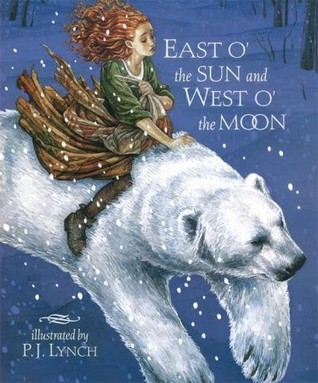
And there's that image of the girl on the bear. It's not explicitly Superman flying with Lois Lane, but I think the same emotions underlie them both.
![]() |
| I love this picture, but can't find any indication who the artist is. |
Here's a link to the previous post about Superman and Folktales, and next time...beauty and the beast.
Tuesday, June 5, 2012
Lois Lane
I think Lois Lane's time has come. If any character could carry a comic book, it's her. Her silver age series only interests me as a historical curiosity. Her persistence in trying to prove that Superman is Clark Kent is a literary dead end. It's only partly because she should be able to figure it out after a couple of days. It's really because it's not terribly interesting as a story. So she figures it out. So what?
I think Lois is a compelling character even without Superman in the story. Sure, the attempts to give her a showcase haven't been all that successful, but they also don't seem all that sincere. Jimmy Olsen should get a series of stories in which he trots across the globe, Indiana Jones style, having supernatural adventures. Lois Lane needs the investigative journalist series. I can't be the first person to think this is a good idea (actually, now that I do a google search for a lois lane series, I see all sorts of fan fiction, a proposal for a series of novels, fan campaigns on mtv geek and newsarama, etc.).
![]() |
| Early drawing of Lois by Joe Shuster. |
The way I see Lois, her life is a series of constant frustrations. She begins in Action #1 complaining that she never gets the good stories. She is eternally thwarted in her hope to expose Superman's secret identity. She eventually becomes the lauded reporter she's always wanted to be, and she gets the guy--only to lose him in the recent reboot.
There's been a lot of talk recently about marriage in superhero comics, but I don't think it's relevant to Lois. On her own or as a wife, I think she could be a great lead character. She doesn't need to take a back seat to a leading man, even when that man is Superman.
When writers are given a chance to work on Superman, they often feel the need to address certain concerns, elements of the Superman mythos that have been there for decades and are maybe less than logical: Where does he get his morality? What is Clark Kent like? Why is Luthor a bad guy? And, interestingly, why does Superman like Lois so much?
![]() |
| Until the end of time. Pretty much literally, too. |
In the last decade, we have had a few different answers to this question. Mark Waid's Birthright shows a Lois who inspired awe in Clark Kent when they first met. She stands up for people, doesn't take crap from anyone, and is a woman strong enough to make Superman say, "Wow."
Grant Morrison's All-Star Superman has Lois herself pose the question, "Why me, Superman?" Simply asked, simply answered: "Well...I guess there has to be one thing I just can't help, Lois."
I like Waid's better. Morrison's seems more like a dodge than anything.
I haven't found a woman's take on this one, outside of, maybe, the first season of Lois and Clark, developed by Deborah Joy Levine. Though I have seen that show recently, I don't really have much to say about it.
I will say that I thought Lois Lane was perhaps the best part of Smallville.
Subscribe to:
Posts (Atom)