I think about Superman: Earth One a lot, primarily because I do not like it at all. But in light of recent Superman stories, maybe I'd be better off rephrasing: These days, Superman isn't for me. Smallville, the various DC comics, Man of Steel--looking at what the stories have in common is instructive, leading me to figure out why I don't particularly care for Superman these days.
What's the biggest difference between George Reeves in Adventures of Superman and Tom Welling in Smallville? What separates Earth One from All-Star? Man of Steel from Superman: The Movie?
The answer could be multi-faceted; we could talk about mood and tone, about narrative sophistication, about musculature, about time frame, etc. But for me, the difference comes down to conflict. George Reeves, Christopher Reeve, Grant Morrison, Richard Donner...all these versions of Superman are confident in their role, they don't have any internal conflict over what they should do. Tom Welling, Henry Cavill, Zach Snyder, and J. Michael Straczynski...they all show us a Superman who hesitates, equivocates, and sometimes just plain doesn't want to be a hero.
I'm not saying that Superman shouldn't be allowed a few moments of doubt, or of weakness. Neither am I saying that there shouldn't be stories about heroes who are reluctant or who flinch in the face of difficult choices.
What I'm saying is that I don't care for Superman in that role. I don't need to see him trying to figure out his morality. I don't need to see him wandering, second-guessing himself or his place.
But that's just me. My Superman was fully formed after a single page of exposition written by Jerry Siegel and drawn by Joe Shuster. Even when they had chances to expand--such as in the Superman ongoing series that debuted soon after, or in the newspaper strips--they didn't depict Superman as hemming and hawing about whether or not he'd be a hero. He just is one.
Apparently, a sizeable chunk of the audience does want to see him trying to figure things out, questioning himself. Evidently there's a market for a Superman who is also Spider-Man. That's fine; it's just not for me.
The interesting thing about this, about the current versions of Superman, is to place him into larger contexts. What can we infer about, say, the mentality of the United States based on the version of Superman that dominates pop culture right now?
For one thing, the United States has a confidence problem. It's no longer sure of its identity. It wants somebody to tell it what to do. Sadly, that somebody seems to be military in nature. This lack of self-confidence and the military nature of our appeal for help probably reflects the origin of the nation in both genocide and civil war. When in doubt, charge into battle. This nation is not missionaries, it is not compromisers, it is not negotiatiors.
A while back, when I was in full research mode, I went through All-Star and counted up the total number of panels devoted to violence. It's something around fifty (though I'm not going to look for that page of notes within the thousands that are weighing down my filing cabinet). It's not a story about fighting. It's about finding other ways to solve problems, through unity and sympathy. Whole issues go by without a single punch thrown.
In short, I don't think the United States has always been this way. It's tied to 9/11, of course, and reflected in the dominant stories of our time (as stories have always reflected their tellers' situations). Stories like Superman/Batman and Civil War seem to be meditations on how the United States should use its power. As far as I can tell, they're literally arguments between people about this topic that turn into violence.
Wait a second. Are these movies really about gun control?
I guess I'd have to watch them to find out. I might just reread All-Star instead.
All-Star

Showing posts with label action comics. Show all posts
Showing posts with label action comics. Show all posts
Tuesday, May 3, 2016


Wednesday, February 5, 2014
Different Perspectives
 |
| Quitely and Grant |
Since I've posted quite a bit about All-Star Superman in the past, I thought I'd do so again.
Here's a link to a long article about the ray bradbury reference in the first issue.
The writers at Hooded Utilitarian didn't buy into the general praise of the series, and they offer a series of insightful articles about why. This first one by Noah Berlatsky discusses how All-Star feels decadent, a retread of the silver age stories that never quite captures their true feeling. Here's another he wrote on the same subject.
 |
| I borrowed Berlatsky's scan of the sea dragon, art by Marley for the Korean comic Dokebi Bride. Looks amazing. |
This next one by Berlatsky is a comparison of two images, one of Superman and the other of a big dragon. Here's a follow-up. I wanted to post these stories in part to give an alternate perspective on All-Star Superman, and the art of Frank Quitely. The writer shows the images in part to point out how the superhero image suffers by comparison. There's something worth quoting here:
The point here is that super-hero comics very rarely have a
strong sense of wonder. With all the spectacular feats, you’d think they would—but
somehow they all end up as tricks; they’re fun and goofy, or I guess more recently
bloody, but they don’t actually inspire awe. And I think it’s because of
something Tom said, “Superman keeps the universe our size.” Super-heroes are
there to make things more manageable. Awe—a sense of vastness, of human
insignificance or vulnerability—is antagonistic to everything they stand for.
If Superman saw that dragon, he wouldn’t be scared or impressed—he’d just punch
it in the snout. (As Wonder Woman did in a similar situation..) There’d be big
explosions! There’d be excitement! There’d be action! But there wouldn’t be a
moment where you said, “oh my god,” and felt rooted to one particular spot, and
overwhelmed.
The
point here is that super-hero comics very rarely have a strong sense of
wonder. With all the spectacular feats, you’d think they would — but
somehow they all end up as tricks; they’re fun and goofy, or I guess
more recently bloody, but they don’t actually inspire awe. And I think
it’s because of something Tom said, “Superman keeps the universe our
size.” Super-heroes are there to make things more manageable. Awe — a
sense of vastness, of human insignificance or vulnerability — is
antagonistic to everything they stand for. If Superman saw that dragon,
he wouldn’t be scared or impressed — he’d just punch it in the snout.
(As Wonder Woman did in a similar situation..) There’d be big
explosions! There’d be excitement! There’d be action! But there wouldn’t
be a moment where you said, “oh my god,” and felt rooted to one
particular spot, and overwhelmed. - See more at:
http://www.hoodedutilitarian.com/2009/04/nowhere-man-somewhere-dragon/#sthash.OQBMq6hq.dpuf
The
point here is that super-hero comics very rarely have a strong sense of
wonder. With all the spectacular feats, you’d think they would — but
somehow they all end up as tricks; they’re fun and goofy, or I guess
more recently bloody, but they don’t actually inspire awe. And I think
it’s because of something Tom said, “Superman keeps the universe our
size.” Super-heroes are there to make things more manageable. Awe — a
sense of vastness, of human insignificance or vulnerability — is
antagonistic to everything they stand for. If Superman saw that dragon,
he wouldn’t be scared or impressed — he’d just punch it in the snout.
(As Wonder Woman did in a similar situation..) There’d be big
explosions! There’d be excitement! There’d be action! But there wouldn’t
be a moment where you said, “oh my god,” and felt rooted to one
particular spot, and overwhelmed. - See more at:
http://www.hoodedutilitarian.com/2009/04/nowhere-man-somewhere-dragon/#sthash.OQBMq6hq.dpuf
It's certainly an interesting perspective on superhero comics. On the same website, Tom Crippen discusses Superman at length. He warns that it's a idiosyncratic perspective, and everything I've found in my own study of what people do with the character sort of works differently. Crippen wonders about the religious connections, the mythical nature of Superman, and I deal with that a lot (though not exhaustively--I pulled everything about Superman and the hero myth out of my book, though that seems really weird; it may be an article some day, if I can pare it down from the 70 pages it currently takes up). Anyway, here's a key point of Crippen's article:
The
point here is that super-hero comics very rarely have a strong sense of
wonder. With all the spectacular feats, you’d think they would — but
somehow they all end up as tricks; they’re fun and goofy, or I guess
more recently bloody, but they don’t actually inspire awe. And I think
it’s because of something Tom said, “Superman keeps the universe our
size.” Super-heroes are there to make things more manageable. Awe — a
sense of vastness, of human insignificance or vulnerability — is
antagonistic to everything they stand for. If Superman saw that dragon,
he wouldn’t be scared or impressed — he’d just punch it in the snout.
(As Wonder Woman did in a similar situation..) There’d be big
explosions! There’d be excitement! There’d be action! But there wouldn’t
be a moment where you said, “oh my god,” and felt rooted to one
particular spot, and overwhelmed. - See more at:
http://www.hoodedutilitarian.com/2009/04/nowhere-man-somewhere-dragon/#sthash.OQBMq6hq.dpuf
The
point here is that super-hero comics very rarely have a strong sense of
wonder. With all the spectacular feats, you’d think they would — but
somehow they all end up as tricks; they’re fun and goofy, or I guess
more recently bloody, but they don’t actually inspire awe. And I think
it’s because of something Tom said, “Superman keeps the universe our
size.” Super-heroes are there to make things more manageable. Awe — a
sense of vastness, of human insignificance or vulnerability — is
antagonistic to everything they stand for. If Superman saw that dragon,
he wouldn’t be scared or impressed — he’d just punch it in the snout.
(As Wonder Woman did in a similar situation..) There’d be big
explosions! There’d be excitement! There’d be action! But there wouldn’t
be a moment where you said, “oh my god,” and felt rooted to one
particular spot, and overwhelmed. - See more at:
http://www.hoodedutilitarian.com/2009/04/nowhere-man-somewhere-dragon/#sthash.OQBMq6hq.dpuf
There’s my Superman. He’s modernity. It’s what he stands for, and he grows directly out of it. He’s the odd doodle our collective mind drew when the second-by-second experience of modern existence, the way modernity feels, became impossible to ignore. “Super,” the category he embodies, represents the new dimension added to existence by technological development. The most extreme transformations in our physical environment are now produced by means we find unreal and abstract, that feel like they have nothing to do with us; he’s there to bridge the gap.
He also writes: When I was reading Superman, I was getting ready for a lifetime of user manuals and tax forms. All right, I'm bitter.
This is all interesting stuff, and worth thinking about. For Crippen, Superman is all about modernity. For both these writers, Superman isn't enough. He doesn't work in a beneficial way. For Berlatsky, there's no inspiration, no sense of wonder. One result of my own research, which involved interviewing people about what they do with Superman, is that I found Superman to be the inspiration these writers don't find. That's an awkward sentence, but the point is that plenty of people work to make the world a better place, modeled on their interpretation of Superman. The scholar Ben Saunders, in his book Do the Gods Wear Capes?, finds in Superman an evolving meditation on the nature of virtue, something that everyone I interviewed also indicated in one way or another. What Superman does is much less important than what we do with Superman in mind.
 |
| Cover by Mike Allred |
Now, I talked to Superman fans, so they are predisposed to find useful things in Superman stories. When Berlatsky discusses the sense of awe, he's really getting at something religious, Rudolph Otto's sense of the numinous. That's not what Superman does. He's secular. I'm not saying that this makes Quitely's image of Superman in the sun any more valuable (in fact, nobody I talked to mentioned this image as being particularly meaningful to them); what I'm saying is that these writers don't find Superman valuable in the way that other people do. And that's fine. Personally, I like reading all the different perspectives, and both Berlatsky and Crippen make some really interesting points. Well worth reading.
While we're on the subject of Morrison's Superman, here are a few articles on his Action Comics run from a little while a go. From the Mindless Ones. And more. And on Morrison.
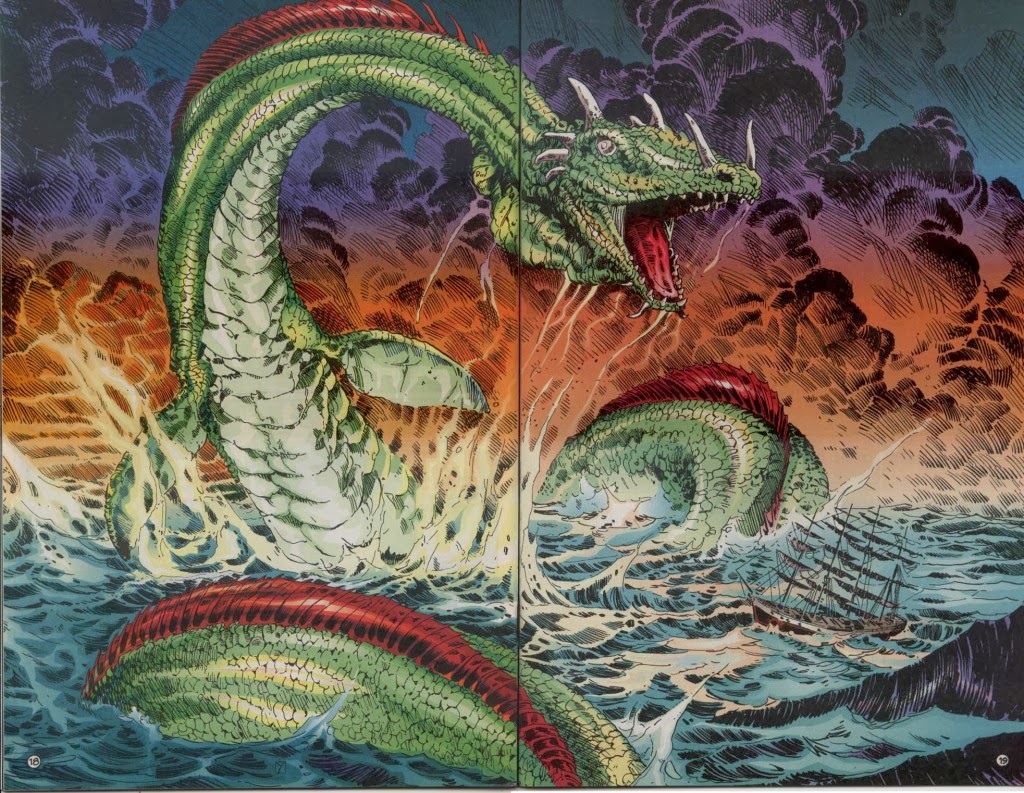
And while we're on the subject of awe-inducing images of sea monsters, I've always like this one, from the World's End volume of Sandman, by penciller Michael Zulli, inker Dick Giordano, and colorist Daniel Vozzo:
Tuesday, January 15, 2013
Man of Steel Trailer
Here's a link to an interesting piece on Robot 6. What's even more interesting is the discussion that follows it. It all kicks off with a quote from J. Michael Straczynski, followed by some commentary from the columnist Michael May, the trailer for Man of Steel. It's all about the idea of what sort of character Superman should be. The comments below it feature some interesting remarks by Straczynski and by Mark Waid. It's also got a link to another article that I'll probably bring up again some day.
The discussion goes in some interesting directions, particularly its focus on the comment in the trailer that Jonathan Kent makes about how 'maybe' Clark shouldn't have saved a bunch of kids from drowning, so he could protect his secret. It's interesting, but I think I'll wait until the movie comes out and I can see the whole scene before I comment on that.
What was especially interesting was the occasional criticism of Straczynski's Earth One stories. The specifics aren't important here. The important part is that Straczynski himself felt it necessary to chime in with a lengthy defense of his stories. My feelings about Earth One aside (it's utter tripe), I think the fact that the writer had to explain what he was trying to do says loads about how well he did it. Meaning he didn't get his point across very well in the story he told.
The discussion made me think of the types of stories being told today, in movies, television, and comic books. We live in an era where fandoms are becoming the dominant audiences courted by media storytellers and executives, in part because fans spend lots of money on things. So there needs to be lots of things for them to spend their money on. The result of this is that stories are told at great length, with the details fleshed out in sometimes excruciating detail. Star Wars is the perfect example of this. What was essentially one paragraph's worth of information in the original movie became more than six hours of film time (not to mention the animated series, novels, comic books, etc). Some people wanted that story told. Not me. Though I was excited to see them, I liked the spark in my imagination, lit by the hints in that one paragraph of information. The Clone Wars in my head are so much more interesting than what the movies revealed them to be.
Anyway, I think that Superman is most compelling as a fully formed hero, not as a hero-in-the-making. Siegel and Shuster got it right in the first place: limit the back story, get right to the adventures in Metropolis. I don't need to see how he came to the decision to be a hero. In fact, I'd say it diminishes him. It makes it contingent on events, tells us that if something had gone just a little bit different when he was 15, or 16, or 18, or 20, he would be a villain, or a different kind of hero. There are plenty of characters whose stories already do that. For Superman, I'd rather have a lot left to my imagination. But that's just me.
The thing is, I know that telling the story of how Superman made the choice to be a hero can be a valuable story. I have interviewed people for whom that story has made a difference in life, has led them to make their own choices, has given them inspiration: an "If Superman could make the right choice, could figure out the best way to live his life, then so can I" sort of thing. I just hope they don't look to Earth One for this inspiration.
The discussion goes in some interesting directions, particularly its focus on the comment in the trailer that Jonathan Kent makes about how 'maybe' Clark shouldn't have saved a bunch of kids from drowning, so he could protect his secret. It's interesting, but I think I'll wait until the movie comes out and I can see the whole scene before I comment on that.
What was especially interesting was the occasional criticism of Straczynski's Earth One stories. The specifics aren't important here. The important part is that Straczynski himself felt it necessary to chime in with a lengthy defense of his stories. My feelings about Earth One aside (it's utter tripe), I think the fact that the writer had to explain what he was trying to do says loads about how well he did it. Meaning he didn't get his point across very well in the story he told.
The discussion made me think of the types of stories being told today, in movies, television, and comic books. We live in an era where fandoms are becoming the dominant audiences courted by media storytellers and executives, in part because fans spend lots of money on things. So there needs to be lots of things for them to spend their money on. The result of this is that stories are told at great length, with the details fleshed out in sometimes excruciating detail. Star Wars is the perfect example of this. What was essentially one paragraph's worth of information in the original movie became more than six hours of film time (not to mention the animated series, novels, comic books, etc). Some people wanted that story told. Not me. Though I was excited to see them, I liked the spark in my imagination, lit by the hints in that one paragraph of information. The Clone Wars in my head are so much more interesting than what the movies revealed them to be.
Anyway, I think that Superman is most compelling as a fully formed hero, not as a hero-in-the-making. Siegel and Shuster got it right in the first place: limit the back story, get right to the adventures in Metropolis. I don't need to see how he came to the decision to be a hero. In fact, I'd say it diminishes him. It makes it contingent on events, tells us that if something had gone just a little bit different when he was 15, or 16, or 18, or 20, he would be a villain, or a different kind of hero. There are plenty of characters whose stories already do that. For Superman, I'd rather have a lot left to my imagination. But that's just me.
The thing is, I know that telling the story of how Superman made the choice to be a hero can be a valuable story. I have interviewed people for whom that story has made a difference in life, has led them to make their own choices, has given them inspiration: an "If Superman could make the right choice, could figure out the best way to live his life, then so can I" sort of thing. I just hope they don't look to Earth One for this inspiration.
Monday, May 2, 2011
controversy
Well, there's a back-up story (The Incident) in this week's Action Comics #900 that's caused a stir. In it, Superman states his intention to renounce his U.S. citizenship so that his international actions may not be construed as American policy. He does so after the Iranian government gets angry because he showed up to nonviolently support some protesters in Tehran. Here are some relevant links.
First, from comic book resources' robot 6. This one's a pretty good summation of the internet reaction.
There's comics alliance, which has a huge discussion in the comments.
Here's an example of the outside (outside of comics fandom, that is), reactionary response.
As for my feeling on the controversy, Douglas Wolk says it pretty well: 'Plenty of stories, from Paul Dini and Alex Ross's Superman: Peace on Earth to the beginning of "Grounded,"have addressed why Superman doesn't simply solve the world's geniune problems. The real answer is that that's not what Superman stories are about. The point of Superman stories is to wildly distort the world as we know it: to provide a huge, fun perspective on alienation, on leading a double life, on the struggle to understand what truth and justice are before one starts fighting for them. And anyone who purports to be offended at "The Incident" should remember that this happens in the same universe where, in 2000, Lex Luthor was elected President of the United States.'
At heart, this is a controversy inherent to the genre. It's one of the things that made a mess of Superman IV: The Quest for Peace. Any time you try to insert real world problems into superhero stories, you run the risk of exposing the genre for what it is: fiction. No genre can stand up to the real world.
The most interesting aspect of the whole thing is the frequent equation of Superman and Obama, which arises from the bafflingly persistent "birther" movement that demands further proof of Obama's US citizenship. People are making lots of jokes about needing to see Superman's birth certificate or something of the kind.
First, from comic book resources' robot 6. This one's a pretty good summation of the internet reaction.
There's comics alliance, which has a huge discussion in the comments.
Here's an example of the outside (outside of comics fandom, that is), reactionary response.
Thus far, I've been unable to find any genuine praise for the element of controversy, aside from the stray comment to news stories or blogs. As a story, regardless of what Superman intends to do, it's really not very good. It's only 9 pages, and lacks a real ending. It's told mostly in flashbacks, and of those 9 pages the entirety of the first is devoted to a guy standing around, checking his watch, and waiting for Superman to arrive. Narrative economy is not on the menu today. It also ends with a pretty lame attempt at demonstrating Superman's inspirational effect on the conflict in Tehran that draws him to Iran in the first place.
As for my feeling on the controversy, Douglas Wolk says it pretty well: 'Plenty of stories, from Paul Dini and Alex Ross's Superman: Peace on Earth to the beginning of "Grounded,"have addressed why Superman doesn't simply solve the world's geniune problems. The real answer is that that's not what Superman stories are about. The point of Superman stories is to wildly distort the world as we know it: to provide a huge, fun perspective on alienation, on leading a double life, on the struggle to understand what truth and justice are before one starts fighting for them. And anyone who purports to be offended at "The Incident" should remember that this happens in the same universe where, in 2000, Lex Luthor was elected President of the United States.'
At heart, this is a controversy inherent to the genre. It's one of the things that made a mess of Superman IV: The Quest for Peace. Any time you try to insert real world problems into superhero stories, you run the risk of exposing the genre for what it is: fiction. No genre can stand up to the real world.
The most interesting aspect of the whole thing is the frequent equation of Superman and Obama, which arises from the bafflingly persistent "birther" movement that demands further proof of Obama's US citizenship. People are making lots of jokes about needing to see Superman's birth certificate or something of the kind.
Wednesday, February 17, 2010
Smallville
As part of this study, I really should watch Smallville more. I watched the last two episodes, but I tend to agree with Chris Sims' assessment: it's not very good. But I liked it in the past. I didn't catch the first few episodes, but somewhere near the beginning I started watching. I sort of kept up with it, if I remembered, for a couple of years. Then, as I recall, it got really really bad. I avoided it like the plague, and then I watched the last two episodes, which did nothing to alter my opinion.
But for this project, I have just watched the first four episodes of Season 1, and I liked them a lot. They blend teen drama, superheroics, weird mystery, monsters (of a sort), and a dash of humor. I suppose that the "monster of the week" plots grew tiresome for the fans eventually, and that the overarching plot of Clark finding out about Krypton, Lex trying to figure out Clark's secret, and the romance took over. But then what happened?
So, now that the show's in its ninth season, Clark is living in Metropolis, working at the Daily Planet, flirting with Lois Lane (who, evidently, has been on the show for five years), has a Neo from the Matrix costume, and fights crime, he still can't fly and isn't called Superman. And I must wonder...why not? Oh, and he doesn't wear glasses.
Certainly I'm not the only one wondering about this.
At the Superman Celebration last summer, I talked to a man named Terry who was there with his grandchildren collecting autographs. He told me that they're all fans of Smallville and that they hunt through the internet to find out all sorts of information. According to Terry, the producers have left the costume decision to Tom Welling, who portrays Clark Kent. I have not found confirmation of this.
Others attribute the lack of the red and blue costume to network interference, because the executives fear that a costumed superman in the television would confuse people when a costumed Superman in a movie theater appears.
It's a curious thing. The show seems to have fallen victim to the same problem that plagues so many shows where the characters are high school students: they have to grow up sometime. For whatever reason, they've kept on with the mission statement--a superman show without superman. Some people are happy with this, some find it unbearable. Enough of both camps still watch it to keep it on the air.
I'm not sure of all the details of the story as it fills out in the subsequent seasons. I know that there's something about Jor-El being sort of a bad guy, and Clark must deal with that. My main interest in this comes because of the origin story. If you consider Superman's origin to be the part of the story from Jor-El placing Kal-El into the rocket to Superman's first public appearance in Metropolis (usually saving Lois Lane), then Smallville still isn't done telling that story. Smallville is the single longest version of Superman's origin out there. Siegel and Shuster's first published version, in Action Comics #1, was precisely one page long. So is Morrison and Quitely's All Star Superman origin. But then, neither of those versions aired on the WB, and needed teen drama to pull in an audience.
But for this project, I have just watched the first four episodes of Season 1, and I liked them a lot. They blend teen drama, superheroics, weird mystery, monsters (of a sort), and a dash of humor. I suppose that the "monster of the week" plots grew tiresome for the fans eventually, and that the overarching plot of Clark finding out about Krypton, Lex trying to figure out Clark's secret, and the romance took over. But then what happened?
So, now that the show's in its ninth season, Clark is living in Metropolis, working at the Daily Planet, flirting with Lois Lane (who, evidently, has been on the show for five years), has a Neo from the Matrix costume, and fights crime, he still can't fly and isn't called Superman. And I must wonder...why not? Oh, and he doesn't wear glasses.
Certainly I'm not the only one wondering about this.
At the Superman Celebration last summer, I talked to a man named Terry who was there with his grandchildren collecting autographs. He told me that they're all fans of Smallville and that they hunt through the internet to find out all sorts of information. According to Terry, the producers have left the costume decision to Tom Welling, who portrays Clark Kent. I have not found confirmation of this.
Others attribute the lack of the red and blue costume to network interference, because the executives fear that a costumed superman in the television would confuse people when a costumed Superman in a movie theater appears.
It's a curious thing. The show seems to have fallen victim to the same problem that plagues so many shows where the characters are high school students: they have to grow up sometime. For whatever reason, they've kept on with the mission statement--a superman show without superman. Some people are happy with this, some find it unbearable. Enough of both camps still watch it to keep it on the air.
I'm not sure of all the details of the story as it fills out in the subsequent seasons. I know that there's something about Jor-El being sort of a bad guy, and Clark must deal with that. My main interest in this comes because of the origin story. If you consider Superman's origin to be the part of the story from Jor-El placing Kal-El into the rocket to Superman's first public appearance in Metropolis (usually saving Lois Lane), then Smallville still isn't done telling that story. Smallville is the single longest version of Superman's origin out there. Siegel and Shuster's first published version, in Action Comics #1, was precisely one page long. So is Morrison and Quitely's All Star Superman origin. But then, neither of those versions aired on the WB, and needed teen drama to pull in an audience.
Monday, April 6, 2009
More Nicknames
Stephen Ireland, who plays soccer for Manchester City FC, is known as Superman.
Glenn Beck calls himself Superman. I don't think it's a nickname is you apply it to yourself. Probably won't stick.
New Zealand Chief's rugby player Dwayne Sweeney became Superman quite recently, if I'm reading the article correctly.
Li Ka-Shing's son, Richard Li, is apparently being called Little Superman, mostly because his father is called Superman. It's all about business acumen.
Here, a high school soccer team is like Superman because they play well when the sun shines.
Then there's Nolan Belcher. I'm beginning to wonder if all of these Supermans are speculative, like this one, or if there's more to it.
Maya Moore plays basketball for UConn, and is called Superman in this article. Evidently, she juggles, too.
This one's all about golf, not specific to any golfer:
The fashion experts can say what they like about the Green Jacket but it has transformative powers, like Superman's cape or a bite from a radioactive spider. Slip one over the shoulders of a golfer and it turns a man into a boy, a jaded professional into a joyful ingénue. The eyes widen, the arm hairs bristle and the spirit soars.
So the cape turns Clark Kent into a boy, a joyful ingenue. Interesting.
I can only describe this as an article confirming that technological progress will either transform us all into Superpeople, or will render Superman unnecessary. Here's a relevant passage:
This is the first of the lessons I have for new smartphone owners: You will drop your phone. You cannot reverse time by flying around the globe. Your phone will be OK. So don't baby it. You bought it to be used, not put in a display case in your living room.
The article itself opens with two paragraphs about the author imagining flying around the globe in reverse--as Superman did in the 1978 movie--so as to reverse time and prevent the accidental fall of a cellphone.
I suppose that the DC Comictitian is going to come up sooner or later. Might as well be now.
Everybody else is linking to this video on YouTube, so I will, too.
And I know that you can see my underwear
And you can joke about it all you want, I really don't care.
Finally. I suppose I should post a picture of Action Comics #1. In the beginning...

Glenn Beck calls himself Superman. I don't think it's a nickname is you apply it to yourself. Probably won't stick.
New Zealand Chief's rugby player Dwayne Sweeney became Superman quite recently, if I'm reading the article correctly.
Li Ka-Shing's son, Richard Li, is apparently being called Little Superman, mostly because his father is called Superman. It's all about business acumen.
Here, a high school soccer team is like Superman because they play well when the sun shines.
Then there's Nolan Belcher. I'm beginning to wonder if all of these Supermans are speculative, like this one, or if there's more to it.
Maya Moore plays basketball for UConn, and is called Superman in this article. Evidently, she juggles, too.
This one's all about golf, not specific to any golfer:
The fashion experts can say what they like about the Green Jacket but it has transformative powers, like Superman's cape or a bite from a radioactive spider. Slip one over the shoulders of a golfer and it turns a man into a boy, a jaded professional into a joyful ingénue. The eyes widen, the arm hairs bristle and the spirit soars.
So the cape turns Clark Kent into a boy, a joyful ingenue. Interesting.
I can only describe this as an article confirming that technological progress will either transform us all into Superpeople, or will render Superman unnecessary. Here's a relevant passage:
This is the first of the lessons I have for new smartphone owners: You will drop your phone. You cannot reverse time by flying around the globe. Your phone will be OK. So don't baby it. You bought it to be used, not put in a display case in your living room.
The article itself opens with two paragraphs about the author imagining flying around the globe in reverse--as Superman did in the 1978 movie--so as to reverse time and prevent the accidental fall of a cellphone.
I suppose that the DC Comictitian is going to come up sooner or later. Might as well be now.
Everybody else is linking to this video on YouTube, so I will, too.
And I know that you can see my underwear
And you can joke about it all you want, I really don't care.
Finally. I suppose I should post a picture of Action Comics #1. In the beginning...
Subscribe to:
Posts (Atom)