All-Star
Monday, January 30, 2017
Holy Heroes by Scott Bayles
Scott Bayles is a pastor in Illinois who is a big Superman fan. I met Scott at the Superman Celebration in Illinois in 2010. We didn't have much time to talk, but we had that thing in common--we were both writing books about Superman. Scott's book came out last spring. It's called Holy Heroes: The Gospel According to DC and Marvel, and it begins with Superman, but goes beyond to examine numerous heroes for their religious resonance. It's got chapters on Wonder Woman, Flash, Hulk, Thor, and others.
Scott's a founding member of Costumers for Christ, which employs superhero costuming in ministry. He's also a key component of my own book; I interviewed him in 2012 and devote half a chapter to him, his family, and his costuming. He blogs about the spiritual aspects of superheroes at Holy Heroes.
Scott has written two other books: The Greatest Commands and Restoring the Restoration Movement.
Wednesday, February 19, 2014
Josh Elder
![]() |
| In stores next week. |
"Dear Superman" is a tremendous story. It's got action and drama, but above all it's a story about the role Superman can play in the lives of individuals. It's not about rescuing people from danger; it's about making life worth living. I actually devote a lot of space in Chapter 3 of my own book (which some day you might even get to read) to this story.
It's also an outstanding example of an economy of storytelling. Josh and artist Victor Ibanez work together to pack an unbelievable amount of material into a very short story. In this age of decompressed comics, it's out of the ordinary to find this sort of storytelling.
Josh created the comic Mail Order Ninja, released by Tokyopop.
![]() |
| Good title. |
He also wrote The Batman Strikes for DC.
![]() |
| He got to write Superman into #44. |
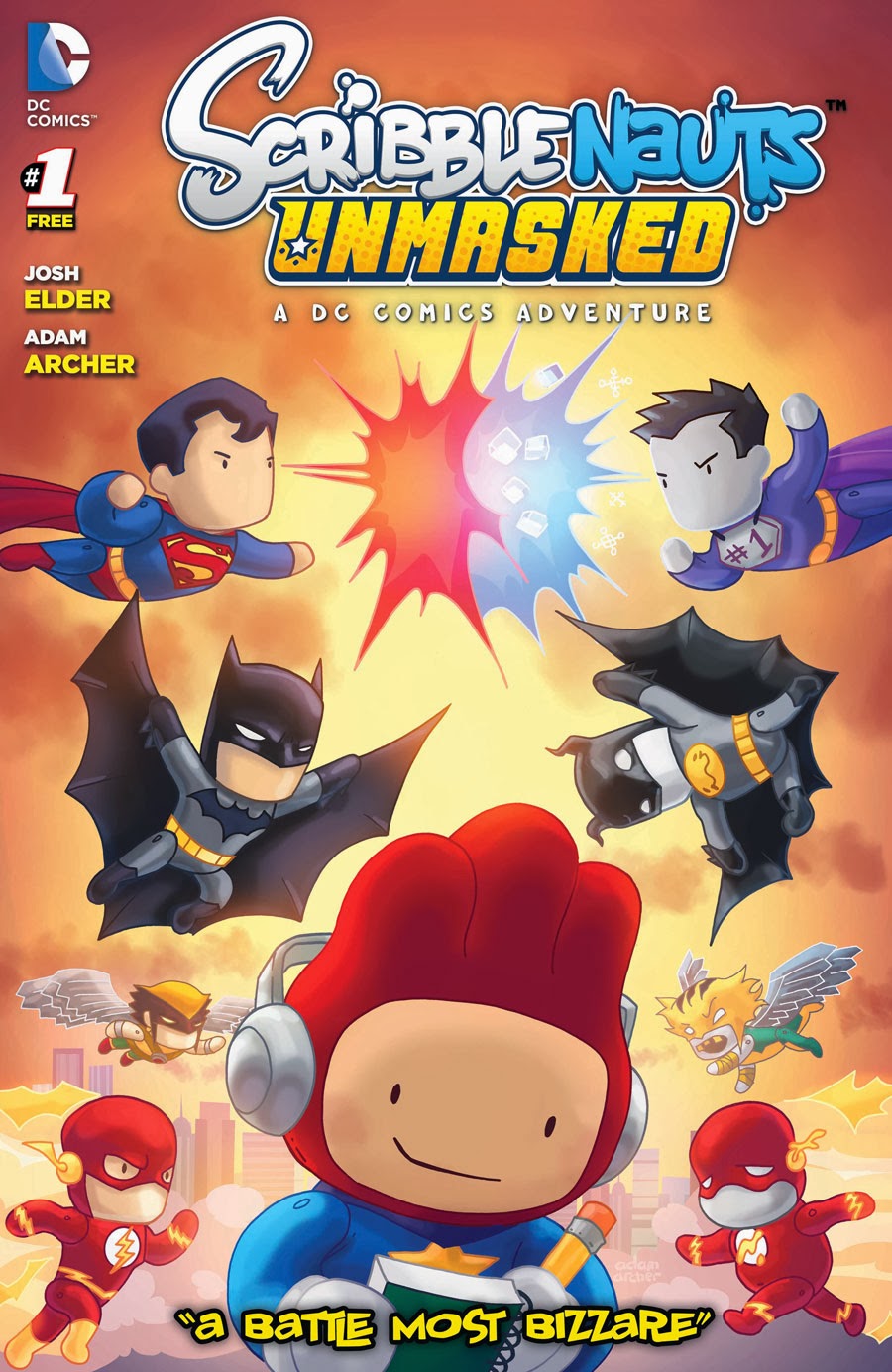
He has also been working on the Scribblenauts Unmasked comic.
![]() |
| My kids love these comics. |
In 2009, Josh started Reading with Pictures, and organization dedicated to promoting the educational value of comic books. Here's their mission statement:
Reading With Pictures is a nonprofit organization that advocates the use of comics in the classroom to promote literacy and improve educational outcomes for all students. We work with academics to cultivate groundbreaking research into the proper role of comics in education. We collaborate with cartoonists to produce exceptional graphic novel content for scholastic use. Most importantly, we partner with educators to develop a system of best practices for integrating comics into their curriculum. At Reading With Pictures, we get comics into schools and get schools into comics.
They're putting out The Graphic Textbook in August of this year.
![]() |
| Is that Abe Lincoln riding a tyrannosaurus? |
As if all that weren't enough for one man, earlier this year Josh traveled to Belarus for the US State Department as Comics Ambassador. Yes, you read that right. Comics ambassador.
So check out his work. He's working to make the world a better place, through comics.
Monday, June 13, 2011
2011 Superman Celebration
Saturday, June 19, 2010
Let's jump ahead to Sunday, with the group picture of the Superfriends of Metropolis.
Another tattoo, this time on the wrist of Kristina Johnson. It's the kryptonian symbol for hope.
People come from far away for this thing. This year, Angie Shelton of the Metropolis Chamber of Commers had the idea of having people put pins in a map to show everybody just how far. Yep, people come from Europe.
Speaking of the opening skit, this year featured the prisoners of the phantom zone released to once again confront Superman. This is a photo taken after the ceremony ended. I have video of the whole thing, but no photographs. Superman is the official Superman of the celebration, but the other Kryptonians are fans.
Tuesday, June 15, 2010
Superman Celebration
So, Brian, thank you. This year, I really got what I needed to get. Except for pictures. Didn't get enough of those.
I've just finished writing up my notes for the weekend. I learned more than I had intended, and see threads that I could possibly follow to new areas of this project, should the need arise. Mostly, this was a series of interviews. They're going to be invaluable for the completion of Superman in Myth and Folklore.
This year, I met a lot of people. That part was easier than last year. I found myself explaining the project more often and more thoroughly than I had expected. My teachers had always told me that you have to do this sort of thing, explain what folklore as a field of study is and whatnot, if you want people to have the kinds of conversations with you that the project requires. This is the first time I've had to do it. But it was worthwhile. People seemed interested and excited about the book. And once I got my points across, they showed me the right way to think about things and look at them.
I went to study a community, and that's exactly what I found. Once I told people this, they would show me things I hadn't noticed, things such as the way in which people help each other, even when they're competing against each other in, say, a costume competition. The point is that people are doing what they want to do in the best way possible, not so much in the winning.
Wednesday, February 17, 2010
Smallville
But for this project, I have just watched the first four episodes of Season 1, and I liked them a lot. They blend teen drama, superheroics, weird mystery, monsters (of a sort), and a dash of humor. I suppose that the "monster of the week" plots grew tiresome for the fans eventually, and that the overarching plot of Clark finding out about Krypton, Lex trying to figure out Clark's secret, and the romance took over. But then what happened?
So, now that the show's in its ninth season, Clark is living in Metropolis, working at the Daily Planet, flirting with Lois Lane (who, evidently, has been on the show for five years), has a Neo from the Matrix costume, and fights crime, he still can't fly and isn't called Superman. And I must wonder...why not? Oh, and he doesn't wear glasses.
Certainly I'm not the only one wondering about this.
At the Superman Celebration last summer, I talked to a man named Terry who was there with his grandchildren collecting autographs. He told me that they're all fans of Smallville and that they hunt through the internet to find out all sorts of information. According to Terry, the producers have left the costume decision to Tom Welling, who portrays Clark Kent. I have not found confirmation of this.
Others attribute the lack of the red and blue costume to network interference, because the executives fear that a costumed superman in the television would confuse people when a costumed Superman in a movie theater appears.
It's a curious thing. The show seems to have fallen victim to the same problem that plagues so many shows where the characters are high school students: they have to grow up sometime. For whatever reason, they've kept on with the mission statement--a superman show without superman. Some people are happy with this, some find it unbearable. Enough of both camps still watch it to keep it on the air.
I'm not sure of all the details of the story as it fills out in the subsequent seasons. I know that there's something about Jor-El being sort of a bad guy, and Clark must deal with that. My main interest in this comes because of the origin story. If you consider Superman's origin to be the part of the story from Jor-El placing Kal-El into the rocket to Superman's first public appearance in Metropolis (usually saving Lois Lane), then Smallville still isn't done telling that story. Smallville is the single longest version of Superman's origin out there. Siegel and Shuster's first published version, in Action Comics #1, was precisely one page long. So is Morrison and Quitely's All Star Superman origin. But then, neither of those versions aired on the WB, and needed teen drama to pull in an audience.
Friday, July 31, 2009
This is a good thing
"We've found out he's not Superman," said Nora Seeley, 54, when asked what she had learned about the president during his first six months on the job. Still, she said, "things are starting to turn around."
It's no surprise that his reputation among Americans is deflating. Nothing else could have happened in the wake of his popularity upon taking office. People may come to realize that there is absolutely nothing that anyone could have done to fix everything in this short a time. I honestly have no idea how he's doing, but I see more and more local businesses hiring, and that's a good thing.
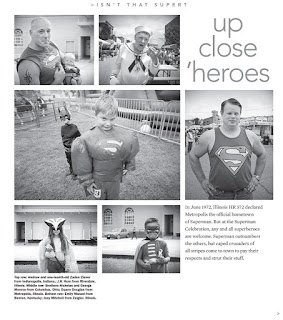
In related news, here are more of Jennifer Silverberg's photos from the Superman Celebration, this time focusing on food. Here's one from the main story, which I should have posted sooner.
Awe and Wonder.
One of the ideas Joseph Campbell is famous for is his four functions of mythology: metaphysical, cosmological, social, and gastronomic. I may have gotten that last one wrong. But why wouldn't mythology help you digest food properly?
Anyway, the metaphysical function, according to campbell, is all about demonstrating to humanity that life is worth living, that creation is a beautiful thing, and all that. Then we get Dave Gibbons, artist who drew Watchmen, most famously, but also a little Superman story called "For the Man who Has Everything." Both written by Alan Moore. In an interview he said,
"Again, my personal view is that they should make it lighter, with that sense of wonder that Superman has always had. Not to make it childish or puerile but to make it something that has a bright sense of adventure and possibility."
He's talking about what a new Superman movie should feel like. He's not the only one. The internets are awash with fans speculating, hoping, decrying, and dismissing a movie that has no script, director, actor, or even basic idea. It's interesting. Part of this is the age we live in, an age of endless discussion not only of what might be and what might have been but what should be, in everyone's own opinion.
While every work has its fanatics and devotees, I wonder if there's something in particular about Superman that makes this speculation appropriate. I won't bother linking to every quotation in which Superman is called a myth, but doesn't that status mean it's different from a lot of other "properties" out there?
It's particularly appropriate to film versions of the character. Film, more than television or comic books, has the ability to instill that sense of awe and wonder. It's bigger than life, and until a couple of decades ago it had to be viewed in something resembling, if not a religious ritual, then at least a public dream. Everyone sitting quietly in a darkened room, slightly leaned back, dazzled by images of things they previously could only imagine. Compare that to sitting at home, phone ringing, neighbors screaming, cars driving by, etc...It's why the rudeness of modern theater goers is such a sad state of affairs.
Where'd that rant come from? I don't even go to the movies more than once a year anymore.
Wednesday, July 29, 2009
Links
Then there's this blog entry, wondering why anyone would want to be Superman, based on a recent viewing of Superman II. The writer, unfamiliar with the many versions of Superman's story, is unfortunately stuck with the "Christ Mission" that the films impose on the character. Other versions have Superman choosing his own fate. I dont' know how that would alter the argument she makes.
In a similar vein, this blog entry wonders about whether or not Superman can get drunk.
Haven't posted anything about Obama lately. Here's someone's reality check: "He's not Superman, right?" I like the "right" at the end. And because the idea is floating around in the ether, here's a cartoon that makes the same point (I would post the image, but for reasons unknown to me it won't work).
A common use of Superman in conversation and writing is to point out to someone "You're not Superman." This is meant to indicate that the person--or persons, or everybody--isn't perfect, can't do everything, and should expect it. In this case, it refers to struggling with alcoholism.
There's this novel, by Rich Cohen:
“David Alroy was the first superhero,” Cohen writes of a false messiah known as “King of the Jews” in 12th-century Persia. “He offered a picture of strength to a people lousy with weakness.” Cohen regards Alroy as a model for the figure created in 1938 — “another dark age for the Jews” — by two Jewish teenagers from Cleveland. “Superman is a writer; Superman is brainy in his glasses; Superman is in exile from an ancient nation destroyed by fire; Superman has two names, a fake WASP-y name (Clark Kent) and a secret name in an ancient tongue, Kal-El; . . . Superman, whose cape is a tallis; Superman, whose logo, the “S” emblazoned on his chest, marks him as a freakish stranger as the yellow Star of David marks the ghetto Jew.”
Finally, this is the first I've heard of the movie "A Man who Was Superman."
Thursday, July 16, 2009
I need to have this link handy
The coverage for this event--entirely done by fans--is amazing. I wasn't able to record this ceremony myself, and would have had a lot of difficulty with something I'm writing if Jamie Kelley and Ronda Marston (aka Clark Kent and Lois Lane) hadn't spent the time getting it and putting it up online. Many many thanks.
Clothes make the man
On Tuesday, he was lying on the sidewalk, which, not surprisingly even in this city, caught the attention of a police officer.
“I am just tired, I am not going anywhere,” prosecutors quoted him as telling the police. “I am Superman, the Governorator, ” he said, according to a law official.
He then ran into the street. Vehicles swerved around him, the complaint said. He “flailed” his arms, refusing to be handcuffed, it said.
And so that was how he landed in Judge Alvin Yearwood’s courtroom, sitting on a hard bench at about 11 a.m. on Wednesday, with a hole in his tights, as prostitution and drunk driving suspects were called up to appear.
“This was the company that Superman was keeping,” said John Marshall Mantel, a freelance photographer for The New York Times who saw him there.
I'm not sure I understand the reason behind referring to the guy as Superman. The "freelance photographer" is only one of the people who do this sort of thing. Because he wears the costume, he is the character. At least that's the logic here. This is a tough subject for me to work through, because there are a lot of facets to it. Lots to account for.
For instance, by putting on a Santa Claus outfit, a person kind of sort of really does become Santa Claus--at least in the eyes of the kids who believe in him. And there is something similar going on with Superman. And with the disney characters. The Superman (Josh Boltinghouse) at the Metropolis Superman Celebration isn't allowed to appear out of Character. He displays his own face (as does Superman--Mark Waid's Superman: Birthright has a great take on why this is necessary; Waid's a guy who really has thought all of this through), and because of his contract, kids who attend the festival will see the same face on Superman for many years.
A guy I interviewed here in Bloomington told me about the day he realized there was no Superman. He told it just like you might imagine a kid relating the story of how he learned there was no Santa Claus. It was the differences from his idealized version and the guy standing in front of him in a truck stop that clued him in. This guy had a wedding ring, a beer gut, and a moustache. None of which the Superman in his imagination possessed.
So what, exactly is going on with comments like the one by the photographer? Why must we conflate the man with the costume? Another example:
Superman and Batman took on New York's Finest last night in an epic Crossroads of the World battle that left the Caped Crusader in cuffs. (from the article linked in my previous post)
The costume is the most important symbolic aspect of Superman. Are these quotations telling us that by appropriating the symbol, we appropriate the identity? Or do they reveal that Superman is only what we make of him? That we control his image with what we do, so we should be careful what we do, especially when dressed as him?
The guy who dresses as Superman in Confessions of a Superhero probably has a lot to say about this. It was kind of appropriate how he as Superman was sort of the leader of all the other people who dress in costume outside the Chinese Theater in LA.
Thursday, June 18, 2009
Celebration
I got lots of good stuff for a book here. If I was ever in doubt that this book will be about something important to people, that doubt was put to rest by this trip. People really make Superman an importatnt part of their lives, and not always for the same reasons. The Superman Celebration crystallizes that into one weekend. For some, it serves the same function that Halloween costuming serves: a chance to put on another face for a day or two, to let loose. I interviewed a pair of brothers, Alex and John Rinaldi, who do not put on costumes but are devoted Superman fans. They said that to dress up like that is to become interesting to others, like becoming a god for a weekend. An interesting observation.
For the town, it's an economic goldmine. They have other things that help this, a casino, a revolutionary war fort (with its own festival and re-enactment), and a harley davidson ralley. But many of them, while not necessarily fans, really get behind Superman and the Celebration. they love the work and the result. They love meeting the people. Karla, one of the chairs of the committee, compared it to a cross between Disneyland and a small town Festival. I'd replace Disneyland with a comic convention, but that might just be because I haven't been to disneyland. But my reason for the convention is the sense of community, which I doubt exists at Disneyland. Do many of the people who run the theme park know the guests by name? Perhaps, but do they incorporate the guests into the opening ceremony, allow them to run a trivia game? My interview with Karla included several moments when attendees would come up to her to chat for a bit. She knew them all by name.
All told, some 40,000 people attended the four day event. There were costume contests, a soft ball game, a car show, and scores of other events. I can't even list them all here, but they spread all over the town. I'm not that adept at fieldwork, having had little practice but a lot of theoretical instruction. I think I may have to go back next year.