I heard Max Landis et al.'s Superman: American Alien was pretty good, so I finally got around to reading it. It came out late last year. Some really good stuff here. When you've got so many artists contributing, the quality will vary, and I liked some issues better than others for precisely that fact. It's a series of essentially stand-alone stories, which I also like. It has its own continuity, but doesn't seem beholden to the DC universe, which I also like.
I don't really have much to say about the stories themselves, though I did notice another example of a recent trend in Superman stories that's worth pointing out: namely, that issues dealing with a young Superman (Superboy?) have to show the tension between Clark and one or both of his parents. In American Alien, this came to the foreground at the end of issue 2 (titled "Hawk"), when Clark and Martha are on the roof talking about Clark's intervention (saving the lives of some folks, mutilating some criminals, getting injured). Clark is worried that his mother sees him as a monster; he's afraid of being rejected. This was also an emotional beat in Geoff Johns and Gary Frank's Superman: Secret Origin. That time it was Clark being worried about his father rejecting him. It's also a more drawn-out theme in early issues of Birthright by Mark Waid and Leinel Francis Yu. This was never part of Jerry and Joe's Superman, to my recollection, nor was it prominent in John Byrne's Man of Steel.
As for movie versions, it's not really present in Superman '78, but it's a big part of Clark's development in Man of Steel.
It fits. Clark's an alien, and in a series whose title foregrounds that quality the tension between an adopted son and his new parents can reflect that otherness. From the examples given above, it's no stretch to say that the relationship between Superman and his adopted parents has become an important aspect of the story. It's key to understanding the current trend in the Superman myth: that Clark Kent is the real identity, and that Superman is an affectation. With the dominance of this interpretation, it's easy to see why the bumbling, mild-mannered Kent has all but vanished (it's worth noting that George Reeves didn't play Kent this way, either; his Kent varied from Superman only in wardrobe).
What conclusions can we draw based on this trend? What does it mean that Superman is not the "real" personality? I think it's a sign that Superman's American-ness is important to people. When Landis's Superman tells Lobo, "I'm from Kansas," (not Krypton) he's embracing a certain patriotism that a lot of people feel is important right now. Kent is American, Kent is human, by choice; Byrne's Superman stories made this an important element of the character, too. At the same time that Superman confirms his American citizenship, Landis shows us that the rest of the world embraces him as well; that fight with Lobo at the end of issue seven is broadcast world-wide.
I don't think there's an intentional response to the story a few years ago in which Superman renounced his American citizenship so that he could be a citizen of the world; this doesn't feel anything like a refutation of that controversial though short and ultimately stand-alone story by David Goyer. But as the international role of the United States, and relationships between countries, change through new administrations and shifting public opinion, it's no surprise that Superman stories would double-down on these themes.
Relationships with parents, with fellow countrymen, with other countries, with aliens...these things are important in Superman stories; they always have been.
All-Star

Showing posts with label origin. Show all posts
Showing posts with label origin. Show all posts
Monday, February 13, 2017


Tuesday, May 3, 2016
Heroism and Superman
I think about Superman: Earth One a lot, primarily because I do not like it at all. But in light of recent Superman stories, maybe I'd be better off rephrasing: These days, Superman isn't for me. Smallville, the various DC comics, Man of Steel--looking at what the stories have in common is instructive, leading me to figure out why I don't particularly care for Superman these days.
What's the biggest difference between George Reeves in Adventures of Superman and Tom Welling in Smallville? What separates Earth One from All-Star? Man of Steel from Superman: The Movie?
The answer could be multi-faceted; we could talk about mood and tone, about narrative sophistication, about musculature, about time frame, etc. But for me, the difference comes down to conflict. George Reeves, Christopher Reeve, Grant Morrison, Richard Donner...all these versions of Superman are confident in their role, they don't have any internal conflict over what they should do. Tom Welling, Henry Cavill, Zach Snyder, and J. Michael Straczynski...they all show us a Superman who hesitates, equivocates, and sometimes just plain doesn't want to be a hero.
I'm not saying that Superman shouldn't be allowed a few moments of doubt, or of weakness. Neither am I saying that there shouldn't be stories about heroes who are reluctant or who flinch in the face of difficult choices.
What I'm saying is that I don't care for Superman in that role. I don't need to see him trying to figure out his morality. I don't need to see him wandering, second-guessing himself or his place.
But that's just me. My Superman was fully formed after a single page of exposition written by Jerry Siegel and drawn by Joe Shuster. Even when they had chances to expand--such as in the Superman ongoing series that debuted soon after, or in the newspaper strips--they didn't depict Superman as hemming and hawing about whether or not he'd be a hero. He just is one.
Apparently, a sizeable chunk of the audience does want to see him trying to figure things out, questioning himself. Evidently there's a market for a Superman who is also Spider-Man. That's fine; it's just not for me.
The interesting thing about this, about the current versions of Superman, is to place him into larger contexts. What can we infer about, say, the mentality of the United States based on the version of Superman that dominates pop culture right now?
For one thing, the United States has a confidence problem. It's no longer sure of its identity. It wants somebody to tell it what to do. Sadly, that somebody seems to be military in nature. This lack of self-confidence and the military nature of our appeal for help probably reflects the origin of the nation in both genocide and civil war. When in doubt, charge into battle. This nation is not missionaries, it is not compromisers, it is not negotiatiors.
A while back, when I was in full research mode, I went through All-Star and counted up the total number of panels devoted to violence. It's something around fifty (though I'm not going to look for that page of notes within the thousands that are weighing down my filing cabinet). It's not a story about fighting. It's about finding other ways to solve problems, through unity and sympathy. Whole issues go by without a single punch thrown.
In short, I don't think the United States has always been this way. It's tied to 9/11, of course, and reflected in the dominant stories of our time (as stories have always reflected their tellers' situations). Stories like Superman/Batman and Civil War seem to be meditations on how the United States should use its power. As far as I can tell, they're literally arguments between people about this topic that turn into violence.
Wait a second. Are these movies really about gun control?
I guess I'd have to watch them to find out. I might just reread All-Star instead.
What's the biggest difference between George Reeves in Adventures of Superman and Tom Welling in Smallville? What separates Earth One from All-Star? Man of Steel from Superman: The Movie?
The answer could be multi-faceted; we could talk about mood and tone, about narrative sophistication, about musculature, about time frame, etc. But for me, the difference comes down to conflict. George Reeves, Christopher Reeve, Grant Morrison, Richard Donner...all these versions of Superman are confident in their role, they don't have any internal conflict over what they should do. Tom Welling, Henry Cavill, Zach Snyder, and J. Michael Straczynski...they all show us a Superman who hesitates, equivocates, and sometimes just plain doesn't want to be a hero.
I'm not saying that Superman shouldn't be allowed a few moments of doubt, or of weakness. Neither am I saying that there shouldn't be stories about heroes who are reluctant or who flinch in the face of difficult choices.
What I'm saying is that I don't care for Superman in that role. I don't need to see him trying to figure out his morality. I don't need to see him wandering, second-guessing himself or his place.
But that's just me. My Superman was fully formed after a single page of exposition written by Jerry Siegel and drawn by Joe Shuster. Even when they had chances to expand--such as in the Superman ongoing series that debuted soon after, or in the newspaper strips--they didn't depict Superman as hemming and hawing about whether or not he'd be a hero. He just is one.
Apparently, a sizeable chunk of the audience does want to see him trying to figure things out, questioning himself. Evidently there's a market for a Superman who is also Spider-Man. That's fine; it's just not for me.
The interesting thing about this, about the current versions of Superman, is to place him into larger contexts. What can we infer about, say, the mentality of the United States based on the version of Superman that dominates pop culture right now?
For one thing, the United States has a confidence problem. It's no longer sure of its identity. It wants somebody to tell it what to do. Sadly, that somebody seems to be military in nature. This lack of self-confidence and the military nature of our appeal for help probably reflects the origin of the nation in both genocide and civil war. When in doubt, charge into battle. This nation is not missionaries, it is not compromisers, it is not negotiatiors.
A while back, when I was in full research mode, I went through All-Star and counted up the total number of panels devoted to violence. It's something around fifty (though I'm not going to look for that page of notes within the thousands that are weighing down my filing cabinet). It's not a story about fighting. It's about finding other ways to solve problems, through unity and sympathy. Whole issues go by without a single punch thrown.
In short, I don't think the United States has always been this way. It's tied to 9/11, of course, and reflected in the dominant stories of our time (as stories have always reflected their tellers' situations). Stories like Superman/Batman and Civil War seem to be meditations on how the United States should use its power. As far as I can tell, they're literally arguments between people about this topic that turn into violence.
Wait a second. Are these movies really about gun control?
I guess I'd have to watch them to find out. I might just reread All-Star instead.
Tuesday, June 18, 2013
Time to Talk about Man of Steel

Spoilers in pretty much everything below.
Man of Steel is the first movie I've seen on opening weekend in nearly seven years. It is one of maybe half a dozen I've seen in a theater during that time frame. I went in expecting something mediocre, based on my opinion of the talents of the creative team putting this film together. What I got was not mediocre, but something else entirely.
At first, I kind of liked it. I was bothered by the camera work (I abhor the shaking camera when it's used to film mundane activity, such as somebody walking around). But other than that I left feeling like it was a decent film, better than Superman Returns at least. The only thing that really struck me was that it didn't feel like a Superman movie. It was a pretty typical superhero movie smashed together with something resembling science fiction in cinema, but that was about it. All in all, an ok movie, but not for me.
Then I had to figure out why it wasn't for me. And the answer has to do with the end of the film, when Superman kills Zod.
This act points to an evolution of Superman over the course of the film and its prospective sequels: he will eventually realize that he made the wrong choice, and when he's confronted with a similar situation, he'll finally make the right one. It makes the story about The Hero's Journey. And I just don't care about the hero's journey, except in an academic way. And I already wrote my book on Superman. I don't want to have to do more research at this point.
You see, one thing I love about Superman's early years in publication is that the origin was precisely one page long and then pretty much forgotten for a while. You had the slight expansion in the first Superman ongoing series, and in the comic strips, but that's to be expected. Sure, they added a few pages worth of material, but that was it. In the Fleischer animated shorts, in the serials, in Adventures of Superman on radio and TV, the origin takes a few minutes of screen time and then it becomes completely irrelevant to the story. The storytellers are saying, "OK, now you know how he got his powers. Let's move on."
The comics in recent years, and the Smallville tv show and now in Man of Steel, there's an obsession with Krypton and Superman's origin that does not resonate with me. It has everything to do with where I am in life, the fact that I'm not searching for some essence of my identity, that I am comfortable with myself. In other words, I'm not engaged in my own personal hero's journey, so I can't muster a lot of interest in watching somebody else's over and over again--this may also be related to the fact that I have read, watched, and listened to every single one of the retellings of Superman's origin during the past two years. Man of Steel goes out of his way to tell us that Superman is 33 when he dons the cape, and then he still doesn't really know who he is enough to know that it's bad to kill, and there's always a better way. (Don't give me that junk about Zod presenting him with a situation in which there's no other possible solution. He's Superman--there's always another solution.)
In other words, the Superman I want to read about and watch isn't somebody who's groping for his role in the world, trying to reach maturity. This is why Smallville just didn't work for me, and why Man of Steel doesn't. I'd much rather read about a character who is already confident, comfortable in his suit, and ready to face the challenges of his chosen role.
When I was digging deep into the body of stories that comprise Superman, I discovered "The Challenge of Superman." I thought of this as the set of oddities presented by the early years of Action Comics, Superman, and Adventures of Superman that any writers of a new version, starting from scratch, have to reconcile. I thought of the challenge of Superman as the union of his secret identity, his fascination with Lois Lane, his choice to be a reporter, and his unwavering moral code. We might also toss in the source of his powers (were all Kryptonians originally 'super'? or is it the yellow sun or the low gravity or something else), but that seems to be fairly well-set these days and not much of a challenge anymore
I like to think that Jerry Siegel and Joe Shuster left The Challenge of Superman to all those who came after them. They were saying, "Here, deal with these apparently nonsensical parts of the story. Make them make sense and you'll achieve greatness. It's a puzzle with many possible solutions." Ok, they didn't say anything of the kind, but the Challenge of Superman has been taken up by pretty much everybody in the ensuing years. And in solving the challenge of Superman, writers are forced to make statements about career, romance, the relationship of the individual to the group, and what makes us the complex, multifaceted people we are. It's an excellent way to approach storytelling.
There are lots of different ways that writers and editors have solved The Challenge of Superman. I think that I might explore some of these solutions in future blog posts, in large part because I have all these thoughts floating around in my head and they had no place in my book. Today, what I will say is that the creative team who produced Man of Steel didn't seem to give a lot of thought to his interest in Lois Lane or to his choice to be a reporter. They really focused on his secret identity, and seem to have set up a way to explore this moral code in another movie.
You see what they did there? They took a simple comment in Superman #1, in which his adoptive father (not yet Jonathan Kent by name) tells Clark he's got to keep his powers a secret, and they made it the focus of the father-son relationship. Sure, Kevin Costner tells Clark that he's been sent here for some reason, but he doesn't follow it up with anything about how Clark should use his powers to help people.
The core of Superman's morality, since Superman #1, has come from his adoptive parents. That's part of why he has such an appeal in the United States: "Baseball, apple pie, and Superman, that's America," John Hambrick told me. He owns the SuperMuseum in Metropolis, Il. It's a good point. The Kents' agrarian midwestern worldview forms half the argument in Gary Engle's foundational essay, "What's So Darned American about Superman?" from the excellent collection Superman at 50 (the other half is that he's an immigrant, according to Engle). So the only lesson Man of Steel allows the Kents to impart is that Clark has to hide his extraordinary abilities, which leads to a number of secret identities before he settles on Clark Kent again and becomes a reporter.
The thing was, I thought they'd already gotten there. There's that moment when Superman turns himself over the the American military, letting them decide whether or not he should be given to Zod. To me, this was a plain rebuke to J. Michael Straczynski and Superman: Earth 1, which had virtually the same situation with a completely different decision on Superman's part. In Earth 1, when an alien (named Tyrell, not a Kryptonian) shows up looking for the last son of Krypton and demands he be handed over, Superman does absolutely nothing for a long time, while Tyrell wreaks havoc and kills lots of people. Eventually, after an agonizing amount of time and long after Tyrell's grace period has elapsed, he puts on his suit and flies out to fight all by himself.
In Man of Steel, Clark Kent has a moments of indecision, during which he goes to a church to ask a random priest what he should do, then doesn't wait around to get advice and chooses to turn himself over to the military. He's asking them to make the decision for him, but he's really already made a decision. He has rejected Zod by giving himself over to the US. He's really making the choice to trust, which the movie tells us, which is Superman saying that he's not wise enough to make the choice himself. It's a noble thing to do, leading to dialogue; even though Superman distrusts Zod, he's willing to work for a nonviolent solution. So while Straczynski's Superman allows countless deaths through his inaction, the Man of Steel doesn't do so--at least not until the fighting begins. Then he doesn't try to save anybody in particular for a while so he can focus on punching and whatnot.
I hope I'm making my point clear. Man of Steel shows us a moral code produced by experience. Nothing explicitly wrong with that, unless you're writing Superman, who's supposed to don the suit with a firmly embodied sense of altruism that values life in all its manifestations above all else. Because with life comes possibility, the true value of the story of Superman. Death robs us of possibility, whether it be the death of a planet or the death of a villain. With death there can be no rehabilitation. Sure, Zod wanted to die, but then again so did the girl on this page:
 |
| All-Star Superman 10, by Morrison, Quitely, and Grant. |
Superman's job is to give us strength, to remind us of the strength we already have, to inspire us. He can't do that by killing people. The greatest crime Man of Steel committed was that it did not even attempt to inspire anybody. The one scene where it approached this, when Superman learns to fly (honestly, I hadn't even noticed that he couldn't fly at this point in the movie) tonally clashes with every other scene. It attempted to show his joy in flight. There's no joy in any other shot in this film, except maybe at the end, when we get the flash back showing us Jonathan and Martha watching a young Clark run around in the back yard with a towel clothespinned to his t-shirt. I was trying to think of movies that had inspired me, had included real joy. I recalled the scene in Metropolis of Superman '78, when Superman is just flying around town, rescuing cats and foiling crooks. That was joy in being Superman.
You know what else: The Incredibles. When Dash is running as fast as he can for the first time, fleeing the bad guys, and discovers that he can run on water (which is basically the same as flying, but that's a discussion for another day). Dash lets out this gleeful laugh, the music kicks it up a notch, and we see him weaving through rock formations, dodging his enemies, and enjoying himself fully for the first time in his life. It makes me want to do that.
I didn't want to do anything that Superman does in Man of Steel. He didn't enjoy having his powers--Jonathan Kent made sure of that.
Tuesday, January 15, 2013
Man of Steel Trailer
Here's a link to an interesting piece on Robot 6. What's even more interesting is the discussion that follows it. It all kicks off with a quote from J. Michael Straczynski, followed by some commentary from the columnist Michael May, the trailer for Man of Steel. It's all about the idea of what sort of character Superman should be. The comments below it feature some interesting remarks by Straczynski and by Mark Waid. It's also got a link to another article that I'll probably bring up again some day.
The discussion goes in some interesting directions, particularly its focus on the comment in the trailer that Jonathan Kent makes about how 'maybe' Clark shouldn't have saved a bunch of kids from drowning, so he could protect his secret. It's interesting, but I think I'll wait until the movie comes out and I can see the whole scene before I comment on that.
What was especially interesting was the occasional criticism of Straczynski's Earth One stories. The specifics aren't important here. The important part is that Straczynski himself felt it necessary to chime in with a lengthy defense of his stories. My feelings about Earth One aside (it's utter tripe), I think the fact that the writer had to explain what he was trying to do says loads about how well he did it. Meaning he didn't get his point across very well in the story he told.
The discussion made me think of the types of stories being told today, in movies, television, and comic books. We live in an era where fandoms are becoming the dominant audiences courted by media storytellers and executives, in part because fans spend lots of money on things. So there needs to be lots of things for them to spend their money on. The result of this is that stories are told at great length, with the details fleshed out in sometimes excruciating detail. Star Wars is the perfect example of this. What was essentially one paragraph's worth of information in the original movie became more than six hours of film time (not to mention the animated series, novels, comic books, etc). Some people wanted that story told. Not me. Though I was excited to see them, I liked the spark in my imagination, lit by the hints in that one paragraph of information. The Clone Wars in my head are so much more interesting than what the movies revealed them to be.
Anyway, I think that Superman is most compelling as a fully formed hero, not as a hero-in-the-making. Siegel and Shuster got it right in the first place: limit the back story, get right to the adventures in Metropolis. I don't need to see how he came to the decision to be a hero. In fact, I'd say it diminishes him. It makes it contingent on events, tells us that if something had gone just a little bit different when he was 15, or 16, or 18, or 20, he would be a villain, or a different kind of hero. There are plenty of characters whose stories already do that. For Superman, I'd rather have a lot left to my imagination. But that's just me.
The thing is, I know that telling the story of how Superman made the choice to be a hero can be a valuable story. I have interviewed people for whom that story has made a difference in life, has led them to make their own choices, has given them inspiration: an "If Superman could make the right choice, could figure out the best way to live his life, then so can I" sort of thing. I just hope they don't look to Earth One for this inspiration.
The discussion goes in some interesting directions, particularly its focus on the comment in the trailer that Jonathan Kent makes about how 'maybe' Clark shouldn't have saved a bunch of kids from drowning, so he could protect his secret. It's interesting, but I think I'll wait until the movie comes out and I can see the whole scene before I comment on that.
What was especially interesting was the occasional criticism of Straczynski's Earth One stories. The specifics aren't important here. The important part is that Straczynski himself felt it necessary to chime in with a lengthy defense of his stories. My feelings about Earth One aside (it's utter tripe), I think the fact that the writer had to explain what he was trying to do says loads about how well he did it. Meaning he didn't get his point across very well in the story he told.
The discussion made me think of the types of stories being told today, in movies, television, and comic books. We live in an era where fandoms are becoming the dominant audiences courted by media storytellers and executives, in part because fans spend lots of money on things. So there needs to be lots of things for them to spend their money on. The result of this is that stories are told at great length, with the details fleshed out in sometimes excruciating detail. Star Wars is the perfect example of this. What was essentially one paragraph's worth of information in the original movie became more than six hours of film time (not to mention the animated series, novels, comic books, etc). Some people wanted that story told. Not me. Though I was excited to see them, I liked the spark in my imagination, lit by the hints in that one paragraph of information. The Clone Wars in my head are so much more interesting than what the movies revealed them to be.
Anyway, I think that Superman is most compelling as a fully formed hero, not as a hero-in-the-making. Siegel and Shuster got it right in the first place: limit the back story, get right to the adventures in Metropolis. I don't need to see how he came to the decision to be a hero. In fact, I'd say it diminishes him. It makes it contingent on events, tells us that if something had gone just a little bit different when he was 15, or 16, or 18, or 20, he would be a villain, or a different kind of hero. There are plenty of characters whose stories already do that. For Superman, I'd rather have a lot left to my imagination. But that's just me.
The thing is, I know that telling the story of how Superman made the choice to be a hero can be a valuable story. I have interviewed people for whom that story has made a difference in life, has led them to make their own choices, has given them inspiration: an "If Superman could make the right choice, could figure out the best way to live his life, then so can I" sort of thing. I just hope they don't look to Earth One for this inspiration.
Tuesday, August 28, 2012
Bill Finger

Marc Tyler Nobleman's new book is now out. He wrote a book about Jerry Siegel and Joe Shuster called Boys of Steel. It's a picture book about the creation of Superman. It's pretty good.
In the same vein, Bill the Boy Wonder is about the creation of Batman. Bill Finger came up with a great many aspects of Batman familiar to everybody today (Robin, Catwoman, the batmobile, and even the design of Batman's costume). But Bob Kane gets all the credit. Nobleman's book is part of a larger endeavor to give Finger the credit he deserves. Nobleman has recently been on NPR and TED talking about this. Those talks are pretty short, and if you're into comics on the internet these days you have probably already learned about Finger's role in the creation of Batman. But they're a good introduction to the topic.
 |
| Art by Al Plastino |

There's an interesting analysis of Finger's impact on Batman and Superman in an essay called "The Dark Knight Origin of the Man of Steel" by Richard Harrison. It's in the Secret Identity Reader, edited by Harrison and Lee Easton.
The story of Bill Finger ties into creator's rights, because he didn't get any. It's a complex story, in the same way that Siegel and Shuster's stories are complex. It was a different time. And learning about it can honor the creator of Batman.
Tuesday, August 21, 2012
Sacrifice
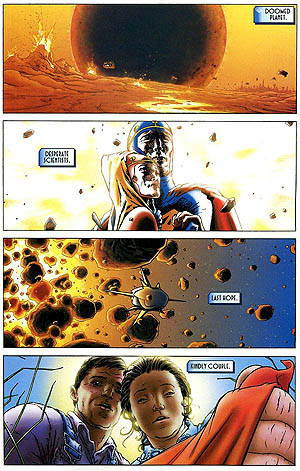
I keep coming across the argument that when Superman's biological parents (usually Jor-El and Lara) put the baby in that rocket ship and sent him to earth, they were committing an act of sacrifice. That somehow, what they did was a sacrifice.
I just don't buy it.
 |
| The first page of Action Comics #1. (Jerry Siegel and Joe Shuster) |
 |
| All-Star Superman #1, (Grant Morrison and Frank Quitely) |
Sometimes, however, they do have a choice. The rocket is occasionally big enough to fit both Lara and little Kal-El (this was as early as 1944). In every case, she chooses to stay with Jor-El. This is not sacrifice. This is being a bad mother. There's no way around it. she's not sacrificing herself so her child can live. She does die because of her own choice, but the child has nothing to do with it. It seems to be a really bad choice, too, since she's leaving the boy to the elements. She could stay with him and take care of him. She doesn't. That's not sacrifice.
 |
| "My place is here with you." From Superman #53 (Bill Finger and Wayne Boring) |
I've also been told that the parents sacrifice their final moments with Superman. I can't even figure this one out. They're giving up their final moments with the baby so the baby can live? That's not sacrifice, that's being a good parent. Again, it's not like they have a choice in the matter of their own life and death. It's not like they're sacrificing themselves for a higher power, to ensure the baby's survival. They're putting the kid in a rocket, hoping he finds some place nice where he won't get eaten the moment the door opens. To keep him would be selfish, and, essentially, not much different from murder. They're taking a big chance; it's a gamble. Would we say that a roulette player is sacrificing some money in order to win more money?
Because of all this, the only thing I can think to make of it all is that people really need the origin to have an element of sacrifice in it. The word as used today has the connotation of nobility and honor, so they need Superman's family to have those qualities. But we don't need to graft ersatz sacrifice onto their actions to obtain this (nor do we need over wrought Christian allegory). Now, there is sacrifice involved in being a parent. It's hard. You give up stuff you want, and stuff you want to do, in order to provide the things that children need. But that's not what Jor-El and Lara did when they put him in the rocket. All they did was take a chance that the kid would survive. They were being good parents.
The idea of sacrifice goes back a long way. It primarily means killing something you need so that the gods will be nice to you. That's not so much what's going on in Superman's origin. But it also denotes giving up something to obtain a greater reward. So they're giving up their son, that's true. But what's their greater reward? They die. We could think that their greater reward is the possibility that their son is going to survive. But that doesn't work because they're giving up the same thing that they're getting as a reward.
That leaves just one more notion of sacrifice. The term itself refers to the act of making something holy (Latin: sacer = holy + facere = to make). By sending Kal-El on his journey through space, to earth, where he becomes Superman, could we say that they are making him holy?
 |
| by Alex Ross |
Monday, May 21, 2012
The story behind the story
From the June 21, 1941, issue of The Saturday Evening Post, we learn that Jerry Siegel once answered his door every to find a group of boys inquiring about Superman. Siegel told them that Superman did live there, but that he was out stopping criminals at that moment. To bolster his claim, he would show the kids one of Superman's spare outfits. He and Joe Shuster "have assumed a solemn obligation to instill faith, whenever possible, in the physical reality of Superman."
Interesting stuff. The article has what has to be one of the earliest printed versions of Siegel's tale of when he came up with the character, on a sleepless and hot summer night:
I am lying in bed counting sheep when all of a sudden it hits me. I conceive a character like Samson, Hercules and all the strong men I ever heard tell of rolled into one. Only more so. I hop right out of bed and write this down, and then go back and think some more for about two hours and get up again and write that down. This goes on all night at two hour intervals, until in the morning I have a complete script.
He then runs to Joe Shuster's house and they work on the character together. In this version, it happened in 1932. I've usually seen the date as 1933. The Steranko History of Comics covers this, too.
 |
| Good stuff. |
There are lots of other versions of this story told these days.There's an illustrated book called Boys of Steel by Mark Tyler Nobleman.
 |
| This seems to be the promotional image for The History of Invulnerability. |
 |
| A thriller that involves secrets about Superman's creator and Cain. Yes, that Cain. |
There's a whole bunch of stuff about it in Brad Meltzer's novel The Book of Lies.
 |
| Where are all those people going? |
Gerard Jones discusses it a bit in Men of Tomorrow. Also, i want to say that it inspired a lot of Michael Chabon's Kavalier and Klay novel.
There's some contention about what drove Jerry Siegel to create Superman, largely because he only talked about that one night in the early 30's and shied away from any self-psychologizing. There are a whole bunch of other discussions of it that I'm omitting here. It's becoming a bigger and bigger part of the Superman story, especially as the publicity of the lawsuit over the rights to the character becomes more and more prominent. It seems likely that, if Warner Brothers could tell the story without making themselves look immoral, they'd probably make a feature film out of it.
On a related note: Google image search turns up some weird stuff, doesn't it?
Friday, July 23, 2010
All right then.
I've got some more links to post.
Recently there was a piece on NPR about Superman.
Then there are parts 6 and 7 of the Fortress of Soliloquy's analysis of Superman's origins. While we're at it, the same blog has some interesting thoughts about Superman 701, the first full issue of the Grounded story where Superman walks across America.
On the same subject, here is a page of links to reviews of Superman 701, courtesy of Comic book resources.
And here's another review. From Living Between Wednesdays.
Moving along, here's a list of the 10 Superman comics you must read.
That'll do.
Recently there was a piece on NPR about Superman.
Then there are parts 6 and 7 of the Fortress of Soliloquy's analysis of Superman's origins. While we're at it, the same blog has some interesting thoughts about Superman 701, the first full issue of the Grounded story where Superman walks across America.
On the same subject, here is a page of links to reviews of Superman 701, courtesy of Comic book resources.
And here's another review. From Living Between Wednesdays.
Moving along, here's a list of the 10 Superman comics you must read.
That'll do.
Wednesday, June 23, 2010
A Big Week
So evidently this is an exciting time to be a Superman fan. There's a lot of hype, anyway, from the comics world. DC's really pushing the fact that Straczynski is writing Superman. Action Comics #700 comes out today. So there's lots of stuff on the web about him right now.
Here's a lengthy and interesting post about his costume and origin.
And a sort of retrospective with lots of visuals.
Then there's The Many Tomorrows of Superman.
Here's a description of Absolute All Star Superman, with a lengthy comment by designer Chip Kidd.
That'll do for now.
Here's a lengthy and interesting post about his costume and origin.
And a sort of retrospective with lots of visuals.
Then there's The Many Tomorrows of Superman.
Here's a description of Absolute All Star Superman, with a lengthy comment by designer Chip Kidd.
That'll do for now.
Wednesday, May 19, 2010
Fashion and the superhero body
Right now, the idea that superheroes as drawn are, essentially, naked is what's taking up most of my time. I'd been working with what to do with this idea for a while, but then Michael Chabon wrote about it nicely in the introductory essay to Superheroes Fashion and Fantasy. It was a museum exhibit and then a book.
Related is this essay, "The Corporatized Child", by Allen Kanner, which is about the way marketers target children and how this is ruining the world. Don't worry, it's related in my head right now, soon to be related on paper and eventually in print. It's all part of a deadline that's looming in my near future.
Since all this is really about Superman's costume, I should take this opportunity to include this link: Showing Superman without Showing Superman. It's about how people put somebody who's obviously Superman on book covers without the specific iconography. Interesting stuff.
Some alternative Superman costumes as well.
And then somebody on the Internets goes and does something so useful for me that it gives me hope for this technology. Tom Foss of The Fortress of Soliloquy is doing a series of blog posts about Superman's origins. He's done five so far. Here's part 1. Part 2. Part 3. Part 4. Part 5. Excellent series, Tom. I hope it continues.
Related is this essay, "The Corporatized Child", by Allen Kanner, which is about the way marketers target children and how this is ruining the world. Don't worry, it's related in my head right now, soon to be related on paper and eventually in print. It's all part of a deadline that's looming in my near future.
Since all this is really about Superman's costume, I should take this opportunity to include this link: Showing Superman without Showing Superman. It's about how people put somebody who's obviously Superman on book covers without the specific iconography. Interesting stuff.
Some alternative Superman costumes as well.
And then somebody on the Internets goes and does something so useful for me that it gives me hope for this technology. Tom Foss of The Fortress of Soliloquy is doing a series of blog posts about Superman's origins. He's done five so far. Here's part 1. Part 2. Part 3. Part 4. Part 5. Excellent series, Tom. I hope it continues.
Monday, March 8, 2010
New Origin
All right. J. Michael Straczinsky is writing a new series of "graphic novel" Superman stories, to be drawn by Shane Davis. It's a retelling of the origin story, which will lead into subsequent "graphic novels" in the future. These are free from the other Superman stories published by DC. I put "graphic novel" in quotes because it's really just a long comic book, on perhaps better quality paper, and probably between hard covers.
Straczynski was interviewed by Newsarama recently. He talks about his love for the character and how excited he is by the job. Here's a section relevant to my own project:
I come from a hardscrabble, difficult and often brutal childhood. I come from the streets, I came from nowhere with nothing, and when as a kid I started to tell people I was going to be a writer someday, the reaction was laughter. ...here was a period when I was about 13 that I literally got beat up every day, because no matter how badly I got beat, I would refuse to give in, so they'd try again the next day....So the idea of someone who could fly away, someone who could be anything he wanted, who couldn't be hurt...all of that had tremendous appeal for me. As a kid, it was pretty much all that sustained me.
That part about being able to fly away sounds sort of like run away from the people beating him up, but that's not how I think he meant it. He connected to the character as an escapist fantasy, as a lot of people do.
Interestingly, his interview draws a lot of ire from people in the comments section. I won't go into it here.
Even more interestingly, a part of the interview where Straczysky discusses altering the destruction of Krypton incites one reader to write a reply called "Leave Krypton Alone, JMS." Here Graeme McMillan discusses the origin and how he thinks it's wrong to make the destruction of Superman's homeworld "a hit job on a planetary scale." He's got his reasons, and he does a good job of explaining how it would affect the character.
The interesting thing to me is that people are invested in the origin story. They consider it on very deep levels, both in terms of the character and in terms of their own lives. It's important. And because it's important, it gets retold a lot, always from a perspective, always for a purpose. Always as somebody new wants it to be retold, which isn't always how the readers want to read it.
Edit: I have to add this link, to Newsarama. Today they posted an essay by Straczynski where he writes about the meaning of Superman, and Wonderwoman, two comics he will soon be writing.
Straczynski was interviewed by Newsarama recently. He talks about his love for the character and how excited he is by the job. Here's a section relevant to my own project:
I come from a hardscrabble, difficult and often brutal childhood. I come from the streets, I came from nowhere with nothing, and when as a kid I started to tell people I was going to be a writer someday, the reaction was laughter. ...here was a period when I was about 13 that I literally got beat up every day, because no matter how badly I got beat, I would refuse to give in, so they'd try again the next day....So the idea of someone who could fly away, someone who could be anything he wanted, who couldn't be hurt...all of that had tremendous appeal for me. As a kid, it was pretty much all that sustained me.
That part about being able to fly away sounds sort of like run away from the people beating him up, but that's not how I think he meant it. He connected to the character as an escapist fantasy, as a lot of people do.
Interestingly, his interview draws a lot of ire from people in the comments section. I won't go into it here.
Even more interestingly, a part of the interview where Straczysky discusses altering the destruction of Krypton incites one reader to write a reply called "Leave Krypton Alone, JMS." Here Graeme McMillan discusses the origin and how he thinks it's wrong to make the destruction of Superman's homeworld "a hit job on a planetary scale." He's got his reasons, and he does a good job of explaining how it would affect the character.
The interesting thing to me is that people are invested in the origin story. They consider it on very deep levels, both in terms of the character and in terms of their own lives. It's important. And because it's important, it gets retold a lot, always from a perspective, always for a purpose. Always as somebody new wants it to be retold, which isn't always how the readers want to read it.
Edit: I have to add this link, to Newsarama. Today they posted an essay by Straczynski where he writes about the meaning of Superman, and Wonderwoman, two comics he will soon be writing.
Wednesday, February 17, 2010
Smallville
As part of this study, I really should watch Smallville more. I watched the last two episodes, but I tend to agree with Chris Sims' assessment: it's not very good. But I liked it in the past. I didn't catch the first few episodes, but somewhere near the beginning I started watching. I sort of kept up with it, if I remembered, for a couple of years. Then, as I recall, it got really really bad. I avoided it like the plague, and then I watched the last two episodes, which did nothing to alter my opinion.
But for this project, I have just watched the first four episodes of Season 1, and I liked them a lot. They blend teen drama, superheroics, weird mystery, monsters (of a sort), and a dash of humor. I suppose that the "monster of the week" plots grew tiresome for the fans eventually, and that the overarching plot of Clark finding out about Krypton, Lex trying to figure out Clark's secret, and the romance took over. But then what happened?
So, now that the show's in its ninth season, Clark is living in Metropolis, working at the Daily Planet, flirting with Lois Lane (who, evidently, has been on the show for five years), has a Neo from the Matrix costume, and fights crime, he still can't fly and isn't called Superman. And I must wonder...why not? Oh, and he doesn't wear glasses.
Certainly I'm not the only one wondering about this.
At the Superman Celebration last summer, I talked to a man named Terry who was there with his grandchildren collecting autographs. He told me that they're all fans of Smallville and that they hunt through the internet to find out all sorts of information. According to Terry, the producers have left the costume decision to Tom Welling, who portrays Clark Kent. I have not found confirmation of this.
Others attribute the lack of the red and blue costume to network interference, because the executives fear that a costumed superman in the television would confuse people when a costumed Superman in a movie theater appears.
It's a curious thing. The show seems to have fallen victim to the same problem that plagues so many shows where the characters are high school students: they have to grow up sometime. For whatever reason, they've kept on with the mission statement--a superman show without superman. Some people are happy with this, some find it unbearable. Enough of both camps still watch it to keep it on the air.
I'm not sure of all the details of the story as it fills out in the subsequent seasons. I know that there's something about Jor-El being sort of a bad guy, and Clark must deal with that. My main interest in this comes because of the origin story. If you consider Superman's origin to be the part of the story from Jor-El placing Kal-El into the rocket to Superman's first public appearance in Metropolis (usually saving Lois Lane), then Smallville still isn't done telling that story. Smallville is the single longest version of Superman's origin out there. Siegel and Shuster's first published version, in Action Comics #1, was precisely one page long. So is Morrison and Quitely's All Star Superman origin. But then, neither of those versions aired on the WB, and needed teen drama to pull in an audience.
But for this project, I have just watched the first four episodes of Season 1, and I liked them a lot. They blend teen drama, superheroics, weird mystery, monsters (of a sort), and a dash of humor. I suppose that the "monster of the week" plots grew tiresome for the fans eventually, and that the overarching plot of Clark finding out about Krypton, Lex trying to figure out Clark's secret, and the romance took over. But then what happened?
So, now that the show's in its ninth season, Clark is living in Metropolis, working at the Daily Planet, flirting with Lois Lane (who, evidently, has been on the show for five years), has a Neo from the Matrix costume, and fights crime, he still can't fly and isn't called Superman. And I must wonder...why not? Oh, and he doesn't wear glasses.
Certainly I'm not the only one wondering about this.
At the Superman Celebration last summer, I talked to a man named Terry who was there with his grandchildren collecting autographs. He told me that they're all fans of Smallville and that they hunt through the internet to find out all sorts of information. According to Terry, the producers have left the costume decision to Tom Welling, who portrays Clark Kent. I have not found confirmation of this.
Others attribute the lack of the red and blue costume to network interference, because the executives fear that a costumed superman in the television would confuse people when a costumed Superman in a movie theater appears.
It's a curious thing. The show seems to have fallen victim to the same problem that plagues so many shows where the characters are high school students: they have to grow up sometime. For whatever reason, they've kept on with the mission statement--a superman show without superman. Some people are happy with this, some find it unbearable. Enough of both camps still watch it to keep it on the air.
I'm not sure of all the details of the story as it fills out in the subsequent seasons. I know that there's something about Jor-El being sort of a bad guy, and Clark must deal with that. My main interest in this comes because of the origin story. If you consider Superman's origin to be the part of the story from Jor-El placing Kal-El into the rocket to Superman's first public appearance in Metropolis (usually saving Lois Lane), then Smallville still isn't done telling that story. Smallville is the single longest version of Superman's origin out there. Siegel and Shuster's first published version, in Action Comics #1, was precisely one page long. So is Morrison and Quitely's All Star Superman origin. But then, neither of those versions aired on the WB, and needed teen drama to pull in an audience.
Sunday, February 7, 2010
Another Origin

I need to keep this issue in mind. It's time to assemble all the versions of Superman's Origin. This one is Superman 53, from 1948. The site is a review, with a summary and some comparisons to the contemporary continuity. More to come.
Tuesday, November 3, 2009
Another Origin
In the early 70's, there was yet another retelling of the origin. This one by Carmine Infantino and Curt Swan...The Bronze Age of Blogs kindly posts the whole thing.
Thursday, October 15, 2009
More about the Secret Origin
Just a couple of links. The first is to the Superman Homepage, which has reviews of pretty much every Superman comic for the last ten years (and more). In this one, there are a bunch of review for Secret Origin 1.
Then there's a discussion of the same series over at Blue Tights Network. Mixed reviews, but most people seem excited about the series.
So why, you may wonder, so many links to reviews of this particular comic book? I'm interested because this project is mostly about Superman as a myth. Myths, unlike much of literature, usually don't have an established, authoritative text. Even the Bible (in English) has lots of versions, each with agendas that influence the translation. And, for example, the four books of the gospels actually contradict each other every so often. Greek myth is harder to pin down, since there's no text. You've got Hesiod and Homer, but those present problems. Later writers were just writing down what they'd heard, or paraphrasing other writers. And these often contradict each other as well. It gets even more compex with a living mythological tradition. So what happens is that everybody has to decide for themselves what's canon and what's not. The church may try, but with all of the different sects out there, there's something for everybody. And you can always try the church down the road if you don't agree with the interpretation being offered in yours.
With Superman, there's the added element of continuity. He's been constantly in publication since 1938, with stories in every medium. And writers try to make the story interesting in every medium, so they add or eliminate elements. Then there's editorial fiat, or stories introduced to boost sagging sales or garner higher ratings. And every so often, something like Crisis on Infinite Earths or Infinite Crisis happens, so the entire history of the character is wiped away, to be written anew. Then, there are things such as Imaginary Stories, which aren't real.
Right.
What we've got are competing versions of a story. The reviews and discussions are largely about how well the latest version works, which means that the readers evaluate it in terms of the expectations of the myth of Superman. Each person has a preconception of that story, which by virtue of their own identity, will emphasize, highlight, obscure, or outright eliminate motifs of the story as they see fit. Sometimes this isn't even conscious. Some people will imagine a Superman who is absolutely perfect, in morality, in physique, in action and in intent. Others will humanize Superman, giving him physical flaws or moral grey areas.
This includes the writers and editors. One of the Superman homepage reviewers postulates that the writers of comics today are particularly interested in the comics of their youth, so much so that they will force the comics they are working on to fit into the same mold, whether or not the story is progressing that way. They will alter characterization, add in nonsensical plot elements, etc, just so the comic feels like the comics of their youth. I don't know the extent to which this is true of Secret Origins, if it is at all, but I have certainly read comics that feel that way.
Nonetheless, readers are free to pick their version. There's a continuity to DC comics that runs throughout a great many titles. but there are elseworlds. There are Superman Adventures (well, not right now, but there used to be) that were outside the continuity driven titles. There's smallville, and cartoons, and other stories. Superman's also kind of like the weather. If you don't like it, wait a while. It'll change. Not much, of course, but it'll change. The last time it changed was Birthright, by Mark Waid and Leinil Francis Yu. That was way back in 2004.
This variability is one quality that makes a story mythic. I'm not talking about the variability of a single film adaptation of a movie, or even two or three. I'm talking about the fact that there is no fixed text. People can point to an official Moby Dick or Lord of the Rings. They can't point to an official Superman. Would it be this current Secret Origin? Yeah, if you read the comics and adhere to the continuity. For the next five years or so, until they do it all over again because of a universe-shattering battle. But it's not THE Superman if you're only a fan of Smallville, or of George Reeves, or Christopher Reeve, or the Silver Age, or don't read the movies or watch the shows or read the comics but still know about Superman because everybody does. (Seriously, everybody does. Even people with no real access to American media.)
The point of all this is that there is no fixed text. There is no fixed Superman. The nature of the character's existence is to reflect the world because it's a constant product of that world. Sometimes we're awash in nostalgia. Sometimes we need our heroes to be vulnerable. Sometimes we need them to be perfect. And sometimes we need them to have a mullet.

Wednesday, October 14, 2009
Too Perfect
The notion that Superman is just too good to be interesting is one that pops up quite often. Here's one statement, from Miss Cellania:
While Superman is, well, super, he was always too perfect, and rather one-dimensional.
There's Henry Jenkins, from a while ago.
And, because we're still trying to figure out how to make Supermen...Science!
Another review of Secret Origin 1, by Rokk. The discussion is interesing, particularly for this line:
it isn't like DC's continuity or present-day comics for that matter warrant religious following; you pick and choose what you like, sadly
This list is an intersesting one. Not so much for the content--it's really just a list of Superman comics that the writer likes. It's how it's framed that I find worth noting. 10 Essential Superman comics to help you forget Smalliville. As with any sacred narrative worth caring about, there has to be dissention among the ranks. I think this is worth exploring.
I'm going to have to find this one. What if Superman were raised by apes?
I have to post this. In Italy, a Man Dressed like Superman is arrested for stalking Burlesconi.
While Superman is, well, super, he was always too perfect, and rather one-dimensional.
There's Henry Jenkins, from a while ago.
And, because we're still trying to figure out how to make Supermen...Science!
Another review of Secret Origin 1, by Rokk. The discussion is interesing, particularly for this line:
it isn't like DC's continuity or present-day comics for that matter warrant religious following; you pick and choose what you like, sadly
This list is an intersesting one. Not so much for the content--it's really just a list of Superman comics that the writer likes. It's how it's framed that I find worth noting. 10 Essential Superman comics to help you forget Smalliville. As with any sacred narrative worth caring about, there has to be dissention among the ranks. I think this is worth exploring.
I'm going to have to find this one. What if Superman were raised by apes?
I have to post this. In Italy, a Man Dressed like Superman is arrested for stalking Burlesconi.
Friday, October 9, 2009
Links, and a new origin
Recently, DC began publishing a new origin for Superman, called Superman: Secret Origin. A bunch of people have stuff to say about this.
Here's a good one, by Rikdad. It begins thus:
The artist takes a pencil and traces an oval where the face will be. Rather than touching the pencil to the paper and drawing it in one solid curve, the oval is composed of many shorter arcs, parallel, intersecting, concentric. Each one nudges the outline from where the previous faint lines had begun, adjusting them, repositioning the curve, correcting it. The pencil is flipped and the eraser rubs some graphite off the page; a sleeve wipes the rubber and dust away, and then the pencil goes back to work. At some point, a mannequin-like shape is there, and then a face is drawn inside, outside, and over it, without ever erasing the original imperfect outline. Eventually it will have life. Eventually it will be a face. Little strokes keep touching it up, making it better, or at least different.
Superman is a work in progress.
Which is good. An apt analogy for the process by which Superman has survived. But it concludes in an even better fashion:
Superman is the Great American Hero, and America is a country that was saved by a quirky Constitutional fiat called the Great Compromise. If Superman was being torn apart in a creative tug of war, Geoff Johns has refused to pick sides. He's come down hard on the side of not favoring sides. Ultimately, the kind of tail fins the rocket has don't matter so much as the adoption of a version of Superman that reminds a plurality of fans of Superman. What could be more pleasing to Superman than to have everybody win?
Good stuff.
I'm planning a thorough analysis of Grant Morrison's All Star Superman series. Here's someone who likes it a whole lot.
Here's some more about Secret Origin.
And more still, from Newsarama.
One more time, from Comic Book Jones.
The consensus about this Secret Origin seems to be that it's completely unnecessary, but that it's pretty good.
Completely unrelated, but still useful: the kids parade in Grand Island.

Which reminds me...Halloween's coming up. There will no doubt be kids dressed up like Superman. Time to do more fieldwork.
There's something more to be said about the "science" behind Superman's powers.
Subscribe to:
Posts (Atom)