All-Star

All-Star

Friday, July 31, 2009

This is a good thing

I keep finding more and more news stories with passages about Obama such as this one:

"We've found out he's not Superman," said Nora Seeley, 54, when asked what she had learned about the president during his first six months on the job. Still, she said, "things are starting to turn around."

It's no surprise that his reputation among Americans is deflating. Nothing else could have happened in the wake of his popularity upon taking office. People may come to realize that there is absolutely nothing that anyone could have done to fix everything in this short a time. I honestly have no idea how he's doing, but I see more and more local businesses hiring, and that's a good thing.

In related news, here are more of Jennifer Silverberg's photos from the Superman Celebration, this time focusing on food. Here's one from the main story, which I should have posted sooner.


Awe and Wonder.

One of the ideas Joseph Campbell is famous for is his four functions of mythology: metaphysical, cosmological, social, and gastronomic. I may have gotten that last one wrong. But why wouldn't mythology help you digest food properly?

Anyway, the metaphysical function, according to campbell, is all about demonstrating to humanity that life is worth living, that creation is a beautiful thing, and all that. Then we get Dave Gibbons, artist who drew Watchmen, most famously, but also a little Superman story called "For the Man who Has Everything." Both written by Alan Moore. In an interview he said,

"Again, my personal view is that they should make it lighter, with that sense of wonder that Superman has always had. Not to make it childish or puerile but to make it something that has a bright sense of adventure and possibility."

He's talking about what a new Superman movie should feel like. He's not the only one. The internets are awash with fans speculating, hoping, decrying, and dismissing a movie that has no script, director, actor, or even basic idea. It's interesting. Part of this is the age we live in, an age of endless discussion not only of what might be and what might have been but what should be, in everyone's own opinion.

While every work has its fanatics and devotees, I wonder if there's something in particular about Superman that makes this speculation appropriate. I won't bother linking to every quotation in which Superman is called a myth, but doesn't that status mean it's different from a lot of other "properties" out there?

It's particularly appropriate to film versions of the character. Film, more than television or comic books, has the ability to instill that sense of awe and wonder. It's bigger than life, and until a couple of decades ago it had to be viewed in something resembling, if not a religious ritual, then at least a public dream. Everyone sitting quietly in a darkened room, slightly leaned back, dazzled by images of things they previously could only imagine. Compare that to sitting at home, phone ringing, neighbors screaming, cars driving by, etc...It's why the rudeness of modern theater goers is such a sad state of affairs.

Where'd that rant come from? I don't even go to the movies more than once a year anymore.

Thursday, July 30, 2009

Bursting into the imaginary world

There's a trend in people's writing and discussion of Superman, a trend toward imagining what a Superman would be like if he existed in the real world. We saw this in the previous post, where a couple of people imagined what Superman would be like drunk (if indeed he could get drunk) and how the character's politics and morality just wouldn't work. This goes back at least as far as Larry Niven's 1971 essay "Man of Steel, Woman of Kleenex" which delves into the problems of Superman's sexual relationship, should one ever develop, with Lois Lane. Since then, countless writers have engaged in this sort of mental exercise, treating everything from the sensibility and psychological function of the secret-identity to what he would do in his free time. Sometimes, this sort of thing makes its way into comics or television shows (and not just ones featuring Superman--go watch Mallrats for Kevin Smith's contemplation of super hero realities).

There's a sort of opposite number to this mental exercise, in which people imagine what aspects of the real world would be like in Superman's world. Famous examples would be meditations on what Superman would do if actually around for World War II, or 9/11. The example below comes from a galler at Superman.nu. The entire page linked to features fan art of Superman that reacts to the 9/11 attacks. This one was created by Ted Hernandez.


A corrolary of this is perhaps the imaginary casting of a Superman movie. Here's an example that reacts very specficially to the 2006 Superman Returns casting. It's one of those things that people do from time to time, but I've seen a lot of them recently. It may have to do with all the recent reporting on the legal battle over the rights to the character that has gone on between DC/TimeWarner and the Siegel family. It has prompted many rumors about when and if a new movie will go into production.

Wednesday, July 29, 2009

Links

First up, Jennifer Silverberg created a sort of photo essay about the Metropolis, Ill., Superman Celebration. You can check out the published work here, here, or some other photos on her website. Thanks, Jennifer!

Then there's this blog entry, wondering why anyone would want to be Superman, based on a recent viewing of Superman II. The writer, unfamiliar with the many versions of Superman's story, is unfortunately stuck with the "Christ Mission" that the films impose on the character. Other versions have Superman choosing his own fate. I dont' know how that would alter the argument she makes.

In a similar vein, this blog entry wonders about whether or not Superman can get drunk.

Haven't posted anything about Obama lately. Here's someone's reality check: "He's not Superman, right?" I like the "right" at the end. And because the idea is floating around in the ether, here's a cartoon that makes the same point (I would post the image, but for reasons unknown to me it won't work).

A common use of Superman in conversation and writing is to point out to someone "You're not Superman." This is meant to indicate that the person--or persons, or everybody--isn't perfect, can't do everything, and should expect it. In this case, it refers to struggling with alcoholism.

There's this novel, by Rich Cohen:

“David Alroy was the first superhero,” Cohen writes of a false messiah known as “King of the Jews” in 12th-century Persia. “He offered a picture of strength to a people lousy with weakness.” Cohen regards Alroy as a model for the figure created in 1938 — “another dark age for the Jews” — by two Jewish teenagers from Cleveland. “Superman is a writer; Superman is brainy in his glasses; Superman is in exile from an ancient nation destroyed by fire; Superman has two names, a fake WASP-y name (Clark Kent) and a secret name in an ancient tongue, Kal-El; . . . Superman, whose cape is a tallis; Superman, whose logo, the “S” emblazoned on his chest, marks him as a freakish stranger as the yellow Star of David marks the ghetto Jew.”

Finally, this is the first I've heard of the movie "A Man who Was Superman."

Tuesday, July 28, 2009

The Origins of Superman

The novel Gladiator by Philip Wylie may or may not be an inspiration for Superman. It was published several years prior to Superman's first appearance in Action Comics #1, and sources I cannot cite from memory indicate that Jerry Siegel read the book before coming up with the character. The characters share many of the same traits, though not the same genesis, and the stories explore many of the same themes. If I were to make an argument that they are in fact the "same" story, I would have to found that argument on the despair that Hugo Danner (the Gladiator in question) must fight off throughot his life.

Yet Superman does not despair. Does he? The only reference to this that I can point to comes not in a Superman comic or movie, indeed, it's to a comic book in which Superman does not even appear. It's Endless Nights, by Neil Gaiman, and in partular to the story "The Heart of a Star" drawn by Miguelanxo Prado. In it, in the early days of the universe, the stars and nebulae and the things that come before gods get together to have a meeting. In one conversation, Despair tells the star Rao (around which Krypton orbits):

Wouldn't bringing life onto a planet that is inherently unstable add to the beauty of the life? If at any moment it would explode...Truly it would only be perfectly beautiful, a perfect piece of art, if one single life-form escaped. To remember, to mourn, to despair. (Endless Nights, "The Heart of a Star," pg. 76)

This would have us believe that Superman's defining characteristic is not flight or morality, but mourning and despair. He is alone among people who are like him.

Interestingly, I interviewed a woman named Jodi Chromey, whose affinity for Superman echoes this interpretation. She has two half-siblings, whom she is like but unlike in origin and appearance. So she feels an affinity for Superman and even got tattooed with the S-Shield because of this element of his story.

Danner in Gladiator spends his whole life trying to reconcile himself to his powers--gained because his father performs what would no doubt be considered genetic enhancement if the novel were written later in the cnetury. They cause him trouble and pain at every stage of his life, and the novel is a series of explorations of how Danner tries to cope with each new stage and the troubles it brings. It's a great book.

Hugo realized at last that there was no place in his world for him. Tides and tempest, volc anoes and lightning, all other majestic vehemences of the unverse had a purpose, but he had none. Either because he was all those forces unnaturally locked in the body of a man, or because he was a giant compelled to stoop and pander to live among his feeble fellows, his anachronism was complete. (311)

There's no place in the world for him. He spends a lot of time searching, and we have to wonder why he never finds one. Perhaps it is because he is given no clear agenda by his father, whose experiments created Danner's condition (which, by the way, is not hereditary, which actually separates it from genetic). Perhaps it is because he generally keeps his condition a secret, save for a few times. And when the revelation of his nature does not instill disgust or fear in his confidant, Danner retreats from the potential friend. He keeps expecting greatness, so much so that he does not allow himself to attain it. I'm reminded of a line from one of my favorite stories, Mefisto in Onyx by Harlan Ellison. The protagonist, Rudy Pairis, is also gifted in that he can read minds. Instead of a boon, the horror and ugliness that Pairis sees in others essentially keeps him unemployed and mostly friendless. Ellison says that Pairis "couldn't get out of his own way." I think that applies to Danner as well.

But it doesn't apply to Superman. I think first of the Richard Donner movies, in which Superman is given clear purpose by Jor-El, who sends him to Earth as protector and "light to showthe way." In contrast, Siegel didn't, as far as I know, give much reason for Superman's choice to fight crime and social injustice. Later, Mark Waid's Birthright would spend a lot of time exploring Superman's choice and giving sound reason for it. He does not dwell on despair, but on the fact that Superman comes to the decision himself, after seeing the injustice of the world (particularly in Africa).

For both Danner and Superman, the decision as to what they must do with their lives comes at the onset of manhood. This is when despair is most possible, especially without direction. Danner tries being a soldier, a lover, a laborer, a political "lobbyist", a banker, and other things. Always, his strength proves an obstacle that he cannot overcome. Superman, on ther other hand, splits his life into two parts: super hero and journalist. He chooses not one, but two paths. This may be the real need for the secret identity, which many writers have decried as unrealistic and unnecessary save for the tension it provides the relationship with Lois Lane.

What I have learned reading Danner's story is that the difference that comes with such great strength brings with it not merely responsiblity (as Stan Lee would have it) but also adaptation. Such power is not the provenance of mortals, but of gods, which Wylie's narration repeatedly invoke. The rest of us simply cannot handle it in one of our own. We require not equality, but at least the potential for a level playing field. We resent it if someone rises too high, and we must impugn their perfection. Thus the many jokes that subvert Superman's moral rectitude.

We may just look at Superman and Danner as two explorations of the cost of power, one optimistic and one pessimistic. But that's not all that's going on here. Superman is the story of an optimist, and certainly Danner can't get out of his own way, but their stories (their story?) are actually about adaptation to one's lot in life. Superman devises a way to live by disguising himself so that he may present the world his true face in two aspects. Danner tries to hide his nature, but gives himself no outlet. He reveals his powers only grudgingly, and then rejects anyone who offers solace. Superman does just the opposite. Again, Mark Waid's take on the character rings true: his Superman insists that he cannot wear a mask--if he shows his face, peopel will trust him. Danner hides, and his dishonesty is rejected.

A last thought, on gladiators: they're slaves. More to come.

Thursday, July 16, 2009

I need to have this link handy

The swearing in ceremony for the honorary citizens of Metropolis, Illinois.

The coverage for this event--entirely done by fans--is amazing. I wasn't able to record this ceremony myself, and would have had a lot of difficulty with something I'm writing if Jamie Kelley and Ronda Marston (aka Clark Kent and Lois Lane) hadn't spent the time getting it and putting it up online. Many many thanks.

Clothes make the man

Ok, so this is happening a lot: People dressed up as Superman (and super heroes in general) are being arrested. It's getting to be something of a pattern. There's this guy:

On Tuesday, he was lying on the sidewalk, which, not surprisingly even in this city, caught the attention of a police officer.
“I am just tired, I am not going anywhere,” prosecutors quoted him as telling the police. “I am Superman, the Governorator, ” he said, according to a law official.
He then ran into the street. Vehicles swerved around him, the complaint said. He “flailed” his arms, refusing to be handcuffed, it said.
And so that was how he landed in Judge Alvin Yearwood’s courtroom, sitting on a hard bench at about 11 a.m. on Wednesday, with a hole in his tights, as prostitution and drunk driving suspects were called up to appear.
“This was the company that Superman was keeping,” said John Marshall Mantel, a freelance photographer for The New York Times who saw him there.


I'm not sure I understand the reason behind referring to the guy as Superman. The "freelance photographer" is only one of the people who do this sort of thing. Because he wears the costume, he is the character. At least that's the logic here. This is a tough subject for me to work through, because there are a lot of facets to it. Lots to account for.

For instance, by putting on a Santa Claus outfit, a person kind of sort of really does become Santa Claus--at least in the eyes of the kids who believe in him. And there is something similar going on with Superman. And with the disney characters. The Superman (Josh Boltinghouse) at the Metropolis Superman Celebration isn't allowed to appear out of Character. He displays his own face (as does Superman--Mark Waid's Superman: Birthright has a great take on why this is necessary; Waid's a guy who really has thought all of this through), and because of his contract, kids who attend the festival will see the same face on Superman for many years.

A guy I interviewed here in Bloomington told me about the day he realized there was no Superman. He told it just like you might imagine a kid relating the story of how he learned there was no Santa Claus. It was the differences from his idealized version and the guy standing in front of him in a truck stop that clued him in. This guy had a wedding ring, a beer gut, and a moustache. None of which the Superman in his imagination possessed.

So what, exactly is going on with comments like the one by the photographer? Why must we conflate the man with the costume? Another example:

Superman and Batman took on New York's Finest last night in an epic Crossroads of the World battle that left the Caped Crusader in cuffs. (from the article linked in my previous post)

The costume is the most important symbolic aspect of Superman. Are these quotations telling us that by appropriating the symbol, we appropriate the identity? Or do they reveal that Superman is only what we make of him? That we control his image with what we do, so we should be careful what we do, especially when dressed as him?

The guy who dresses as Superman in Confessions of a Superhero probably has a lot to say about this. It was kind of appropriate how he as Superman was sort of the leader of all the other people who dress in costume outside the Chinese Theater in LA.

Tuesday, July 14, 2009

Simply mad about the house.

Thanks to meeks for the link to his footage of the ribbon-cutting ceremony. The opening speech, by Mike Ocevski (am I spelling that correctly?), is great. If anybody knows the guy who delivered it, and can connect me with him, please do so.

Every child's father should be their hero, but if he wasn't there Superman would be a great substitute.

The speech gives us a whole lot of different interpretations of the character and the way people apply them to their lives. I had no idea there is a Siegel and Shuster society.

The rest of the ceremony is great, too. There were a lot of people involved, and it seems really cool that they gave out bricks from the original house to various people, including the current residents. The "official super bricks."

At the end, when a tarp is being removed from a fence that has been cast with the superman logo: "Can I have my men of faith please lift the veil off the fence?" Tongue in cheek religion?

Immigration

The Invincible Super Blog has an interesting take on the idea of Superman as an ideal immigrant, through the eyes of the character Hitman (issue 34). There are a great many ideas about Superman as an immigrant.

Immigration is a key component of what people call the myth of Superman. Gary Engle writes about it in an essay called "What's makes Superman so darned american?" that's in Superman at 50: the persistence of a legend (I wanted to link to something, but there doesn't appear to be any knowledge of this book on the internets--yet I have a copy on my desk right now).

You know, Superman comics don't sell all that well, at least that's what the comic shop workers I've been interviewing tell me. The last movie was not what people wanted. I have no idea if Smallville is a big hit or not, though the eight seasons it has run offer some indication. And yet Superman is huge right now. There are all these things going on, such as the house restoration. And people write about him on their blogs every day. People also dress up as him every day, sometimes getting arrested for it.

Great, now I have to go to Cleveland.

Gods Among Men


Another in a series of essays that compare Superman and Jesus--this time with Heracles thrown into the mix.


And here's a blog that unfavorably looks upon the comparison of Obama and Superman.


A New Site of Pilgrimage


I'm wondering how the restoration of the Siegel home in Cleveland will affect this project. The wording in this article has a religious slant, but the real reason to take a look is the photography:


Since Superman was born in Cleveland seven decades ago, visitors from around the world have made pilgrimages to what they consider holy ground. Above, the childhood home of Jerry Siegel, who, along with his friend Joe Shuster, created Superman, in the Glenville neighborhood of Cleveland.


Also from the Wall Street Journal.


Here's one from the town of Cleveland itself, so to speak, that gives actually useful information, such as the fact that the house is still a private residence, its address, and the ribbon cutting that occurred this past weekend.


It's a curious thing, the way these article are constructed. When I was writing about Prometheus, I took a look at reviews of the recent biography of Robert Oppenheimer (American Prometheus) to see the differences in the way people tell a story second or third hand. What I found was enlightening. I saw that the reviewers skewed the story of Prometheus to fit their own ideas of Oppenheimer. With these articles, the Wall Street Journal plays up the fact that Siegel's father died soon after a robbery to imply that Superman was created as a power fantasy of a fatherless teenage boy. Superman as an absent father, highlighting his role as a protector. The cleveland blog begins with references to Siegel as "lovesick," which highlights the love "triangle" with Lois Lane and, further, the fact that Siegel wanted people (especially girls) to look deeper than his nerdy exterior.


I found this same reading of Clark Kent being put forward by one of the people I interviewed at the Superman Celebration. Brian Morris, sometime contributor to TwoMorrows, saw Clark Kent as a challenge: Superman saying to the world see me for everything that I am, not just for my pledge to help you. Kent is a statement that we're all more complex, deep, and interesting that the surface would indicate.


Other interpretations abound, of course. Here's an article by Richard Roeper that includes a transcript of David Carradine's monologue about Superman from Kill Bill (the beginning is about parking meters, but it's in there, I assure you).


"Now, a staple of the superhero mythology is there's the superhero and the alter ego. Batman is actually Bruce Wayne, Spider-Man is actually Peter Parker. When that character wakes up in the morning, he's Peter Parker. He has to put on a costume to become Spider-Man.
"Superman didn't become Superman, Superman was born Superman. When Superman wakes up in the morning, he's Superman. His alter ego is Clark Kent. His outfit with the big red 'S'. . . those are his clothes. What Kent wears -- the glasses, the business suit -- THAT'S the costume Superman wears.
"Clark Kent is how Superman views us. And what are the characteristics of Clark Kent? He's weak, he's unsure of himself, he's a coward. Clark Kent is Superman's critique on the whole human race."

Thursday, July 9, 2009

Stuff and whatnot

A more and more prominent issue in the study of folklore is creator's rights and copyright. This is paralleled by its prominence in the world of comics. It's particularly relevant where Superman is concerned. The creators, Jerry Siegel and Joe Shuster, sold the rights long ago. There has been a great deal of legal conflict over this, as Siegel himself felt cheated. His (and Shuster's heirs) have continued the fight. I don't feel the need to go into the history of this conflict here, nor am I qualified to comment on the technicalities of copyright.

That said, I side with creators.

There has been a new ruling that seems to favor Warner Brothers and DC Comics, who own the copyright at the moment. The only really interesting piece of news here (to me) is the fact that the heirs will gain all rights to the character in 2013. If I were them, I'd have a giant clock counting down the seconds, like the Chinese used to have in Beijing, right by Tiananmen Square, to count down the time until Hong Kong was once more part of China. That thing was huge.

I found this article on Smallville. I don't have much to say about the writer's opinions, other than I'm not a fan of the show. He makes some interesting comments about "canon" and "straying too far", but the one thing I have to get down in writing is that Smallville's creators didn't come up with the notion that Superman and Luthor were friends as kids. That was Jerry Siegel. He wrote a story in 1960 called "How Luthor Met Superboy" where the true reason behind Luthor's hatred of Superman became known. Superboy made Luthor lose all his hair. I'm not even kidding about that. See this article. This phenomenon of thinking the first time YOU encounter something is the first time it happened is pretty common, I think. I've certainly fallen victim to it a number of times. On TV Tropes they call it "Older Than They Think." TV Tropes is one of my favorite websites. I could read that thing all day long.

In other international news...

The new Prime Minister of Bulgaria is referred to as Superman.

So is Michael Jackson.

Wednesday, July 8, 2009

Two things

This project began as a study of jokes, but that soon led me to studying religious implications of Superman. This blog seems to be an obvious one to study from that perspective (see also entries for Feb. 25, . The writer calls Superman "an archetype of radical giving and effort for a greater good." That seems accurate enough, to a point. If we take archetype as he is using it, Superman is also the archetype of individual achievement and greatness at something, such as sports, sometimes in service to a team.

On an unrelated note, here's an article imagining what it would be like to be Superman's kid. There's been a lot of this sort of thing--working out the real-world possibilities of Superman's existence. Perhaps most famously, Larry Niven wrote "Man of Steel, Woman of Kleenex", which was all about the problems of Superman and Lois Lane's physical relationship.

Tuesday, July 7, 2009

In other news...

So I got a strange message the other day. It came from an acquisitions editor at the University of Mississippi Press. Evidently they're interested in publishing the book I'm writing about Superman. It's not a contract or anything, merely an invitation to submit a proposal.

So there's that.

There's also an interview of me (yes, of me, not by me--) up on YouTube and on the Superman Homepage. Lois Lane interviews me about this project after Clark Kent talks to a comics writer,. about 8 minutes in. Marge's Donut Den!

A story...

What does this story have to do with Superman?

Capt. Vancouver was very anxious to Christianize these people [the Hawaiians], but that can never be done until they are more civilized. The King Amma-amma-hah [Kamehameha] told Capt. Vancouver that he would go with him to the high mountain Mona Roah [Mauna Loa] and they would both jupm off together, each calling on their separate gods for protection, and if Capt, Vancouver's god saved him, but himself was not saved by his god, then his people should believe as Capt. Vancouver did. (as told by Townsend 1888, pg. 74; qtd. in Sahlins, Historical Metaphors and Mythical Realities, 9)

Only time will tell.

Tuesday, June 23, 2009

New Joke

There's a joke circulating right now:


Pinocchio, Snow White, and Superman are out for a stroll in town one day. As they walked, they came across a sign:
Beauty contest for the most beautiful woman in the world. I am entering! said Snow White.
After half an hour she comes out and they ask her, Well, howd ya do?
First Place!, said Snow White.
They continue walking and they see another sign: Contest for the strongest man in the world.
Im entering, says Superman.
After half an hour, he returns and they ask him, How did you make out?
First Place , answers Superman. Did you ever doubt?
They continue walking when they see another sign: Contest! Who is the greatest liar in the world?
Pinocchio enters. After half an hour he returns with tears in his eyes.
What happened? they asked.
Who the hell is Nancy Pelosi? asked Pinocchio


Here's a variation:

Pinocchio, Snow White, and Superman are out for a stroll in town one day. As they walked, they come across a sign: "Beauty contest for the most beautiful woman in the world.""I am entering!" said Snow White. After half an hour she comes out and they ask her, "Well, how'd ya do?""First Place!" said Snow White.They continue walking and they see a sign: "Contest for the strongest man in the world.""I'm entering," says Superman. After half an hour, he returns and they ask him, "How did you make out?""First Place," answers Superman. "Did you ever doubt?"They continue walking when they see a sign: "Contest! Who is the greatest liar in the world?" Pinocchio enters.After half an hour he returns with tears in his eyes."What happened?" they asked.Pinocchio asks, "Who the heck is Nancy Pelosi?"

Here's another variation. No, I have no idea what V Twin Legend is.

Snow White, Superman, Pinocchio, and V_Twin_LegendPinocchio, Snow White, Superman, and V_Twin_Legend are out for a stroll in town one day.As they walk, they come across a sign:"Beauty contest for the most beautiful woman in the world.""I am entering!" said Snow White.After half an hour she comes out and they ask her, "Well, how'd you do?"" First Place !" said Snow White.They continue walking and they see a sign:"Contest for the strongest man in the world.""I'm entering," says Superman.After half an hour, he returns and they ask him, "How did you make out?"" First Place ," answers Superman. "Did you ever doubt?"They continue walking when they see a sign:"Contest! Who is the greatest liar in the world?""I'm entering," says Pinocchio.After half an hour he returns with tears in his eyes."What happened?" they asked."Who the hell is Nancy Pelosi?" asked Pinocchio. They continue walking when they see a sign:"Contest! Who is the greatest moron in the world?""I'm entering," says V_Twin_Legend.After half an hour he returns with anger in his face."What happened?" they asked."Who the hell is ShadowR?" asked V_Twin_Legend.


This is not a brand new joke, since I've been able to find variations from last year:

Pinocchio, Snow White and Superman are walking in the street when they come across a sign 'Beauty contest for the most beautiful woman in the world.' 'I am entering,' said Snow White. After half an hour she comes out and they ask her, 'Well, how was it?' First Place ', said Snow White. They continue walking and they see a sign: 'Contest for the strongest man in the world.' 'I'm entering,' says Superman and after half an hour he returns and they ask him, 'How was it?' First Place,' answers Superman. They continue walking when they see a sign: 'Contest! Who is the greatest liar in the world?' Pinocchio enters. After half an hour he returns with tears in his eyes. 'What happened?' they asked, 'Who is this guy Obama?' asked Pinocchio.

Note the variation at the end. This was October 18, not too long before the election. Right now, the Pelosi variant is the most prominent one, though there are still Obama variants to be found in recent postings. And they're still there in archives.

Then there's a variant with the punchline: "Who the hell is Thaksin?" asked Pinocchio. I'm going to assume that Thaksin here is Thaksin Shinawatra, former prime minister of Thailand, but that not certain.

I think it's really interesting to look at the context for this joke. Contexts, rather. People put this up on blogs, forums, newsgroups, etc. And they provide no context. Despite the fact that the person who came up with this joke could theoretically be identified, no one makes any effort to give credit. Folklore, one of the categories of expression into which this joke falls, is often anonymouse because of the nature of oral tradition. Nobody expects anyone to remember who told a joke to them, but here a link would be very easy. Yet nobody does it. They just copy and post, for the most part. I think it's also important to point out that they're not taking credit for it. A few will reveal that it came to them in e-mail or something like that, but for the most part the posts are nothing more than the joke itself.
Everybody knows that we don't make up the jokes we tell. I remember saying something funny once in response to somebody putting a plastic bag over his head. He asked me where I heard it, and when I said I'd made it up on the spot, he didn't believe me.

Other items of interest in the joke: Superman is a cocky strongman, nothing more.

Why Snow White?

A comic book figure, a character from a children's novel, and a fairy tale princess. There are a lot more versions of this joke out there. Sometimes the variation comes only in a word or two. Sometimes, it's in the punctuation. When people tell a joke out loud, it becomes their own by means of memory, inflection, and taste. When they copy a joke on-line, the variables are different. But variation still happens, despite the potential for verbatim copying. This is fascinating.

Thursday, June 18, 2009

Celebration

This past weekend, I went to Metropolis, Illinois, for the Superman Celebration. I spent the weekend conducting interviews, recording events, and watching stuff.


The Celebration is organized by a committee of citizens of Metropolis who are devoted to their jobs. They're friendly and amazingly organized. Everything went smoothly, and they answered all my questions. I talked to some of them for half an hour or more, and they were gracious and excited about everything going on, even my book. They're led by Lisa Gower and Karla Ogle, who are sisters.


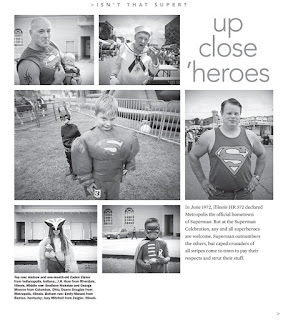
The events were spread out across the town, but many of the activities happened on Market Stree, which runs northeast from the 15' tall Superman statue, famous most recently for a picture of Barack Obama standing in front of it with arms akimbo. Here's the strip of food and vendors looking northeast toward some ominous clouds. About five minutes after I took this, it poured.


And here we are looking southwest, toward the Statue and the courthouse that sits beyond it.


The local businesses, which are located behind the tents in these pictures, use the occasion to try to sell more stuff. Superman gets an endorsement, whether he likes it or not. Here he is, in a collage that includes Obama and a better picture of the statue, advertising for a store. The Skin Shop has super deals (The Skin Shop is a mini day spa, by the way).


Here you can get an idea of the statue's size. These people are standing on the pedement, which is shaped like the Superman s-shield.


There were many people in costume, but only on officially sanctioned Superman, who's name is Josh Boltinghouse. He won the Search for Superman context and a five year deal to play Superman at the Celebration. Here he is, with my son Jacob.


Jacob, by the way, turned 2 this past Monday.


Inside the chamber of Commerce. There are tons of Superman souvenirs there, in case the vendors outside and the Super Museum shop didn't provide enough. (there's also, incongruously, a poster of the Wesley Snipes/Tommy Lee Jones film US Marshalls--which I came to learn was filmed partly in Metropolis). For some reason, I thought this section of the Commerce gift shop worth photographing.


I got lots of good stuff for a book here. If I was ever in doubt that this book will be about something important to people, that doubt was put to rest by this trip. People really make Superman an importatnt part of their lives, and not always for the same reasons. The Superman Celebration crystallizes that into one weekend. For some, it serves the same function that Halloween costuming serves: a chance to put on another face for a day or two, to let loose. I interviewed a pair of brothers, Alex and John Rinaldi, who do not put on costumes but are devoted Superman fans. They said that to dress up like that is to become interesting to others, like becoming a god for a weekend. An interesting observation.

For the town, it's an economic goldmine. They have other things that help this, a casino, a revolutionary war fort (with its own festival and re-enactment), and a harley davidson ralley. But many of them, while not necessarily fans, really get behind Superman and the Celebration. they love the work and the result. They love meeting the people. Karla, one of the chairs of the committee, compared it to a cross between Disneyland and a small town Festival. I'd replace Disneyland with a comic convention, but that might just be because I haven't been to disneyland. But my reason for the convention is the sense of community, which I doubt exists at Disneyland. Do many of the people who run the theme park know the guests by name? Perhaps, but do they incorporate the guests into the opening ceremony, allow them to run a trivia game? My interview with Karla included several moments when attendees would come up to her to chat for a bit. She knew them all by name.

All told, some 40,000 people attended the four day event. There were costume contests, a soft ball game, a car show, and scores of other events. I can't even list them all here, but they spread all over the town. I'm not that adept at fieldwork, having had little practice but a lot of theoretical instruction. I think I may have to go back next year.

Tuesday, June 9, 2009

A bit of this, a bit of that.


I suppose that the recent passing of David Carradine makes his speech in Kill Bill a sensible link at the moment. It is a good speech, so good that it was more or less written in 1968 by Jules Pfeiffer in The Great Comic Book Heroes, reissued by Fantagraphics Press not too long ago. Tarrantino often borrows liberally from other movies (so much that it's even commented on in other movies--Swingers, for example [Swingers...haven't thought about that movie in a while]), which makes me wonder if he's read Pfeiffer's book.


I'm not sure what to make of the St. Cloud Superman. Evidently he's all about free speech.


Again with Flickr. The makeup artist says it's inspired by Superman. Red, yellow, blue. Are there flickr people out there who come up with new make up designs (is that the right word) and post them regularly? Interesting. (sorry, the picture won't post.)


This review of Irredeemable is as good a reason as any to bring up the Superman pastiche. It's pretty common in comics to have a character who's not Superman, but is really Superman in all the important ways. This way creators can tell Superman stories that couldn't otherwise be told. It's akin to the Imaginary Stories, which I think have given way to Elseworlds (if those are still around, my comics information isn't the most current), which is similar to the Earth 2 stuff from a while back. In this version, the Plutonian is more or less an evil Superman. I think. Haven't read it yet, but I intend to. It's written by Mark Waid, who claims to be the only person on the planet to have read, watched, or listened to every Superman story ever told (in Superheroes and Philosophy).


Speaking of which, here's a blog entry Waid wrote earlier this year, which cover one of the reasons why he loves the character so much. Here's a passage:


It didn’t matter that he wasn’t real. What mattered was that he cared about everyone in the world, without exception, without judgment.
Everyone
.


Waid has become one of the superstar writers in comics, and he's moved from a regular gig writing for DC comics, where he got to retell Superman's origin in a series called Birthright, to Boom! Studios, where he's now the editor in chief.


I’d walked into that theater with a very short future ahead of me, and I’d walked out feeling safe and inspired in Superman’s orbit. Without that, I can promise you I would not be here today.


That's a good note on which to end. Well, not as good as this:


Thursday, June 4, 2009

Religion

So a friend, and sort of a collaborator on this Superman project, sent me a link to this site, which delcares 10 Reasons why Superman is better than Jesus. That article links to another, in which a father recounts his daughter's reaction to Superman. According to the daughter, Superman is better than God.

It is perhaps the most interesting aspect of Superman, that he is simultaneously conscripted by Atheists and Christians as an important character, one which points toward all that is good and right about the respective belief system.

Here's another site: "S" for Superman or Savior?

I'll leave you to figure out the specifics of the religions of the two writers above. But in published books, the comparison works out more favorably. Take Greg Garret's Holy Superheroes. Or Steven Skelton's The Gospel According to the World's Greatest Superhero. On the other side of that issue John T. Galloway points out all of the ways in which Superman fails to live up to the ideals of Christ. There are others.

Perhaps the most interesting aspects of the on-line articles are the comments, in which things can get pretty heated. What we learn most of all is that people really think this through. And both sides conclude that Superman is or is not for them. (I think there may be a parallel to this article, in which Superman is cast as a liberal opposed to Batman's conservatism.)

I think the Superman as Christ thing really took off with the Richard Donner film in 78. He and the writers made the parallels (which weren't always in the comics) too obvious to miss--or to ignore. For my own part, I dislike the blatant mapping of one character onto another. But I still loved that movie.

This article shows a bit of how the plot of the Superman story fits in with Otto Rank's Myth of the Birth of the Hero. Rank's is a psychoanalytic sort of study, one which begins with the reduction of the story to a basic structure, but goes on to interpret it in interesting ways that the author of this article never really deals with in his brief analysis. Alan Dundes, freudian folklorist, edited a version of it a while back that is probably the most interesting one to examine.

Rank's study is an interesting one to combine with Lord Raglan's The Hero, which takes the hero's whole life instead of merely the first adventure. He, too, reduces it to a series of episodes and demonstrates that a great deal of heroes will experience many of the 22 episodes he chronicles. I think Oedipus scored the highest. Back to Dundes, I think he determined that Jesus scored 19 of 22. Pretty good score, though not quite up there with Oedipus, if I recall.

So, to sum up...Superman is Jesus to some people, and the anti-Christ to others?

Wednesday, June 3, 2009

What's that one movie...

You know...where Richard Pryor tries to get a donkey to "sit."

Oh, yeah. It's Superman III.

This is just an awful movie. I hadn't seen it since it came out, with good reason. And yet...

There's the hint of something spectacular here. There's the way it opens, without Superman at all. We watch Richard Pryor get denied unemployment benefits. Magnificent.

Then, there's the city scene. It's not well done, but it could have been the best part of any Superman movie ever. If we had seen Clark Kent subtly saving various Metropolitans from disaster and pies in the face, then this could have been great. There's a scene in issue 5 of All Star Superman, where Kent works to quell a prison riot, save the guards, and keep Lex Luthor alive all while avoiding the Parasite and never changing to Superman. If the scene in Superman III had gone that route, it could have been great. Instead, Superman arrives to rip a sunroof off a car. Couldn't Kent have flicked a beer nut to shatter one of the windows (which he does later in the film under the influence of wacky kryptonite)? And what's with that pie?

The rest of the film is really only notable because of the split between the good and bad Supermans. Exposed to a tainted kryptonite, he becomes evil--which consists largely of leering at Lana Lang, arriving too late to save a truck driver, putting the leaning tower of Pisa upright, and flicking beer nuts. Then he divides in two: Superman (whose red is now marroon) and Kent. They fight, Kent wins. Literally, Kent is the good in Superman, who would run rampant, mildly disturbing tourist attractions and otherwise making a nuisance of himself.

Thursday, May 28, 2009


I don't know why I never tire of seeing Obama as Superman. It's always interesting to me. this one is stencilled graffiti, looks like it's on pavement somewhere.


Then there's the cover for this Taiwanese magazine. Flickr is absolutely wonderful for this project.


For a mere 29.95, you too can own your own Superman Obama bobblehead.


Wednesday, May 27, 2009

American Dreamtime

I just finished the book called American Dreamtime, by Lee Drummond. Its "an anthropologist goes to the movies" angle is an intriguiging one, of which I approve. I believe it shows its age a bit, being writting way way back in 1995, with all of its defenses of choosing to study movies, but that's a minor quibble.

There are major quibbles, thought. First, Drummond doesn't mention Superman even once. What's the deal?

On a more serious note, Drummond lays out his theory of culture, which he derives from science and the notion that humanity is not a discrete species. He problematizes boundaries throughout the book. His overall argument is that"culture created humanity" rather than the other way around, by which he means that culture preceded homo sapiens and thus played a key role in evolution. There are some very interesting arguments made about myth, its nature and its importance. There's some pretty good macro-level points here.

On the micor-level, the book falls apart. The writing itself is annoying, but that's another minor quibble. Drummond chooses to focus on four films and series of films: James Bond, Star Wars, ET, and Jaws. Good choices overall. The Bond chapter is probably the most successful, and I wouldn't be surprised if Drummond is a huge fan. The chapter that follows it, on Star Wars, is simply inexcusably bad. Never before have I encountered a scholar who makes up data to fit his theories. Yet Drummond seemingly does so. Star Wars was pretty important to my childhood, so I know the films pretty well (but not the books or comics, which is why I have to say "seemingly does so"). So when Drummond puts certain scenes in the wrong movies (such as the first glimpse of Vader's face being in Empire instead Episode IV, as Drummond has it), I notice it but excuse it. However, Storm Troopers (which Drummond labels Imperial Guard but describes clearly as Storm Troopers) are not machines in the sense that he labels them--robots. He invents a scene where Han tells Luke not to worry about killing them because there's nothing inside the armor.

Everybody who's seen the prequels knows that Storm Troopers are clones. Devotees knew it a long time ago. it's not a recent idea. This is just crazy.

And no Superman. It's too bad, really. Then I might have something to say about it.

Wednesday, May 20, 2009

This article about the reasons for the success of Batman movies and the failure of the recent Superman movie raises some interesting questions and makes a couple of good points. This paragraph, however, is probably a bit off.

So let's break this down into superheroes and its current trend in film. “Superman Returns,” the 2006 Bryan Singer dirge, didn't fail because audiences no longer resonate with a super being that can fly, shoot heat from his eyes and is immune to bullets. It failed because Superman is the epitome of good morals and justice, which today's audience find boring and childish.

I disagree with his reasoning here. I don't think that "today's audience" finds that boring at all. Success for Superman and for Batman do not have to be mutually exclusive things. I think, rather, that it's entirely more probably that people going to see a movie went with the idea that they'd see a Superman movie. Instead, they got something else. I'm not sure what that something else was--all I know is that it wasn't good by any reasonable standard. They got a lame plot. They got too much nostalgia and too little adventure and excitement. It failed because it wasn't a good movie.

SPORTS

I've been compiling a list of athletes (among others) who are called Superman. The Bleacher Report has done a short one, too, but with the added critique of pointing out how everyone on the list is not Superman for one reason or another.

Tuesday, May 12, 2009

Art

Evidently the term Superman in fitness (at least in this article) refers to "Lying flat on your stomach, simultaneously raise both arms and legs (knees locked) as high as you can". From the pose Superman makes when he flies, no doubt.


Interestingly, that pose is sort of justified in The Iron Giant. I watched that not too long ago. It's fantastic, but I watched it because there's a lot about Superman in it. In an essay in the Man From Krypton: A Closer Look at Superman, David Hopkins says that the movie uses Superman as a guide to morality for powerful people. But Hogarth (the kid who befriends the Iron Giant) tells the giant to hold his arms out like Superman to steady himself as he flies. It works.


The latest edition of Wired UK has the Superman logo on the cover. For whatever reason, the computer I'm using won't download the on-line sample of the issue, so I don't exactly know why, but the cover blurb reads "How science is re-engineering your mind, body, and spirit..." so that may have something to do with it. Superman is, in some ways, and especially in the All Star version, about perfecting humanity.


A while back, Neil Gaiman and Adam Rogers wrote a brief piece in Wired called "The Myth of Superman." It's not a bad little essay, though I disagree with their assessment of Superman's villains. Sure, a lot of them are disposable, but as far as I know the only villain who's entered the general lexicon of pretty much everybody is Bizarro. Brainiac gets used pretty often, too. And everybody knows who Lex Luthor is.


I read a really good article on Halloween, called "Does the Word 'Dog' Bite?" It's by the legendary folklorist Linda Degh--legendary because of her primary area of study (legends) and her stature within the field. Her book Legend and Belief changed the way I approach narratives in general. The article only mentions Superman once, as a disguies for children on Halloween, but it's just generally interesting, so I thought I'd mention it. She points out that dressing up as Superman is enacting the legend of superman, a retelling of the story that she labels ostension (after Umberto Eco).
Then there's this, Superdavid:

There's a site called worth1000.com. It ran a contest called Superhero ModRen. People were invited to take a renaissance painting and photoshop in a superhero or villain. Three different entries portrayed Michaelangelo's David as Superman. I liked this one the best, but that's just me. Looking at that statue from the front, it's easy to forget that it's actually a portrayal of David of David and Goliath fame. Once around back, you can see the sling draped over his shoulder in detail, and the story comes into focus. He was supposed to be perfection, I guess, as is Superman. He sired a line of kings that putatively lasted until Jesus.

In a related story, my wife Mandy and I went to see that statue in Florence. Waiting in line, a pigeon pooped on her head.

Monday, May 11, 2009

I wrote my dissertation on Prometheus, and I analyzed every use of the character I could find, from references in books to businesses that are named after the character. I also studied the use of the name as a referent in conversation. What did people mean when they referred to something as Prometheus, or Promethean?


I'm not doing this for Superman, because that would take the rest of my life, but I still think it's interesting. Take, for instance, the story "Sometimes You Feel Like a Man of Steel". It's hilarious for two reasons: First, because of the description of the pump at the beginning, which goes into far more detail about big macs than is necessary. Second, for the ending, and the perfect way the writer handles being punched in the stomach by a random drunk girl. I think the series of which this is a part, "Life is Real: Writing the final chapters" is a really great idea. I can barely imagine what it must be like to fight terminal cancer, but I think that having a forum to write about it must help in some small way.


Then there's stuff like this. The meaning that people find in Superman's secret identity takes a long time to catalogue. I hadn't come across a homosexual interpretation until now. I don't recall for sure, but I seem to remember a lot of people writing about the homosexual subtext to Superman Returns, basing it on the director's sexual orientation more than anything else. Wait a minute, I don't have to recall anything: i've got the internets...


Here's just about the only one worth a look:


"I think the generation of gay men that grew up on Superman and a few of the other comic superheroes probably read a lot of stuff into it that they recognized -- the whole double-life situation and running into 'closet-like' spaces," Lock says.


In Other News...


Friday, May 8, 2009

Back

Since I discovered that someone is actually reading this (see the comment for the last post--by a real guy!), I figure I should remark on what I've been doing in my absence. First of all, I went to Los Angeles to deliver a portion of this project as a paper for the Western States Folklore Society annual meeting. The reception was enthusiastic, and there was a good discussion afterwards. It prompted one scholar--the incomparable Wolfgang Meider--to give me a book, which was nice. I got some nice feedback, notably from Elliott Oring, a humor scholar of much renown. The paper, by the way, was on a joke:


A guy walks into a bar on the top of a very tall building. He sits down, orders a huge beer, chugs it, walks over to the window, and jumps out. Five minutes later, the guy walks into the bar again, orders another huge beer, chugs it, walks over to the window, and jumps out again. Five minutes later, he re-appears and repeats the whole thing. About half an hour later, another guy at the bar stops the first guy and says, "hey, how the heck are you doing that?!" The first guy responds, "Oh, it's really simple physics. When you chug the beer, it makes you all warm inside and since warm air rises, if you just hold your breath you become lighter than air and float down to the sidewalk." "WOW!" exclaims the second man, "I gotta try that!" So he orders a huge beer, chugs it, goes over to the window, jumps out, and splats on the sidewalk below. The bartender looks over to the first man and says, "Superman, you're a jerk when you're drunk."


It's the same joke I posted a link to (in video version) in the first post. I must say, it got a good laugh when I told it to the crowd of folklorists. The meeting--and my talk in particular--were well attended, which was really nice. It was a good group of people, most of whom I'd never met before.


The other reason for the lack of posts is that I've been writing the next chapter. It's called "The Apotheosis of Our Former Selves" because why wouldn't I use the most ridiculous-sounding chapter title ever? It makes me laugh to think that I may be delivering a paper with this title at the next American Folklore Socity conference. It's in Boise. I've never been to idaho before.


This next chapter is about a joke as well:


At his request, each morning 3-year-old Ray's mother pinned a bath towel to the back shoulders of his size two T-shirt. Immediately in his young imaginative mind, the towel became a magic blue and red cape. And he became Superman. Outfitted each day in his "cape," Ray's days were packed with adventure and daring escapades. He was Superman. This fact was clearly pointed out last fall when his mother enrolled him in kindergarten class. During the course of the interview, the teacher asked Ray his name. "Superman," he answered politely and without hesitation. The teacher smiled, cast an appreciative glance at his mother, and asked again, "Your real name, please." Again, Ray answered, "Superman." Realizing the situation demanded more authority, or maybe to hide amusement, the teacher closed her eyes for a moment, then in a stern voice said, "I will have to have your real name for my records." Sensing he'd have to play straight with the teacher, Ray slid his eyes around the room, hunched closer to her, and answered in a voice hushed with conspiracy, "Clark Kent."


This one has gotten a few laughs as well. I've found it, verbatim, on five different websites. in the process of studying this joke, I've come to invent a whole biography for Ray. he and I don't get along very well.


While we're on the subject of fashion: It seems as if this warrants mentioning:


The "Superman" is what we work-hard-play-hard ladies named our semi-public wardrobe change ... where we wiggle out of the boring business suit and throw on a halter or the cocktail dress that's been smashed in the bottom of a work tote all day.


I'm not sure if this is an example of a journalist inventing a term, or it's real. Either way...


Finally, because there hasn't been a picture of Obama as Superman here in a while:


Wednesday, April 22, 2009

The Cape


One thing that keeps coming up is the importance of Superman's cape. Alvin Schwartz insists that the cape is indestructible (in his book An Unlikely Prophet), and the cape appears to be the most common item donned by children when they pretend to be Superman. it's iconic and essential. You can't be Superman without the cape.


That being said, you can buy a reproduction (so is there a real one out there somewhere?) at a comic shop in cincinatti for $295. The article and shop in question (the shop's name is Up Up and Away, which is what I wanted to call this blog) are promoting Free Comic Book day, which is coming up in a week and a half. In case somebody beside me is actually reading this, and that person doesn't know, Free Comic Book Day is exactly what it sounds like. You go to a comics shop and they give you a few free comics that publishers send to the expressley for this pupose.


The cape is one of the two places where the S-Shield is featured. Its color scheme on the cape varies. But since Superman wasn't the guy's name on his home planet, and yet the S-Shield was explained to be part of the blanket or something that he had when he arrived on earth, people started to wonder what the S was all about. So, somebody came up with an explanation, one that involved creating a new language, Kryptonese (later, Kryptonian--they're #'s 10 and 11 on the list of languages on the site I linked). Kryptonian is becoming pretty common in tattoos, such as in this guy's tattoo of his name:


What's weird is that in that Kryptonian alphabet, there's no symbol like the one on the S-shield. The closest is the equivalent for the letter S. I seem to recall that the S-shield stood for the family, the House of El, if memory serves. I'll have to find out.


RANDOM STUFF


I suppose it's inevitable that the world turns into a musical someday. Half the world is busy lip-synching to some song or other on youtube. So why not revive the old Superman broadway show, with a new book?


This one's come up a few times now. Not sure what to make of it yet. Evidently it's in answer to a question about why the crime rate never ends if Superman is so great.


At long last, action-hero-pant-wearing day has the green light. In the UK, anyway. And it supports charity. Evidently, it's not a day when everybody wears a Superman costume they bought at the story; they simply put their underwear outside their trousers. There will be stickers, and the article makes use of the word "whilst." How very English of it.


A guy proposes to his girlfriend while he's wearing a superman outfit.

"She calls me her Superman because I look after her and make sure she doesn't do anything wrong."

That's not the first time this has happened. The Superman guy in Confessions of a Superhero does the same thing. Then gets married in his costume underneath the Superman statue in Metropolis, IL.


There's something called the superman punch.


I don't watch the show HEROES. I found this reference to Superman in the most recent episode. Are there lots of these sorts of things in the show?


You're noble like Superman, you believe in truth and justice like Superman. You're a little fascist like Superman.


Evidently this is a villain calling a hero superman in an attempt to make the hero out to be a fascist.


Wednesday, April 15, 2009

Superman is real...?


I've come across this kind of thing before. I've never known what to make of it.


And I was just reading about Superman being a mass hallucination. Then this came up.


This long essay is a good one to have on file. It's got lots of good pictures, including the one that caused much trouble recently--of Clark Kent drinking.


Imagination

I'm trying to figure out exactly what to do with the fact that kids pretend to be Superman. A big part of me is already dealing with the concept of ostension, which is enacting a behavior that you read about or hear about (such as a kid playing russian roulette because he read about it in a comic book--see The Ten Cent Plague). There was, after all, a rumor that George Reeves killed himself because he felt guilty when all sorts of kids hurt themselves pretending they could fly.


So kids pretend to be superheroes. Scholars study this. Advice sites tell you how to deal with it. Frederic Wertham condemns it and the art form that prompted it. But what does it all mean? I'll get back to you on that.


More Nicknames...

Finally a baseball superman. Shannon Wilkerson of Augusta State.


Soccer. Derby's Superman, Oscar Machapa. The article doesn't refer to him as that except in the headline.


Boxing. Edwin Valero. He's from venezuela.


Mixed Martial Arts. Anthony Manacio. He's got superman tattoos, too.


Lacrosse. Ryan Fioretti. he's a goal keeper.


This one's not in reference to a specific person's nickname, but refers to the fact that superman is a character type. It's in reference to some Dodgers players realizing that they're not going to be "superman." Someone who plays even when they're not feeling up to it. So, you know, it's still sports.


Enough of that. Tattoos

This is funny:


Then there's Turk--Donald Faison of Scrubs. According to some, he's going to remove his superman tattoo.


From an interview in American Way:

I was 18. I wanted to get a tattoo. Superman was the coolest. He could solve every problem. He was the man of steel. I wanted to do it. My right arm is my strong arm, so I thought if I put the tattoo on that arm, it’d make me stronger. Didn’t really do anything for me. I’m just permanently marked with another man’s insignia. You live and learn.


And then there's this one:


Friday, April 10, 2009

More Obama

Just when i think I'm done working on this for the day...The Daily Show has to go and compare Obama to Superman.

"If you're going to steal from a Superman movie, don't make it Superman IV." That's a paraphrase. Evidently Obama's speech about ridding the world of nuclear threats echoed Superman's speech about throwing nuclear weapons into the sun.

Does anybody else think that the Daily Show will now only be making fun of Fox News?

Superhero decadence

Superman stands at the forefront of the superhero genre. And thus he comes up a lot in discussing its finer points, its tropes, its triumphs and failings. And so it's natural that he comes up as the first example of what's wrong with superhero comics in Bill Willingham's discussion of the degradation of the superhero, which has been referred to as the age of superhero decadence. More on this to come

Thursday, April 9, 2009

Tattoo

I've been considering Superman in folklore, but mostly in verbal folklore: nicknames, jokes, etc. I've gotten a few pictures here and there, mostly of Obama as Superman. I don't know why it's taken me so long to consider Superman tattoos. It took Scrubs to open my eyes. Turk has a Superman tattoo on his shoulder.


Here are a few pictures. This one from a forum on Wizard, but a guy whose screen name is Team Rocket:


This one's cool. It's on the arm of a guy named Dan Spaulding, of Scenic City Builders, which explains the hammer:


This one's on a thread at bluetights.net, and there are a whole lot of picuters here. I choose this one because it comes up first in a search, and because the placement of the tattoo is another traditional choice. It comes with many names, the placement, which I will not get into here. It's posted by txsupergirl87:


There will no doubt be more tattoo posts in the future. I hear Shaq's got one, too.
Recently, I've noticed a more populist view of Superman. I sense it lurking underneath All Star Superman, by Grant Morrison, and in a whole lot of articles. Here's one about Superman, Obama, and Warren Buffett.


Speaking of Obama, the Guardian calls him, President Barack Hussain Obama, the multicultural Superman for the globalised world. And i don't think I've posted this picture yet:


Then there's Indonesia. Apparently, Superman and other pop culture heroes have become icons for the ballot, with at least five aspiring legislators superimposing their faces on the bodies of superheroes and using the images on their campaign posters, according to CNN. They neglect to show pictures of these, unfortunately. The article I've linked to is fascinating, actually. It's largely about visual imagery and democracy--how candidates are employing pictures to win votes. It's light on the details of Indonesian democracy, which has only been around since 1998, but the few facts are interesting. I guess I just never expect for there to be other systems of democracy, which seems as if it's taught in schools as a monolithic thing: there's democracy, as opposed to monarchy, or despotism, or oligarchy or Felocracy. But there are forms of democracy. In Indonesia, until recently, voters could only vote for parties. And there is an election to determine which parties get on the ballots.

I guess the most surprising thing is how diverse the topics become when doing a search for Superman.

Monday, April 6, 2009

More Nicknames

Stephen Ireland, who plays soccer for Manchester City FC, is known as Superman.


Glenn Beck calls himself Superman. I don't think it's a nickname is you apply it to yourself. Probably won't stick.


New Zealand Chief's rugby player Dwayne Sweeney became Superman quite recently, if I'm reading the article correctly.


Li Ka-Shing's son, Richard Li, is apparently being called Little Superman, mostly because his father is called Superman. It's all about business acumen.


Here, a high school soccer team is like Superman because they play well when the sun shines.


Then there's Nolan Belcher. I'm beginning to wonder if all of these Supermans are speculative, like this one, or if there's more to it.


Maya Moore plays basketball for UConn, and is called Superman in this article. Evidently, she juggles, too.


This one's all about golf, not specific to any golfer:


The fashion experts can say what they like about the Green Jacket but it has transformative powers, like Superman's cape or a bite from a radioactive spider. Slip one over the shoulders of a golfer and it turns a man into a boy, a jaded professional into a joyful ingénue. The eyes widen, the arm hairs bristle and the spirit soars.


So the cape turns Clark Kent into a boy, a joyful ingenue. Interesting.


I can only describe this as an article confirming that technological progress will either transform us all into Superpeople, or will render Superman unnecessary. Here's a relevant passage:


This is the first of the lessons I have for new smartphone owners: You will drop your phone. You cannot reverse time by flying around the globe. Your phone will be OK. So don't baby it. You bought it to be used, not put in a display case in your living room.


The article itself opens with two paragraphs about the author imagining flying around the globe in reverse--as Superman did in the 1978 movie--so as to reverse time and prevent the accidental fall of a cellphone.


I suppose that the DC Comictitian is going to come up sooner or later. Might as well be now.


Everybody else is linking to this video on YouTube, so I will, too.


And I know that you can see my underwear

And you can joke about it all you want, I really don't care.


Finally. I suppose I should post a picture of Action Comics #1. In the beginning...


Thursday, April 2, 2009

A central focus of my book is the morality at the heart of Superman. The jokes about him lead me there, as do the conversations I've had about the character. So I'm glad to see essays like this one, at FaceTheReckoning.com. It's a response the idea that Superman's morality would be shaped by his powers, that he would inevitably give in to the temptation to use them for his own selfish ends and because he doesn't, he's not an interesting character. The response is well articulated.


The list of people given the nickname Superman grows every day. Here's Shane McConkey, extreme skiier. Then there's Dr. Gahl, about whom I know nothing other than that he's associated with the fight against Hermansky-Pudlak Syndrome.


The title for the Dr. Gahl post refers to him as "our Superman." I recently read that superheroes are not so much gods in the sense of a lot of gods whose nature gives them provenance over some force of nature or human institution (i.e., Zeus was god of justice and lightning; Athena was god of wisdom in battle and weaving), but rather superheroes are tutelary deities who protect specific cities. It's not entirely true, but super heroes are first and foremost associated with cities, especiallly Superman. Superman is also associated, with varying degrees of agreement, with "the American way," which makes him a patriotic figure more so than pretty much any other super hero. The iconography supports the argument.


What I'm getting at here is the "god's on our side" attitude. It crops up in sports, in war, and probably in lots of other places. Several religious people have written books on Superman, mostly to point out the parallels with Christ and show us the way, so to speak. John T. Galloway, Jr. wrote perhaps the earliest one of these, The Gospel According to Superman. More recent books attempt to demonstrate that Superman is Christ-like, and that this is a good thing. Galloway goes in the opposite direction, labeling Superman a false god and saying that the best response to his story is to compare it unfavorably to the gospels. In particular, he notes that Superman is "on our side," which he criticizes because of his belief that god is on everyone's side. I've simplified his argument perhaps too much, but I hope the point is clear.

If there's "our Superman" there can be one for other people, too. All of which is sort of beside the point. I think the post I've been discussing labels Dr. Gahl as Superman because of his tireless efforts attempting to find a cure for the disease in question. So "our" here isn't a form of patriotism, and in fact includes everyone. I don't even necessarily agree with Galloway. Just writing and writing and writing. Here's a patriotic picture:


Interestingly, the image came up on a website devoted to stem cell research, something Christopher Reeve advocated, if I recall correctly, because it could lead to advancements in treatment for the injuries he sustained. There was an episode of South Park about this, which pitted Reeve against Gene HackMan. Funny stuff.


Then there's this:


Wednesday, April 1, 2009

superstition

One of the types of folklore in which Superman is featured is superstition, or folk belief. There are evidently some people out there who believe there is a Superman Curse. Evidently, just pretending to be Superman for a paycheck will lead to the end of your career or life. The evidence are the untimely demises of Christopher Reeve and George Reeves. Also cited are the less-than-thrilling post-Superman careers of Dean Caine, Kirk Alyn, and others. There's an article about it in Glenn Yeffeth's The Man from Krypton (in the Smart Pop book series). It takes the form of a letter to Brandon Routh on the eve of his debut in Superman Returns.


George Reeve contributes the most to this belief, it seems. Snopes has a page devoted to the rumors surrounding his death. There is evidently a book about it, which I have not yet read, and a recent movie called Hollywoodland, which I have not seen. I really need to catch up on my movie watching.


This picture is a custom figure, built by someone called Sillof, who does this sort of thing a lot. Custom figures are more common than I realized. The Superman guy from the Confessions of a Superhero documentary does this sort of thing as well. Here, Sillof imagines a Victorian Superman, based, he explains, on the idea behind Gotham by Gaslight, which imagined Batman solving the Jack the Ripper murders, if I recall correctly.