All-Star

All-Star

Tuesday, August 28, 2012

Bill Finger


Marc Tyler Nobleman's new book is now out. He wrote a book about Jerry Siegel and Joe Shuster called Boys of Steel. It's a picture book about the creation of Superman. It's pretty good.

In the same vein, Bill the Boy Wonder is about the creation of Batman. Bill Finger came up with a great many aspects of Batman familiar to everybody today (Robin, Catwoman, the batmobile, and even the design of Batman's costume). But Bob Kane gets all the credit. Nobleman's book is part of a larger endeavor to give Finger the credit he deserves. Nobleman has recently been on NPR and TED talking about this. Those talks are pretty short, and if you're into comics on the internet these days you have probably already learned about Finger's role in the creation of Batman. But they're a good introduction to the topic.

Art by Al Plastino
Finger also wrote some Superman stories, including the influential Superman #61, which was a retelling of his origin, and where Superman finds out about his past for the first time.


There's an interesting analysis of Finger's impact on Batman and Superman in an essay called "The Dark Knight Origin of the Man of Steel" by Richard Harrison. It's in the Secret Identity Reader, edited by Harrison and Lee Easton.

The story of Bill Finger ties into creator's rights, because he didn't get any. It's a complex story, in the same way that Siegel and Shuster's stories are complex. It was a different time. And learning about it can honor the creator of Batman.

Monday, August 27, 2012

Superheroes and Hindu gods

I want to see this exhibit.


KATHMANDU: Can you imagine Superman in the Nataraj pose, or Lord Bhairab playing with Captain America, or Goddesses Kali in Superman’s improvised costume, or Hulk-like character flying with a mountain in one hand a la Hanuman? Such pictures have probably not crossed your mind, but artist Manish Harijan has visualised such images at his exhibition ‘Rise of the Collateral’ on at the Siddartha Art Gallery, Baber Mahal Revisited, from August 22.

Alas, I can find no images of it yet.

Tuesday, August 21, 2012

Sacrifice


I keep coming across the argument that when Superman's biological parents (usually Jor-El and Lara) put the baby in that rocket ship and sent him to earth, they were committing an act of sacrifice. That somehow, what they did was a sacrifice.

I just don't buy it.

The first page of Action Comics #1. (Jerry Siegel and Joe Shuster)
I've been told that they were sacrificing themselves to save him. That's not true at all. They didn't have a choice in the matter. The rocket couldn't fit them, so they did the only logical thing and tried to save their son. That's not sacrifice; it's just saving somebody. The fact that they died doesn't make it a sacrifice, precisely because they didn't have a choice.

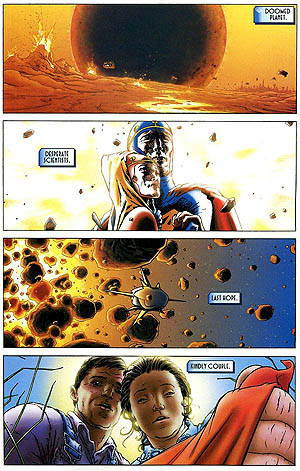
All-Star Superman #1, (Grant Morrison and Frank Quitely)
 

Sometimes, however, they do have a choice. The rocket is occasionally big enough to fit both Lara and little Kal-El (this was as early as 1944). In every case, she chooses to stay with Jor-El. This is not sacrifice. This is being a bad mother. There's no way around it. she's not sacrificing herself so her child can live. She does die because of her own choice, but the child has nothing to do with it. It seems to be a really bad choice, too, since she's leaving the boy to the elements. She could stay with him and take care of him. She doesn't. That's not sacrifice.

"My place is here with you." From Superman #53 (Bill Finger and Wayne Boring)

I've also been told that the parents sacrifice their final moments with Superman. I can't even figure this one out. They're giving up their final moments with the baby so the baby can live? That's not sacrifice, that's being a good parent. Again, it's not like they have a choice in the matter of their own life and death. It's not like they're sacrificing themselves for a higher power, to ensure the baby's survival. They're putting the kid in a rocket, hoping he finds some place nice where he won't get eaten the moment the door opens. To keep him would be selfish, and, essentially, not much different from murder. They're taking a big chance; it's a gamble. Would we say that a roulette player is sacrificing some money in order to win more money?

Because of all this, the only thing I can think to make of it all is that people really need the origin to have an element of sacrifice in it. The word as used today has the connotation of nobility and honor, so they need Superman's family to have those qualities. But we don't need to graft ersatz sacrifice onto their actions to obtain this (nor do we need over wrought Christian allegory). Now, there is sacrifice involved in being a parent. It's hard. You give up stuff you want, and stuff you want to do, in order to provide the things that children need. But that's not what Jor-El and Lara did when they put him in the rocket. All they did was take a chance that the kid would survive. They were being good parents.

The idea of sacrifice goes back a long way. It primarily means killing something you need so that the gods will be nice to you. That's not so much what's going on in Superman's origin. But it also denotes giving up something to obtain a greater reward. So they're giving up their son, that's true. But what's their greater reward? They die. We could think that their greater reward is the possibility that their son is going to survive. But that doesn't work because they're giving up the same thing that they're getting as a reward.

That leaves just one more notion of sacrifice. The term itself refers to the act of making something holy (Latin: sacer = holy + facere = to make). By sending Kal-El on his journey through space, to earth, where he becomes Superman, could we say that they are making him holy?

by Alex Ross


Friday, August 17, 2012

Morality

So I found this today and thought it was worth noting. It's an essay about Superman and Jesus, from a site called At the Intersection of Faith and Culture. It's interesting stuff, though I disagree with a basic point.

The author, Jack Kerwick, agrees with the common notion that heroes must be relatable. By which I think he, and others, mean that they have to be flawed so that we can see they are human, finding bits of ourselves in them. Now, he's talking about Superman and Jesus. Sure, we can look at their psychologies and see some evidence of humanity there, but I think there we need to consider that there are different rules when thinking about gods.

When it comes to heroes, sure, we need to see their lives as basically similar to our own, different in degree but not in kind. But gods are different in kind. This is, to me, the most interesting intellectual component of Christianity. How is Jesus both human and divine? It's an old question, and it sparked quite the controversy in the early church. I'm not going to even try to answer it here. But...can we ask a similar question about Superman? How is he both human and alien?

John Byrne answered that question in his Man of Steel series. Superman may be genetically Kryptonian, but he was raised on earth and has chosen to stay here to make it a better place. So he's born alien but chooses to be human.


On a related note...

Here's a link to an essay on Superman, Batman, and morality. The author is a Superman supporter, finding that the character's optimism is preferable to Batman's pessimism; that the unattainable ideal is a better model than the lower bar set by Batman. I generally agree, but then he gets into some specifics that I can't agree with. Such as...

Batman is certainly a more tempting role model because his is an attainable standard...

I've heard this argument many times. Batman is better than Superman because he's human. He doesn't have super powers, so his heroism is all the more impressive. Leonard Finkelman, the author of the above piece, doesn't agree that Batman's better because he's human, but he's making that part of the argument. The thing is, Batman's no less superior to humanity than Superman. He's just as imaginary. To be Batman, you've gotta be the strongest, fastest, smartest, richest, and toughest human being on the planet. You've got to have the several lives' worth of time to perfect your mind and your body to that point. You have to have the incredible luck to be born into a phenomenally wealthy family. That's not quite as impossible as being from another planet, but when we get down to it, there aren't degrees of impossibility.

Anyway, there are some great insights in the essay. And he ends on a great, mythological note:

Like Kant, I am continually filled with wonder by the starry heavens above and the moral law within, and to be a Superman is to bring the one closer to the other.

Festivities

Well, various circumstances prevent me from attending the Plano, Illinois, Smallville Superfest, which is going on this weekend. Plano served as the location for shooting the Smallville scenes of the Man of Steel movie to be released next year.

This makes Illinois the site of two different Superman festivals. And people think he's from Kansas...

Wednesday, August 15, 2012

Better than the Book: Get Shorty


I’m beginning to think that the whole basis for films being superior to the books on which they’re based is the presence of a soundtrack. Get Shorty can practically serve as the argument in favor of this. Great music--a mix of jazz and pop and instrumental mood-setting that is really on to something. If you look at the list of tracks, you might not think it would suit a tale of a gangster who wants to become a movie producer, so many people must die a horrible death,* but it does.


My son owns several books that play music. One is a rendition of “Up on the Housetop” that sets the lyrics to illustrations and plays the melody along. But even I can’t read the whole book before the song ends. It doesn’t include enough music to get through all the verses. The other book is an elmo pop-up book, which has buttons you push to play music for each page. You’re supposed to read the lyrics along with the music on each page. Neither of these books technically has a soundtrack in the sense that movies have soundtracks, but they make me think that the technology would be possible, were any demand to arise. I doubt it will. However, there's a whole section of the greeting card industry now devoted to putting music into cards. Sound and reading material, together at last.


Travolta and Hackman are fantastic in this. The movie, not the car.


Anyway...Get Shorty’s great. Travolta’s great. Hackman’s great. It was the first film in which I saw Dennis Farina, who swears in nearly every line he utters in the film. Travolta also has the following line, when asking Renee Russo to see Touch of Evil with him: “We can go watch Charlton Heston be a Mexican.” It’s funny when he says it.


Dennis Farnia is fantastic in this.


Combine great actors with Barry Sonnenfeld, who’s a fantastic director. He did the cinematography for another great film, Raising Arizona. And he really works wonders here, too. Almost every shot is a marvel to watch--movement, motivated movement at that, all the time. For me, the whole movie is encapsulated in one shot: John Travolta walking up the stairs. Allow me to explain.


Rene Russo is fantastic in this.


Travolta, playing the gangster Chilli Palmer, is set to have lunch with Russo and Hackman. They see that some rival gangsters-who-want-to-be-producers have been there before them, trying to get Hackman to work with them instead. Travolta sees the threat implied by James Gandolfini’s approach to the stairwell. This was Gandolfini before he became Tony Soprano, by the way. So Travolta, who had been cool and charming with Russo, asks her to step back. He glances up the stairs, takes a step, and Greyboy’s Panacea begins. Travolta walks up the stairs, seemingly with the beat of the song. The camera pulls back--he’s coming right at us--and he’s a whole different person. He was a guy with a girl, about to have lunch before. Now, he’s all business. And Gandolfini gets a whuppin. Everything comes together right in that shot: music, acting, directing; it doesn’t get much better than that.

The book, by Elmore Leonard, isn’t too bad. It’s not nearly as funny. Overall, it’s just not all that great. The movie is.


Danny DeVito is fantastic in this.

Elmore Leonard, by the way, wrote a book called Killshot. It’s one of the only books I started reading but vowed never to finish. It’s that bad--which is too bad, since it’s set in my hometown. I didn’t get more than twenty or thirty pages into it. You might say that I never got to any of the good stuff. But I don’t think that’s possible. Three other people had the same reaction.


*I stole this line from, of course, Joel and Ethan Coen. They used something similar for their movie The Man Who Wasn’t There--it’s about a barber who wants to become a dry cleaner, so many people must die a horrible death. No offense is intended to them. Theirs is funnier. I just can’t help myself.

Monday, July 23, 2012

Quotations: Community Edition, Part 2


The only reason I slammed Jeff's head against the table was because I wanted to feel like an adult.
--Annie


I refused to give Santa a Cristmas list because I didn't want to depend on a man for anything. Now look at me. I'm betty Crocker. I'm Martha Stewart. I'm one of the Steppenwolf wives.
--Britta.

You guys, you create fun, and I destroy it. Of course a silly little joke ends with a dead body on the lawn, I should have known that, but I wanted to do it anyway, cause I wanted to be like you. I wanted to be funny. Knock knock! Who's there? Cancer. Oh, good, come on in. I thought it was Britta.
--Britta

I just yanked a little dude out of my friend.
--Britta


I have two boys, and when we have a serious discussion I find that a brownie helps them to relax. So...why do you hate me and Jesus?
--Shirley

Oh, look. Britta brought what she believes in. Nothing.
--Shirley


Don't you get it, Jeff? They're not evil people that are good at foosball. They're good at foosball because they're evil. It's an evil game that brings out the worst in us, like out of town weddings where the reception is in the same place as everybody's rooms.
                                                                                          --Shirley


Bonus Anthony Michael Hall quote from the first season Christmas Episode...

My life is a gym!

If this dude doesn't show up we're definitely going to Applebees, cause I'm getting into a fight today no matter what.
--Mike

Friday, July 13, 2012

Own Worst Enemy Tonight

I'll be out of town next week, so I doubt I'll post anything.

However, tonight at the Bishop (corner of 4th and Walnut in Bloomington), I'll be screening the film Own Worst Enemy. I wrote it with Mike Judd, who directed it with his wife Jessica. Everyone is welcome.


In the interest of keeping some Superman content, here's a story from the AV Club about one guy's identification with Superman. I might make reference to this in my book, if I ever get around to revising it for publication. By which I mean, if it ever gets accepted for publication, at which point I would get to work revising it immediately.

The AV Club story, by Todd VanDerWiff, is a lengthy story about his own experience with Superman comics, which didn't begin in earnest until he was in his 20's. He's trying to capture what makes Superman resonate with people, and he does a pretty good job. Here's how he concludes the article:

We’re all constantly walking forward through a life that keeps stripping everything we have from us and asking us if that’s all we’ve got. For every joy we have, we will have just as much despair, and for every good day, there will be a dozen bad.
But we’ve all been sent here for some reason. And maybe someday, we’ll figure out how to fly.

Like I said, pretty good stuff. He focuses on the inspiration component of Superman, and how that ties into the resonance of his situation. He gets at the idea that Superman lives beyond the media in which he appears, and his point is that this is why it happens. In essence, he's building up to the same points I try to make in my book. But where he uses his own personal experience and speculation/vague anecdotal evidence for his argument, I use fieldwork. That's not a criticism, by the way, it's just a different method. Good stuff.


Thursday, July 12, 2012

Never Ending

Ahhh...the internet. Like the 24hour cable news network, the internet requires that the people there always have something to say. So people say things. They have to. Sometimes it's their job. Sometimes it's because there's a medium, which is a vacuum. And culture abhors a medium vacuum, so people fill it. They fill it with things like this...
  
Why There Will Never, Ever Be Another Great Superman Movie

This is labeled news, and I guess it qualifies if you're writing for E!. It's that weird thing on the internet where somebody writes an opinion in wildly overblown hyperbole. It should be on a comment forum for something, or on somebody's blog. But it's on E!. Which is weird. If you read the article, there's an argument there, and there may be some merit to it. What the writer, Joal Ryan, is saying is fairly simple: Richard Donner's Superman: The Movie was pretty fantastic, and because it was the product of its time, and because times have changed, there will never be another movie like it. The reason it was fantastic was because of the sincerity with which the character and superheroism was handled. We live in a more cynical time, where sincerity makes us uncomfortable. So we won't have another movie like this. Ever.

This quotation should sum up  his point nicely:
Above all, Superman is a confident, unburdened hero because Donner and his writers let him be. And Donner and his writers let him be because, all those years ago, they didn't have graphic-novel-prescribed psychoanalysis to answer to or sift through.
Today, the modern movie superhero is a wreck.
He (and it's still almost always a he) must be touched by a form of madness in order to get to the point where he dons a suit.
The Superman in Superman: The Movie, by comparison, just does it.


Here's the thing that's interesting to me. This is precisely the same thing that, more or less, happened to comics sixteen or seventeen years before Donner's Superman movie. The superheroes, following the example of Superman, were going along just fine in their straightforward, sincere, and uncynical adventures. Then came the Fantastic Four, the Hulk, and most importantly, Spider-Man. They were complicated, and selfish, and flawed, and their psyches were there on the page to see. This is precisely the 'graphic-novel-prescribed psychoanalysis' that Ryan refers to, happening in 1962. Or at least that's the generally accepted story.

From Superman 61, by Bill Finger and Al Plastino

It's not true, of course. Batman, as soon as his origin was revealed, was a Freudian's dream. And when Superman's origin was revisited, so that for the first time the character became aware of Krypton's destruction and the death of everyone in the cosmos who was like him, he gets a host of psychological trouble for it. Both those origin revisions, by the way, were in the 1940's. Both were written by Bill Finger. If you want to see scans of the pages from all the major retellings of Superman's origins, check out the site Superman through the Ages. History is never quite as linear as people like to say it is. Trends are never smooth.


I may be criticizing the unabashed hyperbole of Ryan's article (which may just be a symptom of the internet culture), but there is something to it. What he's really saying is that the psychologically troubled superhero sells right now, so the people who are making big-budget movies will probably stick with that formula. But there's no real reason they have to. Sure, we live in an age suspicious of sincerity, but maybe that will change. Maybe there's a movie out there that can show us the folly of cynicism and remind us that there's value in pure heroism. Times change. Never say never.


Wednesday, July 11, 2012

Better than the Book: Wonder Boys


Michael Chabon is being hailed as a master of the literary form. He moves easily through genres, always keeping a decent style and relying on character and theme more than that pesky necessity called plot. Reading just the first few sentences of his novel about the comics industry, The Amazing Adventures of Kavalier and Clay, reveals his confidence and command of language. Of all his work that I have read, my favorite piece is his introduction to the reprint of D’Aullaire’s Norse Myths. It’s a great book all around, but Chabon’s intro gives an account of his personal relationship with mythology that just made me smile. His characterization of Loki as the god of the eight-year-old boy is simply genius, and I don’t doubt that it will show up in an academic piece I write sooner or later.


That being said, Wonder Boys just didn’t work for me as a book. I saw the movie first, and I loved every minute of it. I think a lot of it has to do with Michael Douglas, who simply dominates the movie without being overbearing. All the actors are great, even that guy who plays Vernon Hardapple, whose introduction is perhaps one of my favorite moments in cinematic storytelling (that means storytelling in a movie, not a movie as a story).


Steve Kloves gained some success writing adaptations for a little franchise you might have heard of called Harry Potter. In Wonder Boys, it seems like he realizes that sometimes, what you don’t see on the screen is as important as what you do see. Normally, phrase like that would be applied to horror films, where the director keeps the gore and monster off-screen until the end. Here, it applies to the wife. You never see the woman to whom the lead character is married, though Douglas tries to track her down, even going to her parents’ house. In the book, she and her whole family is there, and it leads to the characters partaking in a religious dinner that is frankly too long and not at all interesting. In the film, Kloves turns the scene into a brief but important conversation between Tripp and his wife’s father that is a turning point for Tripp’s character. It’s direct, concise, and important--qualities the novel does not muster for this scene. It’s Chabon’s largest excess in the book, and it was probably obvious that it had to go. Little changes in a similar vein make the film as a whole much more enjoyable, much more effective.

 
One other thing the film has over the book is its soundtrack. It’s as if the book didn’t even try here, while the movie used Leonard Cohen, Bob Dylan, John Lennon, Van Morrison, and a bunch of other guys whose names I don’t know.

I will give Chabon credit, though. His handling of the tuba is inspired. In the film, it is revealed to be the possession of a transvestite whom Tripp’s literary agent meets on a plane to visit Tripp. In the book, the characters merely think it belongs to the transvestite. It doesn’t, and among the many crimes committed by the characters, tuba theft must be added. It stays with Tripp throughout, and is brought to the foreground at all the right moments. The film, on the other hand, uses it for a joke about trunkspace. A good joke, but the book does so much more with it.

I mention this to make clear that the book--as with most of the books I’ll be writing about--has merit. Wonder Boys is a good book. It’s just not as good as the movie.

Tuesday, July 10, 2012

The 1001 Nights


So I've been reading my way through the 1001 Nights. Or the Arabian Nights. Or the Thousand Nights and One Night. Depending on all sorts of things. I've got the three volume Penduin edition, and I love it. I tried to read Richard Burton's translation a while ago, and just couldn't get through it. Each story was one paragraph, which sometimes lasted over sixth pages. Bleagh.

The Penguin edition is great. Of the first 100 nights, 25 is the best. It's got this proto-Weekend at Bernie's quality that cracks me up.

Monday, July 9, 2012

Superman Is an Arab

Now this is interesting. A Lebanese writer, Joumana Haddad, has written a book called Superman Is an Arab: On God, Marriage, Macho Men, and Other Disastrous Inventions. There's an interview with her at Now Lebanon. I've never heard of this writer or her previous work, but I'll check out her new book when it comes out in September. Here are a couple of quotes from the interview:

I thought there was a need to tackle manhood, not only womanhood, because, as you might know I’m a third-wave feminist, which means I don’t believe in women’s solidarity; I believe in human solidarity. I believe in partnership between men and women, and if our suffering is going to change it won’t be by women alone.
And it hit me that in the Superman story I always preferred Clark Kent, because he’s real. And I think many of our leaders and religious representatives here in the Middle East think of themselves as invincible supermen.

And this: And God is a superman – that’s my first enemy, the monotheist God. That’s the first Superman we need to get rid of.

You can really see her point of view here.


I wrote about Susan Faludi and her book The Terror Dream a while back. I think the perspectives of these books might have a lot in common, with their view of the dangers of masculinity and the effects that idolizing it can have on a society. It'll be interesting to see how similar they are, and the reactions Haddad gets. It's tempting to offer some comments about her thoughts just on the interview, but it's wiser to wait until I can get my hands on the whole book.

Friday, July 6, 2012

Quotations: Community Edition


So, Community is one of my favorite tv shows. Here's a bunch of things the guys on it have said.


When I was young I discovered that if I kept talking long enough, I could convince people that anything I said was right. So either I'm god or truth is relative.
--Jeff.


Nothing is impossible here. Animals can talk. Your heart is shaped like a heart. And the smell of pie can make you float.
--Abed


Energon doesn't grow on trees, Jeff. It's harvested by super bees in a buddhist meteor crater.
--Pierce


Sometimes I think I lost something really important to me and it turns out I already ate it.
--Troy

What are those underwear made of? They look luxurious.
--Troy

 Set phasers to 'love me.'
--Troy


Harrison Ford is irradiating our testicles with microwave satellite transmissions.
--Jeff


 Next time on "Quotations"...the women of Community.


Tuesday, July 3, 2012

Better than the Book: History of Violence


It’s a good idea for a story--a man who can’t escape his past.  That past, in this particular plot, which began as a comic book before being adapted by Josh Olson for David Cronenberg (Viggo Mortensen plays the man, Tom), is indeed one of violence.  And it comes back to haunt Tom after an act of defense (in the book--it’s heroism in the film) brings him national media attention.  People from his past show up, and his family is put in danger. 

I’ll be straightforward here:  The reason the movie is better than the book is that the book has no characters.  It has plot points in the shape of people.  They exhibit no real emotion, intensity, complexity, or pathos, and thus are completely unengaging.  Olson’s adaptation gives them this complexity, which thus makes the story more complex and interesting. 

I’ll give the most obvious example:  the scene where the wife confronts Tom about his past.  He’s been wounded defending himself and his family from gangsters, and they’re in the hospital.  In the book, his son’s there, too.  They say they want the truth from Tom, and he tells it to them.  We learn it in the form of an extended flashback, where we see that Tom does indeed have a history of violence, though he was a bit reluctant to engage in it.  That’s it.  Nobody reacts to the news that their husband or father is a killer. We just move on to the next scene.


In the film, it’s just husband and wife.  There’s almost no mention of what the incident was in the entire film, no flashback, no concern with specifics.  The fact that he killed for reasons other than self-defense is all that’s important, and that he doesn’t want to do it anymore.  If you were his wife, would that be enough for you?  In the confrontation scene, there’s anger, pain, and believable emotion.  Mortensen and Maria Bello do a fine job.  They play real humans, not plot points. 

In both book and film, Tom confronts and defeats his past.  He has made his future safe for his family.  Only the film has the guts to ask if that’s enough.  Can we transcend the choices we made?  Can we become a new and better person?  What are the consequences of twenty years of lies and twists of truth?  The book does not ask or answer these questions in any meaningful way.  It says that we solve violence by violence.  And then we go back home.  The film says that maybe we have to solve violence by violence, but that there are consequences, and there’s a bit of doubt about whether there will still be a home to return to when it’s all said and done.

I’m not sure what I think of History of Violence as a film.  It’s certainly better than the book, by a wide margin.  The book is interesting, but lacks the main qualities that make a story great.  The film has many of them, including a deft hand a creating suspense and tension, but I felt like there was something missing.  Not sure what it was though.  It may just be that the film moved Tom’s new home from Michigan to Indiana.  Not sure why that would bother me.


Monday, July 2, 2012

Harry Potter

My wife and I recently watched all of the Harry Potter movies. We'd both read the books when they came out. In the interest of having something to say about the issue, I thought I'd post the best line in all the films:

Oh, Harry...If you die down there you're welcome to share my toilet.

I'm sure you know the character who says this and what books it's from. That is all.

Ending things

I've been thinking about this Superman project a lot lately. I'm not reconsidering things I've written, or contemplating new chapter or anything like that. I'm thinking about how it's ending. I spent two and a half years working on it, from the spark of an idea in March of 2009 to the manuscript I submitted to a publisher in October 2011. That's really not all that long for an academic book. And I haven't looked at the manuscript, or thought much about it, since October.

Right now, the only thing that will get me working on it again is the promise of publication. My hope is that, one day soon, I get a letter from a certain university press telling me that they want to publish it, and they offer some suggestions on how to improve it. Then I'll start revising it. Or, in many months' time, another press will be interested in it. Should all that fail, I'll probably break it up and make it into separate articles to send to journals.

Regardless, that will be that. But what's got me thinking  now are two things: my subscriptions to Superman comics, and my Superman google alert. Every month, I purchase Superman and Action. Every day, I receive a list of links to websites that mention Superman. And I read them all. So far, in those nine months since I submitted my manuscript, I haven't encountered a single thing that I thought had to be included in my book.

So why do I still do it? I have no attachment to the stories in either Superman or Action. The interest I had when I learned that Grant Morrison would be writing a monthly title faded quickly when I saw Rags Morales' art, and the storyline has been less than I expected. Some people like it, I guess, but not me. And I have not one single good thing to say about the monthly Superman title.

As for the alerts...well, they've become nothing more than a daily list of where to find rumors and pictures of the new Man of Steel movie combined with a catalogue of which athletes have Superman as their nickname. It's not terribly interesting.

Yet I haven't stopped. What keeps me going back to these things? Three years now. Does that have something to do with it?