All-Star

All-Star

Friday, February 7, 2014

Quotations


There's no real theme to these quotes. Just stuff I've written down at some point, for some reason often lost to me.


With us, positive knowledge so greatly overflows our imaginative powers that our imagination, unable to apprehend the world that is revealed to it, has no other alternative than to run to myth again.
Levi-Strauss, The Story of Lynx


Every world must be won by interpretation, of which common sense, science, and religion are all variants.
Stewart Guthrie, Faces in the Clouds


All money, false or true, depends on a confidence trick.
Mary Douglas , Purity and Danger


Truth is what you make it.
Roger Zelazny, Lord of Light


It has not been recorded that any human being has gained a very large or permanent contentment from meditating upon the fact that he is better off than others.
Sinclair Lewis, Main Street


You know, I like to think that I am general enough and common enough so that I have some empathetic approach to nearly every human emotion and feeling and thought. Of course it is only that I like to think this. It does not make it true but if it were true I would be a better writer for it. There is one field of feeling, however, in which either I am different from most people or they do not tell the truth—perhaps not knowing it or not daring to face it or perhaps feeling that it is a monstrous thing which should not be brought to light. I don’t know that this is so. I simply offer these as reasons why people do not seem to feel as I do. I refer to the will to live. I have very little of it. This must not be confused with a death wish. I have no will to die but I can remember no time from earliest childhood until this morning when I would not have preferred never to have existed. No moment of joy or excitement or sharp experience of pain or sorrow has even made me want to be alive if the opposite were possible. You see it is no longing for death but a kind of hunger never to have lived. The few times I have stated this I have been attacked with everything from straight disbelief to a kind of hatred as though I were a traitor to life. And perhaps I am.
John Steinbeck, Journal of a Novel


I remember the lies, but the truth escapes me.
Paul McGarity


Thursday, February 6, 2014

Can we talk about the Brothers Grimm for a minute?

I'm working my way through Ralph Manheim's translation of the Grimms' Tales for Young and Old. 32 stories in, just sitting there on the page, like everything's perfectly normal, is "Clever Hans." (Here's a full translation of it.).  I'll probably have a lot more to say about the Grimms' tales when I'm done with the whole thing. For now, let me tell you about Clever Hans.

It starts out pretty normal. Hans is going to see Gretel. She says he should have brought her something. Of course he replies that he didn't, so she should give him something instead. She gives him a needle. He sticks it in a hay wagon and walks home behind it. His mother asks him what he was doing, and he tells her about the needle. She says, "That was foolish, Hans. You should have stuck it in your sleeve."


The next day, he goes to see Gretel, again without a gift. She gives him a knife, which he sticks in his sleeve, thinking that's the best thing to do based on what his mother told him. But when he gets home, she says this was foolish; he should have put it in his pocket.

by Arthur Rackham
You see the structure starting to take shape already. The days play out the same way. Gretel gives him a goat, which of course he puts in his pocket. Mothers says he should have put a rope around its neck and led it home. Gretel gives him some bacon, which he ties to a rope, but should have put on his head. Puts a calf on his head, should have roped it and led it to trough.

by John D. Gruelle


When he goes to visit Gretel the next day, she says she'll just come home with him. So he ties a rope around her neck and takes her to the feed rack and ties her up there. His mother, in response to this, tells him he should have "cast sheep's eyes at her." Now, I'm presuming that "sheeps' eyes" refers to something romantical. But, you can imagine what happens next. If you can't, I'll quote it directly from Manheim:

Hans goes to the barn, cuts the eyes out of all the sheep, and throws them in Gretel's face. At that Gretel gets angry, tears herself loose, and runs away. She's not engaged to Hans anymore.

Some day I'm going to put together a collection of the greatest short stories humanity has ever produced. Somewhere in the middle, between Hemingway's "The Snows of Kilimanjaro" and O'Connor's "A Good Man Is Hard to Find," I'll put "Clever Hans."

Wednesday, February 5, 2014

Different Perspectives


Quitely and Grant

Since I've posted quite a bit about All-Star Superman in the past, I thought I'd do so again.

Here's a link to a long article about the ray bradbury reference in the first issue.

 The writers at Hooded Utilitarian didn't buy into the general praise of the series, and they offer a series of insightful articles about why. This first one by Noah Berlatsky discusses how All-Star feels decadent, a retread of the silver age stories that never quite captures their true feeling. Here's another he wrote on the same subject.

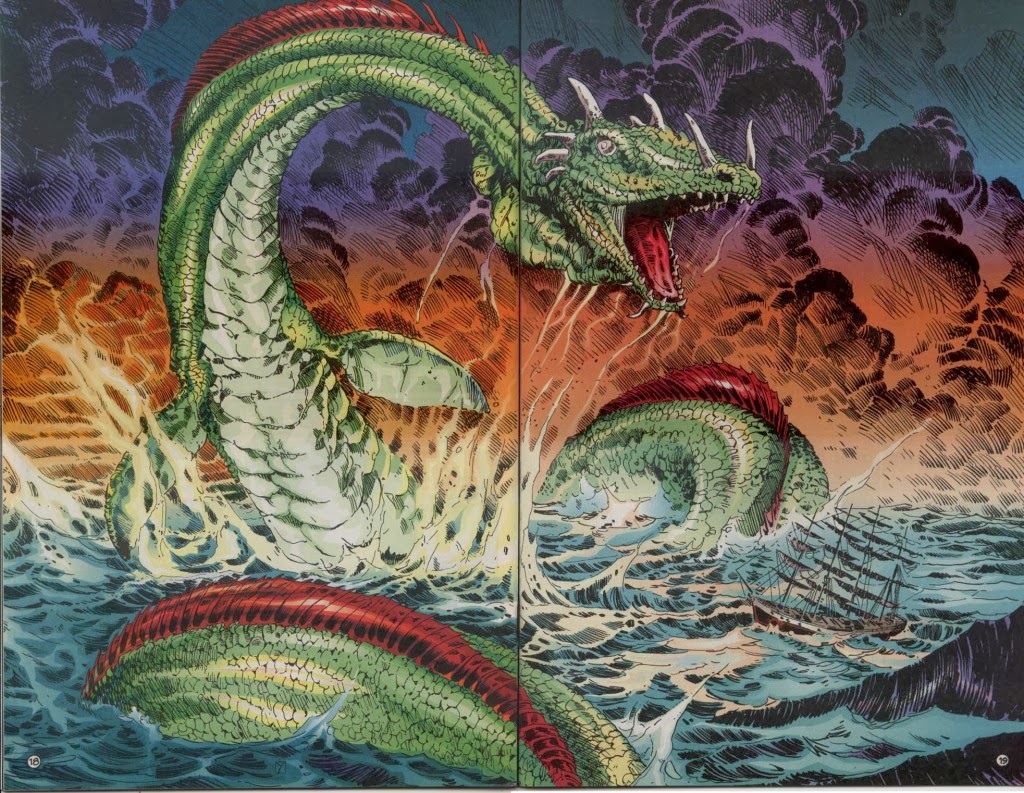
I borrowed Berlatsky's scan of the sea dragon, art by Marley for the Korean comic Dokebi Bride. Looks amazing.

This next one by Berlatsky is a comparison of two images, one of Superman and the other of a big dragon. Here's a follow-up. I wanted to post these stories in part to give an alternate perspective on All-Star Superman, and the art of Frank Quitely. The writer shows the images in part to point out how the superhero image suffers by comparison. There's something worth quoting here:


The point here is that super-hero comics very rarely have a strong sense of wonder. With all the spectacular feats, you’d think they would—but somehow they all end up as tricks; they’re fun and goofy, or I guess more recently bloody, but they don’t actually inspire awe. And I think it’s because of something Tom said, “Superman keeps the universe our size.” Super-heroes are there to make things more manageable. Awe—a sense of vastness, of human insignificance or vulnerability—is antagonistic to everything they stand for. If Superman saw that dragon, he wouldn’t be scared or impressed—he’d just punch it in the snout. (As Wonder Woman did in a similar situation..) There’d be big explosions! There’d be excitement! There’d be action! But there wouldn’t be a moment where you said, “oh my god,” and felt rooted to one particular spot, and overwhelmed.

The point here is that super-hero comics very rarely have a strong sense of wonder. With all the spectacular feats, you’d think they would — but somehow they all end up as tricks; they’re fun and goofy, or I guess more recently bloody, but they don’t actually inspire awe. And I think it’s because of something Tom said, “Superman keeps the universe our size.” Super-heroes are there to make things more manageable. Awe — a sense of vastness, of human insignificance or vulnerability — is antagonistic to everything they stand for. If Superman saw that dragon, he wouldn’t be scared or impressed — he’d just punch it in the snout. (As Wonder Woman did in a similar situation..) There’d be big explosions! There’d be excitement! There’d be action! But there wouldn’t be a moment where you said, “oh my god,” and felt rooted to one particular spot, and overwhelmed. - See more at: http://www.hoodedutilitarian.com/2009/04/nowhere-man-somewhere-dragon/#sthash.OQBMq6hq.dpuf

The point here is that super-hero comics very rarely have a strong sense of wonder. With all the spectacular feats, you’d think they would — but somehow they all end up as tricks; they’re fun and goofy, or I guess more recently bloody, but they don’t actually inspire awe. And I think it’s because of something Tom said, “Superman keeps the universe our size.” Super-heroes are there to make things more manageable. Awe — a sense of vastness, of human insignificance or vulnerability — is antagonistic to everything they stand for. If Superman saw that dragon, he wouldn’t be scared or impressed — he’d just punch it in the snout. (As Wonder Woman did in a similar situation..) There’d be big explosions! There’d be excitement! There’d be action! But there wouldn’t be a moment where you said, “oh my god,” and felt rooted to one particular spot, and overwhelmed. - See more at: http://www.hoodedutilitarian.com/2009/04/nowhere-man-somewhere-dragon/#sthash.OQBMq6hq.dpuf
It's certainly an interesting perspective on superhero comics. On the same website, Tom Crippen discusses Superman at length. He warns that it's a idiosyncratic perspective, and everything I've found in my own study of what people do with the character sort of works differently. Crippen wonders about the religious connections, the mythical nature of Superman, and I deal with that a lot (though not exhaustively--I pulled everything about Superman and the hero myth out of my book, though that seems really weird; it may be an article some day, if I can pare it down from the 70 pages it currently takes up). Anyway, here's a key point of Crippen's article:


There’s my Superman. He’s modernity. It’s what he stands for, and he grows directly out of it. He’s the odd doodle our collective mind drew when the second-by-second experience of modern existence, the way modernity feels, became impossible to ignore. “Super,” the category he embodies, represents the new dimension added to existence by technological development. The most extreme transformations in our physical environment are now produced by means we find unreal and abstract, that feel like they have nothing to do with us; he’s there to bridge the gap.

He also writes: When I was reading Superman, I was getting ready for a lifetime of user manuals and tax forms. All right, I'm bitter.

This is all interesting stuff, and worth thinking about. For Crippen, Superman is all about modernity. For both these writers, Superman isn't enough. He doesn't work in a beneficial way. For Berlatsky, there's no inspiration, no sense of wonder. One result of my own research, which involved interviewing people about what they do with Superman, is that I found Superman to be the inspiration these writers don't find. That's an awkward sentence, but the point is that plenty of people work to make the world a better place, modeled on their interpretation of Superman. The scholar Ben Saunders, in his book Do the Gods Wear Capes?, finds in Superman an evolving meditation on the nature of virtue, something that everyone I interviewed also indicated in one way or another. What Superman does is much less important than what we do with Superman in mind.

Cover by Mike Allred


Now, I talked to Superman fans, so they are predisposed to find useful things in Superman stories. When Berlatsky discusses the sense of awe, he's really getting at something religious, Rudolph Otto's sense of the numinous. That's not what Superman does. He's secular. I'm not saying that this makes Quitely's image of Superman in the sun any more valuable (in fact, nobody I talked to mentioned this image as being particularly meaningful to them); what I'm saying is that these writers don't find Superman valuable in the way that other people do. And that's fine. Personally, I like reading all the different perspectives, and both Berlatsky and Crippen make some really interesting points. Well worth reading.

While we're on the subject of Morrison's Superman, here are a few articles on his Action Comics run from a little while a go. From the Mindless Ones. And more. And on Morrison.

And while we're on the subject of awe-inducing images of sea monsters, I've always like this one, from the World's End volume of Sandman, by penciller Michael Zulli, inker Dick Giordano, and colorist Daniel Vozzo:


Tuesday, February 4, 2014

Better than the Book: The Black Stallion

I've put a few of these posts up before, in which I extoll the virtues of cinema by pointing out that books aren't always better than the movies based on them. Let's see, there was Wonder Boys, Psycho, The Wizard of Oz, Fight Club, Get Shorty, Lord of the Rings, and History of Violence. I've got a good sized list of these for future posts, but today's story came up recently.


I read this book to my son not too long ago. It's a good book, well worth reading. I'm such a fan of the movie that I couldn't believe I'd never read it before.

This was Walter Farley's first novel, and it shows. The prose isn't all that smooth--but to be fair I should note that I haven't read the subsequent volumes, and maybe he improves with experience. After all, he started writing it when he was in high school. The prose really isn't an issue, though. It's a kids' book, and the prose does its job. Regardless, the story's great.

This is a pretty great book.
So what makes the movie better? Showing us the horse. It's as simple as that. One thing implicit in all of these "Better than the Book" entries is that prose style is the equivalent of cinematography. We get to see lots of shots of the horse running and jumping and just being a horse on a beach. It's great, especially if you're a kid who already loves horses. It would take a tremendous talent to capture in prose what the camera can capture in images. Here, the medium makes the film better.

The movie has a couple of other things going for it. One is Hoyt Axton, who plays the father. He does a great job with the small amount of material he has. In the movie he tells a version of the story of Alexander the Great's horse, Bucephalus. He wins a tiny bronze figurine of Bucephalus in a card game, gives it to Alec, his son. Alec keeps it with him while stranded on the island after the boat sinks. I guess I could get into variations of the Bucephalus story (the version I know has the horse being afraid of its shadow, so the young Alexander merely turns the horse so it's facing away from the shadow, and it calms down enough so he can ride--that's not mentioned in the movie), but it's not entirely relevant.

I think what the movie does, and the book doesn't, is equate riding a horse with flying. Riding can give you that feeling. It's a feeling of endless possibility. Of strength and freedom. The book didn't really attempt to do this at all. It was purely a product of cinematography--of director Carroll Ballard and cinematographer Caleb Deschanel.


I want a bronze statue like that sooo very much.

Farley had a huge impact on my childhood. My grandfather was a horse trader, and lived just a mile from my parents' house. So I got to ride horses pretty much whenever I wanted. I named my horse Little Black, after Farley's picture book of the same name.


The Mystery Horse


So, the long and the short of it is that the film made me love this story, and the book is great, too. As I kid, I wanted to be Alec Ramsey. Reading it as an adult, I kinda still do. So maybe the movie's only better because I didn't read the book until I was an adult.


Monday, February 3, 2014

"Well, I'm back," he said.

Hello again.  Sorry it's been so long.

For a variety of reasons, I've decided to start blogging again. Not sure what I'll be writing about, but I will be writing. Probably daily.  I never really meant to stop. I just meant to write a few other things, which I thought would take me a few weeks but somehow have stretched into seven months.

Anyway, just finished a fourth draft of "Superman as Myth and Folklore." Sent it off to the publisher last week (I finished three other deadlines last week, too), who may or may not want to publish it. We'll see.

What really got me to return to blogging (which I hope to continue on a daily basis for a while) is this picture:


It came up on a google image search for Superman, and the link to the original page is broken. I haven't been able to find anything specific about it other than the summary from google: "Pedro Sanchez, a dwarf bullfighter dressed in a 'Superman' costume from the Superlandia group, flips near a calf at the Plaza de Toros La Macarena in..." That's it. That's all there is. So I dug into the internet a bit.

Plaza de Toros La Macarena is in Medellin, Colombia. I've found the photo on a number of sites. Superlandia seems to be a group of bullfighters in Colombia who dress in all sorts of costumes.

I'm not sure what to make of bullfighting anymore. It was cool when Bugs Bunny did it in the cartoons. Hemingway wrote a book about it (Death in the Afternoon). It's a topic I never expected would come up when studying Superman. And yet here we are.

What all this means is that my book and my research barely scratched the surface of Superman material, and I have been working on it for nearly five years.

So, if you've been checking daily for the past seven months, wondering when I'd return to blogging--wonder no more. It's today.

More to come.

Friday, July 12, 2013

Superman Stops Shoplifter and Other Stories


Luke Junior, real life Superman?


In England, this happened:

Luke Junior, 24, was wearing the distinctive blue and red caped outfit as he took part in a charity fundraising event outside a shop.
When he spotted a thief running out of the store and being chased by staff, he grabbed hold of the shoplifter and made a citizen’s arrest.

The kicker:  

Mr Junior, who was already nicknamed Superman after previously pulling two men from a car accident.

So, this guy was dressed as Superman to raise money for a Sheffield hospital, saw a crime, and stopped it. As they carted away the criminal, the store's DJ played the Superman theme. This story couldn't possibly be better.

In other news:

Apparently that scene in Man of Steel where everybody hides beneath the overpass did cause some concern at the national weather service. The story rightfully point out that, no matter how much Warner Brothers points out that their movie is not intended as an instruction video for how to survive tornadoes, people will still pay attention to it.

Also, I haven't mentioned the marketing of Man of Steel to Christians much, or at all. Here's a response to it, by a minister who didn't care much for the overwrought allusions and references and parallels.

The desire to tie Superman to Jesus seems to run deep. I have even been invited to special clergy pre-screenings of the movie and have received emails, sponsored by the movie, with tips and notes on how to preach on Superman on Father's Day. The effort to tie the movie to Christianity is not what I would call subtle.
Now, I love Superman but I will not be preaching about how Superman is like Jesus. There won't even be a children's sermon. Why?
Violence. That's why.

 There's more to it, about the nature of salvation and the like. It perhaps warrants further exploration on this blog some day.

Thursday, June 27, 2013

Some links

The Curse of Superman has been something people have talked about for a while. I think Benbella books The Man from Krypton had a chapter about it (titled "A Word of Warning for Brandon Routh). Anyway, this piece for Business Day online by Phil Altbeker is about the curse, and seems to be the most comprehensive statement of it that I've seen.

I didn't write about the curse at all in my book. It's not really about superman in the way that certain jokes or the Superman Celebration is about the character. It's about the actors. Additionally, I've never heard it mentioned outside of the media, so it's really not folklore (as far as I can tell). I suppose if somebody wanted to explore it, the best place to start would be to talk to the actors themselves, see what they've been told.

Then there's this curiosity over at the AV Club: a defense of Superman returns by David Sims. I disagree with everything the article asserts about how the story was handled, but in the end what I really take issue with is this line:

The Christ/angel imagery is inescapable (at one point, Supes falls from the sky, his arms outstretched as if he’s on a cross), but what else could you possibly be looking for in a Superman film?

Maybe Sims doesn't think that people could be looking for a Superman story in a Superman film.

From a while ago, a review of Man of Steel that seems worth reading by Timothy O'Neil.

Another review of the same movie that seems worth reading, by Justice Carmon. Takes the opposite perspective.

That's about it.

Tuesday, June 25, 2013

One Last Thing about Man of Steel


Anybody else notice how Pa Kent, who has lived in Kansas for what we can only presume has been his entire life, makes exactly the wrong decision by herding everybody to the underpass when the tornado happens?

Underpasses focus the winds of a tornado, making them stronger in that area. That last link actually gets into the debate about the issue.

Monday, June 24, 2013

Super Boys by Brad Ricca


I haven't seen much written about this book. A not so kind review ran in the New York Times, a favorable review in The Sci-Fi Christian. That's it, aside from the book store websites.

Ricca has done a tremendous amount of research, and that's the strength of the book. I've been reading about this stuff for four years now, and still I could only fill a single chapter's worth of stuff, though in my own defense I'm not writing anything about Jerry Siegel and Joe Shuster.

Ricca focuses almost entirely on these two men. What comes through is the intensity that drove them to write and draw, write and draw, write and draw...seemingly forever, if they could have. At times the sheer volume of ideas Jerry was throwing at the wall is astounding. When I was asking comic retailers which Superman story people were buying most often, or asked for most often, they told me about Red Son. When I did a little digging, I found out that pretty much everybody liked it because of the ending, in which it's revealed that Superman isn't from Krypton's past, but from Earth's future, sent back in time. Grant Morrison gave that idea to Mark Millar when Millar was having trouble finishing his Red Son. But right there on page 101 of Super Boys:

The version [artist Russel] Keaton drew is an origin story of a three-year-old Superman who is rocketed to 1935 from the future instead of a faraway planet.

So Jerry Siegel came up with that more than half a century before Red Son. (I'm not saying that Morrison would have known about this story, which was never published--I don't think he stole the idea at all).

Yes, the overwhelming results of research kept me reading this book, but the writing didn't. I was put off by the very first sentence of the book, and I never came around to liking Ricca's writing style. Alas, I can't describe why, but that first sentence (of the acknowledgements) "I wrote this book myself" just bothers me. The rest of the book is like that. It's inconsistent in its perspective and style, too.

I will say that it nearly brought me to tears at one point, though, because of this:

Dated March 1
I, the undersigned, am an artist or author and have performed work for strip entitled SUPERMAN.
          In consideration of $130.00 agreed to be paid by me to you, I hereby sell and transfer such work and strip, all good will attached thereto and exclusive right to the use of the characters and story, continuity and title of strip contained therein, to you and your assigns to have and hold forever and to be your exclusive property and I agree not to employ said characters by their names contained therein or under any other names at any time hereafter to any other person firm or corporation, or permit the use thereof by said other parties without obtaining your written consent therefore. The intent hereof is to give you exclusive right to use and acknowledge that you own said characters or story and the use thereof, exclusively. I have received the above sum of money.
Sgd. Joe Shuster
Sgd. Jeronme Siegel
Returned by mail on March 3, 1938.

That breaks my heart.  But it's really a separate topic.

Super Boys spends more time on Siegel, but is probably the only way you can tell this story. Shuster became more and more reclusive as time went on, and Siegel was more active in trying to get Superman back.

I knew the broad strokes of this story, from Steranko's history, Jones' Men of Tomorrow, and Tye's recent Superman book. But this gets into detail. Hundreds of footnotes. Looks at their stories more than I had thought possible. It's a tough book to read, knowing the outcome, but it's worth reading. The one thing it makes clear is that the ideas that form the core of Superman--the vocabulary used to construct him--was floating around in culture everywhere Siegel and Shuster looked. His attitude, his appearance, his powers...these were fruits that the Super Boys plucked from a tree and mashed together into a brilliant character (I'm not sure what to make of this, though, since Ricca at one point tells us that if they hadn't done it, sooner or later someone else would have; it may not be a fair assessment of the situation, though I'm not in a position to fully evaluate it). Ricca credits them with creating Lois Lane whole cloth, though, since he can't find precedent for her. And I've got to say that he may be on to something with that one. Lois is constantly struggling against the constraints her world puts on her, to her credit. She probably deserves a book all her own.


Thursday, June 20, 2013

Further Thoughts on Man of Steel


More spoilers.

I can't stop thinking about Man of Steel. This isn't a good thing, because the more I think about it, the less I like it. I really want to like this movie. It's just not working out.

Let's get back to Superman killing Zod. Over the past couple of days, it's come to light that producer Christopher Nolan was initially opposed to the idea of this happening. But writer David Goyer and director Zack Snyder thought it was a good idea for two reasons: 1. having Zod vanish into the phantom zone was anticlimactic, and 2. that they hadn't established an 'origin' for Superman's aversion to killing.

The first reason, I sort of agree with. There needs to be a confrontation between Superman and Zod at the very end. I just don't think it should be a physical one.

The second reason, well that's just stupid.

Superman's least interesting aspect is his physical strength. It was a big part of him initially, but the character has evolved over time to the point that there's no real point in writing a story in which he has to punch harder than somebody else in order to win.

How much better would it have been if he had confronted Zod, not by fighting him , but by trying to convince Zod that his plan is wrong. Lots of people have already pointed out that Zod's plan is stupid: he could just kryptoform any planet; he's going to lose all those great superpowers if he destroys earth, etc. Zod is a poorly written character, and for me it all comes down to that final scene.

So Zod wants to die, and he's threatening to kill a bunch of people in a train station or something, and he's shooting his heat vision at him. And Superman grabs his head to stop him. I'll let Rob Bricken from IO9.com put it in his own way, as an alternative dialogue that might have played out in that scene:

Superman: All right, I guess I have to kill you.
Zod: No, goddammit! You don’t! I would, because I’m a fucking bad guy, but you’re supposed to be the hero! You’re supposed to find a goddamn way that solves this problem that doesn’t go against your moral code! And there are so many fucking ways you can get out of this situation without killing me! You could cover my eyes! You could fly off with me! And that’s just off the top of my head!
Superman: Well, if you really wanted to kill these people, you could, you know, just look at them.
Zod: I’m trying! You’re holding my head!
Superman: Yeah, but you know you can move your eyes without moving your head, right?

And there it is. The screenwriter and director wanted to have Superman kill Zod, so they just forced him to. Nothing about the situation forced the character to do it. It wasn't a natural development of the plot. They wanted it to happen, so they made it happen. That's bad storytelling. 


This picture has nothing to do with this blog entry.

So aside from the violations of logic and biology that ruin the climax of the film, there's also another aspect of it I've been thinking about. If they really wanted to show how Superman developed such an aversion to killing, they picked probably the worst way to do it. It's not that he needed to kill somebody to see how wrong it is--as the entire internet has pointed out, lots of people have that aversion without killing people. I can't help but thing that his aversion stems from such a selfish place. He kills somebody on purpose. He doesn't see that there are negative repercussions of his action. Everybody in the city could plausibly see his action as heroic, since Superman hasn't shown them the extent of his morality yet. So he develops his aversion to killing because of how it makes him feel. I can't help but think that he should come to this conclusion because of a combination of the morality imparted to him by his parents and his observations. He can't observe the repercussions of Zod's death, not really. Nobody will grieve over Zod's death, since everybody who knew him is in the Phantom Zone. Superman doesn't see the way the death of an individual affects the rest of the world, the loss and the sadness the anger it engenders. Killing a human being is wrong not merely because it robs that person of the right of living, but because killing ruptures the fabric of society. So he develops a moral code against killing because it makes him feel bad.

I honestly don't know if this is a valid reading of the scene, or of how morality devlops. Is it a bad thing if you stay within the law or you develop your own morality based solely on how you feel after doing something?  That's not how people work, at least not all the time.

In studying the reactions people have to movies, it's become very obvious that if people want to like a movie, they'll find a way to like it. If they don't want to like it, they'll find things they don't like about it. What's odd for me is that I wanted to like this movie, and I have stopped liking it after a short period of time.

What I learned from talking to people who love Superman is that they find something of value in every Superman story, no matter how poorly conceived or executed. I'll be interested to find out what some of those people, who form the subject of my book, have thought of this movie.

Wednesday, June 19, 2013

Hindu Religion, Superman, and Mythology

Well, it appears that actor Henry Cavill's comment, comparing Superman to Hindu gods, using the word mythology, has caused a bit of a stir. Here are his words: India has a rich mythology and they're both [Superman and Hindu mythology] rooted in the same thing - hope and goodness,’ Cavill said during a promotional event, the Times of India reported.

We're not told much about the context of these words, other than that it was at a promotional event for Man of Steel.

One of the first things I was told when I studied mythology in graduate school is that the term mythology can be taken as an insult by members of certain religions. I understand this completely. To call something a mythology is, sometimes, to denigrate it, to imply that it's false, the product of an outdated worldview. It's saying that a religion isn't true. The end of the article linked to above gets into this, quoting a blogger who wrote about the Western, capitalistic appropriation of Hinduism:

“This is by far one of the most insulting descriptions to characterize the religion with,” she noted. “In reality, all religions are theoretically mythological because no one religion can prove its validity. Can Christians prove that the word of The Bible comes directly from God? Can they prove that the world was created in seven days? No, but even so Christianity’s core beliefs are rarely described as myths.”

This blogger, Foram Mehta, is later quoted in the article saying that she doesn't think Cavill meant any insult, just that he chose the wrong words.This latter quote comes, I think, from an interview with Mehta done for the IB Times, linked to above.

Anyway, the primary reason, aside from the use of the term 'mythology,' is that Cavill compared a fictional character created by two humans with gods, eternal and omnipotent creators.

Angry Hindu statesman Rajan Zed tells WENN, "Comparing gods with a human-created comic book fictional character is a trivialisation of all-powerful God, to whom we owe our existence. Superman, at most is a cultural icon, while God produced and sustained the world and was the source of being and life.

It's this trivialization, which arises from a superficial knowledge of the tradition behind the religion, that bothers both Rajan Zed and Foram Mehta.

Mehta writes of her experience of seeing Hindu religion compared to other ancient religions in school and being asked if she really believed in all those deities: Hey, wait a second, there’s not really more than one God. And why are Shiva, Vishnu, Saraswati, and Lakshmi being referred to as ‘gods’ and ‘goddesses?’ The Bhagavad-Gita is mythology? Like Greek mythology? This doesn’t sound right…

 She might be interested to learn that she's calling something mythology that is a thriving religious system in Greece today.

Mehta's blog entry is not at all about Superman, Henry Cavill, or his comments on Hinduism. She seems to have posted it in mid-February of this 2010. The perception of insult stems from terminology. Mehta's blog entry focuses a lot on word choice, noting that describing the story of Krishna and Rhada as 'erotic' is just as insulting as calling Hinduism a mythology, and that referring to the Hindu deities as 'gods' with a lower case g is as insulting as referring to the Christian god with a lower case g. She points out that Hinduism isn't polytheistic, it's polymorphic: The identities of Shiva, Ganesh, and the others are merely different manifestations or emanations of the one God.

These elements of language are important to her, and they should be. Language shapes our perceptions.

Now, it's time to write as a mythologist.

I don't view the term mythology as a derogatory one. In my mind, a mythology is a system of related stories, describing the creation of the cosmos and humanity, that is associated with ritual and serves as the foundation of a worldview. I'm also a folklorist by training, and part of that training included extensive fieldwork. During the process of learning how to interact with people in an academic manner, I was taught that you don't insult the people who have been kind enough, generous enough, to allow you into their lives in the service of scholarship and friendship. So I have always found it odd that people can title their books Hindu Mythology, Handbook of Hindu Mythology, and the like. You must honor those with whom you work, not insult them.

Still, without the word mythology in there, it's difficult to write about it in a comparative way. To be clear:  yes, I would write about Christian mythology, about Greek mythology. Mythology is the term that we can use to unite these things. In other words, for scholars, it's useful. That doesn't mean we should abuse it. It's just a standard way to categorize certain stories that are associated with religion, not a judgment on those stories.

In that light, I also write about secular mythology, of which Superman is perhaps the prime example outside of science. I wrote a book called "Superman in Myth and Folklore" (hopefully it will see publication some day...) that explores this idea. My point in that book is that people do the same things with Superman that they do with religious figures: they utilize him as a way to think through the problems they encounter in the world, such as how to maintain their sense of morality in an increasingly difficult world, how to integrate themselves into a large community, and how to negotiate their identity in a multiplicity of situations. This thought process manifests itself in tattoos, festivals, rituals, folk speech, fashion, jokes, and a whole bunch of other things in pop culture and folklore. It's not religious, but it incorporates nearly every component of religion other than belief--therefore there's no worship involved.

The rhetoric surrounding Superman and other superheroes that compares them to gods and other mythological and religious figures is an attempt by certain components of Western (and especially American) culture to elevate Superman, not to insult the religions. It's a way to express the notion that America does have its mythological system, comparable to these other mythological systems. This is an impulse that's pretty old. The writer of Sir Gawain and the Green Knight, a medieval English poem, felt the need to invent a mythical British ancestor, Brutus, comparable to Romulus so as to put England on the same footing when it came to a proto-nationalistic pride in the stories that formed the bedrock of the burgeoning nation. It's the same motivation that prompted J.R.R. Tolkien to invent his legendarium of Middle-Earth, and led to the writing of The Lord of the Rings.

In the end, I agree with Mehta: Cavill probably meant no harm, but he should have chosen his words more sensitively. That he didn't speaks more to his lack of knowledge about Hindus than anything else: he likely didn't know that the term mythology would be insulting or that the comparison would be.

Tuesday, June 18, 2013

Time to Talk about Man of Steel


Spoilers in pretty much everything below.


Man of Steel is the first movie I've seen on opening weekend in nearly seven years. It is one of maybe half a dozen I've seen in a theater during that time frame. I went in expecting something mediocre, based on my opinion of the talents of the creative team putting this film together. What I got was not mediocre, but something else entirely.

At first, I kind of liked it. I was bothered by the camera work (I abhor the shaking camera when it's used to film mundane activity, such as somebody walking around). But other than that I left feeling like it was a decent film, better than Superman Returns at least. The only thing that really struck me was that it didn't feel like a Superman movie. It was a pretty typical superhero movie smashed together with something resembling science fiction in cinema, but that was about it. All in all, an ok movie, but not for me.

Then I had to figure out why it wasn't for me. And the answer has to do with the end of the film, when Superman kills Zod.

This act points to an evolution of Superman over the course of the film and its prospective sequels: he will eventually realize that he made the wrong choice, and when he's confronted with a similar situation, he'll finally make the right one. It makes the story about The Hero's Journey. And I just don't care about the hero's journey, except in an academic way. And I already wrote my book on Superman. I don't want to have to do more research at this point.

You see, one thing I love about Superman's early years in publication is that the origin was precisely one page long and then pretty much forgotten for a while. You had the slight expansion in the first Superman ongoing series, and in the comic strips, but that's to be expected. Sure, they added a few pages worth of material, but that was it. In the Fleischer animated shorts, in the serials, in Adventures of Superman on radio and TV, the origin takes a few minutes of screen time and then it becomes completely irrelevant to the story. The storytellers are saying, "OK, now you know how he got his powers. Let's move on."

The comics in recent years, and the Smallville tv show and now in Man of Steel, there's an obsession with Krypton and Superman's origin that does not resonate with me. It has everything to do with where I am in life, the fact that I'm not searching for some essence of my identity, that I am comfortable with myself. In other words, I'm not engaged in my own personal hero's journey, so I can't muster a lot of interest in watching somebody else's over and over again--this may also be related to the fact that I have read, watched, and listened to every single one of the retellings of Superman's origin during the past two years. Man of Steel goes out of his way to tell us that Superman is 33 when he dons the cape, and then he still doesn't really know who he is enough to know that it's bad to kill, and there's always a better way. (Don't give me that junk about Zod presenting him with a situation in which there's no other possible solution. He's Superman--there's always another solution.)

In other words, the Superman I want to read about and watch isn't somebody who's groping for his role in the world, trying to reach maturity. This is why Smallville just didn't work for me, and why Man of Steel doesn't. I'd much rather read about a character who is already confident, comfortable in his suit, and ready to face the challenges of his chosen role.

When I was digging deep into the body of stories that comprise Superman, I discovered "The Challenge of Superman." I thought of this as the set of oddities presented by the early years of Action Comics, Superman, and Adventures of Superman that any writers of a new version, starting from scratch, have to reconcile. I thought of the challenge of Superman as the union of his secret identity, his fascination with Lois Lane, his choice to be a reporter, and his unwavering moral code. We might also toss in the source of his powers (were all Kryptonians originally 'super'? or is it the yellow sun or the low gravity or something else), but that seems to be fairly well-set these days and not much of a challenge anymore

I like to think that Jerry Siegel and Joe Shuster left The Challenge of Superman to all those who came after them. They were saying, "Here, deal with these apparently nonsensical parts of the story. Make them make sense and you'll achieve greatness. It's a puzzle with many possible solutions." Ok, they didn't say anything of the kind, but the Challenge of Superman has been taken up by pretty much everybody in the ensuing years. And in solving the challenge of Superman, writers are forced to make statements about career, romance, the relationship of the individual to the group, and what makes us the complex, multifaceted people we are. It's an excellent way to approach storytelling.

There are lots of different ways that writers and editors have solved The Challenge of Superman. I think that I might explore some of these solutions in future blog posts, in large part because I have all these thoughts floating around in my head and they had no place in my book. Today, what I will say is that the creative team who produced Man of Steel didn't seem to give a lot of thought to his interest in Lois Lane or to his choice to be a reporter. They really focused on his secret identity, and seem to have set up a way to explore this moral code in another movie.

You see what they did there? They took a simple comment in Superman #1, in which his adoptive father (not yet Jonathan Kent by name) tells Clark he's got to keep his powers a secret, and they made it the focus of the father-son relationship. Sure, Kevin Costner tells Clark that he's been sent here for some reason, but he doesn't follow it up with anything about how Clark should use his powers to help people.

The core of Superman's morality, since Superman #1, has come from his adoptive parents. That's part of why he has such an appeal in the United States: "Baseball, apple pie, and Superman, that's America," John Hambrick told me. He owns the SuperMuseum in Metropolis, Il. It's a good point. The Kents' agrarian midwestern worldview forms half the argument in Gary Engle's foundational essay, "What's So Darned American about Superman?" from the excellent collection Superman at 50 (the other half is that he's an immigrant, according to Engle). So the only lesson Man of Steel allows the Kents to impart is that Clark has to hide his extraordinary abilities, which leads to a number of secret identities before he settles on Clark Kent again and becomes a reporter.

The thing was, I thought they'd already gotten there. There's that moment when Superman turns himself over the the American military, letting them decide whether or not he should be given to Zod. To me, this was a plain rebuke to J. Michael Straczynski and Superman: Earth 1, which had virtually the same situation with a completely different decision on Superman's part. In Earth 1, when an alien (named Tyrell, not a Kryptonian) shows up looking for the last son of Krypton and demands he be handed over, Superman does absolutely nothing for a long time, while Tyrell wreaks havoc and kills lots of people. Eventually, after an agonizing amount of time and long after Tyrell's grace period has elapsed, he puts on his suit and flies out to fight all by himself.

In Man of Steel, Clark Kent has a moments of indecision, during which he goes to a church to ask a random priest what he should do, then doesn't wait around to get advice and chooses to turn himself over to the military. He's asking them to make the decision for him, but he's really already made a decision. He has rejected Zod by giving himself over to the US. He's really making the choice to trust, which the movie tells us, which is Superman saying that he's not wise enough to make the choice himself. It's a noble thing to do, leading to dialogue; even though Superman distrusts Zod, he's willing to work for a nonviolent solution. So while Straczynski's Superman allows countless deaths through his inaction, the Man of Steel doesn't do so--at least not until the fighting begins. Then he doesn't try to save anybody in particular for a while so he can focus on punching and whatnot.

I hope I'm making my point clear. Man of Steel shows us a moral code produced by experience. Nothing explicitly wrong with that, unless you're writing Superman, who's supposed to don the suit with a firmly embodied sense of altruism that values life in all its manifestations above all else. Because with life comes possibility, the true value of the story of Superman. Death robs us of possibility, whether it be the death of a planet or the death of a villain. With death there can be no rehabilitation. Sure, Zod wanted to die, but then again so did the girl on this page:


All-Star Superman 10, by Morrison, Quitely, and Grant.


Superman's job is to give us strength, to remind us of the strength we already have, to inspire us. He can't do that by killing people. The greatest crime Man of Steel committed was that it did not even attempt to inspire anybody. The one scene where it approached this, when Superman learns to fly (honestly, I hadn't even noticed that he couldn't fly at this point in the movie) tonally clashes with every other scene. It attempted to show his joy in flight. There's no joy in any other shot in this film, except maybe at the end, when we get the flash back showing us Jonathan and Martha watching a young Clark run around in the back yard with a towel clothespinned to his t-shirt. I was trying to think of movies that had inspired me, had included real joy. I recalled the  scene in Metropolis of Superman '78, when Superman is just flying around town, rescuing cats and foiling crooks. That was joy in being Superman.

You know what else: The Incredibles. When Dash is running as fast as he can for the first time, fleeing the bad guys, and discovers that he can run on water (which is basically the same as flying, but that's a discussion for another day). Dash lets out this gleeful laugh, the music kicks it up a notch, and we see him weaving through rock formations, dodging his enemies, and enjoying himself fully for the first time in his life. It makes me want to do that.

I didn't want to do anything that Superman does in Man of Steel. He didn't enjoy having his powers--Jonathan Kent made sure of that.