 | |
| by Charles Addams |
All-Star

Friday, April 22, 2016


Friday, April 15, 2016
Batman versus Superman
Here's a topic that will probably always get me to link to it: That page in All-Star Superman 10.
Then there's this thing, claiming that nobody cares about people disliking BvS. I'm willing to look past the title, even though I very much do care what people think about this movie.
And here's an example of why I care.
And another example: discussions about superheroes don't get more interesting than this one, from Panels.net--a site I've come to like quite a bit. Yeah, it's got that Morrison/Quitely page from All-Star Superman 10 once more. Still inspiring people. If you're reading along, make sure to check out the comments on that article, since they make a counter-argument that's also worthwhile.
Still haven't seen Dawn of Justice. But that preview of Rogue One looks cool.
Then there's this thing, claiming that nobody cares about people disliking BvS. I'm willing to look past the title, even though I very much do care what people think about this movie.
And here's an example of why I care.
And another example: discussions about superheroes don't get more interesting than this one, from Panels.net--a site I've come to like quite a bit. Yeah, it's got that Morrison/Quitely page from All-Star Superman 10 once more. Still inspiring people. If you're reading along, make sure to check out the comments on that article, since they make a counter-argument that's also worthwhile.
Still haven't seen Dawn of Justice. But that preview of Rogue One looks cool.
Thursday, April 14, 2016
Comics out Loud

When I was a kid, the comic I read the most was The Mighty Thor—in particular, numbers 337-382, the Walter Simonson run. It’s still my favorite comic story. I had to buy the omnibus edition when it came out in 2011, and his new Ragnarok series draws me to the comic shop the day each new issue goes on sale.
Despite owning the omnibus, I’ve never done more than flip through it until recently. I know the story well enough that I don’t need to read it straight through. I flip through it, looking at specific moments and battles. It’s a fantasy comic, much moreso than it is a superhero comic, and it rewards this kind of revisitation. But a few weeks ago, I go lucky when my five-year-old son asked me to read the whole thing to him. I’m not sure what prompted this request, but I wasn’t about to refuse.
Now, understand that my kids ask me to read comics to them quite a bit. After the first time, I’ve said no about seventy-five percent of the time. We’ve read a few Super Dinosaur, Transformers, and Uncle Scrooge, but not many of them. But they’re all a bit of an ordeal. You’ve got to point to the panel you’re reading, often back and forth between multiple speaking characters in the same panel. And characters frequently speak off-panel just to complicate things further. The sound effects often sound altogether wrong when uttered. Then, in some comics, you’ve got to differentiate between thought bubbles and word balloons. And if you do voices…
Storybooks lack that complicated structure—even though many of them are almost exactly like comics, lacking only word balloons.There's usually just one or two pictures per page spread, and often I can read through the words quickly enough. With a comic, there are so many pictures per page that it's hard to keep his attention on a single panel at a time. He often asks about what's going on in a panel on the bottom of the recto whilst I'm still reading narration for the first panel on the verso. Sorry for the obscure diction. That just happens sometimes.
So, yeah, I do voices. My Odin is a lot like John Houston. Thor is an octave lower than my own. Balder is soft and light. And the warriors three are probably what you'd expect: Volstag bellows everything. Fandral is my attempt at Errol Flynn. Hogun is Charles Bronson (I don't remember where I came across the information, but I'm fairly certain that Kirby had these men in mind when he designed the characters). I do my best fox impression for Loki, even though it makes no sense. And for reasons I don't understand, I make Beta Ray Bill sound like John Hurt. Nobody has an English accent. I don't even want to describe what it sounds like when I read the women's dialogue.
Then there are sound effects. What I have found is that, strangely, these almost never work for me when I read them out loud, so I end up just making a noise like what I think the thing would sound like.
So far, we've read nearly 500 pages of the omnibus. Lots more to go, but it's a fascinating, challenging experience.
Tuesday, March 29, 2016
What is Superman?
Batman v. Superman: Dawn of Justice opened up. I've become slightly obsessed with reactions to it. I have no intention of seeing it any time soon, but I can't help reading and watching how people feel about it. I went through a similar sort of obsession with Revenge of the Sith. Maybe the best reaction so far has been this article:
19 Real-Life Heroes who Remind us Why Superman still Matters.
But there are thousands of other responses, most of which are critical. Some people do like the movie. And it made a lot of money. So there's that. But what I've really taken away from everything on the internet about this movie--the title of which I refuse to type again--is that it's poorly constructed, poorly paced, and that the director/writers don't do much interesting with Superman. This stems, it seems, from a mistaken notion of what and who Superman is; Zack Snyder, people are saying, doesn't know what Superman means.
Most of the time, I don't like to dictate what a given story means (one of the qualities that gets a story into the Best Story in the World is its capacity for multiple interpretations), but I do think that there are limits to how far you can stretch any story or character from its center before it becomes something different. From what I've read about this movie, even the people who like it don't think it's a good portrayal of Superman.
19 Real-Life Heroes who Remind us Why Superman still Matters.
But there are thousands of other responses, most of which are critical. Some people do like the movie. And it made a lot of money. So there's that. But what I've really taken away from everything on the internet about this movie--the title of which I refuse to type again--is that it's poorly constructed, poorly paced, and that the director/writers don't do much interesting with Superman. This stems, it seems, from a mistaken notion of what and who Superman is; Zack Snyder, people are saying, doesn't know what Superman means.
Most of the time, I don't like to dictate what a given story means (one of the qualities that gets a story into the Best Story in the World is its capacity for multiple interpretations), but I do think that there are limits to how far you can stretch any story or character from its center before it becomes something different. From what I've read about this movie, even the people who like it don't think it's a good portrayal of Superman.
Monday, March 21, 2016

Thursday, March 17, 2016
A Likely Story, part 2: Planet of the Apes by Pierre Boulle
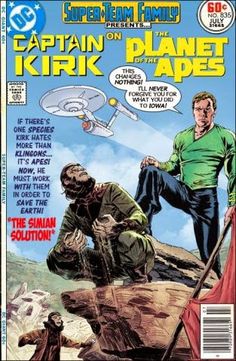
For whatever reason, reading the novel version of Apes made me think that.
Planet of the Apes, as a complex of stories, reveals itself to be all about language as the defining characteristic of humanity. It's not the tools, or the opposable thumb; lots of other animals have those. I read Jared Diamond's The Third Chimpanzee a while back, and one of the ideas I took away from that book is that pretty much everything unique about humanity comes down to degree, not kind. Other species have architecture, use tools, develop communication systems, and whatnot; we just have developed them in greater complexity.
Language, like species, evolves, and it does so virtually without artificial selection. Sure, people sometimes try to police the way we speak, and we've developed things like dictionaries that prescribe rather than just describe language, but most efforts are futile. We can more directly, if slowly, influence the course of certain species. Language, in the apes stories, signifies not merely sapience, but more importantly the capacity to transcend through defiance. The apes' first word is a defiant "no." Language also allows for classification--it's how Caesar, in Dawn, rationalizes killing Koba. Once you've got language, as the chimps in the novel demonstrate, you can keep secrets. It's also how people consolidate power.
The punchline to Boulle's novel is that the same thing that happened on the Betelgeuse planet (called Sorros in the novel--a name given by the humans but also, strangely, used by the apes as well) happens on Earth, too, while Ulysse's in space. There's a slight problem there: Ulysse's narrative ends with this arrival on earth and the realization that he's meeting apes instead of humans. The last line reveals that, then we jump straight to the vacationing couple. The narrative leaves unexplained how, then, Ulysse's manuscript got into space. If he left Earth again, why doesn't he write about what happened? If he didn't leave Earth, how'd it get into space?
The most plausible sequence of events, I think, puts him in space with apes in control (maybe going to visit Betelgeuse?). He smuggles his manuscript and, unable to write in it anymore, he jettisons it first chance he gets. This postulates an antagonistic relationship with the apes of Earth, but there's no reason to think it must be that way. What if they're excited to see him? They might have read of his space flight in history books or records and been waiting for him, wanting to see what he's like compared to the humans they know. That would make for the beginning of an interesting story.
***********************************************************************************
Well, that brings us to the end of the apes...for now. I hear there's another movie in the works, called War for the Planet of the Apes, set to be released next July. I suppose it will be good to revisit this topic then.
Wednesday, March 16, 2016
A Likely Story: Planet of the Apes...the novel

Planet of the Apes, 1963.
A couple is taking a pleasure cruise through the cosmos when they find a "message in a bottle" sort of thing. They read the manuscript inside, and it's the story of a man named Ulysse Merou, who was on the first manned interstellar flight. He and two other men went to a planet near Betelgeuse, on which they land. It's habitable for humans, and they soon find humans. Unfortunately, the people there are human in shape but not in mentality; they're animals, plain and simple--they can't talk. Soon, they're attacked by apes. Ulysse is captured and caged.
Soon he starts communicating with a receptive chimp named Zira, and eventually learns the apes' language. He demonstrates his intelligence before the apes at large, and is treated well for a while. We learn that Zira's fiance Cornelius is investigating ape origins, and the three go to an archaeological site that is older than anything apes have found. Ape history goes back about ten thousand years. At this site, they find evidence that ape civilization was preceded by a human civilization.
Cornelius eventually finds a way to make other humans talk through some weird brain science, and this somehow allows him to tap into racial memories through a woman. This reveals, luckily, exactly what they want to know about their history: namely, that human civilization did precede their own, and that humans began keeping apes as pets and servants, and that the apes slowly gained sapience, and eventually, over time, deposed humanity. Interestingly, when apes learned to talk, the first thing they did was refuse the humans' commands. It's easy to imagine this being Cornelius's story from Escape that the first ape word was "No" (dramatized in Rise).
Eventually the novelty of a talking man wears off among the apes--especially the orangutans. Ulysse has impregnated Nova, and she gives birth to a boy who shows all the signs of sapience. This of course poses a threat to the apes, and the orangutans and gorillas will certainly do something drastic in response. Zira and Cornelius conspire with some other chimps to get the new family off the planet, back to Ulysse's orbiting space craft, and back to earth.
Twist: Earth is now dominated by apes!
The novel ends with the couple finishing the manuscript, and commenting on how it's not plausible because of the intelligence it ascribes to humans. We learn what we've suspected all along: that the vacationing couple are chimps.
If a picture's worth a thousand words, how come there's so much more in a novel than in a film? A novel like Apes, which must be 80,000 words at the most, would only be worth 80 pictures. Film is thousands of frames--and each frame a picture--flickering at 24 per second, for, let's say 90 minutes. That's 7,776,000 pictures. Yet a novel feels richer. Without reducing things to raw data (pictures do take up a lot more space on a hard drive than the thousand words they allegedly represent) I have to say that we must call into question the meaning of "worth."
What I'm getting at is that the novel of Planet of the Apes feels so much denser than the film--any of the films. I love these movies; I'd go so far to say that I like them more than the book on which they're based. But they don't have a human mating dance (yep, that's something that happens in the novel), nor do they have the various speculations about the course of evolution. The narrator and characters in the novel assume a telos, a natural progression of evolution with a species dominating the planet even if they don't assume a specific end point. There's also a lot of discussion of the nature of ape as a verb--to imitate--and its relationship to the apes' sapience. The apes of the Betelgeuse planet are, strangely, stagnant when it comes to their culture, science, and development. It's implied that they haven't advanced since taking over for the humans ten thousand years before Ulysse's arrival. They can imitate, but not generate, if that makes sense. Some chimps are showing their intellect, but it's not many, and they're considered outliers by the orangutans and gorillas; they're not altogether trusted.
This stuff just doesn't fit in a movie very well.
I'm rambling on and on without end, so I think I'll continue this tomorrow.
Tuesday, March 15, 2016
The Best Stories in the World: KFR
There's this married couple, see, and they're about to celebrate their first anniversary. But their lives are hectic, almost out of control as they try to work hard enough to save money for their first house. Both are full-timers, staying late. So they decide to give themselves a break on their anniversary. On their way home, they pick up a bucket of Kentucky Fried Chicken. The husband sets out a picnic blanket on the floor, dims the lights, and pours the wine. The wife gets the plates. They chat and flirt and though things are tough, they see a bright future ahead of them. They don't mind that they're eating cheap food. Until the wife takes her first bite of a drumstick. There's something wrong with it, she says. It tastes weird, and it feels weird. The husband turns the lights up, and they see the tail of a rat hanging down from the battered and fried drumstick.
Is there a better urban legend than the Kentucky Fried Rat? Maybe. I don't know. Who cares? The rat is glorious. So glorious that it persists--just last year a dude reported receiving a rat instead of a chicken from the fast food restaurant. He even supplied photographic evidence. What's even better: the KFC in question had the offending meat tested at "a lab," which determined that it was chicken after all.
The story comes in lots of forms. One with a particular meaning places all the blame on the wife, who promises to cook for the husband but runs out of time, prompting her to get fast food and disguise it with fancy plates and napkins.
I remember teaching folklore right around the time that KFC changed its name to the initials instead of Kentucky Fried Chicken. My students insisted that they did so because their meat had been altered genetically to the point that it couldn't legally be called chicken anymore. Which is awesomely hilarious. I mean, why would anybody think KFC operates its own chicken farms? And believing this urban legend requires a person to believe that science has advance to the point that people can genetically engineer life forms without feathers, beaks, and the like. Sure, scientists can produce embryos with snouts instead of beaks, or turn on the gene that produces teeth, but things haven't progressed that much.
So why is this the best story in the world? Well, all urban legends comment directly on some element of society, some way that we're making ourselves uncomfortable. This one's about food preparation, reminding us that we probably put too much faith in overworked, underpaid teenagers when it comes to giving us things to eat, that we put too much faith in gigantic corporations that probably don't have our best interests in mind when it comes to giving us things to eat. So the story implicates her in the tragedy for not doing her wifely duty. Misogynistic or not, the story is about our failure to engage with our own lives in the important realm of sustenance. I also love it because, like all urban legends, it makes us shudder.
This legend goes back a few decades. Jan Brunvand writes about it in The Vanishing Hitchhiker. Gary Alan Fine devoted an article to it for the Journal of the Folklore Institute.
"If Colonel Sanders was to be careful how he worded it, he could actually advertise an extra piece."
Is there a better urban legend than the Kentucky Fried Rat? Maybe. I don't know. Who cares? The rat is glorious. So glorious that it persists--just last year a dude reported receiving a rat instead of a chicken from the fast food restaurant. He even supplied photographic evidence. What's even better: the KFC in question had the offending meat tested at "a lab," which determined that it was chicken after all.
The story comes in lots of forms. One with a particular meaning places all the blame on the wife, who promises to cook for the husband but runs out of time, prompting her to get fast food and disguise it with fancy plates and napkins.
I remember teaching folklore right around the time that KFC changed its name to the initials instead of Kentucky Fried Chicken. My students insisted that they did so because their meat had been altered genetically to the point that it couldn't legally be called chicken anymore. Which is awesomely hilarious. I mean, why would anybody think KFC operates its own chicken farms? And believing this urban legend requires a person to believe that science has advance to the point that people can genetically engineer life forms without feathers, beaks, and the like. Sure, scientists can produce embryos with snouts instead of beaks, or turn on the gene that produces teeth, but things haven't progressed that much.
So why is this the best story in the world? Well, all urban legends comment directly on some element of society, some way that we're making ourselves uncomfortable. This one's about food preparation, reminding us that we probably put too much faith in overworked, underpaid teenagers when it comes to giving us things to eat, that we put too much faith in gigantic corporations that probably don't have our best interests in mind when it comes to giving us things to eat. So the story implicates her in the tragedy for not doing her wifely duty. Misogynistic or not, the story is about our failure to engage with our own lives in the important realm of sustenance. I also love it because, like all urban legends, it makes us shudder.
This legend goes back a few decades. Jan Brunvand writes about it in The Vanishing Hitchhiker. Gary Alan Fine devoted an article to it for the Journal of the Folklore Institute.
"If Colonel Sanders was to be careful how he worded it, he could actually advertise an extra piece."
Monday, March 14, 2016
Scars make you strong: Dawn of the Planet of the Apes

Dawn of the Planet of the Apes, 2014, directed by Matt Reeves.
It starts with apes fighting a bear and hunting deer. It's been ten years since the battle on the Golden Gate Bridge, and the apes are doing well in their new Redwood home. They haven't seen humans in a couple of years, so they get kind of disturbed when a few show up in their park. Caesar (Serkis again) leads a party to the human stronghold in the city and tells them to stay away. Of course the humans don't--they went into the forest in the first place to try to get a dam working so they can maintain their electricity. See, civilization sort of fell apart after Rise, what with the super-virus killing ninety-some percent of humanity.
Caesar lets the humans get at the dam, but one chimpanzee in particular--Koba (Toby Kebble)--isn't happy with it. Koba was mistreated, scarred, and experimented on by humans, so he's more than a little bit angry at the whole species. He goes to the city and finds out that humans are stockpiling their weaponry. He then steals some guns, and shoots Caesar. But nobody sees him do it, so the rest of the apes are convinced when Koba says that a human did it. Based on that, Koba is able to lead the apes in an attack on the humans, using the guns they stole and a bunch of horses that they got from who knows where. Lots of dudes and apes die.
But Caesar isn't dead, and the humans who were with the apes take him back to the house where Rodman raised him. There they fix him up, and he goes to confront Koba. The two fight, and Caesar lets Koba fall to his apparent doom. That last bit is important, because one of the ape rules is "Ape Not Kill Ape." Koba recites this to Caesar at the end, but Caesar replies, "You are not ape" before dropping him.
It's pretty grim stuff, but compelling. It's more or less a meditation on the origins and necessities of civilization. Caesar begins the movie with a scowl, which lasts until he's shot. Not even the birth of his second son cheers him up. Once he's revived by the humans, his scowl becomes a frown and he spends the rest of the movie being sad.
Caesar's a great character, but even so when I was watching this movie the first time I was disappointed by it. The whole plot with the dam felt a little light-weight for a movie about revolution and apocalypse. But this time I saw it for what it was--an excuse to throw the humans into conflict with the apes. That's why it doesn't matter that they get the dam going almost immediately. This movie borrows quite a bit from the end of the earlier apes franchise, Battle for the Planet of the Apes, in which Caesar goes into the ruins of the city to find some old recordings of his parents. It doesn't so much matter there, either, why the two groups come into conflict--though in that film the humans attack the apes' settlement. Dawn reverses that.
Battle and Dawn both highlight the ambivalence of civilization. Neither side can claim to be wholly good. Caesar's decision to drop Koba at the end highlights this. In Battle, the conflict among the apes is also inter-species; Koba's role is filled by a gorilla general named Aldo, and Aldo falls to his death through no action of Caesar's. Chimps dominate Dawn. One orangutan, Maurice from the previous film, gets some screen time, and there are gorillas, but not named or given anything to do but be intimidating.
Where Battle felt unnecessary to me because Caesar had rejected violence at the end of Conquest, this one isn't about rejecting violence. It's about, in some ways, purging the violent or undesirable element...through violence. That's the bleak part about it. It seems to be saying that civilization will always have that element, no matter how you try to eradicate it. Even redefining the problem doesn't get rid of it; it's merely rationalization. Once the apes have language, what do they do with it?
I've been interested in these movies partly because of the potential to explore a culture of another species. It's one thing that speculative fiction can do really well when it wants to--show us how someone other than us solves the same problems we encounter. Speculative ethnography. In the apes movies, we get very little culture (movies really aren't suitable to any sort of deep depiction). So we see that the female chimps attending Cornelia's labor are wearing weird face veils, which they may or may not wear during other times (not all of them wear the veils, which seem to be made of shells or something, can't really tell). The standard is to show viewers an education scene, in which kids are being taught something. Battle did that, making it fit into the conflict between the gorilla and chimpanzee ways of doing things, and showing us the second-class (or maybe fourth-class) status humans endured so soon after the revolution. Dawn gives us one such scene, during which apes are being taught by Maurice. That's where we first see the "Ape Not Kill Ape" rule. We also see their sign language, since even the best of them can speak only haltingly, with great difficulty. I'm no expert on sign language, but it looks like they've developed their own based on what Maurice and Caesar knew before their escape. I like that about the film.
Friday, March 11, 2016
Superman Links
I was surprised to learn that the Batman/Superman movie is coming out in two weeks. That explains why there are so many articles about Superman on various websites. Here are a few that seem interesting.
The m0vie blog is running a series of retrospectives examining Batman and Superman comics stories. Here's the one on Superman Unchained; one on Morrison's Action Comics run, and on about Superman and the Joker.
Speaking of the movie, IO9 put up this article about how Zack Snyder has responded to criticism of the ending of Man of Steel.
"There's nothing wrong with Superman, and hating him only proves there's something wrong with us."
The m0vie blog is running a series of retrospectives examining Batman and Superman comics stories. Here's the one on Superman Unchained; one on Morrison's Action Comics run, and on about Superman and the Joker.
Speaking of the movie, IO9 put up this article about how Zack Snyder has responded to criticism of the ending of Man of Steel.
"There's nothing wrong with Superman, and hating him only proves there's something wrong with us."
Thursday, March 10, 2016
Your ape...he spoke: Rise of the Planet of the Apes

Rise of the Planet of the Apes, 2011, directed by Rupert Wyatt.
At Gen-Sys, a laboratory in San Francisco, Will Rodman (James Franco) is trying to cure Alzheimers's disease with some kind of virus. They test on apes, and one of them shows results. But that ape goes on a rampage and is killed. They then discover that she has a son. Ordered to kill all the apes, Rodman brings the baby home to hide him. They name the baby Caesar (Andy Serkis).
Caesar inherited whatever changes the virus/drug wrought on his mother--specifically, he's extremely intelligent. Pan sapiens. Eventually his presence in Rodman's house is discovered (eight years later) and Caesar is taken to an ape sanctuary place. He's tormented by the apes and the men who run the place. But he's smart, and rises to the top of the food chain among the apes. He then steals the virus that Rodman used to make them smarter and exposes the rest of the apes to it. Then the apes kill one of the guys who run the place and escape. They set loose the apes from the zoo and Gen-Sys lab, and make their way to a redwood park north of the city. On the way, they wreak havoc in the city and confront the authorities on the Golden Gate Bridge. They win the big battle, and go to the park to make their new home.
Then there's the virus. Rodman gave it to his father to see if it would work, and it does for a while. Then the Alzheimer's gets worse, so Rodman makes the drug/virus more aggressive. During one trial on a chimp (named Koba), one of the guys in the lab is exposed to the new virus. He gets sick, spreads the sickness to a pilot, and dies. The pilot then spreads the virus, and eventually it goes global.
Also, we're told that NASA has launched the first manned mission to Mars, which disappears.
This is Caesar's movie. Andy Serkis and the technology are great. I like the story itself, which has an ambiguous relationship with the previous Apes movies. Based on just this film, we can say for sure that Escape, Battle, and Conquest didn't happen, at least not precisely the way they played out. This Caesar isn't the son of Zira and Cornelius. Yet the mission to Mars leaves open the events of the first two films.
What I like about this film is that it jettisons the time travel components. I found Taylor going forward in time okay, but once the apes came backward and planted the seed for apes evolving and taking over, I was sort of disappointed. I'm not much of a fan of stories that devolve into a "loop of inevitability." It's okay, but it's not terribly compelling. At least to me.
In addition, this film provides a more realistic way for the apes to develop intelligence. Instead of a single generation, in which apes evolve without any explanation (as in Conquest), we're given the Alzheimer's therapy. It's still easy, but it allows for several generations to develop sapience and fully upright posture. And the fact that Caesar inherits the changes allows us to accept, if we want, that he's even more developed than the first generation. He can talk, which means that the difference is physical, not merely neurological.
Then there's the virus, which allows humanity to descend as the apes rise. So from my reading, Rise presents a more streamlined (as in no time travel) sequence of events for the ape ascension. It also shows them as being apes, which makes sense because they're just regular apes for most of the movie.
There are still references to Apes 68--"Bright Eyes" being the first. And Draco Malfoy utters Heston's "stinking paws" line. I watched one of the special features and learned that the writers named the drug ALZ112 because the first apes movie was 112 minutes long. That's...well...I guess, why not? Apparently the story took shape because of the little bit of ape lore from Escape, in which Cornelius tells us that the first ape to speak said, "No." In the earlier version, the defiant ape certainly wasn't Caesar. Still, I like that they went that way with it.
It's Caesar's movie, and it's only because of him that it works. In the beginning, I pitied him. He was stuck in the house, watching the world around him, unsure of what kind of creature he was. It gets worse when he's taken to the sanctuary, beaten by Rocket the chimp. Then the emotion he evokes changes; he becomes chilling as he takes over. When he's teaching the apes sign language and the human owner of the sanctuary sees him, the look on Caesar's face is calculating, cold, and confident. At this point, he's kind of a villain, from a certain point of view.
It's interesting that the movie doesn't make any substantial comment on the animal drug trials. We're not invited to condemn Rodman for testing on chimps. We might interpret the virus and the subsequent downfall of human civilization as comment enough, but it's not framed that way (and by Dawn, the drug is all but forgotten, along with Rodman). We are invited to despise Rodman's boss, whose motivation for sponsoring the drug research isn't so much to cure a disease as it is to make money. His story doesn't end well. Rodman's, on the other hand, who illegally tries the drug on his own father and illegally keeps a chimp (though it might be legally done; we don't get the details), doesn't really end at all. He wants to help Caesar, and he's turned away at the end.
Yet we're invited to root for the apes. Americans tend to root for the underdogs, and a bunch of apes facing off against machine guns and helicopters is an underdog story. Point of view matters a lot in the apes movies. Who's dehumanized, who advocates war and bloodshed, who faces insurmountable odds? These questions matter. I'm reminded of the shift in tone that happens during Escape; in the first bit, things are meant to be light and fun, but then Cornelius has to kill a dude, and things get tense for the rest of the series. Here, we begin with pity, for Caesar as well as for Rodman and his father. That leads to simultaneously rooting for Caesar to escape and worry about what will happen when he does. Is Caesar a hero? Of course; he's an ape hero. And we're apes, albeit with considerably less hair.
Watching this film, you can't ignore the ambiguous relationship it has with its predecessors. Will things turn out as they do in Apes 68, with an ape society that's strictly hierarchical in terms of its distribution of knowledge, that's slave-based, that's essentially no better than anything humans have come up with? Or will Caesar learn anything from how he was treated and pass that on? Then again, Apes 68 takes place well into the future, so things will have changed regardless. Caesar's best intentions might not matter in 1500 years. A lot of movies can take place during that time frame.
Wednesday, March 9, 2016
The Best Stories in the World: Ali of Persia
I'm calling it right now: "Ali of Persia" is the greatest story in the world...I write that with only a little irony.
In the story Shahrazad tells from nights 294 to 296 of the 1001 Nights, Haroun al-Raschid, protector of the faithful, is bored. He calls for a story, and this is what he gets:
This guy named Ali (he's from Persia, as you've probably figured, but he lives in Baghdad) goes to Cairo. When he arrives, this other guy comes up and grabs his satchel, claiming that he lost it yesterday. The two of them fight over it, and they're taken to the qadi (i.e., a judge). "Tell me what's in the bag," says the qadi, quite sensibly. "Whosoever gets it right is the rightful owner."
The thief goes first. He says (and it's worth quoting directly from Malcolm C. Lyons's translation): "In it there are two silver kohl sticks, together with kohl for my eyes, a hand towel in which placed two gilt cups and two candlesticks. There are two tents, two basins, a cooking pot, two clay jars, a ladle, a pack needle, two provision bags, a cat, two bitches, on large bowl and two large sacks, a gown, two furs, a cow with two calves, one goat, two sheep, a ewe with two lambs, two green pavilions, one male and two female camels, a buffalo, two bulls, a lioness and two lions, a she-bear, two foxes, a mattress, two couches, a palace, two halls, a colonnade, two chairs, a kitchen with two doors and a group of Kurds who will bear witness to the fact that this is my bag."
That having been said, and without batting an eye at the list, the qadir asks Ali what's in the bag. Ali says, "...one little ruined house and another one with no door, a dog kennel and a boys' school, with boys playing dice. It had tents and their ropes, the cities of Basra and Baghdad, the palace of Shaddad ibn 'Ad, a blacksmith's forge, a fishing net, sticks, tent pegs, girls, boys, and a thousand pimps who will testify that the bag is mine."
Then the first guy strengthens his case: "In it are fortresses and castles, cranes, beasts of prey, chess players and chessboards. there is a mare and two foals, a stallion and two horses, together with two long spears. It also has a lion, two hares, a city and two villages, a prostitute with two villainous pimps, a hermaphrodite, two good-for-nothings, one blind man and two who can see, a lame man and two who are paralyzed, a priest, two deacons, a patriarch and two monks, a qadi and two notaries, and these will bear witness that this is my bag."
The qadi gives Ali one last chance to prove it's his bag, and Ali says, "In this bag of mine is a coat of mail, a sword and stores of weapons. there are a thousand butting rams, a sheep-fold, a thousand barking dogs, orchards, vines, flowers, scented herbs, figs, apples, pictures and statues, bottles and drinking cups, beautiful slave girls, singing girls, wedding feasts with noise and tumult, wide open spaces, successful men, dawn raiders with swords, spears, bows and arrows, friends, dear ones companions, comrades, men imprisoned and awaiting punishment, drinking companions, mandolins, flutes, banners and flags, boys, girls, unveiled brides and singing slave girls. There are five girls from Abyssinia, three from India, four from al-Medina, twenty from Rum, fifty Turkish girls and seventy Persians, eighty Kurdish girls and ninety Georgians. The Tigris and the Euphrates are there, together with a fishing net, flint and steel for striking sparks, Iram of the Columns and a thousand good-for-nothings and pimps. there are exercise grounds, stables, mosques, baths, a builder, a carpenter, a plank of wood, a nail, a black slave with a fife, a captain and a groom, cities and towns, a hundred thousand dinars, Kufa and al-Anbar, twenty chests filled with materials, fifty storehouses for food, Gaza, Ascalon, the land from Damietta to Aswan, the palace of Chosroe Anushirwan, the kingdom of Solomon and the land from Wadi Nu'man to Khurasan, as well as Balkh and Isfahan and what lies between India and the land of the Blacks. It also contains--May God prolong the life of our master the qadi--gowns, turban cloth and a thousand sharp razors to shave off the qadi's beard, unless he fears my vengeance and rules that the bag is mine."
Acknowledging the oddity of what he has just heard, the qadi orders the bag opened. In it were a piece of bread, lemons, cheese, and olives.
The caliph Haroun al-Raschid hears this and laughs until he falls over.
This story is often referred to as "The Wonderful Bag," and believe it or not it has been illustrated as a children's book. Also, heaven help us, it was adapted for theater.
So why is this the greatest story in the world? Seriously? Didn't you just read it? What in the world is going on with this story, do you think? Why would someone invent it? There's probably some clue to be found in the escalation of items found in the bag. I don't know. Honestly, my favorite part is that Ali says the bag contains "wide open spaces."
In the story Shahrazad tells from nights 294 to 296 of the 1001 Nights, Haroun al-Raschid, protector of the faithful, is bored. He calls for a story, and this is what he gets:
This guy named Ali (he's from Persia, as you've probably figured, but he lives in Baghdad) goes to Cairo. When he arrives, this other guy comes up and grabs his satchel, claiming that he lost it yesterday. The two of them fight over it, and they're taken to the qadi (i.e., a judge). "Tell me what's in the bag," says the qadi, quite sensibly. "Whosoever gets it right is the rightful owner."
The thief goes first. He says (and it's worth quoting directly from Malcolm C. Lyons's translation): "In it there are two silver kohl sticks, together with kohl for my eyes, a hand towel in which placed two gilt cups and two candlesticks. There are two tents, two basins, a cooking pot, two clay jars, a ladle, a pack needle, two provision bags, a cat, two bitches, on large bowl and two large sacks, a gown, two furs, a cow with two calves, one goat, two sheep, a ewe with two lambs, two green pavilions, one male and two female camels, a buffalo, two bulls, a lioness and two lions, a she-bear, two foxes, a mattress, two couches, a palace, two halls, a colonnade, two chairs, a kitchen with two doors and a group of Kurds who will bear witness to the fact that this is my bag."
That having been said, and without batting an eye at the list, the qadir asks Ali what's in the bag. Ali says, "...one little ruined house and another one with no door, a dog kennel and a boys' school, with boys playing dice. It had tents and their ropes, the cities of Basra and Baghdad, the palace of Shaddad ibn 'Ad, a blacksmith's forge, a fishing net, sticks, tent pegs, girls, boys, and a thousand pimps who will testify that the bag is mine."
Then the first guy strengthens his case: "In it are fortresses and castles, cranes, beasts of prey, chess players and chessboards. there is a mare and two foals, a stallion and two horses, together with two long spears. It also has a lion, two hares, a city and two villages, a prostitute with two villainous pimps, a hermaphrodite, two good-for-nothings, one blind man and two who can see, a lame man and two who are paralyzed, a priest, two deacons, a patriarch and two monks, a qadi and two notaries, and these will bear witness that this is my bag."
The qadi gives Ali one last chance to prove it's his bag, and Ali says, "In this bag of mine is a coat of mail, a sword and stores of weapons. there are a thousand butting rams, a sheep-fold, a thousand barking dogs, orchards, vines, flowers, scented herbs, figs, apples, pictures and statues, bottles and drinking cups, beautiful slave girls, singing girls, wedding feasts with noise and tumult, wide open spaces, successful men, dawn raiders with swords, spears, bows and arrows, friends, dear ones companions, comrades, men imprisoned and awaiting punishment, drinking companions, mandolins, flutes, banners and flags, boys, girls, unveiled brides and singing slave girls. There are five girls from Abyssinia, three from India, four from al-Medina, twenty from Rum, fifty Turkish girls and seventy Persians, eighty Kurdish girls and ninety Georgians. The Tigris and the Euphrates are there, together with a fishing net, flint and steel for striking sparks, Iram of the Columns and a thousand good-for-nothings and pimps. there are exercise grounds, stables, mosques, baths, a builder, a carpenter, a plank of wood, a nail, a black slave with a fife, a captain and a groom, cities and towns, a hundred thousand dinars, Kufa and al-Anbar, twenty chests filled with materials, fifty storehouses for food, Gaza, Ascalon, the land from Damietta to Aswan, the palace of Chosroe Anushirwan, the kingdom of Solomon and the land from Wadi Nu'man to Khurasan, as well as Balkh and Isfahan and what lies between India and the land of the Blacks. It also contains--May God prolong the life of our master the qadi--gowns, turban cloth and a thousand sharp razors to shave off the qadi's beard, unless he fears my vengeance and rules that the bag is mine."
Acknowledging the oddity of what he has just heard, the qadi orders the bag opened. In it were a piece of bread, lemons, cheese, and olives.
The caliph Haroun al-Raschid hears this and laughs until he falls over.
This story is often referred to as "The Wonderful Bag," and believe it or not it has been illustrated as a children's book. Also, heaven help us, it was adapted for theater.
So why is this the greatest story in the world? Seriously? Didn't you just read it? What in the world is going on with this story, do you think? Why would someone invent it? There's probably some clue to be found in the escalation of items found in the bag. I don't know. Honestly, my favorite part is that Ali says the bag contains "wide open spaces."
Monday, March 7, 2016
Get your hands off me: Planet of the Apes (2001)
 What does it say about a movie that I can't pick out any memorable lines, even though I finished watching it less than one minute ago? All that lingers are references to Apes 68, and that weird run through the ape caves when the humans are escaping.
Planet of the Apes, 2001, directed by Tim Burton.
The movie starts on a space station, testing chimps (and, apparently, other apes) as pilots to go into situations that might be dangerous for humans. A few minutes in, and they send out a chimp named Pericles to explore this weird space storm thing. When they lose contact, a pilot named Davidson (Mark Wahlburg) steals a ship and goes after it. Things get all screwy because of the storm, and Davidson crashes on a planet. His ship sinks.
Almost immediately, a bunch of people almost run right into him. They're being chased by apes, who capture a lot of them, including Davidson. He's given to an orangutan named Limbo, apparently for some sort of experimentation. It's never clear to me what's supposed to happen. While being sized up, Davidson grabs a sympathetic ape named Ari (Helena Bonham Carter), threatening her in order to get free. Instead, for some reason, Ari agrees to buy him from Limbo. So, along with the pretty girl with whom he was captured, he's now a slave in Ari's house. They escape, bringing along Ari's dad and brother (?). The dad dies along the way. For whatever reason, Ari and her gorilla friend Krull go with them, and they capture Limbo along the way. A bunch of other junk happens, and eventually the group finds the space station ship thingy from the beginning of the movie. Even though it's apparently been a whole long time, the batteries still work, so they learn that the apes on the ship--who have been tampered with scientifically--eventually killed everybody and are apparently the ancestors of the sapient apes on the planet.
The apes have followed the gang to the ship, and they attack. When things look bleak for our heroes, the ape test pilot Pericles shows up. This confuses people and the fighting stops. Then Pericles goes into the ship--that's what he was trained to do--followed by the bad ape general and Davidson. There's some irrelevant fighting, and then it's over. And Davidson gets in Pericles's ship and tries to get back home. He leaves Pericles behind for some reason. Anyway, he goes back through the storm and crashes on Earth, which is now dominated by apes.
It's not a great movie. When Davidson and his gang arrive at the old ship, all of a sudden all these other people show up and start treating him like he's the messiah or something. It's weird, and out of nowhere, and doesn't contribute to the story or character development other than to have a bunch of humans there to fight the ape army when they arrive. Then there's the chase scene, in which Davidson et. al. run through a bunch of apes' bedrooms in caves because there don't seem to be any doors on anybody's rooms. This is where we learn some stuff about the apes' lives (worshiping, doing weird mating dances, etc.), but it plays so strangely that I can't even say any more about it.
The ape effects are great, though. Rick Baker is, of course, the best there is at this stuff. There was a lot of attention to ape behavior, from facial tics to the way they walk and run. There's even a moment of brachiation that no other Apes film has bothered to show us. And the male orangutans actually have cheek pouches. However, and oddly, the movie seems to think that apes have incredibly strong legs, capable of standing long jumps that put Olympic athletes to shame. That's a weird thing for them to evolve.
The previous Apes movies have all explored some aspect of something beyond themselves. In the first, it was dehumanization and the nature of civilization, with a bit of youth culture commentary thrown in. Others were about what makes us human, over and against what makes an animal in our eyes, or the threat of nuclear annihilation, or the cost of violence. Stuff like that. I can't really say that this film is about anything other than Planet of the Apes movies. There's stuff in here that only works if you've got knowledge about the previous films, and it suffers for that.
I'm not really sure what they were going for with that ending, though. Where were they going to take it for a sequel? I guess it doesn't really matter. Like gigantopithecus, this one's an evolutionary dead end.
Thursday, February 25, 2016
The greatest danger of all is that danger never ends: Battle for the Planet of the Apes

Battle for the Planet of the Apes, 1973, directed by J. Lee Thompson.
We see that the gorillas are militant, the chimps are smart, and the orangutans are...there. Half a generation or so has passed since the night of fires, and ape society is doing its best. Humans are second-class, if that. They're not allowed to say "no" to an ape. The gorillas are all for exterminating what few humans there are. Things aren't going well, so MacDonald (not the black guy from Conquest, but his brother, which is weird; they even refer to the brother, but he's not in it, just like this brother was referred to in Conquest but wasn't in it) tells Caesar, who's in charge, about tapes that will allow Caesar to hear his parents talk and help him figure out how to deal with the problems in his society. Caesar, MacDonald, and an orangutan named Virgil to go to the nearest city. They do hear the tapes, and find out how bad things turn out--for both humans and apes.
But of course the mutants living under the city discover them. They follow the group and find their settlement, and decide to destroy it. They've got lots of guns and bombs, see.
Back at the settlement, the gorillas are trying to take over. Caesar's son Cornelius overhears the gorillas' plans, so the gorillas (well, the lead rabble-rouser Aldo anyway) tries to kill the kid. He only partly does the job. Then the humans attack, and the apes defeat them.
With his dying breath, Cornelius reveals that Aldo is his killer. When everyone learns that Aldo has violated the inviolable ape rule of "Ape shall never kill ape," they forsake his attempt to take over. Caesar confronts him, though it's not a fight. They just climb a tree and Aldo falls out, to his death.
There's a framing mechanism, in which the Lawgiver is telling the story of this battle. At the end, we learn that he's teaching it to a bunch of human and chimp kids. So learning about the past has, at least six hundred years in the future, allowed Caesar and those who come after him to make a different future than the one that Taylor found in the first two films. Then, we see a statue of Caesar, and for some reason it's crying.
What a horrible way to end the movie, and the series. Why in the world is that statue crying?
Anyway, the coolest thing about the movie is that John Huston plays the Lawgiver. What a great voice. As great as Ian McKellan was as Gandalf, Huston's version from the Rankin/Bass cartoons is the one I hear in my head (though I couldn't reproduce it well when I read Lord of the Rings to my son the first time).
The apes' fashion doesn't change in the thousand years or whatever it is between this movie and the future of the first film, when Taylor arrives. Neither does their English. The fact that everybody speaks English is hard to get around, and I'm willing to forget that. But that they wear exactly the same clothing, divided by species? Not so much.
There's some effort devoted to making the apes move like apes, but it's mostly confined to the way they run and facial twitching. C for effort.
I'm not crazy about the villain falling to his death. It's a cheat, a way that allows for resolution without requiring the hero to kill.
I couldn't get into this movie. It just seemed so unnecessary to me. I see what they're going for, in establishing that Caesar steers the future away from what Taylor found, but I feel like this was maybe the least interesting way to go about it. And the proto-mutants, who worship the nuclear weapon that Taylor eventually sets off, aren't very interesting. I'm not sure what I was looking for in this movie, which I don't think I'd seen before (except in its more recent reconfiguration as Dawn of the Planet of the Apes), but this wasn't it.
Wednesday, February 24, 2016
In case you were wondering exactly what kind of nerd I am...
So the other day I was listening to The Beatles's "Across the Universe." Now, the thing about me you need to understand is that I can't understand song lyrics. I mean, I never know exactly what the words are unless I read them. I usually just have to make them up if I want to sing along in my head, because I'm not one to look them up.
So, "Across the Universe" is on, and for the first time I realize that I have no idea what the chorus is. Never have. It doesn't even sound like it's in English (and it isn't, of course). I understand that "Nothing's gonna change my world" well enough, but what's that next line? You probably already know what it is--this is the Beatles, after all. You want to know what I'd thought it was, for like the last two decades?
"Shai Hulud Avon."
Yup, I thought John Lennon was singing about the sand worms from Dune.
And, yeah, I just accepted that I didn't understand the last bit.
Turns out he was singing "Jai Guru Deva Om," a transcendental meditation mantra about dispelling darkness and enlightenment and whatnot. Apparently he learned that from some bracelets he got in India.
So, "Across the Universe" is on, and for the first time I realize that I have no idea what the chorus is. Never have. It doesn't even sound like it's in English (and it isn't, of course). I understand that "Nothing's gonna change my world" well enough, but what's that next line? You probably already know what it is--this is the Beatles, after all. You want to know what I'd thought it was, for like the last two decades?
"Shai Hulud Avon."
Yup, I thought John Lennon was singing about the sand worms from Dune.
And, yeah, I just accepted that I didn't understand the last bit.
Turns out he was singing "Jai Guru Deva Om," a transcendental meditation mantra about dispelling darkness and enlightenment and whatnot. Apparently he learned that from some bracelets he got in India.
Thursday, February 18, 2016
Now that I know they won't kill me, I don't enjoy them: Conquest of the Planet of the Apes
 Roddy McDowall returns as his own ape son. Armando (Ricardo Montalban) is back, too. This film follows from the more intense ending of the last. There's little humor, lots of social commentary, even a black guy, which allows for some reflection on race.
Conquest of the Planet of the Apes: 1972, directed by J. Lee Thompson.
The story starts 20 years after Escape, at which point apes have already gone from pets to slaves in the wake of the space virus that killed all the dogs and cats (no mention of the fate of pet fish, hamsters, and birds, though I presume they're dead, too). Caesar (now all grown up) is brought to town--though I don't think which city they're in is ever stated--by Armando to advertise the circus. The ape has a hard time seeing how humanity treats the apes, and when one ape is being beaten badly, Caesar yells at the police. Since he's not supposed to be able to talk, the police confront them. Caesar runs, but Armando goes to the police so as to try to avoid suspicion of Caesar being Cornelius and Zira's son. Caesar blends in with the rest of the apes, and is eventually bought by the mayor. Armando, meanwhile, dies in police custody after trying to deny that Caesar is intelligent. Caesar finds out, and his hatred for humanity increases.
Eventually, the mayor finds out that Caesar is the talking ape. He orders an execution, but his assistant MacDonald, who just happens to be black, balks at the idea--even after he learns that Caesar can talk. So MacDonald saves Caesar, who then gets out and organizes and ape revolution. They take over the city, and Caesar at first calls for ape rule and what sounds like brutality toward humanity. Then he steps back and says that they'll show mercy to the mayor and others. The city is burning.
Okay, a couple of things. First, that last scene is pretty weird. The apes have won the city, and they've got the mayor in their hands. The gorillas stand ready to execute him, and at first Caesar is going to give the order. But MacDonald tells him that this wasn't supposed to be how it was and he shouldn't be so violent. Then Caesar gives a rousing speech about taking over and ruling and making humans their servants. At the end, I expected all the gorillas to cheer, but everybody just stood there quietly for a moment. Then a few gorillas raised their weapons like they're going to kill the mayor, but the woman chimp speaks for the first time and says, "No." Caesar then tells everybody that they're going to be kinder than the humans have been to them. And the film ends.
Second, at one point MacDonald is talking to the (white) mayor about treating the apes like slaves. The mayor says, "All of us were slaves once, in one sense or another." And MacDonald doesn't so much reply--he's only the assistant, after all.
There's a lot more ape behavior in this one, since there are a lot more apes that aren't so far removed from their current evolutionary form. Except for Caesar, they can't talk yet. So there's lots of grunting and arm waving; at the beginning, Armando even has to teach Caesar to walk more like an ape, using his shoulders more, so he fits in. Yet all the apes walk more upright than their wild forebears, and they've got hands that are more like human hands. And the female chimp talks at the end. Those are huge evolutionary changes in a single generation. So, now, let's deconstruct that notion.
Conquest is set in the 1990s, at which time humans have already been far into outer space. Things are different, especially when it comes to science. They've got suspended animation, which we learned in the first Apes movie. So why not advances in evolutionary biology: let's say that, upon adopting apes as pets, and discovering just how useful they were as servants/slaves, people started modifying them. A more upright posture would free the hands for more tasks. Following that, modify the fingers and thumb for better tactile use. But don't give them speech--they still know Zira and Cornelius's tale about the end of human civilization and fear talking apes. I actually think it makes more sense for the government to be afraid of talking apes if they'd set apes down a different evolutionary path already. They're afraid of their own creation. Why not?
I liked this movie a lot. There's an extended sequence in which we see the apes preparing themselves for revolution. They do apparently simple things in protest, like keep a lighter away from the lady who utters the quotation I put in the title of this post. Or polish a guy's sock instead of his shoe. Or dump over trash and start stomping on it. And in the background of all these acts of protest, Caesar watches, nodding his approval. Caesar goes from a guy being swept up in something to an underground guerrilla leader. It's pretty cool. I liked watching his struggle with the fact that he couldn't speak or he'd give himself away.
Monday, February 15, 2016
So were your mother and father: Escape from the Planet of the Apes

Escape from the Planet of the Apes: 1971, directed by Don Taylor.
The movie opens with Taylor's space ship in...an ocean. Some military guys bring it to shore and out come Zira, Cornelius, and and ape we've never met before named Milo (he dies early on). The apes don't talk, and they're taken to a zoo infirmary where, eventually, they reveal to a veterinary psychologist (Dr. Bratton) that they are intelligent. They're brought before a committee and show the world that they can talk and whatnot. There follows some lighthearted scenes of the apes in human society, buying clothes, drinking wine, hobnobbing, and the like. But there's another scientist, a time travel expert sort of guy named Hasslein, who finds holes in their story and eventually learns that the apes rule the earth in the future and that the planet gets destroyed. Hasslein becomes convinced that the only way to save the future is to kill the apes--including Zira's unborn child. The apes are taken into custody, but they escape, killing a guy in the process. The hunt is on, and Bratton hides them in a circus run by a guy named Armando (played by Ricardo Montalban of all people). Zira has her child--born about the same time as another chimp at the circus. But for reasons I can't recall, the apes can't stay in the circus. Instead, they hide in an old shipyard. They're found, and all three are killed. Another bleak ending...or is it.
Of course not. They need more sequels. So, as was hinted earlier, Zira switched her own baby with that of the other chimp mother at the circus. Armando is fully aware of this, and it's with him and baby Milo that the movie ends. Milo proving his lineage by saying "mama."
Maybe the most interesting thing about this movie is the jarring shift from the apes romping about town with their human entourage and the murderous last act. After the previous movies, you've got to know that something bad is coming, but, man...
As with the previous movies, there's not much interrogation of the concept that an evolved ape would be appreciably different from a human being. There's no distinctly chimpanzee behavior displayed by the adult apes, though the newborns are, interestingly, played by actual apes. Apart from the scene in which one is shot four times, of course. There are a couple of vocalizations on the part of Roddy McDowell/Cornelius that veer toward simian in character, again when he's distressed, but that's it.
We get more of the future history of earth, though, which is interesting. We learn about the plague that killed all the pets and, I think, inspired the direction of the two most recent films. We learn that, though the apes speak English, they don't know it by that name. We learn that people started keeping apes as pets, and that eventually apes gained sapience and learned to talk through close contact with humans.
There was an opportunity to critique the culture of the time, with the apes being clothed in human trappings, but it's largely not taken. This isn't that kind of movie, though I wish it would have been, at least a little. A little less plot, a little more of the ape perspective on 1970s America could have been really interesting.
Still, I liked this movie. I don't recall anything about its two sequels, though, so I'm interested to see where they go.
Thursday, February 11, 2016
A Green and Insignificant Planet: Beneath the Planet of the Apes
 Beneath the Planet of the Apes is a pretty strange follow-up to the first film. That BBC piece I mentioned last time refers to the fact that Boulle was unable to write an acceptable sequel to the film, though it gives no explanation as to why. It's hard not to wonder what the studio wanted, how much Heston wanted to be involved, etc. Heston's only in it for what amounts to maybe three scenes (surprisingly, because he wanted nothing to do with the film).
 Beneath the Planet of the Apes: 1970, directed by Ted Post
The story goes like this...Another space ship--sent to rescue Heston's character Taylor, whose comrades are never mentioned--lands on future-Earth, and its sole survivor, Brent (who looks more than a little like Taylor) runs into Nova, alone on the horse she and Taylor took at the end of the last film. We learn from a flashback that Nova and Taylor encountered some strange things as they wandered along, and Taylor vanished into a rock wall that appeared out of nowhere and then disappeared. Nova takes Brent to the ape city, where he witnesses some hawkish military rhetoric by a gorilla leader. Nova then takes Brent to Zira and Cornelius, who basically just tell them to leave before they're caught. They're caught anyway, but escape with Zira's help. The gorilla war party heads toward the forbidden zone to kill somebody...I got kind of lost as to why they felt the need to go to war against an enemy they hadn't even seen. Brent and Nova find a "human" group living underground and worshiping an atomic bomb. The humans are psychic and can create illusions and control people's minds. They throw Brent in prison with Taylor (surprise!) and force them to fight. Nova shows up and for the first time speaks--Taylor's name. This distracts the "human" forcing them to fight, and the good guys kill him. By this time the gorillas have arrived, killing the "humans" and coming to the room with the bomb. That's where Brent and Taylor are headed, too (Nova dies along the way, shot by a gorilla). So Taylor gets shot, Brent gets shot, and as he dies Taylor sets off the bomb. The film ends with somebody narrating: "In one of the countless billions of galaxies in the universe lies a medium-sized star, and one of its satellites, a green and insignificant planet, is now dead." Roll credits.
Cheerful stuff. Not what anybody expected in 1970, I'm guessing. I remember being particularly shocked when Heston got shot. It just seemed so unlikely.
Anyway, in dealing with stories, I like to pay attention to the little things, the things that could probably be removed without damaging the plot. In these things, we can look for meaning. Like Zira's nephew from the first Apes movie, who goes on and on about how grown-ups suck. In this, we've got a thematically similar scene in which a bunch of apes protest the gorilla war party, chanting for peace and freedom. The only mention of their age is made by the gorillas, who call them "young people" and force them off the road. This movie is a product of its time, of course, so we also get Zira reflecting on Dr. Zaius, who chooses to accompany the gorillas. She says of him, "He has only one motive: to keep things as they have always been." She doesn't use the term "establishment," but she might have.
Then there's the moment at which the lack of speech on the part of Nova and her kindred becomes a moment for philosophy. Hiding out underground, confronted with the fact, as Taylor was at the end of the first film, that he's on his own planet far in the future, Brent stares at Nova as she sleeps. He wonders aloud, "Are you what we were? Before we learned to talk. Made a mess of everything. Did any goo ever come from all that talk around all those tables?" He looks around at the ruins of his own civilization as he says it. There's no further discussion of the nature, morality, and value of human speech (which is something that Marshall McLuhan described as "the flower of evil" in Understanding Media), so we've got to look elsewhere for the consequences of talk. For instance, the future humans no longer need to talk; they communicate telepathically. They seem powerful, able to create illusions and control minds, but are ultimately impotent against the apes and their guns. And we can't forget that all the talking Taylor did in the first film didn't convince the apes in charge to listen to him or grant him his freedom. It's only at the end, when he's got a rifle, that he actually accomplishes that.
The apes, of course, talk. Though it's interesting to note that when confronted by the humans' defensive illusion of ape bodies, a wall of flame, and--significantly--the appearance of a bleeding statue of the apes' Lawgiver, the apes display the only ape-like behavior in the first two films: they grunt and screen and hop around like gorillas do today. It's up to the orangutan Zaius to convince them of the illusion.
Then there's the religious factor. Brent chokes on stagnant holy water at one point. The bleeding Lawgiver statue. The crucified ape illusion. The future humans worship a bomb capable of destroying the whole planet. And the whole planet gets destroyed. We don't learn a whole lot about ape religion, despite all the references to scripture in the first film. The Lawgiver is pretty important.
Everything leads to death, and not even an important death, as that final narration reminds us: the earth and everything that happens on it, is insignificant, despite how green it is. What a great movie.
Wednesday, February 10, 2016
Some links
Here's a lengthy examination of Bizarro, a character that works best in short bursts.
Also, I had no idea that the comics letterer Todd Klein has a blog. He writes about what he's reading, mostly Vertigo and DC stuff but books and art, too. And he sells some prints of his own work. I'm thinking of getting either the King Arthur or the Pegasus/Bellerophon.
On a related note, here's a bunch of jokes, courtesy of Vulture.
Here's an examination of what recent Superman stories have done with the idea of Superman, courtesy of The Atlantic. This one's gotten a lot of attention lately.
And it's always nice to see an appreciation of Moore and Gibbons' "For the Man Who Has Everything."
Also, I had no idea that the comics letterer Todd Klein has a blog. He writes about what he's reading, mostly Vertigo and DC stuff but books and art, too. And he sells some prints of his own work. I'm thinking of getting either the King Arthur or the Pegasus/Bellerophon.
On a related note, here's a bunch of jokes, courtesy of Vulture.
Here's an examination of what recent Superman stories have done with the idea of Superman, courtesy of The Atlantic. This one's gotten a lot of attention lately.
And it's always nice to see an appreciation of Moore and Gibbons' "For the Man Who Has Everything."
Tuesday, February 9, 2016
Beware the beast Man: Planet of the Apes '68
 So HBO has all the old Planet of the Apes movies available right now. I haven't watched any of them since college, and I thought now would be a good time to go through them again. Might as well write about them here.
I have seen the newer ones as well. I'll get to them eventually, too.
My own history with this story isn't terribly long. Haven't read the comics or seen the cartoons. The only thing really worth reporting is that my mother told me long ago that the novel Planet of the Apes was the only book she ever saw her father read. My father moved from Tennessee to Michigan to work in the auto industry. He retired early to become a horse trader. I had to read Planet of the Apes immediately upon learning that he'd read it; I hope to track down a copy for a re-read soon. It's by Pierre Boulle (original title: La Planete des Singes, translated as apes but singes actually means monkeys if my high school French serves me well), who was a spy trained in science who, according to this BBC piece, wrote the end of his stories first and worked backward--sounds like an interesting guy.
The story begins: 1968's Planet of the Apes directed by Franklin J. Schaffner, written by Michael Wilson and Rod Serling.
The story starts out with Taylor (Charlton Heston) talking to himself. Good contrast with his later inability to talk after being injured. He and his crew are out in space, and while in stasis they crash on a strange planet. They trek across a desert in search of sustenance, and they meet some other humans who apparently can't talk. They do have food, though. Unfortunately, before Taylor and the others can conquer these tribal and insapient (is that word allowable? I don't want to use primitive; they're not able to talk or reason, as far as is presented to us in this film) humans, the apes show up and capture them all. One of the other crewmen is killed, the other gets a labotimizing head wound, and Taylor is rendered incapable of speech. We learn a bit about the ape society and their laws, but not too much, and eventually the apes learn that Taylor can speak. They suppress this--well, except for Cornelius and Zira, who are chimps that want to find out the truth in contrast to the zealously guarded other apes--and eventually put Taylor on trial. The chimps help Taylor and his cage-mage Nova escape, and they confront the other apes (epitomized by an orangutan called Zaius) with evidence that human civilization preceded the apes. Zaius knows all this, of course, and was warned by their scriptures to "Beware the beast Man..." who kills for sport and laid waste to the world and all that. So they let Taylor and Nova run off, but Cornelius and Zira are going to have to stand trial. Then Taylor discovers that he's really on earth far in the future. Roll credits, etc.
Bit of a cliff-hanger there for the chimps. I can't remember what happens to them in the sequel.
It's a pretty great move, I think. Different from the book; it's its own thing, with its own agenda. I was struck this time by Zira's nephew Lucius, who's a teenager spouting all this stuff about adults being the absolute worst; Taylor even says something about never trusting anybody over 30. It's weird in a movie that's about an ape society.
What I wish the movie had done (and what later movies will do) is explore how an ape society would be different than a human one. Though the apes aren't living in 20th century America, there's nothing particularly apey about their culture. They have a lawgiver from some distant past. They have flaws and foibles and talk (in English, of course) and interact much as humans might. They look sort of like differently evolved apes, but that's about it.
Of course, that wasn't the film's purpose. It's a film about culture shock, really; the shock of the devastation that Taylor's own culture could produce. There's even an Animal Farm reference, just in case we weren't picking up on it.
Monday, February 8, 2016
On Neil Gaiman
I started reading stories by Neil Gaiman because of two guys with sort of the same name. Sean Houthoofd recommended I read Sandman. He said it was the sort of thing I would like. I read comics, I liked mythology. I forget which paperback he showed me first, but whatever it was, I hated the art enough that I didn't take another look at Sandman for a decade.
Later, Shawn Galdeen lent me Stardust--the Vertigo edition with the spectacular Charles Vess illustrations. Then he lent me Neverwhere, which wasn't as good but I still liked it. This was right before American Gods came out, so I have been able to follow Gaiman's works since them.

Eventually, based on American Gods, I went back and read Sandman. Now that I trusted Gaiman's writing enough to get past the art, I really got into it. I never came to appreciate the art, except Michael Zulli's issues and certain others like Vess's (Issue 19 is a masterpiece of both writing and penciling).

Then came Anansi Boys. I liked about the first fifty pages of that book, but after that I found it boring and anti-climactic. Gaiman writes an awful lot of anti-climaxes. The Last Temptation, done in collaboration with Michael Zulli and Alice Cooper, is a perfect example. So's Odd and the Frost Giants. And, to some extent, the entirety of Sandman. An anti-climax isn't always a bad thing. Gaiman's characters, when coming to the end of their stories, tend to talk things through rather than fight. That's what Odd does with the frost giant--and it works for that story. Odd is such a great character as he is, lamed in a logging accident, that an explosive confrontation would be totally out of tone with the rest of the book. But in Anansi Boys, the ending just felt flat. Lots of people seem to like it, though.
One problem for me was that I love Anansi--the spider and trickster figure from certain mythologies. I wanted a story that felt like Anansi stories feel, and the novel wasn't like that at all, even when it was retelling some of the folktales. So it didn't match my expectations. That, in part, is on me.
Like many writers, Gaiman explores similar themes across his stories. The cyclical nature of stories and of time is one. The nature of identity as related to choice is another.

Between the publication of American Gods and Anansi Boys, I attended the Sandman convention called Fiddler's Green. It was a good excuse to visit Galdeen in Minneapolis, and I got to talk to Todd Klein about lettering for a very long time. What a great guy. At that convention, we watched Neil Gaiman and Kaitlin Kiernan write a single-page Sandman story each. We saw Charles Vess and Jill Thompson draw them. We saw Todd Klein letter them. And we were each given a single photocopy of the two stories. It doesn't get much better than that.
Then I read Gaiman's Marvel series, 1602 and The Eternals. I did not enjoy either one of them. I can't exactly put it into words why I didn't like them. Just didn't. Somewhere in the middle there I read Smoke and Mirrors, and enjoyed a lot of that. Loved Coraline, too.
Then came Fragile Things. I liked a few of the stories and poems in there: "The Day the Saucers Came" is great. So's "Forbidden Brides of the Faceless Slaves in the Secret House of the Night of Dread Desire." And the idea at the heart of "Inventing Aladdin" is a nice one, even if Shahrzad learned all her stories from books. I like Gaiman's characterization of Shahrzad as desperate, finding inspiration in her quotidian existence, but I also like the supremely confident Shahrzad, who enters Shahriyar's chamber with all the learning of the world in her head.
Other than that, the rest of Fragile Things feels like the same story told over and over again, and it's not even a terribly interesting story, at least for me. It's the story of a guy who just doesn't understand women. So the women become aliens, or huldre folk, or nothing more than a few scraps of a life found in a bus. It's not that Gaiman's stories depict woman in a negative light in this way, but it's just boring to read again and again. Sure, "Sunbird's" good, but I prefer Sylvia Warner's "The Phoenix," which covers much the same territory.
I tried to read The Graveyard Book. Didn't like it, so I gave up a few chapters into it.. I might give it another try in a while. I did like Sandman: Overture, but that seems irrelevant at this point. It's Sandman, after all.
What's given me more faith in him in the long run are Fortunately: The Milk (which I was predisposed to like because of the Skottie Young illustrations) and The Ocean at the End of the Lane.
Regardless, I'll pay attention to what Gaiman's writing. It just might be great.
Later, Shawn Galdeen lent me Stardust--the Vertigo edition with the spectacular Charles Vess illustrations. Then he lent me Neverwhere, which wasn't as good but I still liked it. This was right before American Gods came out, so I have been able to follow Gaiman's works since them.
Eventually, based on American Gods, I went back and read Sandman. Now that I trusted Gaiman's writing enough to get past the art, I really got into it. I never came to appreciate the art, except Michael Zulli's issues and certain others like Vess's (Issue 19 is a masterpiece of both writing and penciling).
Then came Anansi Boys. I liked about the first fifty pages of that book, but after that I found it boring and anti-climactic. Gaiman writes an awful lot of anti-climaxes. The Last Temptation, done in collaboration with Michael Zulli and Alice Cooper, is a perfect example. So's Odd and the Frost Giants. And, to some extent, the entirety of Sandman. An anti-climax isn't always a bad thing. Gaiman's characters, when coming to the end of their stories, tend to talk things through rather than fight. That's what Odd does with the frost giant--and it works for that story. Odd is such a great character as he is, lamed in a logging accident, that an explosive confrontation would be totally out of tone with the rest of the book. But in Anansi Boys, the ending just felt flat. Lots of people seem to like it, though.
One problem for me was that I love Anansi--the spider and trickster figure from certain mythologies. I wanted a story that felt like Anansi stories feel, and the novel wasn't like that at all, even when it was retelling some of the folktales. So it didn't match my expectations. That, in part, is on me.
Like many writers, Gaiman explores similar themes across his stories. The cyclical nature of stories and of time is one. The nature of identity as related to choice is another.
Between the publication of American Gods and Anansi Boys, I attended the Sandman convention called Fiddler's Green. It was a good excuse to visit Galdeen in Minneapolis, and I got to talk to Todd Klein about lettering for a very long time. What a great guy. At that convention, we watched Neil Gaiman and Kaitlin Kiernan write a single-page Sandman story each. We saw Charles Vess and Jill Thompson draw them. We saw Todd Klein letter them. And we were each given a single photocopy of the two stories. It doesn't get much better than that.
Then I read Gaiman's Marvel series, 1602 and The Eternals. I did not enjoy either one of them. I can't exactly put it into words why I didn't like them. Just didn't. Somewhere in the middle there I read Smoke and Mirrors, and enjoyed a lot of that. Loved Coraline, too.
Then came Fragile Things. I liked a few of the stories and poems in there: "The Day the Saucers Came" is great. So's "Forbidden Brides of the Faceless Slaves in the Secret House of the Night of Dread Desire." And the idea at the heart of "Inventing Aladdin" is a nice one, even if Shahrzad learned all her stories from books. I like Gaiman's characterization of Shahrzad as desperate, finding inspiration in her quotidian existence, but I also like the supremely confident Shahrzad, who enters Shahriyar's chamber with all the learning of the world in her head.
Other than that, the rest of Fragile Things feels like the same story told over and over again, and it's not even a terribly interesting story, at least for me. It's the story of a guy who just doesn't understand women. So the women become aliens, or huldre folk, or nothing more than a few scraps of a life found in a bus. It's not that Gaiman's stories depict woman in a negative light in this way, but it's just boring to read again and again. Sure, "Sunbird's" good, but I prefer Sylvia Warner's "The Phoenix," which covers much the same territory.
I tried to read The Graveyard Book. Didn't like it, so I gave up a few chapters into it.. I might give it another try in a while. I did like Sandman: Overture, but that seems irrelevant at this point. It's Sandman, after all.
What's given me more faith in him in the long run are Fortunately: The Milk (which I was predisposed to like because of the Skottie Young illustrations) and The Ocean at the End of the Lane.
Regardless, I'll pay attention to what Gaiman's writing. It just might be great.
Wednesday, February 3, 2016
The Domesticated Fox

So this guy decided to domesticate foxes. Dymitri Belyaev was a Russian geneticist who wanted to study the domestication process, so he just went ahead and did so, starting in 1959. In 1999, fourteen years after his death, Lyudmila Trut published an article about the experiment, which is ongoing, in American Scientist.
It's fascinating stuff, marred only (as far as I can tell) by the conditions in which the foxes are kept: "To ensure that their tameness results from genetic selection, we do not train the foxes. Most of them spend their lives in cages and are allowed only brief "time dosed" contact with human beings. Pups are caged with their mothers until they are 1 1/2 to 2 months old. Then they are caged with their litter mates but without their mothers. At three months, each pup is moved to its own cage."
The results of the selective breeding of 45,000 foxes across some fifty generations is that they've succeeded in crafting a domesticated fox. But they were selecting only for tameness, only for behavior. Nonetheless, they found that many physical features changed as well, including pigment, ear floppiness, and skull features. They note changes to reproductive cycles, infant development, and sexual maturation (the domesticated foxes reach maturity a month earlier than do their farmed and wild counterparts).
Of interest to the folklorist in me is that analogy that Trut uses to characterize the experiment: "By intense selective breeding, we have compressed into a few decades an ancient process that originally unfolded over thousands of years. Before our eyes, the Beast has turned into Beauty," as the aggressive behavior of our herd's wild progenitors entirely disappeared."
Here's a link to a video chronicling the experiment, in which you can see the silver foxes in question.
Of all the sciences that feature in science fiction, I'm most interested in evolutionary biology. I'm not well-read enough in that discipline to know what other experiments are being conducted within its laboratories and field work , but this stuff about foxes is fascinating. Why does their coloring change and their ears get floppy when selected for behavior and attitude? Why is neoteny a thing? And, above all, what are the ethical implications of this sort of work? In the video linked to above, we learn that the scientists are also breeding for aggression: one of the researchers gets bit by one and says, "This isn't a fox, it's a dragon."
Anyway, one of their findings is that aggression/tameness isn't related to the way the fox is raised; they have "cross-fostered" some of the pups, giving the offspring of an aggressive to a tame mother. The aggression wins out, not the way the mother raises the pup. Nature trumps nurture.
Friday, January 29, 2016
Cerebus Links

Let's start with, sadly, an excerpt. I haven't tracked down the whole thing, by Tim Kreider, for The Comics Journal: "The Irredeemable: Dave Sim's Cerebus."
Tim O'Neil's notes for a power point presentation at The Hurting. Here. Here. Here.
Then, a question posed by Noah Berlatsky at The Hooded Utilitarian: Is Cerebus the Worst Comic Ever?
Then Timothy Callahan at Comic Book Resources: Of Art and Aardvarks, Absolute Cerebus I, and Absolute Cerebus II.
More recently, Andrew Hickey's book by book discussion (as of December 2014, through Church and State) at The Mindless Ones.
And more more recently, Chad Nevett's thoughts upon reading Cerbeus for the first time: "Die Alone, Unmourned, and Unloved."
And a final one: the blog Moment of Cerebus.

 | ||
| I love Gerhard's work. I wish he had his own regular book. |
Thursday, January 28, 2016
Some words
Some interesting words found in Clark Ashton Smith's "The City of the Singing Flame":
scoriac--like rough fragments of lava, slag
tarn--a small mountain lake
boscage--a mass of trees or shrubs; thicket; underwood; grove
stridulation--a shrill grating or creaking sound; chirp
sidereal--of, pertaining to, or concerned with with stars or constellations; measured by the stars
fortalice--a minor defensive fort
divagate--to wander or drift about; ramble; digress
A pretty great story. A little long, but it's lingering in my head. I keep thinking about the singing flame and what it means and why events unfold as they do. It's one of those stories that can have lots of applications, lots of implications. If you want to relate it to your life, it's not hard to do so. It's not an old-fashioned, rip-roaring adventure yarn. It's slow, contemplative. I liked it.
scoriac--like rough fragments of lava, slag
tarn--a small mountain lake
boscage--a mass of trees or shrubs; thicket; underwood; grove
stridulation--a shrill grating or creaking sound; chirp
sidereal--of, pertaining to, or concerned with with stars or constellations; measured by the stars
fortalice--a minor defensive fort
divagate--to wander or drift about; ramble; digress
A pretty great story. A little long, but it's lingering in my head. I keep thinking about the singing flame and what it means and why events unfold as they do. It's one of those stories that can have lots of applications, lots of implications. If you want to relate it to your life, it's not hard to do so. It's not an old-fashioned, rip-roaring adventure yarn. It's slow, contemplative. I liked it.
Wednesday, January 27, 2016
Resumption
I've been ill. Now I'm maybe getting better, so I'm resuming this blog. And because I'm resuming this blog, I have to have something to write about, and science fiction, fantasy, folklore, Superman, comics and folklore seem like good things. Mostly I think I'll write about stories. And words.
As I get better, I've got to exercise. I'd gone long stretches of time without any real sustained activity, but there were always things that kept me moving. Except this time I was in the hospital for a while, and really couldn't walk much, and I've discovered what atrophy really is. So while I exercise, I've been listening to the On the Road with Ellison recordings. Pretty much perfect for me. And as I listen, I've been noting all the writers he mentions. It's an obvious thing to do--follow your favorite writer through the writers that shaped him/her. I'd done it for Vonnegut and others. This mainlining of Ellison material is in part brought about by the recent release of Can and Can'tankerous, which is the first new collection of his fiction to come out in a while. Just got my copy, and I love it. With all the material available at harlanellisonbooks.com right now, it's a bad time to be broke.
First on the list is Clark Ashton Smith, and I got "The City of the Singing Flame" in August Derleth's collection The Other Side of the Moon. Ellison apparently read this story over and over again. For the last few months I've been reading a story every day--either a folktale, myth, legend, short story, or what have you. Something short enough to get through in one sitting. I imagine I'll write about those stories a lot in the days to come. I've been going through Shirley Jackson's work (my favorite of which is "Just Like Mother Used to Make" from The Lottery collection, though I'm only four or five stories into that one). "City of the Singing Flame" is a great title.
Earlier this year, I noticed that everybody on the Internet was setting reading goals for themselves. Seems like a good idea, so my reading goal for this year is to read a lot of books and stories written by women. I don't want to put a number on it, just read a lot. I started with Ursula K. Le Guin's Gifts, then Naomi Novk's Uprooted, both of which I liked quite a lot. Le Guin sort of cheated with hers, keeping something from the reader to create tension that was ultimately a bit of a letdown once the truth is revealed. Still, I intend to read its follow-ups.
Uprooted surprised me. I'm not sure why I picked it up, probably saw it on a list of recommendations from some website or other, but I'm glad I read it. There's a little bit of everything in it--adventure, romance, action, magic, trees, oxen made of mud. I liked the way Novik described the system of magic, especially how it varied for each character and was something the protagonist Agnieszka had to figure out even while being taught. Uprooted has a very Slavic/eastern-European flavor, which I appreciated. Baba Yaga references. I opened it and started reading without knowing anything more than the title, and I think that's the best way to approach it. If you need a reason to pick up this book, here's one: It contains the line, "her laugh was like a song that made you want to sing it." That would be enough for me.
My own favorite writers who happen to be women--aside from Le Guin and Jackson--are Diana Wynne Jones and Flannery O'Connor. I've got some Octavia Butler, Margaret Atwood, and Kate Wilhelm waiting for me on the shelf. Should be a good year.
As I get better, I've got to exercise. I'd gone long stretches of time without any real sustained activity, but there were always things that kept me moving. Except this time I was in the hospital for a while, and really couldn't walk much, and I've discovered what atrophy really is. So while I exercise, I've been listening to the On the Road with Ellison recordings. Pretty much perfect for me. And as I listen, I've been noting all the writers he mentions. It's an obvious thing to do--follow your favorite writer through the writers that shaped him/her. I'd done it for Vonnegut and others. This mainlining of Ellison material is in part brought about by the recent release of Can and Can'tankerous, which is the first new collection of his fiction to come out in a while. Just got my copy, and I love it. With all the material available at harlanellisonbooks.com right now, it's a bad time to be broke.
First on the list is Clark Ashton Smith, and I got "The City of the Singing Flame" in August Derleth's collection The Other Side of the Moon. Ellison apparently read this story over and over again. For the last few months I've been reading a story every day--either a folktale, myth, legend, short story, or what have you. Something short enough to get through in one sitting. I imagine I'll write about those stories a lot in the days to come. I've been going through Shirley Jackson's work (my favorite of which is "Just Like Mother Used to Make" from The Lottery collection, though I'm only four or five stories into that one). "City of the Singing Flame" is a great title.
Earlier this year, I noticed that everybody on the Internet was setting reading goals for themselves. Seems like a good idea, so my reading goal for this year is to read a lot of books and stories written by women. I don't want to put a number on it, just read a lot. I started with Ursula K. Le Guin's Gifts, then Naomi Novk's Uprooted, both of which I liked quite a lot. Le Guin sort of cheated with hers, keeping something from the reader to create tension that was ultimately a bit of a letdown once the truth is revealed. Still, I intend to read its follow-ups.
Uprooted surprised me. I'm not sure why I picked it up, probably saw it on a list of recommendations from some website or other, but I'm glad I read it. There's a little bit of everything in it--adventure, romance, action, magic, trees, oxen made of mud. I liked the way Novik described the system of magic, especially how it varied for each character and was something the protagonist Agnieszka had to figure out even while being taught. Uprooted has a very Slavic/eastern-European flavor, which I appreciated. Baba Yaga references. I opened it and started reading without knowing anything more than the title, and I think that's the best way to approach it. If you need a reason to pick up this book, here's one: It contains the line, "her laugh was like a song that made you want to sing it." That would be enough for me.
My own favorite writers who happen to be women--aside from Le Guin and Jackson--are Diana Wynne Jones and Flannery O'Connor. I've got some Octavia Butler, Margaret Atwood, and Kate Wilhelm waiting for me on the shelf. Should be a good year.
Thursday, May 21, 2015
More about All-Star
In preparation for the final revision of my book about Superman, I've been getting back to reading about him. In the process, I found a couple of links that are worth saving:
First, a lengthy discussion about Morrison/Quitely/Grant's All-Star series. There's a lot of stuff worth reading here, though perhaps the most worthwhile portion is the material about Superman as a Marxist hero.
Second--and linked to in the above article--is a strip written and drawn by Paul Chadwick, about Superman and someone stranded in a car. I might have to track down the original.
First, a lengthy discussion about Morrison/Quitely/Grant's All-Star series. There's a lot of stuff worth reading here, though perhaps the most worthwhile portion is the material about Superman as a Marxist hero.
Second--and linked to in the above article--is a strip written and drawn by Paul Chadwick, about Superman and someone stranded in a car. I might have to track down the original.
 |
| From Chadwick's "Ex Machina" in Christmas with the Super-Heroes #2 (1989) |
Subscribe to:
Comments (Atom)