All-Star
Monday, April 29, 2013
Superman and Philosophy
So this collection includes 20 essays written about Superman by philosophers. I'm not a philosopher, I'm a folklorist, so I don't consider myself adequately trained to comment on a lot of what they're discussing. There are lots of essays on morality, ethics, and the like, of course. There are some that explore themes brought up in Superman stories, such as whether or not Superman should use his powers to stop crime, etc. The first half of the book, and a bit more than that, feels repetitive because the writers are all discussing these themes, using the ideas of Nietzsche, Kant, utilitarianism, and the like. In the latter half, the topics broaden a bit (well, once they're past Nietzsche). There are discussions about the secret identity, the meaning of The American Way, the nature of an alien being trying to be human, stuff like that.
I don't know. I really don't have a lot to say about it. Most of the essays just ran together in my head. They're kind of bland. There are some analyses of Kingdom Come, All-Star, Red Son, and the other big stories, but I never felt like I was reading anything particularly new or innovative. And there sure were some sloppy comics references. And there are some summaries of stories that don't seem too worried about getting things right, either. (There's also some sloppy scholarship in general, such as when one writer tells us that he's sure Siegel and Shuster created Superman as a direct refutation of Nietzsche's ubermensch, which just seems silly to assert without even trying to find evidence).
I think what I was looking for was a more thorough exploration of one theme that I've found compelling: Should Superman just take over? Since he's so good, morally and physically, why wouldn't we want him to make laws instead of just being a vigilante? This has been explored in comics, both in Superman stories and those of his analogues (Miracle Man is a good example), and with Plato being referenced a couple of times, I just expected the notion of a sovereign Superman to come up more.
Wednesday, April 24, 2013
The Promethean Luthor
![]() |
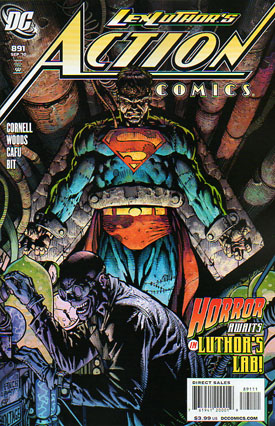
| Cover to Superman 891 by David Finch |
Man, I love that cover. I've become obsessed with mad scientists lately.
So, this comic (which I've just gotten around to reading) begins with Luthor fantasizing about being Prometheus, stealing fire from the gods and providing it to an impoverished humanity.
His next fantasy (he's being influenced by a huge caterpilarcalled Mister Mind, who's allowing him to indulge all his wildest dreams, mentally anyway) is of being Dr. Frankenstein. He tears the sheet of his creation to find that he has created not Superman, but...himself.
Then he becomes an Old West Sheriff, which isn't so relevant.
Moving on, in Superman Returns, Kevin Spacey's Luthor has following conversation with Parker Posey's Kitty:
“Do you know the story of
Prometheus? No, of course you
don’t. Prometheus was a god who stole
the power of fire from the other gods and gave control of it to mortals. In essence, he gave us technology. He gave us power.”
“So we’re stealing fire? In the arctic?”
“Actually, sort of. You see, whoever controls technology controls
the world. The Roman empire ruled the
world because they built roads. The
British empire ruled the world because they built ships. America, the atom bomb, and so on
and so forth. I just want what
Prometheus wanted.”
“Sounds great, Lex, but you’re
not a god.”
“Gods are selfish beings who fly around in little red
capes and don’t share their power with mankind.
No. I don’t want to be a
god. I just want to bring fire to the
people. And I want my cut.”The novel Frankenstein is subtitled "The Modern Prometheus." It's probably the first mad scientist story.
Prometheus formed the subject of my dissertation. It's one of the things that prompted me to write about Superman. I spent three years of my life studying that story, and it hasn't let me quit yet.
The interesting thing about Prometheus is that he fits into both the hero and villain category nicely. If you like Zeus, he's the villainous trickster. If you don't like Zeus, he's a benevolent culture hero.
Or, as in the case of Luthor, a villain who thinks of himself as a hero.
Friday, April 19, 2013
Post-Birthday Blues
![]() |
| This picture, of Siegel and Shuster looking up at a drawing by Neil Adams, seems the most appropriate for today. |
After combing through twitter to see what all sorts of people are saying about Superman on the 75th anniversary of Action #1, I've decided that this tweet, from today, is my favorite:
I liked the internet better yesterday, when we were all talking about Superman.
— Ron Marz (@ronmarz) April 19, 2013
There are all sorts of articles to link to, so I'll do it simply:
From IGN.
From the fantastically-named Ars Technica.
From the ComicsGrid.
And from the New Republic.
Thursday, April 18, 2013
Superman Day
![]() |
| The place where Joe Shuster lived for a while in Cleveland. |
Today, the 18th of April, marks the 75th anniversary of the publication of Action Comics #1. Superman had been created some years earlier (circa 1933), but today's the day that people first saw him on the stands.
I had really hoped my book would be published at this point, but it's still stuck in the quagmire of peer review. For the moment at least, it's out of my hands.
Still, there's no shortage of books on Superman and the various stories behind the stories. I discussed Weldon's book recently; there's also Superman and Philosophy, which I'm working my way through (my first impression, being about half way to the end, is that it's ok but not great); there's The Ages of Superman, released last year. And coming in June is Super Boys, which is about Siegel and Shuster.
Commemorating the date, there are some events in Cleveland (I'm curious about the birthday cake at the airport) and lots of online and print articles such as this one in the New York Times.
Tuesday, April 9, 2013
Glen Weldon's Superman
Glen Weldon has a weird fixation on Superman's mullet.
His new book, an Unauthorized Biography of Superman, contains a lot of plot summaries. There's some behind the scenes stuff, lots of evaluations of what works and what doesn't work for the character, things like that. He starts at the beginning--no substantial references to influences until later on--and moves right on up to 2013.
Weldon writes a blog for NPR, and his writing style reflects that occupation. His wordplay is often clever, sometimes grating, but always fluid and clear. There's nothing new to his book, nothing that you can't get in others, but Weldon's focus on release dates, on some contextualization, and on some minor aspects of Superman trivia, is good t read. Of course, there's a lot he's left out. There's not a way around that when you're writing about Superman.
Still, he can't seem to get over that mullet.
There are other oddities, such as Weldon's inclusion of the odd detail that Jerry Siegel happened to die on a day when a Superbowl was played. But this is exactly the type of book I expected to see this year, Superman's 75 year in publication. No pictures, though, which is a shame.
There's another new book, called Superman in Philosophy. Haven't read that yet.
Tuesday, April 2, 2013
Reasons to Love the 1001 Nights
Monday, March 25, 2013
Quotes: Thor Edition
I was a Thor fan as a kid. I fully acknowledge that the Thor film released a couple of years ago was not terribly good. But I love it. Nothing you can say will convince me not to love it.
There is precisely one truly outstanding line in that movie, and when it's uttered by Thor, it feels like a throwaway line:
We drank, we fought, he made his ancestors proud.
--Thor
It's followed soon after by...
I still don't think you're the god of thunder, but you should be.
--Erik Selvig
Can't wait for The Dark World...
![]() |
| The King!!!! |
![]() |
| Walt Simonson's run on Thor has probably been the most influential story in my life. |
![]() |
| I detested Stracyzinsky's Thor story. But I loved Olivier Coipel's art. |
Friday, March 22, 2013
Superman and Science
A while back I wrote a brief summary of the popular science books that utilize Superman and other superheroes to teach scientific concepts. This method is still at work. In a Scientific American blog, Kyle Hill writes 'Superman Explains Why He Didn't Destroy the Russian Meteor.' You may recall that meteor, hitting the atmosphere above the town of Chelyabinsk about a month ago. The explosion, in the atmosphere, shattered windows and shook the earth.
So, in order to explain why it would have been a bad idea to destroy the meteor in flight, Kyle imagines Superman telling people why he decided to let the atmosphere take care of it.
“We can only speculate, as no one has ever exploded a bomb of that size at that height,” said the Man of Steel, “but if I punched the meteor where it disintegrated over Chelyabinsk, I probably would have killed people.”
So, in order to explain why it would have been a bad idea to destroy the meteor in flight, Kyle imagines Superman telling people why he decided to let the atmosphere take care of it.
“We can only speculate, as no one has ever exploded a bomb of that size at that height,” said the Man of Steel, “but if I punched the meteor where it disintegrated over Chelyabinsk, I probably would have killed people.”
Monday, March 18, 2013
Wednesday, March 6, 2013
Artist Chris Sprouse leaves Card Superman Project
Well, looks like the Orson Scott Card controversy has reached a 'to be continued...'. Card's views on gay marriage and his advocacy of overthrowing a government that allows it have caused lots and lots of news outlets to report that some people won't buy or sell a Superman story that he wrote. Then, all of a sudden, the artist of the story, Chris Sprouse, decides he doesn't want to be involved. Sprouse released this statement:
It took a lot of thought to come to this conclusion, but I've decided to step back as the artist on this story. The media surrounding this story reached the point where it took away from the actual work, and that's something I wasn't comfortable with. My relationship with DC Comics remains as strong as ever and I look forward to my next project with them.
DC Comics reports that they're looking for a new artist, and in the interim they've removed the book from publication. They apparently have no problem with Sprouse's exit.
The links above all lead to news stories on sites that remain objective about the whole situation. There are others, however, who are less objective.
We kind of wish Sprouse had said it was Card’s bigotry that was taking away from the work, not “the media surrounding this story.” But if this get’s DC closer to canning the Ender’s Game scribe, so much the better.
Wired, tipping their hat a bit, includes the line, "The now non-homophobic Adventures of Superman no. 1 will be launched digitally on April 29, with the print edition following on May 29."
That makes me wonder if a homophobic writer can ever write a non-homophobic story.
Anyway, the whole thing may just be quietly forgotten by DC now that they have an out. How hard will they look for a new artist? To be continued...
I don't think I ever linked to the petition to get DC to remove Card from the project. Here it is, 16,500 signatures strong.
It reads, in part:
We need to let DC Comics know they can't support Orson Scott Card or his work to keep LGBT people as second-class citizens. They know they're accountable to their fans, so if enough of us speak out now, they'll hear us loud and clear.
It took a lot of thought to come to this conclusion, but I've decided to step back as the artist on this story. The media surrounding this story reached the point where it took away from the actual work, and that's something I wasn't comfortable with. My relationship with DC Comics remains as strong as ever and I look forward to my next project with them.
DC Comics reports that they're looking for a new artist, and in the interim they've removed the book from publication. They apparently have no problem with Sprouse's exit.
The links above all lead to news stories on sites that remain objective about the whole situation. There are others, however, who are less objective.
We kind of wish Sprouse had said it was Card’s bigotry that was taking away from the work, not “the media surrounding this story.” But if this get’s DC closer to canning the Ender’s Game scribe, so much the better.
Wired, tipping their hat a bit, includes the line, "The now non-homophobic Adventures of Superman no. 1 will be launched digitally on April 29, with the print edition following on May 29."
That makes me wonder if a homophobic writer can ever write a non-homophobic story.
Anyway, the whole thing may just be quietly forgotten by DC now that they have an out. How hard will they look for a new artist? To be continued...
I don't think I ever linked to the petition to get DC to remove Card from the project. Here it is, 16,500 signatures strong.
It reads, in part:
We need to let DC Comics know they can't support Orson Scott Card or his work to keep LGBT people as second-class citizens. They know they're accountable to their fans, so if enough of us speak out now, they'll hear us loud and clear.
Tuesday, March 5, 2013
Card, Superman, Retailers
Comics Alliance has been running a series of interviews with comic book retailers regarding the Orson Scott Card Superman thingie. I linked to the first one here. They've added parts two and three and four.
Part 2 is a conversation with the manager of Acme comics in North Carolina. It's a lot about how content can affect sales, but the manager ultimately believes his job is to give the choice to his customers, so he'll be stocking the comic in question. Even when he disagrees with the creator or content, it doesn't affect his business practices.
Jermaine Exum: Just like in the worlds of entertainment and sports, the comics industry is not immune to creators who are divisive or are, in some cases, difficult to support. The moment where a fan must decide if they support the creation or the creator is never fun, nor is it anything you can prepare for until it happens. I myself recently purged my personal collection of the work of a creator I had previously enjoyed, due to his outlook on the industry we are both part of and my interaction with him at conventions. That creator's work is still on prominent display at Acme Comics, and we reorder it regularly as needed.
In the third, with the owners of Challengers in Chicago, we learn that this store is planning on donating all their profits to the LGBT advocacy group called Human Rights Campaign. A couple of relevant passages:
Patrick Brower: It is never our intention to take the choice away from the people who shop with us. Just because we may not be fond of this particular creator's very public personal beliefs doesn't mean fans of Superman that choose to shop at Challengers should be denied the opportunity to get that issue of Adventures of Superman. That we don't want to profit from it is not a good enough reason to not let someone buy it if they want it. Also, that issue is an anthology and Chris Samnee has work in that book. Have you seen his Superman pin-up? It's gorgeous.
Part 2 is a conversation with the manager of Acme comics in North Carolina. It's a lot about how content can affect sales, but the manager ultimately believes his job is to give the choice to his customers, so he'll be stocking the comic in question. Even when he disagrees with the creator or content, it doesn't affect his business practices.
Jermaine Exum: Just like in the worlds of entertainment and sports, the comics industry is not immune to creators who are divisive or are, in some cases, difficult to support. The moment where a fan must decide if they support the creation or the creator is never fun, nor is it anything you can prepare for until it happens. I myself recently purged my personal collection of the work of a creator I had previously enjoyed, due to his outlook on the industry we are both part of and my interaction with him at conventions. That creator's work is still on prominent display at Acme Comics, and we reorder it regularly as needed.
In the third, with the owners of Challengers in Chicago, we learn that this store is planning on donating all their profits to the LGBT advocacy group called Human Rights Campaign. A couple of relevant passages:
Patrick Brower: It is never our intention to take the choice away from the people who shop with us. Just because we may not be fond of this particular creator's very public personal beliefs doesn't mean fans of Superman that choose to shop at Challengers should be denied the opportunity to get that issue of Adventures of Superman. That we don't want to profit from it is not a good enough reason to not let someone buy it if they want it. Also, that issue is an anthology and Chris Samnee has work in that book. Have you seen his Superman pin-up? It's gorgeous.
W. Dal Bush:This book is a print edition of a digital-first DC superhero comic; it's not Saga. Based on our sales for other digital-first comics, such as Batman Beyond Unlimited or Arrow,
we'd have been lucky to sell a dozen copies even if there'd been no
controversy regarding the creators involved. While our donation of
profits might not be apparent to DC, I don't know that a missing 12
copies would've either. All things being equal, we felt better making a
donation and selling the book than boycotting the title.
Part 4 is an interview with Adam Healy, of Cosmic Monkey comics in Oregon. he is carrying the comic because it's his job to provide comics for his customers. Beyond that, here's an interesting statement:
We worry about not being able to satisfy our customers more than losing customers. We stock fairly low numbers on the shelf of most of the books DC and Marvel publish. They put out so many books that they compete against each other and lose. We simply can't afford to stock most books more than lightly since we have no evidence that there is a demand for the product beyond what our pre-orders are for each book. Realistically, without the media attention, an Orson Scott Card-written Superman book is not something that would sell well. Superman is a character that lacks the social relevance he had 75 years ago. People don't know what he stands for or why he does what he does, and current storylines do nothing to address this confusion.
Part 4 is an interview with Adam Healy, of Cosmic Monkey comics in Oregon. he is carrying the comic because it's his job to provide comics for his customers. Beyond that, here's an interesting statement:
We worry about not being able to satisfy our customers more than losing customers. We stock fairly low numbers on the shelf of most of the books DC and Marvel publish. They put out so many books that they compete against each other and lose. We simply can't afford to stock most books more than lightly since we have no evidence that there is a demand for the product beyond what our pre-orders are for each book. Realistically, without the media attention, an Orson Scott Card-written Superman book is not something that would sell well. Superman is a character that lacks the social relevance he had 75 years ago. People don't know what he stands for or why he does what he does, and current storylines do nothing to address this confusion.
Friday, March 1, 2013
The Measure of a Man
I've been thinking about Issue 6 of All-Star Superman a lot lately. I've excised the chapter that focused on it from my book, replacing it with a chapter based on fieldwork instead. I'm contemplating turning the excised chapter into an article, so it's got my attention even though it's gone. And I've been looking over the story.
On top of that, there were the superheroics of early last month. It would seem to work nicely with a line from All-Star issue 6. Clark Kent, delivering a eulogy for his father Jonathan, says: "He taught me that the measure of a man lies not in what he says but what he does." It seems a profound moment.
But it only seems that way. I'm not the only one to find trouble in this, or in other aspects of Morrison's work, but as time goes by I feel like this line in particular just isn't correct.
So, this really isn't a post about Superman.
With that out of the way, the idea at issue in the line--that doing things is more important than saying things--creates a dichotomy between words and actions. We've all heard the notion that 'actions speak louder than words.' There's a hint of this in the old saw that 'seeing is believing,' because it opposes the active seeing to the passive 'hearing about' something (the modern phrase, however, is just half the older version, which told us that "seeing is believing, but touching is for real").
It's a false dichotomy.
Talking is doing. A silly sentence, yes, but it gets right to the point. I'm troubled by the notion that speech isn't an action, that there's no agency behind it. It's right up there in the US Constitution, among the other actions of petition, assembly, and whatnot in the First Amendment. If speaking wasn't an action, then it would have no effect. People wouldn't be motivated by words, or driven to hatred and love. In performance studies, there's a special word for speaking as action: speech act. I dub thee knight. I pronounce you husband and wife. I'm breaking up with you. Some of these are accompanied by actions, but the words are often enough by themselves. Words written, words spoken, words signed...these things can bring us to tears, spur us to victory, put us to sleep, and take away our fears.
And to me, it's interesting that Morrison, a man who makes his living with his output of words, overlooks that when writing Superman's speech.
Thursday, February 28, 2013
A Rap about OS Card and Superman? Why not?
So Adam WarRock has recorded a song about the whole situation with Orson Scott Card writing a Superman story.
If Superman was real, you know I think he'd feel
He wouldn't want a man of hate to tell his story
If Superman was real you know the man of steel
He'd say all people could just share in the glory.
He writes in his blog:
If Superman was real, you know I think he'd feel
He wouldn't want a man of hate to tell his story
If Superman was real you know the man of steel
He'd say all people could just share in the glory.
He writes in his blog:
Some people say you shouldn’t judge an
artist for their beliefs. You should judge them for their works. I don’t
believe that. When an artist puts their beliefs out there, they are
making those beliefs a part of their works, a part of the whole
experience of them as an artist. If you disagree, or are offended by
those beliefs, then you can judge them for it, you can boycott or
actively protest against their works. This is the machine that we have
in society, to fight back against ignorance, stupidity, hatred. We
change people’s minds through action, through discourse, through
engagement.
He ends, like so many do, by showing a bit from All-Star Superman:
![]() |
| You're much stronger than you think you are. |
Tuesday, February 26, 2013
One more
Let's just add this link to a Comics Alliance interview with the owner of Zeus Comics in Dallas, who says:
Let me pull back for a moment because you're speaking directly to choice, and I've seen the word "censor" and the phrase "freedom of speech" bandied about in regards to Orson Scott Card and his relationship to DC Comics and Superman. Card can say, write, blog, advocate whatever he wants. That does not mean that speech comes consequence free. Free speech and censorship relate to a government and its citizens. It does not directly apply to businesses and their relationships. Your employer decides your dress code, your hours, your work ethic and in particular the things you can and can not say to your peers or the business' customers. Businesses decide whether or not to hire or fire folks based on things discovered on their Facebook page, Twitter feed, even their appearance.
Now, Card has said some venomous things about the LGBT community and he advocates such through his relationship with NOM. In the same way Nike can drop Lance Armstrong because of his potential to hurt their brand, DC can drop Card because his hate speech towards a group is damaging to DC Comics and Superman. Card is contracted to write a Superman story. DC is under no obligation to publish or print that story in part or in whole. DC will edit that story, ask for rewrites and often dictate the content. For example, DC would not let Card's Superman drop the F-Bomb. Is it censorship of Card's story? It isn't. Its not Card's story. Its DC's story. They hired him and they can decide what to publish. Is it censorship if Zeus Comics decides not to carry the comic? It isn't. Each month, when ordering products through Diamond, I am making a decision whether or not to carry a comic based on values, quality of work, and its ability to sell. That's not censorship, that's capitalism.
Also, in print publishing, the comic shop is DC's customer. It's completely within our right to ask DC to remove Card and/or provide us with a product we can sell. If a writer's personal opinions are so contrary to my audience's values, their work won't sell. The coverage this last week about Card's near two decades of outspoken anti-gay bigotry and anti-gay activism have made Orson Scott Card toxic to Zeus' customers. In the end, it's really Card's outspoken animus for gay people that made the decision.
Let me pull back for a moment because you're speaking directly to choice, and I've seen the word "censor" and the phrase "freedom of speech" bandied about in regards to Orson Scott Card and his relationship to DC Comics and Superman. Card can say, write, blog, advocate whatever he wants. That does not mean that speech comes consequence free. Free speech and censorship relate to a government and its citizens. It does not directly apply to businesses and their relationships. Your employer decides your dress code, your hours, your work ethic and in particular the things you can and can not say to your peers or the business' customers. Businesses decide whether or not to hire or fire folks based on things discovered on their Facebook page, Twitter feed, even their appearance.
Now, Card has said some venomous things about the LGBT community and he advocates such through his relationship with NOM. In the same way Nike can drop Lance Armstrong because of his potential to hurt their brand, DC can drop Card because his hate speech towards a group is damaging to DC Comics and Superman. Card is contracted to write a Superman story. DC is under no obligation to publish or print that story in part or in whole. DC will edit that story, ask for rewrites and often dictate the content. For example, DC would not let Card's Superman drop the F-Bomb. Is it censorship of Card's story? It isn't. Its not Card's story. Its DC's story. They hired him and they can decide what to publish. Is it censorship if Zeus Comics decides not to carry the comic? It isn't. Each month, when ordering products through Diamond, I am making a decision whether or not to carry a comic based on values, quality of work, and its ability to sell. That's not censorship, that's capitalism.
Also, in print publishing, the comic shop is DC's customer. It's completely within our right to ask DC to remove Card and/or provide us with a product we can sell. If a writer's personal opinions are so contrary to my audience's values, their work won't sell. The coverage this last week about Card's near two decades of outspoken anti-gay bigotry and anti-gay activism have made Orson Scott Card toxic to Zeus' customers. In the end, it's really Card's outspoken animus for gay people that made the decision.
More about Card
A few more shops have decided not to carry the new Adventures of Superman, written by Orson Scott Card. One in Canada and one in Ireland. The Irish shop, called The Big Bang Comic Shop, released a statement which read, in part:
Ironically in all of this it’s a Superman story. And Superman stands for Truth and Justice. I’m pretty sure Superman, if he were a real living breathing person wouldn’t be into restricting the rights of any person no matter what their sexual orientation was but Mr Card is and that doesn’t represent the principles of Truth and Justice to us. The second irony in all of this, if we were to boycott the title all together we’d be no better than Mr Card restricting people’s right to get this issue if they so wanted to. We’re not about censoring rights, unlike Mr Card.
A couple of things here: note the lack of 'the American way.' And the idea that the shop management (no names were included in the article I read) knows what Superman would do if he were a real person.
Here's a thoughtful response on how this story relates to one family's opinions about Card's other work--in short, his views on marriage and homosexuality have ruined a story (Ender's Game) that the writer and his family once loved. This isn't the first time I've seen a statement like that.
And another response, from TG Daily, makes the connection between 'geeks' and gay folks:
Ironically in all of this it’s a Superman story. And Superman stands for Truth and Justice. I’m pretty sure Superman, if he were a real living breathing person wouldn’t be into restricting the rights of any person no matter what their sexual orientation was but Mr Card is and that doesn’t represent the principles of Truth and Justice to us. The second irony in all of this, if we were to boycott the title all together we’d be no better than Mr Card restricting people’s right to get this issue if they so wanted to. We’re not about censoring rights, unlike Mr Card.
A couple of things here: note the lack of 'the American way.' And the idea that the shop management (no names were included in the article I read) knows what Superman would do if he were a real person.
Here's a thoughtful response on how this story relates to one family's opinions about Card's other work--in short, his views on marriage and homosexuality have ruined a story (Ender's Game) that the writer and his family once loved. This isn't the first time I've seen a statement like that.
And another response, from TG Daily, makes the connection between 'geeks' and gay folks:
We geeks know what it’s like to be excluded in life, and know how
painful prejudice can be. Like gay people and other minorities, we just
want to be accepted and treated like everyone else, and when it comes to
genre worship, enthusiasm and sincerity is all that really matters, not
the color of your skin, nationality, or sexual preference.
Friday, February 22, 2013
Card's Superman
Let's dig a little bit deeper into the controversy surrounding DC's choice to hire sf writer Orson Scott Card to create some Superman stories.
First, here's a USAToday article that sums up the issue:
DC Comics ignited a firestorm last week by announcing that Card, who has been criticized over the years for his vocal anti-gay political stance, would be one of a stable of writers contributing to a new digital-first anthology, Adventures of Superman. The series, launching in April (a print version will be sold in stores starting in May), features the iconic hero who has long been associated with the phrase "truth, justice and the American way.''
The Lesbian, Gay, Bisexual, Transgender activist website AllOut.org has collected more than 11,000 signatures on an online petition asking DC to drop Card from the project....
In addition to being the author of the 1985 science-fiction novel Ender's Game and many other sci-fi works, Card is on the board of directors for the National Organization for Marriage, which is outspoken in its denouncement of same-sex marriage.
Here's another summary, from The Daily Beast. And one from The Guardian.
DC's response has been to brush it off:
As content creators we steadfastly support freedom of expression, however the personal views of individuals associated with DC Comics are just that — personal views — and not those of the company itself.
Beyond the petition, several shops have decided not to carry the print version of the comic.
At issue are both Card's beliefs and his actions. He's not merely someone who believes that certain people should be denied marriage, he sits on the board of an organization devoted to stopping it, and has stated that, should gay marriage become a federal right, people should rise up against the government. Michael Hartney has written on just this point:
If this was a holocaust denier or a white supremacist, there would be no question. Hiring that writer would be an embarrassment to your company. Well, Card is an embarrassment to your company, DC. This is the same. The LGBTQ community will no longer take this lying down. Our civil rights are no longer up for debate or discussion.
Ugh. And of all the characters Card could have been hired to write, you give him Superman? The character that taught me to lead by example? To do the right thing, even when it was hard? To keep going, even when it seemed hopeless? What an insult. Kids are killing themselves. They are killing themselves in a climate of intolerance and homophobia publicly fostered by people like Orson Scott Card. You don’t have to contribute to this. You shouldn’t. You mustn’t.
Christopher Butcher takes it further:
Orson Scott Card is a dangerous bigot. If he will not even attempt to atone for his dangerous bigotry (including: hate-filled screeds, lies, and incitements to violence), then I don’t care if he never gets another job again. Let alone writing a beloved icon of children and adults.
Here's a thoughtful response from Wired, about how the writer is disappointed by Card's views, but doesn't agree that he should be pulled from the story:
Let him write the story, and let DC publish it. You can then choose to buy the comic or not. You can then choose to protest the message in the actual story if you are offended by it. But silencing a voice — even one with as intolerant a message as his — is not the answer. It’s better to hold that intolerance up to the light of day and show it for what it truly is: fear. Fear of the alien. Fear of the other and the strange. A fear that, ironically, it was Orson Scott Card who helped me confront and vanquish at an early age, whether he meant to or not.
Mark Millar has apparently tweeted that calling for the firing of Card based on his views is nothing short of fascism.
But others have been prompted to more reflective statements about their view of the character:
Superman may not live in the real world, but I’d like to think that if he were a real being he would be on the side of justice for LGBT community members.
It's important to point out that the issue is coming to a head because of the character. Nobody seems to have complained much when Card wrote Iron Man stories, as many of the above links make clear. Because Superman is involved, people suddenly have strong opinions. Following on a point from Butcher above, Tom Spurgeon wonders about this:
Butcher's line about Superman having power as an icon above and beyond his role as a corporate-owned character attached to a dubious history of exploitation and issue-alignment, and that this matters, is well-taken. That is very much a blind spot for me. For me, Superman is an empty suit. One of my first Internet fiascoes was a mid-1990s declaration that no adult person actually considered Superman a role-model and being lectured by an array of adults on CompuServe that told me that they very much considered Big Blue a role-model and how dare I suggest otherwise. Live and learn. I'm still always a little confused that the ideal outweighs the uglier aspects for folks that are routinely exposed to both. This expression of that notion here, that being assigned to Superman means something more than if Card were given, say, his own entire comics line, comes from hardcore comics fans, not from like my Mom or from my friends growing up or their kids. It's sort of like if the press corps and Secret Service that dealt with JFK on a daily basis had a more hardcore idealized version of the president than Catholic households in Boston with his picture above the television had, although maybe that doesn't explain it well, and maybe those men and women did hold Kennedy in higher regard.
It's legitimately fascinating that Superman seems to me to have been traditionally claimed by conservatives as having ideals in that direction, and here is claimed for what we tend to think of as American liberal values such as inclusiveness. In fact, the irony from the perspective of this being a headache for DC Comics is that they've sold and sold and sold this viewpoint where they are in shared custody with generations of fans of an important set of ideas and principles wearing a cape, and in this instance they have to deal with the fact that people are going to hold them to that. Good.
So there's all that stuff wrapped up in this issue. The general sentiment above is that Card is wrong in his opinions, and that he is in the minority. Some people think that Superman shouldn't be written by a person who feels the way Card feels, who advocates the things he advocates. As I see it, it all comes down to the idea that some people think that Superman should represent inclusivity--he saves everyone. They extend this idea beyond the character and the stories told about him to the complex of events surrounding the creation of those stories, including the people involved in the creation.
First, here's a USAToday article that sums up the issue:
DC Comics ignited a firestorm last week by announcing that Card, who has been criticized over the years for his vocal anti-gay political stance, would be one of a stable of writers contributing to a new digital-first anthology, Adventures of Superman. The series, launching in April (a print version will be sold in stores starting in May), features the iconic hero who has long been associated with the phrase "truth, justice and the American way.''
The Lesbian, Gay, Bisexual, Transgender activist website AllOut.org has collected more than 11,000 signatures on an online petition asking DC to drop Card from the project....
In addition to being the author of the 1985 science-fiction novel Ender's Game and many other sci-fi works, Card is on the board of directors for the National Organization for Marriage, which is outspoken in its denouncement of same-sex marriage.
Here's another summary, from The Daily Beast. And one from The Guardian.
DC's response has been to brush it off:
As content creators we steadfastly support freedom of expression, however the personal views of individuals associated with DC Comics are just that — personal views — and not those of the company itself.
Beyond the petition, several shops have decided not to carry the print version of the comic.
At issue are both Card's beliefs and his actions. He's not merely someone who believes that certain people should be denied marriage, he sits on the board of an organization devoted to stopping it, and has stated that, should gay marriage become a federal right, people should rise up against the government. Michael Hartney has written on just this point:
If this was a holocaust denier or a white supremacist, there would be no question. Hiring that writer would be an embarrassment to your company. Well, Card is an embarrassment to your company, DC. This is the same. The LGBTQ community will no longer take this lying down. Our civil rights are no longer up for debate or discussion.
Ugh. And of all the characters Card could have been hired to write, you give him Superman? The character that taught me to lead by example? To do the right thing, even when it was hard? To keep going, even when it seemed hopeless? What an insult. Kids are killing themselves. They are killing themselves in a climate of intolerance and homophobia publicly fostered by people like Orson Scott Card. You don’t have to contribute to this. You shouldn’t. You mustn’t.
Christopher Butcher takes it further:
Orson Scott Card is a dangerous bigot. If he will not even attempt to atone for his dangerous bigotry (including: hate-filled screeds, lies, and incitements to violence), then I don’t care if he never gets another job again. Let alone writing a beloved icon of children and adults.
Here's a thoughtful response from Wired, about how the writer is disappointed by Card's views, but doesn't agree that he should be pulled from the story:
Let him write the story, and let DC publish it. You can then choose to buy the comic or not. You can then choose to protest the message in the actual story if you are offended by it. But silencing a voice — even one with as intolerant a message as his — is not the answer. It’s better to hold that intolerance up to the light of day and show it for what it truly is: fear. Fear of the alien. Fear of the other and the strange. A fear that, ironically, it was Orson Scott Card who helped me confront and vanquish at an early age, whether he meant to or not.
Mark Millar has apparently tweeted that calling for the firing of Card based on his views is nothing short of fascism.
But others have been prompted to more reflective statements about their view of the character:
Superman may not live in the real world, but I’d like to think that if he were a real being he would be on the side of justice for LGBT community members.
It's important to point out that the issue is coming to a head because of the character. Nobody seems to have complained much when Card wrote Iron Man stories, as many of the above links make clear. Because Superman is involved, people suddenly have strong opinions. Following on a point from Butcher above, Tom Spurgeon wonders about this:
Butcher's line about Superman having power as an icon above and beyond his role as a corporate-owned character attached to a dubious history of exploitation and issue-alignment, and that this matters, is well-taken. That is very much a blind spot for me. For me, Superman is an empty suit. One of my first Internet fiascoes was a mid-1990s declaration that no adult person actually considered Superman a role-model and being lectured by an array of adults on CompuServe that told me that they very much considered Big Blue a role-model and how dare I suggest otherwise. Live and learn. I'm still always a little confused that the ideal outweighs the uglier aspects for folks that are routinely exposed to both. This expression of that notion here, that being assigned to Superman means something more than if Card were given, say, his own entire comics line, comes from hardcore comics fans, not from like my Mom or from my friends growing up or their kids. It's sort of like if the press corps and Secret Service that dealt with JFK on a daily basis had a more hardcore idealized version of the president than Catholic households in Boston with his picture above the television had, although maybe that doesn't explain it well, and maybe those men and women did hold Kennedy in higher regard.
It's legitimately fascinating that Superman seems to me to have been traditionally claimed by conservatives as having ideals in that direction, and here is claimed for what we tend to think of as American liberal values such as inclusiveness. In fact, the irony from the perspective of this being a headache for DC Comics is that they've sold and sold and sold this viewpoint where they are in shared custody with generations of fans of an important set of ideas and principles wearing a cape, and in this instance they have to deal with the fact that people are going to hold them to that. Good.
So there's all that stuff wrapped up in this issue. The general sentiment above is that Card is wrong in his opinions, and that he is in the minority. Some people think that Superman shouldn't be written by a person who feels the way Card feels, who advocates the things he advocates. As I see it, it all comes down to the idea that some people think that Superman should represent inclusivity--he saves everyone. They extend this idea beyond the character and the stories told about him to the complex of events surrounding the creation of those stories, including the people involved in the creation.
Monday, February 18, 2013
Superman and Orson Scott Card
The big Superman news lately, aside form Man of Steel publicity, is that DC has hired Orson Scott Card to write some Superman stories. I've only seen negative responses to this news. Here's one, by Glen Weldon:
In Action Comics #1 from 1938, Siegel and Shuster slapped together a one-page origin story in which he discovers his powers. We don't actually see him in the baby-blue longjohns until the very last panel of this introduction.
But when we do see him for the very first time, these are the first words that appear directly below, the first epithet applied to this newly-minted creation as it was unleashed upon the world:
Champion of the Oppressed.
There it is, coded into his creative DNA from the very beginning: He fights for the little guy.
And that's why this bugs me, and why I'm not the least bit curious about what Card's Superman might be like.
DC Comics has handed the keys to the "Champion of the Oppressed" to a guy who has dedicated himself to oppress me, and my partner, and millions of people like us. It represents a fundamental misread of who the character is, and what he means.
It is dispiriting. It is wearying. It is also, finally, not for me.
Some comics shops are refusing to carry the stories (they're digital, but apparently there will also be print copies for sale), and many people are calling for the company to stop the whole thing. Other people point out that an author's political views shouldn't have anything to do with whether or not he gets a writing gig.
In Action Comics #1 from 1938, Siegel and Shuster slapped together a one-page origin story in which he discovers his powers. We don't actually see him in the baby-blue longjohns until the very last panel of this introduction.
But when we do see him for the very first time, these are the first words that appear directly below, the first epithet applied to this newly-minted creation as it was unleashed upon the world:
Champion of the Oppressed.
There it is, coded into his creative DNA from the very beginning: He fights for the little guy.
And that's why this bugs me, and why I'm not the least bit curious about what Card's Superman might be like.
DC Comics has handed the keys to the "Champion of the Oppressed" to a guy who has dedicated himself to oppress me, and my partner, and millions of people like us. It represents a fundamental misread of who the character is, and what he means.
It is dispiriting. It is wearying. It is also, finally, not for me.
Some comics shops are refusing to carry the stories (they're digital, but apparently there will also be print copies for sale), and many people are calling for the company to stop the whole thing. Other people point out that an author's political views shouldn't have anything to do with whether or not he gets a writing gig.
Wednesday, February 6, 2013
Superheroism
A guy in Georgia has taken to dressing as Superman while helping clean up after a recent tornado.
He doesn't want the broadcasters to reveal his name. He says he wears the suit to help spread the message of "compassion and friendship." It's effective; he most likely wouldn't have made the news if he weren't in the costume.
Labels:
breaking into the real world,
costume,
morality,
ostension,
real world
Friday, January 25, 2013
Quotations: Community Season 3 Edition
If I wanted to run a monkey hotel, I’d install a banana buffet. I’d use vines as elevators. And I’d put tail holes in the bathrobes and I’d lower all the shower knobs.
Dean Pelton
Feel the terror of the Norwegian Troll!
Pierce
I demand to be housewarmed!
Troy
And he chainsawed them into bits. And then he put them back together, and then he chainsawed them again. Forever.
Shirley
And she ripped into his torso like a gerbil shredding a Quaker Oats box, sending chunks of viscera and an aerosol mist of blood all over the skanky concubine. Then she flossed her teeth with his tendons. And because he was vampire he lived through all of it. He had to watch her swallow his last eyeball. She kept it connected to the optic nerve so he could see down her throat to his own partially digested flesh in her stomach.
Annie
I've become a stranger to myself. I'm bald now. I've always been bald. I merely dreamt of having hair. And now the bald man is awake.
Jeff
I know what an analogy is. It's like a thought with another thought's hat on.
Britta.
You think this is just a room where Troy and I play dinosaurs versus river boat gamblers together?
Abed
I'm more turned on by women in pajamas than lingerie. I just want to know they're comfortable.
Troy/Abed
Talk to me more about 'crazy town banana pants.'
Dr. Heidi
Chang eats the sun and drinks the sky and they both go with him when he dies.
Some girl in the heist episode.
Shut up Leonard...
I found your youtube page. What's the point in reviewing frozen pizzas anyway?
I know about your crooked wang.
those teenage girls you play ping pong with are doing it ironically.
Tuesday, January 15, 2013
Man of Steel Trailer
Here's a link to an interesting piece on Robot 6. What's even more interesting is the discussion that follows it. It all kicks off with a quote from J. Michael Straczynski, followed by some commentary from the columnist Michael May, the trailer for Man of Steel. It's all about the idea of what sort of character Superman should be. The comments below it feature some interesting remarks by Straczynski and by Mark Waid. It's also got a link to another article that I'll probably bring up again some day.
The discussion goes in some interesting directions, particularly its focus on the comment in the trailer that Jonathan Kent makes about how 'maybe' Clark shouldn't have saved a bunch of kids from drowning, so he could protect his secret. It's interesting, but I think I'll wait until the movie comes out and I can see the whole scene before I comment on that.
What was especially interesting was the occasional criticism of Straczynski's Earth One stories. The specifics aren't important here. The important part is that Straczynski himself felt it necessary to chime in with a lengthy defense of his stories. My feelings about Earth One aside (it's utter tripe), I think the fact that the writer had to explain what he was trying to do says loads about how well he did it. Meaning he didn't get his point across very well in the story he told.
The discussion made me think of the types of stories being told today, in movies, television, and comic books. We live in an era where fandoms are becoming the dominant audiences courted by media storytellers and executives, in part because fans spend lots of money on things. So there needs to be lots of things for them to spend their money on. The result of this is that stories are told at great length, with the details fleshed out in sometimes excruciating detail. Star Wars is the perfect example of this. What was essentially one paragraph's worth of information in the original movie became more than six hours of film time (not to mention the animated series, novels, comic books, etc). Some people wanted that story told. Not me. Though I was excited to see them, I liked the spark in my imagination, lit by the hints in that one paragraph of information. The Clone Wars in my head are so much more interesting than what the movies revealed them to be.
Anyway, I think that Superman is most compelling as a fully formed hero, not as a hero-in-the-making. Siegel and Shuster got it right in the first place: limit the back story, get right to the adventures in Metropolis. I don't need to see how he came to the decision to be a hero. In fact, I'd say it diminishes him. It makes it contingent on events, tells us that if something had gone just a little bit different when he was 15, or 16, or 18, or 20, he would be a villain, or a different kind of hero. There are plenty of characters whose stories already do that. For Superman, I'd rather have a lot left to my imagination. But that's just me.
The thing is, I know that telling the story of how Superman made the choice to be a hero can be a valuable story. I have interviewed people for whom that story has made a difference in life, has led them to make their own choices, has given them inspiration: an "If Superman could make the right choice, could figure out the best way to live his life, then so can I" sort of thing. I just hope they don't look to Earth One for this inspiration.
The discussion goes in some interesting directions, particularly its focus on the comment in the trailer that Jonathan Kent makes about how 'maybe' Clark shouldn't have saved a bunch of kids from drowning, so he could protect his secret. It's interesting, but I think I'll wait until the movie comes out and I can see the whole scene before I comment on that.
What was especially interesting was the occasional criticism of Straczynski's Earth One stories. The specifics aren't important here. The important part is that Straczynski himself felt it necessary to chime in with a lengthy defense of his stories. My feelings about Earth One aside (it's utter tripe), I think the fact that the writer had to explain what he was trying to do says loads about how well he did it. Meaning he didn't get his point across very well in the story he told.
The discussion made me think of the types of stories being told today, in movies, television, and comic books. We live in an era where fandoms are becoming the dominant audiences courted by media storytellers and executives, in part because fans spend lots of money on things. So there needs to be lots of things for them to spend their money on. The result of this is that stories are told at great length, with the details fleshed out in sometimes excruciating detail. Star Wars is the perfect example of this. What was essentially one paragraph's worth of information in the original movie became more than six hours of film time (not to mention the animated series, novels, comic books, etc). Some people wanted that story told. Not me. Though I was excited to see them, I liked the spark in my imagination, lit by the hints in that one paragraph of information. The Clone Wars in my head are so much more interesting than what the movies revealed them to be.
Anyway, I think that Superman is most compelling as a fully formed hero, not as a hero-in-the-making. Siegel and Shuster got it right in the first place: limit the back story, get right to the adventures in Metropolis. I don't need to see how he came to the decision to be a hero. In fact, I'd say it diminishes him. It makes it contingent on events, tells us that if something had gone just a little bit different when he was 15, or 16, or 18, or 20, he would be a villain, or a different kind of hero. There are plenty of characters whose stories already do that. For Superman, I'd rather have a lot left to my imagination. But that's just me.
The thing is, I know that telling the story of how Superman made the choice to be a hero can be a valuable story. I have interviewed people for whom that story has made a difference in life, has led them to make their own choices, has given them inspiration: an "If Superman could make the right choice, could figure out the best way to live his life, then so can I" sort of thing. I just hope they don't look to Earth One for this inspiration.
Labels:
action comics,
affinity,
archetypes,
Birthright,
clark,
fan culture,
mark waid,
morality,
origin,
straczynski
Subscribe to:
Posts (Atom)