2001 may well be the masterpiece it proclaims itself to be. I was amazed by the descriptions that made me feel as if something was actually happening, page after page of ecology and climate during which no human acted nor any change took place felt as if it were vitally important.
The mystery unfolded into greater clarity than the movie would allow. Kubrick told the end in images, but Clarke laid it all out for us through the perspective of David Bowman. In this, the film may qualify as a myth while the book would be literature, if we define myth as that genre of narrative that comes closest to music because it requires a great deal of intellectual investment on the part of its audience. We all come out of music, as we all come out of myth, with our own interpretation based upon our own mood and history. While this is certainly true of all narrative, the mode of myth is particularly good at it. So while Clarke's description of Bowman's journey through the Monolith is fascinating and compelling, it is also clearly delineated. Bowman doesn't reveal much about those who created the monoliths, but we know all that he knows.
Which is not true of the film.
2010 is pretty good, too. There's stuff going on. 2061, however, was a huge disappointment. The mystery is never resolved to any interesting point, and the compelling component of the series is barely present. 3001 does little to advance it, preferring the plot to the idea. The ideas come in the form of futurity; of world-building and speculation. That's not why I read that book, and even though some reviews I dug up prepared me for a lack of answers, I was still annoyed. The interesting aspects of the story were perpetually deferred. There was little compelling in terms of character, though that is true of the series as a whole, aside, perhaps, for HAL.
Interestingly, Clarke revisits the same passages throughout. His chapter of 3001 called "The Firstborn" occurs in all four books, if I'm not mistaken. And while he proclaims that these repetitions are heavily edited, I'm not willing to check that statement. We revisit the firstborn, the depths of Europa, and the atmosphere of Jupiter, and a dying Astronaut's final words.
I began this series, as you may recall, as part of a study of science fiction versions of the "uplifting" of humanity by aliens. I'm fascinated by the idea that aliens came to earth long ago and tampered with people to make us somehow better, according to their standards. 3001 is the first book in this series that postulates a negative connotation to this idea. The aliens may not be entirely benevolent. They may lack a certain emotion, which might cause them to exterminate us because they don't like the way we've developed. The ideas are put forward, but never really explored. Towers stretching to the stratosphere, on the other hand, are described in great detail. But I wasn't the least bit interested in the towers.
That might have been to do with my own agenda, reading more for the aliens than for the vison of the future; but I doubt I am alone in this. And so, when the epilogue comes round, short and sweet ("'Their little universe is very young, and its god is still a child. but it is too soon to judge them; when We return in the Last Days, We will consider what should be saved.'"), I was more interested than in the 246 pages that preceded it.
What an evocation. It rivals and perhaps betters "My God, it's full of stars" from from the film. Note that it's a quotation. Something is saying that to something else.
We're given few clues. 3001 brings religious themes into the foreground far more prominently than the others. For the first time, the monoliths--especially the first one, from the African hominid chapters of 2001--are cast in a religious light: "This was where--in time and space--the human species had really begun. And this Monolith was the very first of all its multitudinous gods" (56).
There's a character, Theodore Kahn, whose sole purpose is to inject religion into discussions. And then there's Frank Poole's conversation with David Bowman, where Bowman says that "twice I have--glimpsed--powers...entities--far superior to the Monoliths, and perhaps even their makers. We may both have less freedom than we imagine" (233) .
It's not specifically a religious statement, but when freedom--or free will, as Poole formulates it--comes up, religion can't be far behind. Clarke has some interesting thoughts on religion in the future, which has all but vanished in the wake of the curing of mental illness.
So the effort to push humanity to sapience (or Mind, as Clarke first puts it) might be misguided in the end. But humanity fights against extinction. Everything seemed so optimistic in the first novels. By 3001, the violence of the twentieth century becomes the instrument of humanity's potential destruction. In the novel's timeframe, people have moved past such violence, but the length of time it takes messages to travel through space renders irrelevant the advancements of the third millennium. Clarke's message is clear: We can overcome our current insanity, but it might already be too late.
All-Star

Tuesday, September 29, 2009


Wednesday, September 23, 2009
Not a good business model.
My e-mail is awash with reports that there will be no Superman movie in the near future.
This, evidently, is news. Something not happening. Is news.
Everyday, I get messages that there is no plan for a live-action, feature-length, theatrical-release of a Superman movie. There are so many of these reports that I won't even bother linking to any of them.
Why is this important?
Well, according to one poll, Superman is the one comic book film that people want to see.
And the reason there's no Superman film in the works? I don't know. Maybe it has something to do with the legal stuff going on.
This, evidently, is news. Something not happening. Is news.
Everyday, I get messages that there is no plan for a live-action, feature-length, theatrical-release of a Superman movie. There are so many of these reports that I won't even bother linking to any of them.
Why is this important?
Well, according to one poll, Superman is the one comic book film that people want to see.
And the reason there's no Superman film in the works? I don't know. Maybe it has something to do with the legal stuff going on.
Monday, September 21, 2009
Science and Superman
In the world of comic books, the greatest villain is Frederic Wertham. His 1953 book Seduction of the Innocent crystallized the public opinion against comics, giving a voice to the distaste that obtained in many minds throughout the United States. It led directly to the Comics Code Authority, a self-censorship board that comics publishers created in order to pre-empt governmental involvement. Wertham objected vehemently to Superman, whom Wertham labeled a fascist who encouraged children to distrust authority (especially their parents) and to engage in vigilante justice. Embedded among these critiques was a subtler one: that Superman taught children incorrect lessons about physics: “Superman not only defies the laws of gravity, which his great strength makes conceivable; in addition he gives children a completely wrong idea of other basic physical laws. Not even Superman, for example, should be able to lift up a building while not standing on the ground, or to stop an airplane in mid-air while flying himself” (34).
Well, this article, The Science of Superman, goes to some length to prove that the science of Superman simply doesn't make sense--which, I suppose, none of us needed evidence of in the first place. Still, it's an interesting thought exercise. It comes from a book called The Science of Superheroes, by Lois Gresh and Robert Weinberg. I wonder if they tackle the perennial question, Would Wonder Woman's lariat really make me tell the truth?
This sort of thing--wondering about the possibilities behind Superman and other science fiction stories--is, evidently, a popular pastime among writers. Maybe among readers, too. There was a National Geographic channel special on the subject, as well as a book called The Science of Superman by Mark Wolverton. Here's an article from the USA Today about it. Predictably, a lot of this stuff came out around the time of the last Superman film, in 2006. Brief comparison: Where Gresh and Weinberg try to point out why Superman's powers simply cannot work, Woverton tries to come up with ways in which they could.
I spent a bit of time studying film, and I wonder if any film scholars have looked at it from the angle of cultural/economic focus point. This is more than trendiness, I think, though there is a bit of that going on. When a film comes out, lots of other aspects of the culture industry get behind it. Books appear, news stories and magazine articles explore it. Its history is laid bare for us to follow. And with Superman, it seems that all of a sudden, the putative science behind it became important.
And then there's this:

The strip is called Bizarro. He does a lot of Superman humor.
Well, this article, The Science of Superman, goes to some length to prove that the science of Superman simply doesn't make sense--which, I suppose, none of us needed evidence of in the first place. Still, it's an interesting thought exercise. It comes from a book called The Science of Superheroes, by Lois Gresh and Robert Weinberg. I wonder if they tackle the perennial question, Would Wonder Woman's lariat really make me tell the truth?
This sort of thing--wondering about the possibilities behind Superman and other science fiction stories--is, evidently, a popular pastime among writers. Maybe among readers, too. There was a National Geographic channel special on the subject, as well as a book called The Science of Superman by Mark Wolverton. Here's an article from the USA Today about it. Predictably, a lot of this stuff came out around the time of the last Superman film, in 2006. Brief comparison: Where Gresh and Weinberg try to point out why Superman's powers simply cannot work, Woverton tries to come up with ways in which they could.
I spent a bit of time studying film, and I wonder if any film scholars have looked at it from the angle of cultural/economic focus point. This is more than trendiness, I think, though there is a bit of that going on. When a film comes out, lots of other aspects of the culture industry get behind it. Books appear, news stories and magazine articles explore it. Its history is laid bare for us to follow. And with Superman, it seems that all of a sudden, the putative science behind it became important.
And then there's this:
The strip is called Bizarro. He does a lot of Superman humor.
Friday, September 11, 2009
Fan Culture
I've been struggling with what to do with "fan culture" since it's in some ways the foundation of my project. I'm in the thick of it now. But the problem is that I'm a folklorist who wants my book to be about folklore, not about pop culture. Superman is a strange topic for this, since the character arose in pop culture and has resided there for seventy years.
Well, it's not so much a problem in my mind. One of my goals is to demonstrate how little the boundaries of academic disciplines matter to people in their everyday lives. Medium matters to people, but not the way it does to university departments.
The primary thing that separates folklore from popular culture is standardized production--which is largely irrelevant to most people. Folklore is not mass produced. It doesn't come off the assembly line or the printing press. That's key to the definition of folkloristics as an academic discipline. It's what has historically separated it from others, such as English and film studies, etc. The lack of standardized production means that everytime folklore is performed, it will exhibit variation. Every time you tell a story, it will be different, for a possibly infinite number of reasons. And those differences might be meaningful. Then again, they might not. It's what I love about folklore. Endless possibility.
Fan culture does not so much exist for the performances of folklore. It exists for mediated entertainment, such as comic books. The creations of that fan culture, in the form of fan fiction, for example, would not qualify as folklore because the production, while creative, is standardized. Once you write your story and publish it to the internet, it's always the same. The text doesn't change. Every time someone clicks on it to read it, it's the same (other things may change, but that's a different story).
Yet fan culture does exhibit the variation and multiplicity that I love about folklore. It can come in the jokes told, the costumes made (and endlessly changed, as I'm learning through interviews with people who make and wear them--although there are costumes you can buy at the store, which are quite controversial in the world of fan costuming...), there are tattoos, and anecdotes, and all sorts of interesting bits of folklore. That's what I'm writing about in the first four chapters of my book. It's the stuff generally left out of fan culture studies, which focus on institutional, standardized responses to media.
Here's some stuff I've found about fan cultures:
There's a guy named Henry Jenkins who wrote about Fan Culture a while ago. He's got a blog with several entries about Superman. This one, written in response to the 2006 Superman Returns film, is particularly useful.
Then there's Matthew Pustz' book Comic Book Culture: Fanboys and True Believers.
Sort of about fan culture are the works of Lawrence and Jewett: The Myth of the American Hero and The American Monomyth.
Then there's Bill Schelly's The Golden Age of Comic Fandom.
A chapter of Martin Barker's Comics: Ideology, Power and the critics is called "Reading the Readers." I haven't gotten to this yet, but it might be relevant to fan culture.
Christopher Knowles' book Our Gods Wear Spandex: The Secret History of Comic Book Heroes isn't of much use, but it does have a few passages about fans, especially about Alex Ross as a fan-turned-creator.
Speaking of fans as creators, Lauire Cowan's documentary Participate: The Revolution of Fan Culture is not too bad. Mostly interviews from a comic con in New York.
For me, the Holy Grail of Superman responses is the fan who posts to the internet something along the lines of "What Superman Means to Me." It's not as common as I'd like, and I get plenty of it from interviews. This essay by The Onion's Noel Murray is a good one, and it concludes thus:
The appeal of Superman–again, maybe just to me, though I think to others as well–is that because he can do everything, he doesn't have to do much at all. He can take care of business and then chill out, solitude-style, at his Arctic clubhouse, where he tinkers with robots and obsessively arranges his souvenirs into a massive monument to himself. Or he can spend a whole day thinking up the perfect birthday present for Batman. Or he can make publicity appearances, while dodging Lois' attempts to find out his secret identity. The stakes are pretty low in those forty-year-old Superman stories–even in the "imaginary tales" where some bored staffer figured out a way to end the endless Superman saga, at least for a week. And if somebody today wants to know how to write a Superman story, it shouldn't be that hard. Just ask a ten-year-old boy what he'd do if he were Superman, and take notes.
There's other good stuff in there, but this strikes me as something I might quote one day--especially that last line.
Well, it's not so much a problem in my mind. One of my goals is to demonstrate how little the boundaries of academic disciplines matter to people in their everyday lives. Medium matters to people, but not the way it does to university departments.
The primary thing that separates folklore from popular culture is standardized production--which is largely irrelevant to most people. Folklore is not mass produced. It doesn't come off the assembly line or the printing press. That's key to the definition of folkloristics as an academic discipline. It's what has historically separated it from others, such as English and film studies, etc. The lack of standardized production means that everytime folklore is performed, it will exhibit variation. Every time you tell a story, it will be different, for a possibly infinite number of reasons. And those differences might be meaningful. Then again, they might not. It's what I love about folklore. Endless possibility.
Fan culture does not so much exist for the performances of folklore. It exists for mediated entertainment, such as comic books. The creations of that fan culture, in the form of fan fiction, for example, would not qualify as folklore because the production, while creative, is standardized. Once you write your story and publish it to the internet, it's always the same. The text doesn't change. Every time someone clicks on it to read it, it's the same (other things may change, but that's a different story).
Yet fan culture does exhibit the variation and multiplicity that I love about folklore. It can come in the jokes told, the costumes made (and endlessly changed, as I'm learning through interviews with people who make and wear them--although there are costumes you can buy at the store, which are quite controversial in the world of fan costuming...), there are tattoos, and anecdotes, and all sorts of interesting bits of folklore. That's what I'm writing about in the first four chapters of my book. It's the stuff generally left out of fan culture studies, which focus on institutional, standardized responses to media.
Here's some stuff I've found about fan cultures:
There's a guy named Henry Jenkins who wrote about Fan Culture a while ago. He's got a blog with several entries about Superman. This one, written in response to the 2006 Superman Returns film, is particularly useful.
Then there's Matthew Pustz' book Comic Book Culture: Fanboys and True Believers.
Sort of about fan culture are the works of Lawrence and Jewett: The Myth of the American Hero and The American Monomyth.
Then there's Bill Schelly's The Golden Age of Comic Fandom.
A chapter of Martin Barker's Comics: Ideology, Power and the critics is called "Reading the Readers." I haven't gotten to this yet, but it might be relevant to fan culture.
Christopher Knowles' book Our Gods Wear Spandex: The Secret History of Comic Book Heroes isn't of much use, but it does have a few passages about fans, especially about Alex Ross as a fan-turned-creator.
Speaking of fans as creators, Lauire Cowan's documentary Participate: The Revolution of Fan Culture is not too bad. Mostly interviews from a comic con in New York.
For me, the Holy Grail of Superman responses is the fan who posts to the internet something along the lines of "What Superman Means to Me." It's not as common as I'd like, and I get plenty of it from interviews. This essay by The Onion's Noel Murray is a good one, and it concludes thus:
The appeal of Superman–again, maybe just to me, though I think to others as well–is that because he can do everything, he doesn't have to do much at all. He can take care of business and then chill out, solitude-style, at his Arctic clubhouse, where he tinkers with robots and obsessively arranges his souvenirs into a massive monument to himself. Or he can spend a whole day thinking up the perfect birthday present for Batman. Or he can make publicity appearances, while dodging Lois' attempts to find out his secret identity. The stakes are pretty low in those forty-year-old Superman stories–even in the "imaginary tales" where some bored staffer figured out a way to end the endless Superman saga, at least for a week. And if somebody today wants to know how to write a Superman story, it shouldn't be that hard. Just ask a ten-year-old boy what he'd do if he were Superman, and take notes.
There's other good stuff in there, but this strikes me as something I might quote one day--especially that last line.
Tuesday, September 8, 2009
Links
Nicknames
I've been staying away from the topic of nicknames lately. There are far too many, and they largely aren't interesting or worthy of comment. But two of them strike me as worth posting:
The Superman of volunteerism, Justin Brownlee.
And a commentary on Dwight Howard and Shaquille O'Neill, both called Superman, I suppose. Though I hadn't heard Shaq called that (he does have the tattoo). The writer thinks Howard should wait to take on the mantle until Shaq retires.
In Other Links
Here's an article that calls the Siegel house "A Shrine to Superman."
If I ever compete in mixed martial arts, I'll know how to perform the Superman punch.
I've been staying away from the topic of nicknames lately. There are far too many, and they largely aren't interesting or worthy of comment. But two of them strike me as worth posting:
The Superman of volunteerism, Justin Brownlee.
And a commentary on Dwight Howard and Shaquille O'Neill, both called Superman, I suppose. Though I hadn't heard Shaq called that (he does have the tattoo). The writer thinks Howard should wait to take on the mantle until Shaq retires.
In Other Links
Here's an article that calls the Siegel house "A Shrine to Superman."
If I ever compete in mixed martial arts, I'll know how to perform the Superman punch.
Who Owns Superman?
There's a legal battle being fought for the copyright to Superman, and there's a concomitant internet debate about who should have the copyright.
Here's a basic statment of the issue. here's another.
This writer thinks a Superman in the public domain is a good thing, for "culture." He continues his argument here, the foundation of which can be summed up as follows:
Creative endeavours ultimately are the property of the commons, the public.
A great many things are wrong with that sentence. But, moving on...
There's no new information in this article, but the title is telling: "Writing and Ownership, Why Superman has Abandoned us."
And one final article, which sums up the status of the current legal situation, gives a nice timeline (though it's from Wikipedia, it seems ok), and has a strange prediction: Marvel will publish Superman.
Copyright is currently one of the more compelling issues in folklore. Who owns traditional culture? Who can determine what's done with it? Who gets the money from its display?
There seems to be three opinions to the matter.
1. Superman belongs to Time/Warner, who own DC Comics, who, under a different name, bought the character from Siegel and Shuster in 1938 and have renewed their ownership ever since. This is the corporate stance.
2. Superman belongs to the creators and their heirs, despite having sold the character long ago and being paid the contracted amount. They have tried to regain the character at several time since. This is the creator stance.
3. Superman belongs to everybody. This is the, um, public good stance.
Mark Twain argued in favor of eternal copyright, extending unto the descendants of writers. In his formulation, a business created by an individual could be run in perpetuity by that individuals descendants, so why on earth would the creations of a writer be any different? I'm sure other writers have chimed in on this stuff.
Let's talk about mythology.
If Superman is a myth, then everybody already owns the character. The most recent ruling has to do with the particulars of the origin story, which is perhaps the most often told story of the last century. I'm not talking about just the movies and the comics, but also about public discourse. Think of Obama's joking speech of last year, where he denied being christ but insisted that instead he was rocketed to earth from Krypton. That sort of retelling goes on all the time, in every medium as well as in everday conversation. Telling the story in that manner does not infringe upon copyright, as no one's making money from it. And parody is, of course, protected. Then there's the pastiche, such as Alan Moore's Supreme stories. Or Kurt Busiek's Samaratan. Or about a thousand other comic book characters.
There are academic retellings, there are political retellings, there are comedic retellings. And it's all fine. Thus making the third position both correct and irelevant. Unless somebody wants to publish their own Superman comic, or make their own Superman movie, to turn a profit.
As for positions
Here's a basic statment of the issue. here's another.
This writer thinks a Superman in the public domain is a good thing, for "culture." He continues his argument here, the foundation of which can be summed up as follows:
Creative endeavours ultimately are the property of the commons, the public.
A great many things are wrong with that sentence. But, moving on...
There's no new information in this article, but the title is telling: "Writing and Ownership, Why Superman has Abandoned us."
And one final article, which sums up the status of the current legal situation, gives a nice timeline (though it's from Wikipedia, it seems ok), and has a strange prediction: Marvel will publish Superman.
Copyright is currently one of the more compelling issues in folklore. Who owns traditional culture? Who can determine what's done with it? Who gets the money from its display?
There seems to be three opinions to the matter.
1. Superman belongs to Time/Warner, who own DC Comics, who, under a different name, bought the character from Siegel and Shuster in 1938 and have renewed their ownership ever since. This is the corporate stance.
2. Superman belongs to the creators and their heirs, despite having sold the character long ago and being paid the contracted amount. They have tried to regain the character at several time since. This is the creator stance.
3. Superman belongs to everybody. This is the, um, public good stance.
Mark Twain argued in favor of eternal copyright, extending unto the descendants of writers. In his formulation, a business created by an individual could be run in perpetuity by that individuals descendants, so why on earth would the creations of a writer be any different? I'm sure other writers have chimed in on this stuff.
Let's talk about mythology.
If Superman is a myth, then everybody already owns the character. The most recent ruling has to do with the particulars of the origin story, which is perhaps the most often told story of the last century. I'm not talking about just the movies and the comics, but also about public discourse. Think of Obama's joking speech of last year, where he denied being christ but insisted that instead he was rocketed to earth from Krypton. That sort of retelling goes on all the time, in every medium as well as in everday conversation. Telling the story in that manner does not infringe upon copyright, as no one's making money from it. And parody is, of course, protected. Then there's the pastiche, such as Alan Moore's Supreme stories. Or Kurt Busiek's Samaratan. Or about a thousand other comic book characters.
There are academic retellings, there are political retellings, there are comedic retellings. And it's all fine. Thus making the third position both correct and irelevant. Unless somebody wants to publish their own Superman comic, or make their own Superman movie, to turn a profit.
As for positions
Monday, September 7, 2009
Aliens Among Us
I recently came across the transcript of the conference where George Lucas, Steven Speilberg, and Lawrence Kasdan sat down and hashed out the details of a little flick called Raiders of the Lost Ark. It's an amazing, 120 single-spaced pages of instructions on how to work out a story. But interestingly, right in the middle there's a reference to Erich Von Daniken.
Von Daniken wrote a book called Chariots of the Gods, published first in 1968. His basic premise is there's a single answer to all of the mysteries from humanity's prehistory. Evidently everything we can't explain--how the Egyptians built the pyramids, why the Mayans abandoned their civilization, what early artwork is all about, what's the truth in the stories of the gods...--can be solved: Aliens.
Aliens probably seeded earth with humanity, and returned at various intervals to help along the processes of evolution. Our destiny is in the stars, and getting there will involve mining the past for its wisdom. (Much debunking has occurred; see this article for particularly funny stuff)
(Ok, the relevance to Raiders comes in that Von Daniken thought that the Ark was built as a radio transimitter to god--the aliens--a point made by Belloq in the scene where he tells Indy to "sit down before you fall down.")
Also published in 1968: 2001 A Space Odyssey, by Arthur C. Clarke (the Kubrick film came out the same year). It's a story about mankind's evolution being guided by aliens.
Twelve years later, astrophysicist David Brin published his first book, Sundiver. It's a story set in the future, when humanity has successfully guided the evolution of dolphins and chimpanzees to the point of sentience. They've also been contacted by a number of alien species. Basic to the book (and its sequels) is the idea that no species has attained sentience without the aid of extraterrestrial intelliences. I haven't gotten through the whole of the Uplift series yet, but it's hinted that there is a "mythical" alien species, referred to only as The Progentiors, that got the whole thing started billions of years ago. One of the mysteries of the series so far (I'm only on the second book, Startide Rising) is who, if anyone, "uplifed" humanity.
I'm sure there are a number of other stories that play with this idea: that humanity has been tampered with in its evolutionary path by aliens. I'll seek out as many as I can. As far as I know, Von Daniken is the only one who has taken the idea seriously. His book is a riot, full of "evidence" in the form of pictures of ancient artwork. HIs basic logical argument goes as follows: "Look at this picture! Doesn't it look like an alien!" Or, "We have no idea how the Egyptians got the idea of life after death, so it must have come from aliens."
Oh, right, what's this got to do with Superman?
Well, it seems like Superman is an alien who comes to earth. Now, he doesn't seem to deliberately mess with evolution...but on the other hand, he's always trying to get Lois Lane to go out with him (as Clark Kent). And dating is all about mating.
I'm not an expert in the history of Superman comics, so I don't know if this issue has been broached before. But I do know that in Grant Morrison/Frank Quitely/Jamie Grant's All Star Superman, Superman does eventually record his genetic code and give it to Leo Quintum, super scientist. The purpose of this is ostensibly, or perhaps putatively, so that Quintum can merge Superman's genes with human genes and create a hybrid race so the world will be ok without him. A World without Superman is a recurring trope in Superman comics.
It might just have been me, but I got the impression that Superman wanted Quintum to impregnate Lois Lane with a superbaby (one, presumably, that because it was created in a lab wouldn't give Lois the problems that Larry Niven spelled out in Man of Steel, Woman of Kleenex).
Von Daniken wrote a book called Chariots of the Gods, published first in 1968. His basic premise is there's a single answer to all of the mysteries from humanity's prehistory. Evidently everything we can't explain--how the Egyptians built the pyramids, why the Mayans abandoned their civilization, what early artwork is all about, what's the truth in the stories of the gods...--can be solved: Aliens.
Aliens probably seeded earth with humanity, and returned at various intervals to help along the processes of evolution. Our destiny is in the stars, and getting there will involve mining the past for its wisdom. (Much debunking has occurred; see this article for particularly funny stuff)
(Ok, the relevance to Raiders comes in that Von Daniken thought that the Ark was built as a radio transimitter to god--the aliens--a point made by Belloq in the scene where he tells Indy to "sit down before you fall down.")
Also published in 1968: 2001 A Space Odyssey, by Arthur C. Clarke (the Kubrick film came out the same year). It's a story about mankind's evolution being guided by aliens.
Twelve years later, astrophysicist David Brin published his first book, Sundiver. It's a story set in the future, when humanity has successfully guided the evolution of dolphins and chimpanzees to the point of sentience. They've also been contacted by a number of alien species. Basic to the book (and its sequels) is the idea that no species has attained sentience without the aid of extraterrestrial intelliences. I haven't gotten through the whole of the Uplift series yet, but it's hinted that there is a "mythical" alien species, referred to only as The Progentiors, that got the whole thing started billions of years ago. One of the mysteries of the series so far (I'm only on the second book, Startide Rising) is who, if anyone, "uplifed" humanity.
I'm sure there are a number of other stories that play with this idea: that humanity has been tampered with in its evolutionary path by aliens. I'll seek out as many as I can. As far as I know, Von Daniken is the only one who has taken the idea seriously. His book is a riot, full of "evidence" in the form of pictures of ancient artwork. HIs basic logical argument goes as follows: "Look at this picture! Doesn't it look like an alien!" Or, "We have no idea how the Egyptians got the idea of life after death, so it must have come from aliens."
Oh, right, what's this got to do with Superman?
Well, it seems like Superman is an alien who comes to earth. Now, he doesn't seem to deliberately mess with evolution...but on the other hand, he's always trying to get Lois Lane to go out with him (as Clark Kent). And dating is all about mating.
I'm not an expert in the history of Superman comics, so I don't know if this issue has been broached before. But I do know that in Grant Morrison/Frank Quitely/Jamie Grant's All Star Superman, Superman does eventually record his genetic code and give it to Leo Quintum, super scientist. The purpose of this is ostensibly, or perhaps putatively, so that Quintum can merge Superman's genes with human genes and create a hybrid race so the world will be ok without him. A World without Superman is a recurring trope in Superman comics.
It might just have been me, but I got the impression that Superman wanted Quintum to impregnate Lois Lane with a superbaby (one, presumably, that because it was created in a lab wouldn't give Lois the problems that Larry Niven spelled out in Man of Steel, Woman of Kleenex).
Tuesday, August 11, 2009
Sports
I've stayed away from sports related supermen lately, but this one is interesting. It's about a football player who was injured in a car crash. Corey Wilson now gets around in a wheelchair.
[H]e has a large Superman symbol tattooed on his chest. He said it's mostly about the concept of overcoming any obstacle as opposed to Clark Kent's alter-ego.
Wilson's girlfriend, Pamela Telliz, suggested the idea of rubber bracelets for the players, fittingly in Superman blue.
"I really feel like he has a little bit of Superman in him to go through what he's gone through and still have high spirits," Clayton said.
The two bits I find curious are the way Superman is referred to as "Clark Kent's alter-ego" for no reason and that Wilson has a little bit of Superman in him.
Obama
I've posted plenty of pictures of Obama as Superman on this site, but this is the first time I've encountered Obama as the Joker. Interesting.
Smallville
The show Smallville is soon to begin its ninth season. I watched it long ago (I suppose I'm supposed to refer to the seasons I watched, but I don't remember which ones they were), but stopped because the show went from mildly amusing to uninteresting. Since then, I've checked it out on occasion, and always found it not to my tastes. Still, it's got quite a following nowadays.
When I was in Metropolis for the Superman Celebration, I saw a line forming outside a building. Not knowing what it was all about, I just joined it. It was a good move on my part, because the guy who stood in front of me wanted to chat. He started telling me about how he had just come to town from Cincinatti for the morning so he could get tickets for the autographing lines for his grandchildren, whom he would pick up that evening and bring back the next day. They were all fans of Smallville--they didn't care for the recent movie, didn't read the comics, etc. But they watched the show together. And this guy, Terry was his name, liked to find out all about the show and the actors on the Internets.
He'd told me also that he'd been a big fan of Superman until about the age of 5, when he discovered baseball. He's a Reds fan, of course.
So he went on, revealing that the producers of the show were allowing the lead actor, Tom Welling, to determine whether or not Superman would fly in the show. It hadn't occurred to me that they'd gone eight years without letting Superman fly.
Kevin Smith, writer and director of Clerks and Mallrats, was once employed to write a Superman film. This never came to fruition, but he tells an interesting story about it. Evidently, the produceer of that never-made film wanted this particular incarnation of Superman not to fly and not to wear a cape. Smith points out that these are perhaps the two most important aspects of the character ("The suit and flying defines Superman" in Smith's words).
In conversation with a friend round about fourth of July, this same story came up. Mike Minter (sometimes called Ian) pointed out that the producers of this show Smallville had done the very thing the producer does in Kevin Smith's story: they take away the cape and the flying (that part's about 8 minutes into the video). Interesting to see that it's in part the actor's choice.
Also, evidently in the newest season of Smallville, there will be some sort of suit: "Clark's new look is black with a silver logo and a black cape trenchcoat. But it does sport the Superman logo (in silver)."
I have no idea what to make of all of this. Except key to the suit are the colors. Red, yellow, blue. In Steven Seagle and Teddy Kristiansen's "It's a Bird," the writer devotes several pages to the importance of the colors. Primary colors. It's vital to the character.
That, and Superman ice cream is red, yellow, and blue. You can't go against the ice cream.
I've stayed away from sports related supermen lately, but this one is interesting. It's about a football player who was injured in a car crash. Corey Wilson now gets around in a wheelchair.
[H]e has a large Superman symbol tattooed on his chest. He said it's mostly about the concept of overcoming any obstacle as opposed to Clark Kent's alter-ego.
Wilson's girlfriend, Pamela Telliz, suggested the idea of rubber bracelets for the players, fittingly in Superman blue.
"I really feel like he has a little bit of Superman in him to go through what he's gone through and still have high spirits," Clayton said.
The two bits I find curious are the way Superman is referred to as "Clark Kent's alter-ego" for no reason and that Wilson has a little bit of Superman in him.
Obama
I've posted plenty of pictures of Obama as Superman on this site, but this is the first time I've encountered Obama as the Joker. Interesting.
Smallville
The show Smallville is soon to begin its ninth season. I watched it long ago (I suppose I'm supposed to refer to the seasons I watched, but I don't remember which ones they were), but stopped because the show went from mildly amusing to uninteresting. Since then, I've checked it out on occasion, and always found it not to my tastes. Still, it's got quite a following nowadays.
When I was in Metropolis for the Superman Celebration, I saw a line forming outside a building. Not knowing what it was all about, I just joined it. It was a good move on my part, because the guy who stood in front of me wanted to chat. He started telling me about how he had just come to town from Cincinatti for the morning so he could get tickets for the autographing lines for his grandchildren, whom he would pick up that evening and bring back the next day. They were all fans of Smallville--they didn't care for the recent movie, didn't read the comics, etc. But they watched the show together. And this guy, Terry was his name, liked to find out all about the show and the actors on the Internets.
He'd told me also that he'd been a big fan of Superman until about the age of 5, when he discovered baseball. He's a Reds fan, of course.
So he went on, revealing that the producers of the show were allowing the lead actor, Tom Welling, to determine whether or not Superman would fly in the show. It hadn't occurred to me that they'd gone eight years without letting Superman fly.
Kevin Smith, writer and director of Clerks and Mallrats, was once employed to write a Superman film. This never came to fruition, but he tells an interesting story about it. Evidently, the produceer of that never-made film wanted this particular incarnation of Superman not to fly and not to wear a cape. Smith points out that these are perhaps the two most important aspects of the character ("The suit and flying defines Superman" in Smith's words).
In conversation with a friend round about fourth of July, this same story came up. Mike Minter (sometimes called Ian) pointed out that the producers of this show Smallville had done the very thing the producer does in Kevin Smith's story: they take away the cape and the flying (that part's about 8 minutes into the video). Interesting to see that it's in part the actor's choice.
Also, evidently in the newest season of Smallville, there will be some sort of suit: "Clark's new look is black with a silver logo and a black cape trenchcoat. But it does sport the Superman logo (in silver)."
I have no idea what to make of all of this. Except key to the suit are the colors. Red, yellow, blue. In Steven Seagle and Teddy Kristiansen's "It's a Bird," the writer devotes several pages to the importance of the colors. Primary colors. It's vital to the character.
That, and Superman ice cream is red, yellow, and blue. You can't go against the ice cream.
Friday, July 31, 2009
This is a good thing
I keep finding more and more news stories with passages about Obama such as this one:
"We've found out he's not Superman," said Nora Seeley, 54, when asked what she had learned about the president during his first six months on the job. Still, she said, "things are starting to turn around."
It's no surprise that his reputation among Americans is deflating. Nothing else could have happened in the wake of his popularity upon taking office. People may come to realize that there is absolutely nothing that anyone could have done to fix everything in this short a time. I honestly have no idea how he's doing, but I see more and more local businesses hiring, and that's a good thing.
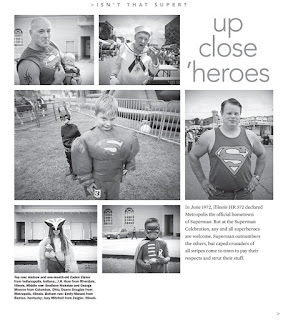
In related news, here are more of Jennifer Silverberg's photos from the Superman Celebration, this time focusing on food. Here's one from the main story, which I should have posted sooner.
"We've found out he's not Superman," said Nora Seeley, 54, when asked what she had learned about the president during his first six months on the job. Still, she said, "things are starting to turn around."
It's no surprise that his reputation among Americans is deflating. Nothing else could have happened in the wake of his popularity upon taking office. People may come to realize that there is absolutely nothing that anyone could have done to fix everything in this short a time. I honestly have no idea how he's doing, but I see more and more local businesses hiring, and that's a good thing.
In related news, here are more of Jennifer Silverberg's photos from the Superman Celebration, this time focusing on food. Here's one from the main story, which I should have posted sooner.
Awe and Wonder.
One of the ideas Joseph Campbell is famous for is his four functions of mythology: metaphysical, cosmological, social, and gastronomic. I may have gotten that last one wrong. But why wouldn't mythology help you digest food properly?
Anyway, the metaphysical function, according to campbell, is all about demonstrating to humanity that life is worth living, that creation is a beautiful thing, and all that. Then we get Dave Gibbons, artist who drew Watchmen, most famously, but also a little Superman story called "For the Man who Has Everything." Both written by Alan Moore. In an interview he said,
"Again, my personal view is that they should make it lighter, with that sense of wonder that Superman has always had. Not to make it childish or puerile but to make it something that has a bright sense of adventure and possibility."
He's talking about what a new Superman movie should feel like. He's not the only one. The internets are awash with fans speculating, hoping, decrying, and dismissing a movie that has no script, director, actor, or even basic idea. It's interesting. Part of this is the age we live in, an age of endless discussion not only of what might be and what might have been but what should be, in everyone's own opinion.
While every work has its fanatics and devotees, I wonder if there's something in particular about Superman that makes this speculation appropriate. I won't bother linking to every quotation in which Superman is called a myth, but doesn't that status mean it's different from a lot of other "properties" out there?
It's particularly appropriate to film versions of the character. Film, more than television or comic books, has the ability to instill that sense of awe and wonder. It's bigger than life, and until a couple of decades ago it had to be viewed in something resembling, if not a religious ritual, then at least a public dream. Everyone sitting quietly in a darkened room, slightly leaned back, dazzled by images of things they previously could only imagine. Compare that to sitting at home, phone ringing, neighbors screaming, cars driving by, etc...It's why the rudeness of modern theater goers is such a sad state of affairs.
Where'd that rant come from? I don't even go to the movies more than once a year anymore.
Thursday, July 30, 2009
Bursting into the imaginary world
There's a trend in people's writing and discussion of Superman, a trend toward imagining what a Superman would be like if he existed in the real world. We saw this in the previous post, where a couple of people imagined what Superman would be like drunk (if indeed he could get drunk) and how the character's politics and morality just wouldn't work. This goes back at least as far as Larry Niven's 1971 essay "Man of Steel, Woman of Kleenex" which delves into the problems of Superman's sexual relationship, should one ever develop, with Lois Lane. Since then, countless writers have engaged in this sort of mental exercise, treating everything from the sensibility and psychological function of the secret-identity to what he would do in his free time. Sometimes, this sort of thing makes its way into comics or television shows (and not just ones featuring Superman--go watch Mallrats for Kevin Smith's contemplation of super hero realities).
There's a sort of opposite number to this mental exercise, in which people imagine what aspects of the real world would be like in Superman's world. Famous examples would be meditations on what Superman would do if actually around for World War II, or 9/11. The example below comes from a galler at Superman.nu. The entire page linked to features fan art of Superman that reacts to the 9/11 attacks. This one was created by Ted Hernandez.

A corrolary of this is perhaps the imaginary casting of a Superman movie. Here's an example that reacts very specficially to the 2006 Superman Returns casting. It's one of those things that people do from time to time, but I've seen a lot of them recently. It may have to do with all the recent reporting on the legal battle over the rights to the character that has gone on between DC/TimeWarner and the Siegel family. It has prompted many rumors about when and if a new movie will go into production.
There's a sort of opposite number to this mental exercise, in which people imagine what aspects of the real world would be like in Superman's world. Famous examples would be meditations on what Superman would do if actually around for World War II, or 9/11. The example below comes from a galler at Superman.nu. The entire page linked to features fan art of Superman that reacts to the 9/11 attacks. This one was created by Ted Hernandez.
A corrolary of this is perhaps the imaginary casting of a Superman movie. Here's an example that reacts very specficially to the 2006 Superman Returns casting. It's one of those things that people do from time to time, but I've seen a lot of them recently. It may have to do with all the recent reporting on the legal battle over the rights to the character that has gone on between DC/TimeWarner and the Siegel family. It has prompted many rumors about when and if a new movie will go into production.
Wednesday, July 29, 2009
Links
First up, Jennifer Silverberg created a sort of photo essay about the Metropolis, Ill., Superman Celebration. You can check out the published work here, here, or some other photos on her website. Thanks, Jennifer!
Then there's this blog entry, wondering why anyone would want to be Superman, based on a recent viewing of Superman II. The writer, unfamiliar with the many versions of Superman's story, is unfortunately stuck with the "Christ Mission" that the films impose on the character. Other versions have Superman choosing his own fate. I dont' know how that would alter the argument she makes.
In a similar vein, this blog entry wonders about whether or not Superman can get drunk.
Haven't posted anything about Obama lately. Here's someone's reality check: "He's not Superman, right?" I like the "right" at the end. And because the idea is floating around in the ether, here's a cartoon that makes the same point (I would post the image, but for reasons unknown to me it won't work).
A common use of Superman in conversation and writing is to point out to someone "You're not Superman." This is meant to indicate that the person--or persons, or everybody--isn't perfect, can't do everything, and should expect it. In this case, it refers to struggling with alcoholism.
There's this novel, by Rich Cohen:
“David Alroy was the first superhero,” Cohen writes of a false messiah known as “King of the Jews” in 12th-century Persia. “He offered a picture of strength to a people lousy with weakness.” Cohen regards Alroy as a model for the figure created in 1938 — “another dark age for the Jews” — by two Jewish teenagers from Cleveland. “Superman is a writer; Superman is brainy in his glasses; Superman is in exile from an ancient nation destroyed by fire; Superman has two names, a fake WASP-y name (Clark Kent) and a secret name in an ancient tongue, Kal-El; . . . Superman, whose cape is a tallis; Superman, whose logo, the “S” emblazoned on his chest, marks him as a freakish stranger as the yellow Star of David marks the ghetto Jew.”
Finally, this is the first I've heard of the movie "A Man who Was Superman."
Then there's this blog entry, wondering why anyone would want to be Superman, based on a recent viewing of Superman II. The writer, unfamiliar with the many versions of Superman's story, is unfortunately stuck with the "Christ Mission" that the films impose on the character. Other versions have Superman choosing his own fate. I dont' know how that would alter the argument she makes.
In a similar vein, this blog entry wonders about whether or not Superman can get drunk.
Haven't posted anything about Obama lately. Here's someone's reality check: "He's not Superman, right?" I like the "right" at the end. And because the idea is floating around in the ether, here's a cartoon that makes the same point (I would post the image, but for reasons unknown to me it won't work).
A common use of Superman in conversation and writing is to point out to someone "You're not Superman." This is meant to indicate that the person--or persons, or everybody--isn't perfect, can't do everything, and should expect it. In this case, it refers to struggling with alcoholism.
There's this novel, by Rich Cohen:
“David Alroy was the first superhero,” Cohen writes of a false messiah known as “King of the Jews” in 12th-century Persia. “He offered a picture of strength to a people lousy with weakness.” Cohen regards Alroy as a model for the figure created in 1938 — “another dark age for the Jews” — by two Jewish teenagers from Cleveland. “Superman is a writer; Superman is brainy in his glasses; Superman is in exile from an ancient nation destroyed by fire; Superman has two names, a fake WASP-y name (Clark Kent) and a secret name in an ancient tongue, Kal-El; . . . Superman, whose cape is a tallis; Superman, whose logo, the “S” emblazoned on his chest, marks him as a freakish stranger as the yellow Star of David marks the ghetto Jew.”
Finally, this is the first I've heard of the movie "A Man who Was Superman."
Tuesday, July 28, 2009
The Origins of Superman
The novel Gladiator by Philip Wylie may or may not be an inspiration for Superman. It was published several years prior to Superman's first appearance in Action Comics #1, and sources I cannot cite from memory indicate that Jerry Siegel read the book before coming up with the character. The characters share many of the same traits, though not the same genesis, and the stories explore many of the same themes. If I were to make an argument that they are in fact the "same" story, I would have to found that argument on the despair that Hugo Danner (the Gladiator in question) must fight off throughot his life.
Yet Superman does not despair. Does he? The only reference to this that I can point to comes not in a Superman comic or movie, indeed, it's to a comic book in which Superman does not even appear. It's Endless Nights, by Neil Gaiman, and in partular to the story "The Heart of a Star" drawn by Miguelanxo Prado. In it, in the early days of the universe, the stars and nebulae and the things that come before gods get together to have a meeting. In one conversation, Despair tells the star Rao (around which Krypton orbits):
Wouldn't bringing life onto a planet that is inherently unstable add to the beauty of the life? If at any moment it would explode...Truly it would only be perfectly beautiful, a perfect piece of art, if one single life-form escaped. To remember, to mourn, to despair. (Endless Nights, "The Heart of a Star," pg. 76)
This would have us believe that Superman's defining characteristic is not flight or morality, but mourning and despair. He is alone among people who are like him.
Interestingly, I interviewed a woman named Jodi Chromey, whose affinity for Superman echoes this interpretation. She has two half-siblings, whom she is like but unlike in origin and appearance. So she feels an affinity for Superman and even got tattooed with the S-Shield because of this element of his story.
Danner in Gladiator spends his whole life trying to reconcile himself to his powers--gained because his father performs what would no doubt be considered genetic enhancement if the novel were written later in the cnetury. They cause him trouble and pain at every stage of his life, and the novel is a series of explorations of how Danner tries to cope with each new stage and the troubles it brings. It's a great book.
Hugo realized at last that there was no place in his world for him. Tides and tempest, volc anoes and lightning, all other majestic vehemences of the unverse had a purpose, but he had none. Either because he was all those forces unnaturally locked in the body of a man, or because he was a giant compelled to stoop and pander to live among his feeble fellows, his anachronism was complete. (311)
There's no place in the world for him. He spends a lot of time searching, and we have to wonder why he never finds one. Perhaps it is because he is given no clear agenda by his father, whose experiments created Danner's condition (which, by the way, is not hereditary, which actually separates it from genetic). Perhaps it is because he generally keeps his condition a secret, save for a few times. And when the revelation of his nature does not instill disgust or fear in his confidant, Danner retreats from the potential friend. He keeps expecting greatness, so much so that he does not allow himself to attain it. I'm reminded of a line from one of my favorite stories, Mefisto in Onyx by Harlan Ellison. The protagonist, Rudy Pairis, is also gifted in that he can read minds. Instead of a boon, the horror and ugliness that Pairis sees in others essentially keeps him unemployed and mostly friendless. Ellison says that Pairis "couldn't get out of his own way." I think that applies to Danner as well.
But it doesn't apply to Superman. I think first of the Richard Donner movies, in which Superman is given clear purpose by Jor-El, who sends him to Earth as protector and "light to showthe way." In contrast, Siegel didn't, as far as I know, give much reason for Superman's choice to fight crime and social injustice. Later, Mark Waid's Birthright would spend a lot of time exploring Superman's choice and giving sound reason for it. He does not dwell on despair, but on the fact that Superman comes to the decision himself, after seeing the injustice of the world (particularly in Africa).
For both Danner and Superman, the decision as to what they must do with their lives comes at the onset of manhood. This is when despair is most possible, especially without direction. Danner tries being a soldier, a lover, a laborer, a political "lobbyist", a banker, and other things. Always, his strength proves an obstacle that he cannot overcome. Superman, on ther other hand, splits his life into two parts: super hero and journalist. He chooses not one, but two paths. This may be the real need for the secret identity, which many writers have decried as unrealistic and unnecessary save for the tension it provides the relationship with Lois Lane.
What I have learned reading Danner's story is that the difference that comes with such great strength brings with it not merely responsiblity (as Stan Lee would have it) but also adaptation. Such power is not the provenance of mortals, but of gods, which Wylie's narration repeatedly invoke. The rest of us simply cannot handle it in one of our own. We require not equality, but at least the potential for a level playing field. We resent it if someone rises too high, and we must impugn their perfection. Thus the many jokes that subvert Superman's moral rectitude.
We may just look at Superman and Danner as two explorations of the cost of power, one optimistic and one pessimistic. But that's not all that's going on here. Superman is the story of an optimist, and certainly Danner can't get out of his own way, but their stories (their story?) are actually about adaptation to one's lot in life. Superman devises a way to live by disguising himself so that he may present the world his true face in two aspects. Danner tries to hide his nature, but gives himself no outlet. He reveals his powers only grudgingly, and then rejects anyone who offers solace. Superman does just the opposite. Again, Mark Waid's take on the character rings true: his Superman insists that he cannot wear a mask--if he shows his face, peopel will trust him. Danner hides, and his dishonesty is rejected.
A last thought, on gladiators: they're slaves. More to come.
Yet Superman does not despair. Does he? The only reference to this that I can point to comes not in a Superman comic or movie, indeed, it's to a comic book in which Superman does not even appear. It's Endless Nights, by Neil Gaiman, and in partular to the story "The Heart of a Star" drawn by Miguelanxo Prado. In it, in the early days of the universe, the stars and nebulae and the things that come before gods get together to have a meeting. In one conversation, Despair tells the star Rao (around which Krypton orbits):
Wouldn't bringing life onto a planet that is inherently unstable add to the beauty of the life? If at any moment it would explode...Truly it would only be perfectly beautiful, a perfect piece of art, if one single life-form escaped. To remember, to mourn, to despair. (Endless Nights, "The Heart of a Star," pg. 76)
This would have us believe that Superman's defining characteristic is not flight or morality, but mourning and despair. He is alone among people who are like him.
Interestingly, I interviewed a woman named Jodi Chromey, whose affinity for Superman echoes this interpretation. She has two half-siblings, whom she is like but unlike in origin and appearance. So she feels an affinity for Superman and even got tattooed with the S-Shield because of this element of his story.
Danner in Gladiator spends his whole life trying to reconcile himself to his powers--gained because his father performs what would no doubt be considered genetic enhancement if the novel were written later in the cnetury. They cause him trouble and pain at every stage of his life, and the novel is a series of explorations of how Danner tries to cope with each new stage and the troubles it brings. It's a great book.
Hugo realized at last that there was no place in his world for him. Tides and tempest, volc anoes and lightning, all other majestic vehemences of the unverse had a purpose, but he had none. Either because he was all those forces unnaturally locked in the body of a man, or because he was a giant compelled to stoop and pander to live among his feeble fellows, his anachronism was complete. (311)
There's no place in the world for him. He spends a lot of time searching, and we have to wonder why he never finds one. Perhaps it is because he is given no clear agenda by his father, whose experiments created Danner's condition (which, by the way, is not hereditary, which actually separates it from genetic). Perhaps it is because he generally keeps his condition a secret, save for a few times. And when the revelation of his nature does not instill disgust or fear in his confidant, Danner retreats from the potential friend. He keeps expecting greatness, so much so that he does not allow himself to attain it. I'm reminded of a line from one of my favorite stories, Mefisto in Onyx by Harlan Ellison. The protagonist, Rudy Pairis, is also gifted in that he can read minds. Instead of a boon, the horror and ugliness that Pairis sees in others essentially keeps him unemployed and mostly friendless. Ellison says that Pairis "couldn't get out of his own way." I think that applies to Danner as well.
But it doesn't apply to Superman. I think first of the Richard Donner movies, in which Superman is given clear purpose by Jor-El, who sends him to Earth as protector and "light to showthe way." In contrast, Siegel didn't, as far as I know, give much reason for Superman's choice to fight crime and social injustice. Later, Mark Waid's Birthright would spend a lot of time exploring Superman's choice and giving sound reason for it. He does not dwell on despair, but on the fact that Superman comes to the decision himself, after seeing the injustice of the world (particularly in Africa).
For both Danner and Superman, the decision as to what they must do with their lives comes at the onset of manhood. This is when despair is most possible, especially without direction. Danner tries being a soldier, a lover, a laborer, a political "lobbyist", a banker, and other things. Always, his strength proves an obstacle that he cannot overcome. Superman, on ther other hand, splits his life into two parts: super hero and journalist. He chooses not one, but two paths. This may be the real need for the secret identity, which many writers have decried as unrealistic and unnecessary save for the tension it provides the relationship with Lois Lane.
What I have learned reading Danner's story is that the difference that comes with such great strength brings with it not merely responsiblity (as Stan Lee would have it) but also adaptation. Such power is not the provenance of mortals, but of gods, which Wylie's narration repeatedly invoke. The rest of us simply cannot handle it in one of our own. We require not equality, but at least the potential for a level playing field. We resent it if someone rises too high, and we must impugn their perfection. Thus the many jokes that subvert Superman's moral rectitude.
We may just look at Superman and Danner as two explorations of the cost of power, one optimistic and one pessimistic. But that's not all that's going on here. Superman is the story of an optimist, and certainly Danner can't get out of his own way, but their stories (their story?) are actually about adaptation to one's lot in life. Superman devises a way to live by disguising himself so that he may present the world his true face in two aspects. Danner tries to hide his nature, but gives himself no outlet. He reveals his powers only grudgingly, and then rejects anyone who offers solace. Superman does just the opposite. Again, Mark Waid's take on the character rings true: his Superman insists that he cannot wear a mask--if he shows his face, peopel will trust him. Danner hides, and his dishonesty is rejected.
A last thought, on gladiators: they're slaves. More to come.
Thursday, July 16, 2009
I need to have this link handy
The swearing in ceremony for the honorary citizens of Metropolis, Illinois.
The coverage for this event--entirely done by fans--is amazing. I wasn't able to record this ceremony myself, and would have had a lot of difficulty with something I'm writing if Jamie Kelley and Ronda Marston (aka Clark Kent and Lois Lane) hadn't spent the time getting it and putting it up online. Many many thanks.
The coverage for this event--entirely done by fans--is amazing. I wasn't able to record this ceremony myself, and would have had a lot of difficulty with something I'm writing if Jamie Kelley and Ronda Marston (aka Clark Kent and Lois Lane) hadn't spent the time getting it and putting it up online. Many many thanks.
Clothes make the man
Ok, so this is happening a lot: People dressed up as Superman (and super heroes in general) are being arrested. It's getting to be something of a pattern. There's this guy:
On Tuesday, he was lying on the sidewalk, which, not surprisingly even in this city, caught the attention of a police officer.
“I am just tired, I am not going anywhere,” prosecutors quoted him as telling the police. “I am Superman, the Governorator, ” he said, according to a law official.
He then ran into the street. Vehicles swerved around him, the complaint said. He “flailed” his arms, refusing to be handcuffed, it said.
And so that was how he landed in Judge Alvin Yearwood’s courtroom, sitting on a hard bench at about 11 a.m. on Wednesday, with a hole in his tights, as prostitution and drunk driving suspects were called up to appear.
“This was the company that Superman was keeping,” said John Marshall Mantel, a freelance photographer for The New York Times who saw him there.
I'm not sure I understand the reason behind referring to the guy as Superman. The "freelance photographer" is only one of the people who do this sort of thing. Because he wears the costume, he is the character. At least that's the logic here. This is a tough subject for me to work through, because there are a lot of facets to it. Lots to account for.
For instance, by putting on a Santa Claus outfit, a person kind of sort of really does become Santa Claus--at least in the eyes of the kids who believe in him. And there is something similar going on with Superman. And with the disney characters. The Superman (Josh Boltinghouse) at the Metropolis Superman Celebration isn't allowed to appear out of Character. He displays his own face (as does Superman--Mark Waid's Superman: Birthright has a great take on why this is necessary; Waid's a guy who really has thought all of this through), and because of his contract, kids who attend the festival will see the same face on Superman for many years.
A guy I interviewed here in Bloomington told me about the day he realized there was no Superman. He told it just like you might imagine a kid relating the story of how he learned there was no Santa Claus. It was the differences from his idealized version and the guy standing in front of him in a truck stop that clued him in. This guy had a wedding ring, a beer gut, and a moustache. None of which the Superman in his imagination possessed.
So what, exactly is going on with comments like the one by the photographer? Why must we conflate the man with the costume? Another example:
Superman and Batman took on New York's Finest last night in an epic Crossroads of the World battle that left the Caped Crusader in cuffs. (from the article linked in my previous post)
The costume is the most important symbolic aspect of Superman. Are these quotations telling us that by appropriating the symbol, we appropriate the identity? Or do they reveal that Superman is only what we make of him? That we control his image with what we do, so we should be careful what we do, especially when dressed as him?
The guy who dresses as Superman in Confessions of a Superhero probably has a lot to say about this. It was kind of appropriate how he as Superman was sort of the leader of all the other people who dress in costume outside the Chinese Theater in LA.
On Tuesday, he was lying on the sidewalk, which, not surprisingly even in this city, caught the attention of a police officer.
“I am just tired, I am not going anywhere,” prosecutors quoted him as telling the police. “I am Superman, the Governorator, ” he said, according to a law official.
He then ran into the street. Vehicles swerved around him, the complaint said. He “flailed” his arms, refusing to be handcuffed, it said.
And so that was how he landed in Judge Alvin Yearwood’s courtroom, sitting on a hard bench at about 11 a.m. on Wednesday, with a hole in his tights, as prostitution and drunk driving suspects were called up to appear.
“This was the company that Superman was keeping,” said John Marshall Mantel, a freelance photographer for The New York Times who saw him there.
I'm not sure I understand the reason behind referring to the guy as Superman. The "freelance photographer" is only one of the people who do this sort of thing. Because he wears the costume, he is the character. At least that's the logic here. This is a tough subject for me to work through, because there are a lot of facets to it. Lots to account for.
For instance, by putting on a Santa Claus outfit, a person kind of sort of really does become Santa Claus--at least in the eyes of the kids who believe in him. And there is something similar going on with Superman. And with the disney characters. The Superman (Josh Boltinghouse) at the Metropolis Superman Celebration isn't allowed to appear out of Character. He displays his own face (as does Superman--Mark Waid's Superman: Birthright has a great take on why this is necessary; Waid's a guy who really has thought all of this through), and because of his contract, kids who attend the festival will see the same face on Superman for many years.
A guy I interviewed here in Bloomington told me about the day he realized there was no Superman. He told it just like you might imagine a kid relating the story of how he learned there was no Santa Claus. It was the differences from his idealized version and the guy standing in front of him in a truck stop that clued him in. This guy had a wedding ring, a beer gut, and a moustache. None of which the Superman in his imagination possessed.
So what, exactly is going on with comments like the one by the photographer? Why must we conflate the man with the costume? Another example:
Superman and Batman took on New York's Finest last night in an epic Crossroads of the World battle that left the Caped Crusader in cuffs. (from the article linked in my previous post)
The costume is the most important symbolic aspect of Superman. Are these quotations telling us that by appropriating the symbol, we appropriate the identity? Or do they reveal that Superman is only what we make of him? That we control his image with what we do, so we should be careful what we do, especially when dressed as him?
The guy who dresses as Superman in Confessions of a Superhero probably has a lot to say about this. It was kind of appropriate how he as Superman was sort of the leader of all the other people who dress in costume outside the Chinese Theater in LA.
Tuesday, July 14, 2009
Simply mad about the house.
Thanks to meeks for the link to his footage of the ribbon-cutting ceremony. The opening speech, by Mike Ocevski (am I spelling that correctly?), is great. If anybody knows the guy who delivered it, and can connect me with him, please do so.
Every child's father should be their hero, but if he wasn't there Superman would be a great substitute.
The speech gives us a whole lot of different interpretations of the character and the way people apply them to their lives. I had no idea there is a Siegel and Shuster society.
The rest of the ceremony is great, too. There were a lot of people involved, and it seems really cool that they gave out bricks from the original house to various people, including the current residents. The "official super bricks."
At the end, when a tarp is being removed from a fence that has been cast with the superman logo: "Can I have my men of faith please lift the veil off the fence?" Tongue in cheek religion?
Immigration
The Invincible Super Blog has an interesting take on the idea of Superman as an ideal immigrant, through the eyes of the character Hitman (issue 34). There are a great many ideas about Superman as an immigrant.
Immigration is a key component of what people call the myth of Superman. Gary Engle writes about it in an essay called "What's makes Superman so darned american?" that's in Superman at 50: the persistence of a legend (I wanted to link to something, but there doesn't appear to be any knowledge of this book on the internets--yet I have a copy on my desk right now).
You know, Superman comics don't sell all that well, at least that's what the comic shop workers I've been interviewing tell me. The last movie was not what people wanted. I have no idea if Smallville is a big hit or not, though the eight seasons it has run offer some indication. And yet Superman is huge right now. There are all these things going on, such as the house restoration. And people write about him on their blogs every day. People also dress up as him every day, sometimes getting arrested for it.
Every child's father should be their hero, but if he wasn't there Superman would be a great substitute.
The speech gives us a whole lot of different interpretations of the character and the way people apply them to their lives. I had no idea there is a Siegel and Shuster society.
The rest of the ceremony is great, too. There were a lot of people involved, and it seems really cool that they gave out bricks from the original house to various people, including the current residents. The "official super bricks."
At the end, when a tarp is being removed from a fence that has been cast with the superman logo: "Can I have my men of faith please lift the veil off the fence?" Tongue in cheek religion?
Immigration
The Invincible Super Blog has an interesting take on the idea of Superman as an ideal immigrant, through the eyes of the character Hitman (issue 34). There are a great many ideas about Superman as an immigrant.
Immigration is a key component of what people call the myth of Superman. Gary Engle writes about it in an essay called "What's makes Superman so darned american?" that's in Superman at 50: the persistence of a legend (I wanted to link to something, but there doesn't appear to be any knowledge of this book on the internets--yet I have a copy on my desk right now).
You know, Superman comics don't sell all that well, at least that's what the comic shop workers I've been interviewing tell me. The last movie was not what people wanted. I have no idea if Smallville is a big hit or not, though the eight seasons it has run offer some indication. And yet Superman is huge right now. There are all these things going on, such as the house restoration. And people write about him on their blogs every day. People also dress up as him every day, sometimes getting arrested for it.
Great, now I have to go to Cleveland.
Gods Among Men
Another in a series of essays that compare Superman and Jesus--this time with Heracles thrown into the mix.
And here's a blog that unfavorably looks upon the comparison of Obama and Superman.
A New Site of Pilgrimage
I'm wondering how the restoration of the Siegel home in Cleveland will affect this project. The wording in this article has a religious slant, but the real reason to take a look is the photography:
Since Superman was born in Cleveland seven decades ago, visitors from around the world have made pilgrimages to what they consider holy ground. Above, the childhood home of Jerry Siegel, who, along with his friend Joe Shuster, created Superman, in the Glenville neighborhood of Cleveland.
Also from the Wall Street Journal.
Here's one from the town of Cleveland itself, so to speak, that gives actually useful information, such as the fact that the house is still a private residence, its address, and the ribbon cutting that occurred this past weekend.

It's a curious thing, the way these article are constructed. When I was writing about Prometheus, I took a look at reviews of the recent biography of Robert Oppenheimer (American Prometheus) to see the differences in the way people tell a story second or third hand. What I found was enlightening. I saw that the reviewers skewed the story of Prometheus to fit their own ideas of Oppenheimer. With these articles, the Wall Street Journal plays up the fact that Siegel's father died soon after a robbery to imply that Superman was created as a power fantasy of a fatherless teenage boy. Superman as an absent father, highlighting his role as a protector. The cleveland blog begins with references to Siegel as "lovesick," which highlights the love "triangle" with Lois Lane and, further, the fact that Siegel wanted people (especially girls) to look deeper than his nerdy exterior.
I found this same reading of Clark Kent being put forward by one of the people I interviewed at the Superman Celebration. Brian Morris, sometime contributor to TwoMorrows, saw Clark Kent as a challenge: Superman saying to the world see me for everything that I am, not just for my pledge to help you. Kent is a statement that we're all more complex, deep, and interesting that the surface would indicate.
Other interpretations abound, of course. Here's an article by Richard Roeper that includes a transcript of David Carradine's monologue about Superman from Kill Bill (the beginning is about parking meters, but it's in there, I assure you).
"Now, a staple of the superhero mythology is there's the superhero and the alter ego. Batman is actually Bruce Wayne, Spider-Man is actually Peter Parker. When that character wakes up in the morning, he's Peter Parker. He has to put on a costume to become Spider-Man.
"Superman didn't become Superman, Superman was born Superman. When Superman wakes up in the morning, he's Superman. His alter ego is Clark Kent. His outfit with the big red 'S'. . . those are his clothes. What Kent wears -- the glasses, the business suit -- THAT'S the costume Superman wears.
"Clark Kent is how Superman views us. And what are the characteristics of Clark Kent? He's weak, he's unsure of himself, he's a coward. Clark Kent is Superman's critique on the whole human race."
Another in a series of essays that compare Superman and Jesus--this time with Heracles thrown into the mix.
And here's a blog that unfavorably looks upon the comparison of Obama and Superman.
A New Site of Pilgrimage
I'm wondering how the restoration of the Siegel home in Cleveland will affect this project. The wording in this article has a religious slant, but the real reason to take a look is the photography:
Since Superman was born in Cleveland seven decades ago, visitors from around the world have made pilgrimages to what they consider holy ground. Above, the childhood home of Jerry Siegel, who, along with his friend Joe Shuster, created Superman, in the Glenville neighborhood of Cleveland.
Also from the Wall Street Journal.
Here's one from the town of Cleveland itself, so to speak, that gives actually useful information, such as the fact that the house is still a private residence, its address, and the ribbon cutting that occurred this past weekend.
It's a curious thing, the way these article are constructed. When I was writing about Prometheus, I took a look at reviews of the recent biography of Robert Oppenheimer (American Prometheus) to see the differences in the way people tell a story second or third hand. What I found was enlightening. I saw that the reviewers skewed the story of Prometheus to fit their own ideas of Oppenheimer. With these articles, the Wall Street Journal plays up the fact that Siegel's father died soon after a robbery to imply that Superman was created as a power fantasy of a fatherless teenage boy. Superman as an absent father, highlighting his role as a protector. The cleveland blog begins with references to Siegel as "lovesick," which highlights the love "triangle" with Lois Lane and, further, the fact that Siegel wanted people (especially girls) to look deeper than his nerdy exterior.
I found this same reading of Clark Kent being put forward by one of the people I interviewed at the Superman Celebration. Brian Morris, sometime contributor to TwoMorrows, saw Clark Kent as a challenge: Superman saying to the world see me for everything that I am, not just for my pledge to help you. Kent is a statement that we're all more complex, deep, and interesting that the surface would indicate.
Other interpretations abound, of course. Here's an article by Richard Roeper that includes a transcript of David Carradine's monologue about Superman from Kill Bill (the beginning is about parking meters, but it's in there, I assure you).
"Now, a staple of the superhero mythology is there's the superhero and the alter ego. Batman is actually Bruce Wayne, Spider-Man is actually Peter Parker. When that character wakes up in the morning, he's Peter Parker. He has to put on a costume to become Spider-Man.
"Superman didn't become Superman, Superman was born Superman. When Superman wakes up in the morning, he's Superman. His alter ego is Clark Kent. His outfit with the big red 'S'. . . those are his clothes. What Kent wears -- the glasses, the business suit -- THAT'S the costume Superman wears.
"Clark Kent is how Superman views us. And what are the characteristics of Clark Kent? He's weak, he's unsure of himself, he's a coward. Clark Kent is Superman's critique on the whole human race."
Thursday, July 9, 2009
Stuff and whatnot
A more and more prominent issue in the study of folklore is creator's rights and copyright. This is paralleled by its prominence in the world of comics. It's particularly relevant where Superman is concerned. The creators, Jerry Siegel and Joe Shuster, sold the rights long ago. There has been a great deal of legal conflict over this, as Siegel himself felt cheated. His (and Shuster's heirs) have continued the fight. I don't feel the need to go into the history of this conflict here, nor am I qualified to comment on the technicalities of copyright.
That said, I side with creators.
There has been a new ruling that seems to favor Warner Brothers and DC Comics, who own the copyright at the moment. The only really interesting piece of news here (to me) is the fact that the heirs will gain all rights to the character in 2013. If I were them, I'd have a giant clock counting down the seconds, like the Chinese used to have in Beijing, right by Tiananmen Square, to count down the time until Hong Kong was once more part of China. That thing was huge.
I found this article on Smallville. I don't have much to say about the writer's opinions, other than I'm not a fan of the show. He makes some interesting comments about "canon" and "straying too far", but the one thing I have to get down in writing is that Smallville's creators didn't come up with the notion that Superman and Luthor were friends as kids. That was Jerry Siegel. He wrote a story in 1960 called "How Luthor Met Superboy" where the true reason behind Luthor's hatred of Superman became known. Superboy made Luthor lose all his hair. I'm not even kidding about that. See this article. This phenomenon of thinking the first time YOU encounter something is the first time it happened is pretty common, I think. I've certainly fallen victim to it a number of times. On TV Tropes they call it "Older Than They Think." TV Tropes is one of my favorite websites. I could read that thing all day long.
In other international news...
The new Prime Minister of Bulgaria is referred to as Superman.
So is Michael Jackson.
That said, I side with creators.
There has been a new ruling that seems to favor Warner Brothers and DC Comics, who own the copyright at the moment. The only really interesting piece of news here (to me) is the fact that the heirs will gain all rights to the character in 2013. If I were them, I'd have a giant clock counting down the seconds, like the Chinese used to have in Beijing, right by Tiananmen Square, to count down the time until Hong Kong was once more part of China. That thing was huge.
I found this article on Smallville. I don't have much to say about the writer's opinions, other than I'm not a fan of the show. He makes some interesting comments about "canon" and "straying too far", but the one thing I have to get down in writing is that Smallville's creators didn't come up with the notion that Superman and Luthor were friends as kids. That was Jerry Siegel. He wrote a story in 1960 called "How Luthor Met Superboy" where the true reason behind Luthor's hatred of Superman became known. Superboy made Luthor lose all his hair. I'm not even kidding about that. See this article. This phenomenon of thinking the first time YOU encounter something is the first time it happened is pretty common, I think. I've certainly fallen victim to it a number of times. On TV Tropes they call it "Older Than They Think." TV Tropes is one of my favorite websites. I could read that thing all day long.
In other international news...
The new Prime Minister of Bulgaria is referred to as Superman.
So is Michael Jackson.
Wednesday, July 8, 2009
Two things
This project began as a study of jokes, but that soon led me to studying religious implications of Superman. This blog seems to be an obvious one to study from that perspective (see also entries for Feb. 25, . The writer calls Superman "an archetype of radical giving and effort for a greater good." That seems accurate enough, to a point. If we take archetype as he is using it, Superman is also the archetype of individual achievement and greatness at something, such as sports, sometimes in service to a team.
On an unrelated note, here's an article imagining what it would be like to be Superman's kid. There's been a lot of this sort of thing--working out the real-world possibilities of Superman's existence. Perhaps most famously, Larry Niven wrote "Man of Steel, Woman of Kleenex", which was all about the problems of Superman and Lois Lane's physical relationship.
On an unrelated note, here's an article imagining what it would be like to be Superman's kid. There's been a lot of this sort of thing--working out the real-world possibilities of Superman's existence. Perhaps most famously, Larry Niven wrote "Man of Steel, Woman of Kleenex", which was all about the problems of Superman and Lois Lane's physical relationship.
Tuesday, July 7, 2009
In other news...
So I got a strange message the other day. It came from an acquisitions editor at the University of Mississippi Press. Evidently they're interested in publishing the book I'm writing about Superman. It's not a contract or anything, merely an invitation to submit a proposal.
So there's that.
There's also an interview of me (yes, of me, not by me--) up on YouTube and on the Superman Homepage. Lois Lane interviews me about this project after Clark Kent talks to a comics writer,. about 8 minutes in. Marge's Donut Den!
So there's that.
There's also an interview of me (yes, of me, not by me--) up on YouTube and on the Superman Homepage. Lois Lane interviews me about this project after Clark Kent talks to a comics writer,. about 8 minutes in. Marge's Donut Den!
A story...
What does this story have to do with Superman?
Capt. Vancouver was very anxious to Christianize these people [the Hawaiians], but that can never be done until they are more civilized. The King Amma-amma-hah [Kamehameha] told Capt. Vancouver that he would go with him to the high mountain Mona Roah [Mauna Loa] and they would both jupm off together, each calling on their separate gods for protection, and if Capt, Vancouver's god saved him, but himself was not saved by his god, then his people should believe as Capt. Vancouver did. (as told by Townsend 1888, pg. 74; qtd. in Sahlins, Historical Metaphors and Mythical Realities, 9)
Only time will tell.
Capt. Vancouver was very anxious to Christianize these people [the Hawaiians], but that can never be done until they are more civilized. The King Amma-amma-hah [Kamehameha] told Capt. Vancouver that he would go with him to the high mountain Mona Roah [Mauna Loa] and they would both jupm off together, each calling on their separate gods for protection, and if Capt, Vancouver's god saved him, but himself was not saved by his god, then his people should believe as Capt. Vancouver did. (as told by Townsend 1888, pg. 74; qtd. in Sahlins, Historical Metaphors and Mythical Realities, 9)
Only time will tell.
Subscribe to:
Posts (Atom)