Sean Kleefeld recently published a book about comic book fans, and I thought it might be a good one for me to read for this project. It's a pretty good book, overall. He calls it Comic Book Fanthropology. He's serializing it over at the website, or you can plunk down a few bucks for a hardcover, paperback, or pdf over at Lulu.com. Kleefeld also keeps a pretty interesting blog.
The book's title throws me off a bit. Kleefeld isn't an anthropologist, nor does he reference anthropologists in his book. Theoretically speaking, his sources come from media studies (McLuhan and Jenkins) as well as social psychology (Tajfel and Turner) more than anything else. I suppose the title might just refer to anthropology as the study of people more than any particular methodology or theoretical stance. And people like puns in titles.
Kleefeld lays out what he's not doing early on: He's not writing a history of fandom, and he's not writing an academic book on fandom. His theory is used sparingly but well applied. Drawing on social psychology (Tajfel and Turner) he elucidates the fact that fandom exists as a social enterprise in part because people like to share their passions and in part because sharing those passions provides an environment where individuals can affirm their identities and boost their sense of self-esteem and -worth. This is all in the early chapters, which also include a brief history. Despite Kleefeld's wish not to write a history, what he does provide works well for him. It shows the origins of fandom as it arises from people getting together to share their passion. First through correspondence and then in person.
In my opinion, the book breaks down in the last few chapters. The chapter I most looked forward to was on participatory culture. Throughout this book, Kleefeld makes the point that fans engage with comics in more ways than merely reading--more than discussing them with friends as well. While Kleefeld lists these ways (including fan music, fiction, costuming, etc) he provides virtually no examples. There's a photo of a man in a Flash suit, but that's about it. Considering that Kleefeld has apparently read Henry Jenkins' Textual Poachers (he cites and quotes Jenkins), this oversight is perplexing.
Perhaps my own perspective will tell you a bit more about why I find this chapter disappointing. I'm a folklorist by training. More than any other discipline, folklore brings to the foreground the texts that are relevant to the discussion. It's not unusual for folklorists to tell whole stories during academic talk, presentations, and lectures. Folklore books include multiple versions of any text being studied. If you want to see an examploe, check out one of the more widely known folklore books, Jan Brunvand's The Vanishing Hitchhiker. This is a classic example of how folklorists work. There are probably ten versions of each urban legend studied in that book. Some people think it's repetitive, and it is, but it's supposed to be. The versions aren't all the same, so you get to see how different people tell the same story. Sometimes, those differences are revealing, sometimes they're curious, and sometimes merely amusing.
Back to participatory culture. Let's look at two examples: fiction and costuming. It's not merely that fans write their own stories about characters they love; it's what's in the stories that's important. Jenkins devotes two chapters to fan fiction, and retells a great many of the stories (and story types) that show up. He's dealing with Star Trek, mostly (which would be important to comics fans). He concludes, in the chapter "Welcome to Bisexuality, Captain Kirk," that the women who write these slash stories are doing so because it enables them to imagine the sorts of relationships they would like to see portrayed on screen. These are women writing about characters in shows produced with a male audience in mind. Often these women don't have much choice in what's on the television, so they make the shows into something that suits them. These factors are important, and I would have liked to see Kleefeld at least explore the fiction surrounding one character.
As for costuming, again, Kleefeld leaves a lot unsaid. I have conducted two short interviews with costumers, and it doesn't seem to me to be all that hard to get information with which to analyze the phenomenon. People want to talk about this stuff. One woman I interviewed talked about the clash between fans who make their own costumes and those who buy them at the store. She said she doesn't enter costume contests because the emphasis is often on who is the most attractive woman rather than on who has the best costume. She talked about the process of making a costume, substituting one piece for another in the same costume as she makes it, always approaching the "perfect" costume but never quite reaching it. All this and much more from 45 minutes. Sometimes just pointing out the controversies is enough.
This is the fieldwork process, which anthropologists as well as folklorists and other employ to get the data for their analysis. It's what I expected. It is not, however, what Kleefeld promised at any time, except perhaps in his title.
I may be being a bit harsh here. The early chapters of the book are quite good. The discussion of cultural capital is rewarding and thorough. He gives a description of the ritual of buying comic books that I find absolutely wonderful and will quote in my book about Superman. His reading is that this process, engaged in repeatedly and recurrently, provides the comfort and stability that we can also find in rituals. It's more than just habit. I also appreciate his qualification on the definition of being a fan. It's not merely something you identify yourself as; another fan must also identify you as one. This fits both Kleefeld's themes of self-esteem and sociality. Is sociality a word?
Other strong points include Kleefeld's acknowledgment of the diversity of fandom, and his bibliography. This last one may not sound like much, but to me it is. He's found some sources I'll be checking out soon, and for me this is a very good thing indeed. I know it may seem strange, but I also appreciate the index.
He gives a lot of time and space to what it means to be a fan. I just wish he's given more to showing what the fans mean when they express themselves. The book is, overall, a little too abstracted from actual fans--too many hypothetical examples, despite the fan profiles that punctuate each chapter.
I'm a fan of the case study. Kleefeld might have really driven home his points if he'd done one or two of these. Followed fans through the process of buying and reading comics to the participatory culture that follows. He gets closest when quoting and discussing fan "origin" stories. These are great. I wanted more. I wanted Kleefeld to point out how each fan describes entering the world of comics with someone. It's always a social process. This is his main point, I think.
Kleefeld cannot be faulted for not writing the book I wanted him to write. There are some omissions that could be rectified in a revised edition. The strucutre is there, and it's a good one.
Wow, that got really long.
All-Star

Sunday, December 20, 2009


Wednesday, December 9, 2009
Comics don't sell well

Normally, this isn't a site for my opinions about Superman or comics, but recently I've been thinking about the decline of the comics busines. It's a poor shadow of its once mighty self. There was a time when pretty much everybody of a certain age read comics. Sure, there wasn't much in terms of entertainment competition: little tv, no video games, etc. But that's not the whole story.
Recently, I've been flipping through The Golden Age of Superman: The Greatest Covers of Action Comics from the '30s to the '50s. It's pretty interesting to see just how exciting those old covers were. The covers that don't feature Superman are outstanding. Here's one:
But the ones that do feature him...those are some stories I want to read. Behold:

In case those words aren't coming through in the image. Superman is demanding more hamburgers. Why? Why must he eat so much to survive? Will the Earth have enough food? I want to know.
Compare that to one of the more recent covers. Let's look at Superman: Secret Origin.

Yep, that's some people standing there. If you're Grant Wood, maybe you can pull that off. Gary Frank, however.... Then there's this one, for Issue 3:

Now, you may have missed it, but there's actually something exciting going on in this image. Lois Lane is chewing on a pen.
Compare:

Not only does this issue feature the star power of Pat Boone, but Superman must stop a song from becoming a hit. Why? How? I must know.
That's what a cover should do--compel you to open the book. Demand your attention and make you want to know more. Do those Secret Origin covers accomplish that? Not even close. I wish this were an isolated thing, but it's not. My favorite comic when I was a kid was Thor. Every issue of the recent Thor series has a cover of Thor swinging his hammer. That's about it. Why would I ever want to buy those?
Tuesday, November 17, 2009
Untold Tales
Thanks to the internet, it's possible to acquire and read scripts for films that will never be shot, plots for novels that will never be written, and ideas for comics that will never be drawn. This is both good and bad, I suppose.
For one thing, it's often funny, as we have seen with the recent revelation of the Nick Cage/Tim Burton Superman Lives movie that never was.
For another, it's often tragic, as with the Superman 2000 proposal by Grant Morrison, Mark Waid, Mark Millar, and Tom Peyer. This Superman, by these writers, would likely have been magnificent. Alas, we'll never know if they could have pulled it off together. Actually, we have clues, as all of these writers have worked with Superman since then. Waid's Birthright was powerful. Millar's Red Son is one of the best-selling superman collections to this day (and one that every comic shop owner has pointed to as a constant favorite of customers), and Morrison's All Star Superman has been called "perfect" by a great many writers and reviewers.
So Superman 2000 didn't happen, but you can read about it. And lots of people like to write about it.
And I'm sure some people have incorporated this into their own idea of who Superman is, the residual image formed from all of their exposure to stories about him.
For one thing, it's often funny, as we have seen with the recent revelation of the Nick Cage/Tim Burton Superman Lives movie that never was.
For another, it's often tragic, as with the Superman 2000 proposal by Grant Morrison, Mark Waid, Mark Millar, and Tom Peyer. This Superman, by these writers, would likely have been magnificent. Alas, we'll never know if they could have pulled it off together. Actually, we have clues, as all of these writers have worked with Superman since then. Waid's Birthright was powerful. Millar's Red Son is one of the best-selling superman collections to this day (and one that every comic shop owner has pointed to as a constant favorite of customers), and Morrison's All Star Superman has been called "perfect" by a great many writers and reviewers.
So Superman 2000 didn't happen, but you can read about it. And lots of people like to write about it.
And I'm sure some people have incorporated this into their own idea of who Superman is, the residual image formed from all of their exposure to stories about him.
Monday, November 9, 2009
And I thought Nick Cage was unusual...
Ok, so this brief exchange on the Baby Backpack part of Yahoo Answers includes statements by two people that they're naming their babies after Superman in some way. Clark. Kal Alexander.
I had no idea.
Sports
Here's a story about clutch-hitting in baseball, which concludes with the odd comment that a hitter notorious for not being good under pressure wears a superman t-shirt under his uniform every game.
Also, Florida Gators' Tim Tebow Is Actually Human and Not Superman, reads the headline for a column in the Bleacher Report.
A Different Opinion
Then there's this cynical assessment of Superman, made in 1988 upon the 50th anniversary of the character. It's by Gary Groth, and that name alone will dictate how a great many people would respond to the essay. It's notable for its glossing over of mythology in general and Greek Mythology in particular, especially in its assessment of what it would take to be a successor to those myths. Here's a summation: My only interest in Superman, marginal at that, stems from his continuing presence as a symbol of banality and infantilism in the history of the American comic book.
Museum
I should start keeping track of all the superhero museum exhibits that crop up these days. Here's one.
Fiction, and Costumes Then there's this...story? Anecdote? Joke? I'm not sure what to call it. It's obviously fictional--what with the superpowers and whatnot, but it's hard to tell what the genre is. It's from Haaretz.com, Israeli news in English, but it's about a Palestinian Superman meeting a fellow countryman in a bar over whiskey. There's a reference to the drunk superman joke in it.
in the related category of people dressing up like superman for various reasons, this guy is doing so and walking thousands of miles to raise money for homeless veterans. Apparently, from the newsstory, dressing like Superman and running down the highway is something that makes people call the police.
And speaking of dressing up, this Halloween was the first during which I've seen Superman costumes with a six-pack built into them. The Philadelphia Inquirer did a story on this. It's not just Superman. It's Superman with over-the-top muscles and a cinched waist. It's not just Superman, either. I think it was Susan Bordeau who wrote a famous article a while back about the male body becoming as objectified as the female body. That trend isn't going away.
Now this is comedy. A boy pretends to be Superman, climbs to a barn roof. And..."The goat did not survive the experience." It's a column from the Clarksville Online, the voice of Clarksville, Tennessee, by Sue Freeman Culverhouse.
I had no idea.
Sports
Here's a story about clutch-hitting in baseball, which concludes with the odd comment that a hitter notorious for not being good under pressure wears a superman t-shirt under his uniform every game.
Also, Florida Gators' Tim Tebow Is Actually Human and Not Superman, reads the headline for a column in the Bleacher Report.
A Different Opinion
Then there's this cynical assessment of Superman, made in 1988 upon the 50th anniversary of the character. It's by Gary Groth, and that name alone will dictate how a great many people would respond to the essay. It's notable for its glossing over of mythology in general and Greek Mythology in particular, especially in its assessment of what it would take to be a successor to those myths. Here's a summation: My only interest in Superman, marginal at that, stems from his continuing presence as a symbol of banality and infantilism in the history of the American comic book.
Museum
I should start keeping track of all the superhero museum exhibits that crop up these days. Here's one.
Fiction, and Costumes Then there's this...story? Anecdote? Joke? I'm not sure what to call it. It's obviously fictional--what with the superpowers and whatnot, but it's hard to tell what the genre is. It's from Haaretz.com, Israeli news in English, but it's about a Palestinian Superman meeting a fellow countryman in a bar over whiskey. There's a reference to the drunk superman joke in it.
in the related category of people dressing up like superman for various reasons, this guy is doing so and walking thousands of miles to raise money for homeless veterans. Apparently, from the newsstory, dressing like Superman and running down the highway is something that makes people call the police.
And speaking of dressing up, this Halloween was the first during which I've seen Superman costumes with a six-pack built into them. The Philadelphia Inquirer did a story on this. It's not just Superman. It's Superman with over-the-top muscles and a cinched waist. It's not just Superman, either. I think it was Susan Bordeau who wrote a famous article a while back about the male body becoming as objectified as the female body. That trend isn't going away.
Now this is comedy. A boy pretends to be Superman, climbs to a barn roof. And..."The goat did not survive the experience." It's a column from the Clarksville Online, the voice of Clarksville, Tennessee, by Sue Freeman Culverhouse.
Tuesday, November 3, 2009
Another Origin
In the early 70's, there was yet another retelling of the origin. This one by Carmine Infantino and Curt Swan...The Bronze Age of Blogs kindly posts the whole thing.
Wednesday, October 28, 2009
Project Progress
I suppose I should provide some sort of update, in case anyone's paying attention. Despite few recent posts, I've been working hard at this project. I traveled to Boise, Idaho, this past weekend to deliver a conference paper based on a chapter, called The Apotheosis of Our Former Selves. It was about Superman and nostalgia and the need for adults to incorporate some sort of playing in their jobs. Good times.
This was part of a panel on mythology at the American Folklore Society meeting. There's some talk of turning the papers from the panel (three or four, depending on what we decide) into an issue of a journal, sort of like a collection of articles. There's a journal interested. We'll see. It was a good panel, and Boise was pretty cool.
About ten days from now, I'm going to deliver another conference paper. This time, it's about the Superman Celebration in Metropolis, Illinois, and the dedication of Jerry Siegel's old house in Cleveland. This will be part of the Hoosier Folklore Conference, in Nashville, Indiana. The paper's called "When Imaginary Places Become Real."
I'm working on revisions of an article to submit to the journal Western Folklore, whose editor has been more than helpful. And I spent half an hour talking to a book publisher on Friday of last week.
But there's still a long way to go. I've got a good sense of the entire book, and an outline, and a lot of research....still, I figure it'll be a year before I've got a manuscript done and ready to show to anyone. That seems sooooo far away.
This was part of a panel on mythology at the American Folklore Society meeting. There's some talk of turning the papers from the panel (three or four, depending on what we decide) into an issue of a journal, sort of like a collection of articles. There's a journal interested. We'll see. It was a good panel, and Boise was pretty cool.
About ten days from now, I'm going to deliver another conference paper. This time, it's about the Superman Celebration in Metropolis, Illinois, and the dedication of Jerry Siegel's old house in Cleveland. This will be part of the Hoosier Folklore Conference, in Nashville, Indiana. The paper's called "When Imaginary Places Become Real."
I'm working on revisions of an article to submit to the journal Western Folklore, whose editor has been more than helpful. And I spent half an hour talking to a book publisher on Friday of last week.
But there's still a long way to go. I've got a good sense of the entire book, and an outline, and a lot of research....still, I figure it'll be a year before I've got a manuscript done and ready to show to anyone. That seems sooooo far away.
Monday, October 19, 2009
Short one
Just needed to keep this link handy. it's a review of All Star Superman that calls it the greatest Superman story.
Thursday, October 15, 2009
More about the Secret Origin
Just a couple of links. The first is to the Superman Homepage, which has reviews of pretty much every Superman comic for the last ten years (and more). In this one, there are a bunch of review for Secret Origin 1.
Then there's a discussion of the same series over at Blue Tights Network. Mixed reviews, but most people seem excited about the series.
So why, you may wonder, so many links to reviews of this particular comic book? I'm interested because this project is mostly about Superman as a myth. Myths, unlike much of literature, usually don't have an established, authoritative text. Even the Bible (in English) has lots of versions, each with agendas that influence the translation. And, for example, the four books of the gospels actually contradict each other every so often. Greek myth is harder to pin down, since there's no text. You've got Hesiod and Homer, but those present problems. Later writers were just writing down what they'd heard, or paraphrasing other writers. And these often contradict each other as well. It gets even more compex with a living mythological tradition. So what happens is that everybody has to decide for themselves what's canon and what's not. The church may try, but with all of the different sects out there, there's something for everybody. And you can always try the church down the road if you don't agree with the interpretation being offered in yours.
With Superman, there's the added element of continuity. He's been constantly in publication since 1938, with stories in every medium. And writers try to make the story interesting in every medium, so they add or eliminate elements. Then there's editorial fiat, or stories introduced to boost sagging sales or garner higher ratings. And every so often, something like Crisis on Infinite Earths or Infinite Crisis happens, so the entire history of the character is wiped away, to be written anew. Then, there are things such as Imaginary Stories, which aren't real.
Right.
What we've got are competing versions of a story. The reviews and discussions are largely about how well the latest version works, which means that the readers evaluate it in terms of the expectations of the myth of Superman. Each person has a preconception of that story, which by virtue of their own identity, will emphasize, highlight, obscure, or outright eliminate motifs of the story as they see fit. Sometimes this isn't even conscious. Some people will imagine a Superman who is absolutely perfect, in morality, in physique, in action and in intent. Others will humanize Superman, giving him physical flaws or moral grey areas.
This includes the writers and editors. One of the Superman homepage reviewers postulates that the writers of comics today are particularly interested in the comics of their youth, so much so that they will force the comics they are working on to fit into the same mold, whether or not the story is progressing that way. They will alter characterization, add in nonsensical plot elements, etc, just so the comic feels like the comics of their youth. I don't know the extent to which this is true of Secret Origins, if it is at all, but I have certainly read comics that feel that way.
Nonetheless, readers are free to pick their version. There's a continuity to DC comics that runs throughout a great many titles. but there are elseworlds. There are Superman Adventures (well, not right now, but there used to be) that were outside the continuity driven titles. There's smallville, and cartoons, and other stories. Superman's also kind of like the weather. If you don't like it, wait a while. It'll change. Not much, of course, but it'll change. The last time it changed was Birthright, by Mark Waid and Leinil Francis Yu. That was way back in 2004.
This variability is one quality that makes a story mythic. I'm not talking about the variability of a single film adaptation of a movie, or even two or three. I'm talking about the fact that there is no fixed text. People can point to an official Moby Dick or Lord of the Rings. They can't point to an official Superman. Would it be this current Secret Origin? Yeah, if you read the comics and adhere to the continuity. For the next five years or so, until they do it all over again because of a universe-shattering battle. But it's not THE Superman if you're only a fan of Smallville, or of George Reeves, or Christopher Reeve, or the Silver Age, or don't read the movies or watch the shows or read the comics but still know about Superman because everybody does. (Seriously, everybody does. Even people with no real access to American media.)
The point of all this is that there is no fixed text. There is no fixed Superman. The nature of the character's existence is to reflect the world because it's a constant product of that world. Sometimes we're awash in nostalgia. Sometimes we need our heroes to be vulnerable. Sometimes we need them to be perfect. And sometimes we need them to have a mullet.

Wednesday, October 14, 2009
Too Perfect
The notion that Superman is just too good to be interesting is one that pops up quite often. Here's one statement, from Miss Cellania:
While Superman is, well, super, he was always too perfect, and rather one-dimensional.
There's Henry Jenkins, from a while ago.
And, because we're still trying to figure out how to make Supermen...Science!
Another review of Secret Origin 1, by Rokk. The discussion is interesing, particularly for this line:
it isn't like DC's continuity or present-day comics for that matter warrant religious following; you pick and choose what you like, sadly
This list is an intersesting one. Not so much for the content--it's really just a list of Superman comics that the writer likes. It's how it's framed that I find worth noting. 10 Essential Superman comics to help you forget Smalliville. As with any sacred narrative worth caring about, there has to be dissention among the ranks. I think this is worth exploring.
I'm going to have to find this one. What if Superman were raised by apes?
I have to post this. In Italy, a Man Dressed like Superman is arrested for stalking Burlesconi.
While Superman is, well, super, he was always too perfect, and rather one-dimensional.
There's Henry Jenkins, from a while ago.
And, because we're still trying to figure out how to make Supermen...Science!
Another review of Secret Origin 1, by Rokk. The discussion is interesing, particularly for this line:
it isn't like DC's continuity or present-day comics for that matter warrant religious following; you pick and choose what you like, sadly
This list is an intersesting one. Not so much for the content--it's really just a list of Superman comics that the writer likes. It's how it's framed that I find worth noting. 10 Essential Superman comics to help you forget Smalliville. As with any sacred narrative worth caring about, there has to be dissention among the ranks. I think this is worth exploring.
I'm going to have to find this one. What if Superman were raised by apes?
I have to post this. In Italy, a Man Dressed like Superman is arrested for stalking Burlesconi.
Monday, October 12, 2009
Following Links
So I was looking at pictures of the Siegel house in Cleveland (Glenville, to be specific). I came across a few interesting things.
There's evidently yet another documentary about Superman, called Last Son. This one delves into the truth behind the creation of the character. If I'm reading correctly, it's more about the death of Siegel's father than anything else. Looks interesting. Not quite sure how to get my hands on it, though.
Marc Tyler Nobleman, creator of Boys of Steel (a comic book biography about Siegel and Shuster) wrote this little post about the current popularity of Superman's creators. The Last Son guy throws his two cents in.
In an unrelated link, there's this essay on the impact of John Byrne's 1986 variation of the Superman story at newsarama, by tomothy Callahan. He says the legacy of Byrne's changes is the humanization of Superman, and the cumulative stories--continuity, in other words, and character issues instead of just fights.
Here's a lesson plan on how to teach heroism and mythology to middle-schoolers.
There's evidently yet another documentary about Superman, called Last Son. This one delves into the truth behind the creation of the character. If I'm reading correctly, it's more about the death of Siegel's father than anything else. Looks interesting. Not quite sure how to get my hands on it, though.
Marc Tyler Nobleman, creator of Boys of Steel (a comic book biography about Siegel and Shuster) wrote this little post about the current popularity of Superman's creators. The Last Son guy throws his two cents in.
In an unrelated link, there's this essay on the impact of John Byrne's 1986 variation of the Superman story at newsarama, by tomothy Callahan. He says the legacy of Byrne's changes is the humanization of Superman, and the cumulative stories--continuity, in other words, and character issues instead of just fights.
Here's a lesson plan on how to teach heroism and mythology to middle-schoolers.
Friday, October 9, 2009
Links, and a new origin
Recently, DC began publishing a new origin for Superman, called Superman: Secret Origin. A bunch of people have stuff to say about this.
Here's a good one, by Rikdad. It begins thus:
The artist takes a pencil and traces an oval where the face will be. Rather than touching the pencil to the paper and drawing it in one solid curve, the oval is composed of many shorter arcs, parallel, intersecting, concentric. Each one nudges the outline from where the previous faint lines had begun, adjusting them, repositioning the curve, correcting it. The pencil is flipped and the eraser rubs some graphite off the page; a sleeve wipes the rubber and dust away, and then the pencil goes back to work. At some point, a mannequin-like shape is there, and then a face is drawn inside, outside, and over it, without ever erasing the original imperfect outline. Eventually it will have life. Eventually it will be a face. Little strokes keep touching it up, making it better, or at least different.
Superman is a work in progress.
Which is good. An apt analogy for the process by which Superman has survived. But it concludes in an even better fashion:
Superman is the Great American Hero, and America is a country that was saved by a quirky Constitutional fiat called the Great Compromise. If Superman was being torn apart in a creative tug of war, Geoff Johns has refused to pick sides. He's come down hard on the side of not favoring sides. Ultimately, the kind of tail fins the rocket has don't matter so much as the adoption of a version of Superman that reminds a plurality of fans of Superman. What could be more pleasing to Superman than to have everybody win?
Good stuff.
I'm planning a thorough analysis of Grant Morrison's All Star Superman series. Here's someone who likes it a whole lot.
Here's some more about Secret Origin.
And more still, from Newsarama.
One more time, from Comic Book Jones.
The consensus about this Secret Origin seems to be that it's completely unnecessary, but that it's pretty good.
Completely unrelated, but still useful: the kids parade in Grand Island.

Which reminds me...Halloween's coming up. There will no doubt be kids dressed up like Superman. Time to do more fieldwork.
There's something more to be said about the "science" behind Superman's powers.
Tuesday, September 29, 2009
Thoughts upon Completing the Space Odyssey Series
2001 may well be the masterpiece it proclaims itself to be. I was amazed by the descriptions that made me feel as if something was actually happening, page after page of ecology and climate during which no human acted nor any change took place felt as if it were vitally important.
The mystery unfolded into greater clarity than the movie would allow. Kubrick told the end in images, but Clarke laid it all out for us through the perspective of David Bowman. In this, the film may qualify as a myth while the book would be literature, if we define myth as that genre of narrative that comes closest to music because it requires a great deal of intellectual investment on the part of its audience. We all come out of music, as we all come out of myth, with our own interpretation based upon our own mood and history. While this is certainly true of all narrative, the mode of myth is particularly good at it. So while Clarke's description of Bowman's journey through the Monolith is fascinating and compelling, it is also clearly delineated. Bowman doesn't reveal much about those who created the monoliths, but we know all that he knows.
Which is not true of the film.
2010 is pretty good, too. There's stuff going on. 2061, however, was a huge disappointment. The mystery is never resolved to any interesting point, and the compelling component of the series is barely present. 3001 does little to advance it, preferring the plot to the idea. The ideas come in the form of futurity; of world-building and speculation. That's not why I read that book, and even though some reviews I dug up prepared me for a lack of answers, I was still annoyed. The interesting aspects of the story were perpetually deferred. There was little compelling in terms of character, though that is true of the series as a whole, aside, perhaps, for HAL.
Interestingly, Clarke revisits the same passages throughout. His chapter of 3001 called "The Firstborn" occurs in all four books, if I'm not mistaken. And while he proclaims that these repetitions are heavily edited, I'm not willing to check that statement. We revisit the firstborn, the depths of Europa, and the atmosphere of Jupiter, and a dying Astronaut's final words.
I began this series, as you may recall, as part of a study of science fiction versions of the "uplifting" of humanity by aliens. I'm fascinated by the idea that aliens came to earth long ago and tampered with people to make us somehow better, according to their standards. 3001 is the first book in this series that postulates a negative connotation to this idea. The aliens may not be entirely benevolent. They may lack a certain emotion, which might cause them to exterminate us because they don't like the way we've developed. The ideas are put forward, but never really explored. Towers stretching to the stratosphere, on the other hand, are described in great detail. But I wasn't the least bit interested in the towers.
That might have been to do with my own agenda, reading more for the aliens than for the vison of the future; but I doubt I am alone in this. And so, when the epilogue comes round, short and sweet ("'Their little universe is very young, and its god is still a child. but it is too soon to judge them; when We return in the Last Days, We will consider what should be saved.'"), I was more interested than in the 246 pages that preceded it.
What an evocation. It rivals and perhaps betters "My God, it's full of stars" from from the film. Note that it's a quotation. Something is saying that to something else.
We're given few clues. 3001 brings religious themes into the foreground far more prominently than the others. For the first time, the monoliths--especially the first one, from the African hominid chapters of 2001--are cast in a religious light: "This was where--in time and space--the human species had really begun. And this Monolith was the very first of all its multitudinous gods" (56).
There's a character, Theodore Kahn, whose sole purpose is to inject religion into discussions. And then there's Frank Poole's conversation with David Bowman, where Bowman says that "twice I have--glimpsed--powers...entities--far superior to the Monoliths, and perhaps even their makers. We may both have less freedom than we imagine" (233) .
It's not specifically a religious statement, but when freedom--or free will, as Poole formulates it--comes up, religion can't be far behind. Clarke has some interesting thoughts on religion in the future, which has all but vanished in the wake of the curing of mental illness.
So the effort to push humanity to sapience (or Mind, as Clarke first puts it) might be misguided in the end. But humanity fights against extinction. Everything seemed so optimistic in the first novels. By 3001, the violence of the twentieth century becomes the instrument of humanity's potential destruction. In the novel's timeframe, people have moved past such violence, but the length of time it takes messages to travel through space renders irrelevant the advancements of the third millennium. Clarke's message is clear: We can overcome our current insanity, but it might already be too late.
The mystery unfolded into greater clarity than the movie would allow. Kubrick told the end in images, but Clarke laid it all out for us through the perspective of David Bowman. In this, the film may qualify as a myth while the book would be literature, if we define myth as that genre of narrative that comes closest to music because it requires a great deal of intellectual investment on the part of its audience. We all come out of music, as we all come out of myth, with our own interpretation based upon our own mood and history. While this is certainly true of all narrative, the mode of myth is particularly good at it. So while Clarke's description of Bowman's journey through the Monolith is fascinating and compelling, it is also clearly delineated. Bowman doesn't reveal much about those who created the monoliths, but we know all that he knows.
Which is not true of the film.
2010 is pretty good, too. There's stuff going on. 2061, however, was a huge disappointment. The mystery is never resolved to any interesting point, and the compelling component of the series is barely present. 3001 does little to advance it, preferring the plot to the idea. The ideas come in the form of futurity; of world-building and speculation. That's not why I read that book, and even though some reviews I dug up prepared me for a lack of answers, I was still annoyed. The interesting aspects of the story were perpetually deferred. There was little compelling in terms of character, though that is true of the series as a whole, aside, perhaps, for HAL.
Interestingly, Clarke revisits the same passages throughout. His chapter of 3001 called "The Firstborn" occurs in all four books, if I'm not mistaken. And while he proclaims that these repetitions are heavily edited, I'm not willing to check that statement. We revisit the firstborn, the depths of Europa, and the atmosphere of Jupiter, and a dying Astronaut's final words.
I began this series, as you may recall, as part of a study of science fiction versions of the "uplifting" of humanity by aliens. I'm fascinated by the idea that aliens came to earth long ago and tampered with people to make us somehow better, according to their standards. 3001 is the first book in this series that postulates a negative connotation to this idea. The aliens may not be entirely benevolent. They may lack a certain emotion, which might cause them to exterminate us because they don't like the way we've developed. The ideas are put forward, but never really explored. Towers stretching to the stratosphere, on the other hand, are described in great detail. But I wasn't the least bit interested in the towers.
That might have been to do with my own agenda, reading more for the aliens than for the vison of the future; but I doubt I am alone in this. And so, when the epilogue comes round, short and sweet ("'Their little universe is very young, and its god is still a child. but it is too soon to judge them; when We return in the Last Days, We will consider what should be saved.'"), I was more interested than in the 246 pages that preceded it.
What an evocation. It rivals and perhaps betters "My God, it's full of stars" from from the film. Note that it's a quotation. Something is saying that to something else.
We're given few clues. 3001 brings religious themes into the foreground far more prominently than the others. For the first time, the monoliths--especially the first one, from the African hominid chapters of 2001--are cast in a religious light: "This was where--in time and space--the human species had really begun. And this Monolith was the very first of all its multitudinous gods" (56).
There's a character, Theodore Kahn, whose sole purpose is to inject religion into discussions. And then there's Frank Poole's conversation with David Bowman, where Bowman says that "twice I have--glimpsed--powers...entities--far superior to the Monoliths, and perhaps even their makers. We may both have less freedom than we imagine" (233) .
It's not specifically a religious statement, but when freedom--or free will, as Poole formulates it--comes up, religion can't be far behind. Clarke has some interesting thoughts on religion in the future, which has all but vanished in the wake of the curing of mental illness.
So the effort to push humanity to sapience (or Mind, as Clarke first puts it) might be misguided in the end. But humanity fights against extinction. Everything seemed so optimistic in the first novels. By 3001, the violence of the twentieth century becomes the instrument of humanity's potential destruction. In the novel's timeframe, people have moved past such violence, but the length of time it takes messages to travel through space renders irrelevant the advancements of the third millennium. Clarke's message is clear: We can overcome our current insanity, but it might already be too late.
Wednesday, September 23, 2009
Not a good business model.
My e-mail is awash with reports that there will be no Superman movie in the near future.
This, evidently, is news. Something not happening. Is news.
Everyday, I get messages that there is no plan for a live-action, feature-length, theatrical-release of a Superman movie. There are so many of these reports that I won't even bother linking to any of them.
Why is this important?
Well, according to one poll, Superman is the one comic book film that people want to see.
And the reason there's no Superman film in the works? I don't know. Maybe it has something to do with the legal stuff going on.
This, evidently, is news. Something not happening. Is news.
Everyday, I get messages that there is no plan for a live-action, feature-length, theatrical-release of a Superman movie. There are so many of these reports that I won't even bother linking to any of them.
Why is this important?
Well, according to one poll, Superman is the one comic book film that people want to see.
And the reason there's no Superman film in the works? I don't know. Maybe it has something to do with the legal stuff going on.
Monday, September 21, 2009
Science and Superman
In the world of comic books, the greatest villain is Frederic Wertham. His 1953 book Seduction of the Innocent crystallized the public opinion against comics, giving a voice to the distaste that obtained in many minds throughout the United States. It led directly to the Comics Code Authority, a self-censorship board that comics publishers created in order to pre-empt governmental involvement. Wertham objected vehemently to Superman, whom Wertham labeled a fascist who encouraged children to distrust authority (especially their parents) and to engage in vigilante justice. Embedded among these critiques was a subtler one: that Superman taught children incorrect lessons about physics: “Superman not only defies the laws of gravity, which his great strength makes conceivable; in addition he gives children a completely wrong idea of other basic physical laws. Not even Superman, for example, should be able to lift up a building while not standing on the ground, or to stop an airplane in mid-air while flying himself” (34).
Well, this article, The Science of Superman, goes to some length to prove that the science of Superman simply doesn't make sense--which, I suppose, none of us needed evidence of in the first place. Still, it's an interesting thought exercise. It comes from a book called The Science of Superheroes, by Lois Gresh and Robert Weinberg. I wonder if they tackle the perennial question, Would Wonder Woman's lariat really make me tell the truth?
This sort of thing--wondering about the possibilities behind Superman and other science fiction stories--is, evidently, a popular pastime among writers. Maybe among readers, too. There was a National Geographic channel special on the subject, as well as a book called The Science of Superman by Mark Wolverton. Here's an article from the USA Today about it. Predictably, a lot of this stuff came out around the time of the last Superman film, in 2006. Brief comparison: Where Gresh and Weinberg try to point out why Superman's powers simply cannot work, Woverton tries to come up with ways in which they could.
I spent a bit of time studying film, and I wonder if any film scholars have looked at it from the angle of cultural/economic focus point. This is more than trendiness, I think, though there is a bit of that going on. When a film comes out, lots of other aspects of the culture industry get behind it. Books appear, news stories and magazine articles explore it. Its history is laid bare for us to follow. And with Superman, it seems that all of a sudden, the putative science behind it became important.
And then there's this:

The strip is called Bizarro. He does a lot of Superman humor.
Well, this article, The Science of Superman, goes to some length to prove that the science of Superman simply doesn't make sense--which, I suppose, none of us needed evidence of in the first place. Still, it's an interesting thought exercise. It comes from a book called The Science of Superheroes, by Lois Gresh and Robert Weinberg. I wonder if they tackle the perennial question, Would Wonder Woman's lariat really make me tell the truth?
This sort of thing--wondering about the possibilities behind Superman and other science fiction stories--is, evidently, a popular pastime among writers. Maybe among readers, too. There was a National Geographic channel special on the subject, as well as a book called The Science of Superman by Mark Wolverton. Here's an article from the USA Today about it. Predictably, a lot of this stuff came out around the time of the last Superman film, in 2006. Brief comparison: Where Gresh and Weinberg try to point out why Superman's powers simply cannot work, Woverton tries to come up with ways in which they could.
I spent a bit of time studying film, and I wonder if any film scholars have looked at it from the angle of cultural/economic focus point. This is more than trendiness, I think, though there is a bit of that going on. When a film comes out, lots of other aspects of the culture industry get behind it. Books appear, news stories and magazine articles explore it. Its history is laid bare for us to follow. And with Superman, it seems that all of a sudden, the putative science behind it became important.
And then there's this:
The strip is called Bizarro. He does a lot of Superman humor.
Friday, September 11, 2009
Fan Culture
I've been struggling with what to do with "fan culture" since it's in some ways the foundation of my project. I'm in the thick of it now. But the problem is that I'm a folklorist who wants my book to be about folklore, not about pop culture. Superman is a strange topic for this, since the character arose in pop culture and has resided there for seventy years.
Well, it's not so much a problem in my mind. One of my goals is to demonstrate how little the boundaries of academic disciplines matter to people in their everyday lives. Medium matters to people, but not the way it does to university departments.
The primary thing that separates folklore from popular culture is standardized production--which is largely irrelevant to most people. Folklore is not mass produced. It doesn't come off the assembly line or the printing press. That's key to the definition of folkloristics as an academic discipline. It's what has historically separated it from others, such as English and film studies, etc. The lack of standardized production means that everytime folklore is performed, it will exhibit variation. Every time you tell a story, it will be different, for a possibly infinite number of reasons. And those differences might be meaningful. Then again, they might not. It's what I love about folklore. Endless possibility.
Fan culture does not so much exist for the performances of folklore. It exists for mediated entertainment, such as comic books. The creations of that fan culture, in the form of fan fiction, for example, would not qualify as folklore because the production, while creative, is standardized. Once you write your story and publish it to the internet, it's always the same. The text doesn't change. Every time someone clicks on it to read it, it's the same (other things may change, but that's a different story).
Yet fan culture does exhibit the variation and multiplicity that I love about folklore. It can come in the jokes told, the costumes made (and endlessly changed, as I'm learning through interviews with people who make and wear them--although there are costumes you can buy at the store, which are quite controversial in the world of fan costuming...), there are tattoos, and anecdotes, and all sorts of interesting bits of folklore. That's what I'm writing about in the first four chapters of my book. It's the stuff generally left out of fan culture studies, which focus on institutional, standardized responses to media.
Here's some stuff I've found about fan cultures:
There's a guy named Henry Jenkins who wrote about Fan Culture a while ago. He's got a blog with several entries about Superman. This one, written in response to the 2006 Superman Returns film, is particularly useful.
Then there's Matthew Pustz' book Comic Book Culture: Fanboys and True Believers.
Sort of about fan culture are the works of Lawrence and Jewett: The Myth of the American Hero and The American Monomyth.
Then there's Bill Schelly's The Golden Age of Comic Fandom.
A chapter of Martin Barker's Comics: Ideology, Power and the critics is called "Reading the Readers." I haven't gotten to this yet, but it might be relevant to fan culture.
Christopher Knowles' book Our Gods Wear Spandex: The Secret History of Comic Book Heroes isn't of much use, but it does have a few passages about fans, especially about Alex Ross as a fan-turned-creator.
Speaking of fans as creators, Lauire Cowan's documentary Participate: The Revolution of Fan Culture is not too bad. Mostly interviews from a comic con in New York.
For me, the Holy Grail of Superman responses is the fan who posts to the internet something along the lines of "What Superman Means to Me." It's not as common as I'd like, and I get plenty of it from interviews. This essay by The Onion's Noel Murray is a good one, and it concludes thus:
The appeal of Superman–again, maybe just to me, though I think to others as well–is that because he can do everything, he doesn't have to do much at all. He can take care of business and then chill out, solitude-style, at his Arctic clubhouse, where he tinkers with robots and obsessively arranges his souvenirs into a massive monument to himself. Or he can spend a whole day thinking up the perfect birthday present for Batman. Or he can make publicity appearances, while dodging Lois' attempts to find out his secret identity. The stakes are pretty low in those forty-year-old Superman stories–even in the "imaginary tales" where some bored staffer figured out a way to end the endless Superman saga, at least for a week. And if somebody today wants to know how to write a Superman story, it shouldn't be that hard. Just ask a ten-year-old boy what he'd do if he were Superman, and take notes.
There's other good stuff in there, but this strikes me as something I might quote one day--especially that last line.
Well, it's not so much a problem in my mind. One of my goals is to demonstrate how little the boundaries of academic disciplines matter to people in their everyday lives. Medium matters to people, but not the way it does to university departments.
The primary thing that separates folklore from popular culture is standardized production--which is largely irrelevant to most people. Folklore is not mass produced. It doesn't come off the assembly line or the printing press. That's key to the definition of folkloristics as an academic discipline. It's what has historically separated it from others, such as English and film studies, etc. The lack of standardized production means that everytime folklore is performed, it will exhibit variation. Every time you tell a story, it will be different, for a possibly infinite number of reasons. And those differences might be meaningful. Then again, they might not. It's what I love about folklore. Endless possibility.
Fan culture does not so much exist for the performances of folklore. It exists for mediated entertainment, such as comic books. The creations of that fan culture, in the form of fan fiction, for example, would not qualify as folklore because the production, while creative, is standardized. Once you write your story and publish it to the internet, it's always the same. The text doesn't change. Every time someone clicks on it to read it, it's the same (other things may change, but that's a different story).
Yet fan culture does exhibit the variation and multiplicity that I love about folklore. It can come in the jokes told, the costumes made (and endlessly changed, as I'm learning through interviews with people who make and wear them--although there are costumes you can buy at the store, which are quite controversial in the world of fan costuming...), there are tattoos, and anecdotes, and all sorts of interesting bits of folklore. That's what I'm writing about in the first four chapters of my book. It's the stuff generally left out of fan culture studies, which focus on institutional, standardized responses to media.
Here's some stuff I've found about fan cultures:
There's a guy named Henry Jenkins who wrote about Fan Culture a while ago. He's got a blog with several entries about Superman. This one, written in response to the 2006 Superman Returns film, is particularly useful.
Then there's Matthew Pustz' book Comic Book Culture: Fanboys and True Believers.
Sort of about fan culture are the works of Lawrence and Jewett: The Myth of the American Hero and The American Monomyth.
Then there's Bill Schelly's The Golden Age of Comic Fandom.
A chapter of Martin Barker's Comics: Ideology, Power and the critics is called "Reading the Readers." I haven't gotten to this yet, but it might be relevant to fan culture.
Christopher Knowles' book Our Gods Wear Spandex: The Secret History of Comic Book Heroes isn't of much use, but it does have a few passages about fans, especially about Alex Ross as a fan-turned-creator.
Speaking of fans as creators, Lauire Cowan's documentary Participate: The Revolution of Fan Culture is not too bad. Mostly interviews from a comic con in New York.
For me, the Holy Grail of Superman responses is the fan who posts to the internet something along the lines of "What Superman Means to Me." It's not as common as I'd like, and I get plenty of it from interviews. This essay by The Onion's Noel Murray is a good one, and it concludes thus:
The appeal of Superman–again, maybe just to me, though I think to others as well–is that because he can do everything, he doesn't have to do much at all. He can take care of business and then chill out, solitude-style, at his Arctic clubhouse, where he tinkers with robots and obsessively arranges his souvenirs into a massive monument to himself. Or he can spend a whole day thinking up the perfect birthday present for Batman. Or he can make publicity appearances, while dodging Lois' attempts to find out his secret identity. The stakes are pretty low in those forty-year-old Superman stories–even in the "imaginary tales" where some bored staffer figured out a way to end the endless Superman saga, at least for a week. And if somebody today wants to know how to write a Superman story, it shouldn't be that hard. Just ask a ten-year-old boy what he'd do if he were Superman, and take notes.
There's other good stuff in there, but this strikes me as something I might quote one day--especially that last line.
Tuesday, September 8, 2009
Links
Nicknames
I've been staying away from the topic of nicknames lately. There are far too many, and they largely aren't interesting or worthy of comment. But two of them strike me as worth posting:
The Superman of volunteerism, Justin Brownlee.
And a commentary on Dwight Howard and Shaquille O'Neill, both called Superman, I suppose. Though I hadn't heard Shaq called that (he does have the tattoo). The writer thinks Howard should wait to take on the mantle until Shaq retires.
In Other Links
Here's an article that calls the Siegel house "A Shrine to Superman."
If I ever compete in mixed martial arts, I'll know how to perform the Superman punch.
I've been staying away from the topic of nicknames lately. There are far too many, and they largely aren't interesting or worthy of comment. But two of them strike me as worth posting:
The Superman of volunteerism, Justin Brownlee.
And a commentary on Dwight Howard and Shaquille O'Neill, both called Superman, I suppose. Though I hadn't heard Shaq called that (he does have the tattoo). The writer thinks Howard should wait to take on the mantle until Shaq retires.
In Other Links
Here's an article that calls the Siegel house "A Shrine to Superman."
If I ever compete in mixed martial arts, I'll know how to perform the Superman punch.
Who Owns Superman?
There's a legal battle being fought for the copyright to Superman, and there's a concomitant internet debate about who should have the copyright.
Here's a basic statment of the issue. here's another.
This writer thinks a Superman in the public domain is a good thing, for "culture." He continues his argument here, the foundation of which can be summed up as follows:
Creative endeavours ultimately are the property of the commons, the public.
A great many things are wrong with that sentence. But, moving on...
There's no new information in this article, but the title is telling: "Writing and Ownership, Why Superman has Abandoned us."
And one final article, which sums up the status of the current legal situation, gives a nice timeline (though it's from Wikipedia, it seems ok), and has a strange prediction: Marvel will publish Superman.
Copyright is currently one of the more compelling issues in folklore. Who owns traditional culture? Who can determine what's done with it? Who gets the money from its display?
There seems to be three opinions to the matter.
1. Superman belongs to Time/Warner, who own DC Comics, who, under a different name, bought the character from Siegel and Shuster in 1938 and have renewed their ownership ever since. This is the corporate stance.
2. Superman belongs to the creators and their heirs, despite having sold the character long ago and being paid the contracted amount. They have tried to regain the character at several time since. This is the creator stance.
3. Superman belongs to everybody. This is the, um, public good stance.
Mark Twain argued in favor of eternal copyright, extending unto the descendants of writers. In his formulation, a business created by an individual could be run in perpetuity by that individuals descendants, so why on earth would the creations of a writer be any different? I'm sure other writers have chimed in on this stuff.
Let's talk about mythology.
If Superman is a myth, then everybody already owns the character. The most recent ruling has to do with the particulars of the origin story, which is perhaps the most often told story of the last century. I'm not talking about just the movies and the comics, but also about public discourse. Think of Obama's joking speech of last year, where he denied being christ but insisted that instead he was rocketed to earth from Krypton. That sort of retelling goes on all the time, in every medium as well as in everday conversation. Telling the story in that manner does not infringe upon copyright, as no one's making money from it. And parody is, of course, protected. Then there's the pastiche, such as Alan Moore's Supreme stories. Or Kurt Busiek's Samaratan. Or about a thousand other comic book characters.
There are academic retellings, there are political retellings, there are comedic retellings. And it's all fine. Thus making the third position both correct and irelevant. Unless somebody wants to publish their own Superman comic, or make their own Superman movie, to turn a profit.
As for positions
Here's a basic statment of the issue. here's another.
This writer thinks a Superman in the public domain is a good thing, for "culture." He continues his argument here, the foundation of which can be summed up as follows:
Creative endeavours ultimately are the property of the commons, the public.
A great many things are wrong with that sentence. But, moving on...
There's no new information in this article, but the title is telling: "Writing and Ownership, Why Superman has Abandoned us."
And one final article, which sums up the status of the current legal situation, gives a nice timeline (though it's from Wikipedia, it seems ok), and has a strange prediction: Marvel will publish Superman.
Copyright is currently one of the more compelling issues in folklore. Who owns traditional culture? Who can determine what's done with it? Who gets the money from its display?
There seems to be three opinions to the matter.
1. Superman belongs to Time/Warner, who own DC Comics, who, under a different name, bought the character from Siegel and Shuster in 1938 and have renewed their ownership ever since. This is the corporate stance.
2. Superman belongs to the creators and their heirs, despite having sold the character long ago and being paid the contracted amount. They have tried to regain the character at several time since. This is the creator stance.
3. Superman belongs to everybody. This is the, um, public good stance.
Mark Twain argued in favor of eternal copyright, extending unto the descendants of writers. In his formulation, a business created by an individual could be run in perpetuity by that individuals descendants, so why on earth would the creations of a writer be any different? I'm sure other writers have chimed in on this stuff.
Let's talk about mythology.
If Superman is a myth, then everybody already owns the character. The most recent ruling has to do with the particulars of the origin story, which is perhaps the most often told story of the last century. I'm not talking about just the movies and the comics, but also about public discourse. Think of Obama's joking speech of last year, where he denied being christ but insisted that instead he was rocketed to earth from Krypton. That sort of retelling goes on all the time, in every medium as well as in everday conversation. Telling the story in that manner does not infringe upon copyright, as no one's making money from it. And parody is, of course, protected. Then there's the pastiche, such as Alan Moore's Supreme stories. Or Kurt Busiek's Samaratan. Or about a thousand other comic book characters.
There are academic retellings, there are political retellings, there are comedic retellings. And it's all fine. Thus making the third position both correct and irelevant. Unless somebody wants to publish their own Superman comic, or make their own Superman movie, to turn a profit.
As for positions
Monday, September 7, 2009
Aliens Among Us
I recently came across the transcript of the conference where George Lucas, Steven Speilberg, and Lawrence Kasdan sat down and hashed out the details of a little flick called Raiders of the Lost Ark. It's an amazing, 120 single-spaced pages of instructions on how to work out a story. But interestingly, right in the middle there's a reference to Erich Von Daniken.
Von Daniken wrote a book called Chariots of the Gods, published first in 1968. His basic premise is there's a single answer to all of the mysteries from humanity's prehistory. Evidently everything we can't explain--how the Egyptians built the pyramids, why the Mayans abandoned their civilization, what early artwork is all about, what's the truth in the stories of the gods...--can be solved: Aliens.
Aliens probably seeded earth with humanity, and returned at various intervals to help along the processes of evolution. Our destiny is in the stars, and getting there will involve mining the past for its wisdom. (Much debunking has occurred; see this article for particularly funny stuff)
(Ok, the relevance to Raiders comes in that Von Daniken thought that the Ark was built as a radio transimitter to god--the aliens--a point made by Belloq in the scene where he tells Indy to "sit down before you fall down.")
Also published in 1968: 2001 A Space Odyssey, by Arthur C. Clarke (the Kubrick film came out the same year). It's a story about mankind's evolution being guided by aliens.
Twelve years later, astrophysicist David Brin published his first book, Sundiver. It's a story set in the future, when humanity has successfully guided the evolution of dolphins and chimpanzees to the point of sentience. They've also been contacted by a number of alien species. Basic to the book (and its sequels) is the idea that no species has attained sentience without the aid of extraterrestrial intelliences. I haven't gotten through the whole of the Uplift series yet, but it's hinted that there is a "mythical" alien species, referred to only as The Progentiors, that got the whole thing started billions of years ago. One of the mysteries of the series so far (I'm only on the second book, Startide Rising) is who, if anyone, "uplifed" humanity.
I'm sure there are a number of other stories that play with this idea: that humanity has been tampered with in its evolutionary path by aliens. I'll seek out as many as I can. As far as I know, Von Daniken is the only one who has taken the idea seriously. His book is a riot, full of "evidence" in the form of pictures of ancient artwork. HIs basic logical argument goes as follows: "Look at this picture! Doesn't it look like an alien!" Or, "We have no idea how the Egyptians got the idea of life after death, so it must have come from aliens."
Oh, right, what's this got to do with Superman?
Well, it seems like Superman is an alien who comes to earth. Now, he doesn't seem to deliberately mess with evolution...but on the other hand, he's always trying to get Lois Lane to go out with him (as Clark Kent). And dating is all about mating.
I'm not an expert in the history of Superman comics, so I don't know if this issue has been broached before. But I do know that in Grant Morrison/Frank Quitely/Jamie Grant's All Star Superman, Superman does eventually record his genetic code and give it to Leo Quintum, super scientist. The purpose of this is ostensibly, or perhaps putatively, so that Quintum can merge Superman's genes with human genes and create a hybrid race so the world will be ok without him. A World without Superman is a recurring trope in Superman comics.
It might just have been me, but I got the impression that Superman wanted Quintum to impregnate Lois Lane with a superbaby (one, presumably, that because it was created in a lab wouldn't give Lois the problems that Larry Niven spelled out in Man of Steel, Woman of Kleenex).
Von Daniken wrote a book called Chariots of the Gods, published first in 1968. His basic premise is there's a single answer to all of the mysteries from humanity's prehistory. Evidently everything we can't explain--how the Egyptians built the pyramids, why the Mayans abandoned their civilization, what early artwork is all about, what's the truth in the stories of the gods...--can be solved: Aliens.
Aliens probably seeded earth with humanity, and returned at various intervals to help along the processes of evolution. Our destiny is in the stars, and getting there will involve mining the past for its wisdom. (Much debunking has occurred; see this article for particularly funny stuff)
(Ok, the relevance to Raiders comes in that Von Daniken thought that the Ark was built as a radio transimitter to god--the aliens--a point made by Belloq in the scene where he tells Indy to "sit down before you fall down.")
Also published in 1968: 2001 A Space Odyssey, by Arthur C. Clarke (the Kubrick film came out the same year). It's a story about mankind's evolution being guided by aliens.
Twelve years later, astrophysicist David Brin published his first book, Sundiver. It's a story set in the future, when humanity has successfully guided the evolution of dolphins and chimpanzees to the point of sentience. They've also been contacted by a number of alien species. Basic to the book (and its sequels) is the idea that no species has attained sentience without the aid of extraterrestrial intelliences. I haven't gotten through the whole of the Uplift series yet, but it's hinted that there is a "mythical" alien species, referred to only as The Progentiors, that got the whole thing started billions of years ago. One of the mysteries of the series so far (I'm only on the second book, Startide Rising) is who, if anyone, "uplifed" humanity.
I'm sure there are a number of other stories that play with this idea: that humanity has been tampered with in its evolutionary path by aliens. I'll seek out as many as I can. As far as I know, Von Daniken is the only one who has taken the idea seriously. His book is a riot, full of "evidence" in the form of pictures of ancient artwork. HIs basic logical argument goes as follows: "Look at this picture! Doesn't it look like an alien!" Or, "We have no idea how the Egyptians got the idea of life after death, so it must have come from aliens."
Oh, right, what's this got to do with Superman?
Well, it seems like Superman is an alien who comes to earth. Now, he doesn't seem to deliberately mess with evolution...but on the other hand, he's always trying to get Lois Lane to go out with him (as Clark Kent). And dating is all about mating.
I'm not an expert in the history of Superman comics, so I don't know if this issue has been broached before. But I do know that in Grant Morrison/Frank Quitely/Jamie Grant's All Star Superman, Superman does eventually record his genetic code and give it to Leo Quintum, super scientist. The purpose of this is ostensibly, or perhaps putatively, so that Quintum can merge Superman's genes with human genes and create a hybrid race so the world will be ok without him. A World without Superman is a recurring trope in Superman comics.
It might just have been me, but I got the impression that Superman wanted Quintum to impregnate Lois Lane with a superbaby (one, presumably, that because it was created in a lab wouldn't give Lois the problems that Larry Niven spelled out in Man of Steel, Woman of Kleenex).
Tuesday, August 11, 2009
Sports
I've stayed away from sports related supermen lately, but this one is interesting. It's about a football player who was injured in a car crash. Corey Wilson now gets around in a wheelchair.
[H]e has a large Superman symbol tattooed on his chest. He said it's mostly about the concept of overcoming any obstacle as opposed to Clark Kent's alter-ego.
Wilson's girlfriend, Pamela Telliz, suggested the idea of rubber bracelets for the players, fittingly in Superman blue.
"I really feel like he has a little bit of Superman in him to go through what he's gone through and still have high spirits," Clayton said.
The two bits I find curious are the way Superman is referred to as "Clark Kent's alter-ego" for no reason and that Wilson has a little bit of Superman in him.
Obama
I've posted plenty of pictures of Obama as Superman on this site, but this is the first time I've encountered Obama as the Joker. Interesting.
Smallville
The show Smallville is soon to begin its ninth season. I watched it long ago (I suppose I'm supposed to refer to the seasons I watched, but I don't remember which ones they were), but stopped because the show went from mildly amusing to uninteresting. Since then, I've checked it out on occasion, and always found it not to my tastes. Still, it's got quite a following nowadays.
When I was in Metropolis for the Superman Celebration, I saw a line forming outside a building. Not knowing what it was all about, I just joined it. It was a good move on my part, because the guy who stood in front of me wanted to chat. He started telling me about how he had just come to town from Cincinatti for the morning so he could get tickets for the autographing lines for his grandchildren, whom he would pick up that evening and bring back the next day. They were all fans of Smallville--they didn't care for the recent movie, didn't read the comics, etc. But they watched the show together. And this guy, Terry was his name, liked to find out all about the show and the actors on the Internets.
He'd told me also that he'd been a big fan of Superman until about the age of 5, when he discovered baseball. He's a Reds fan, of course.
So he went on, revealing that the producers of the show were allowing the lead actor, Tom Welling, to determine whether or not Superman would fly in the show. It hadn't occurred to me that they'd gone eight years without letting Superman fly.
Kevin Smith, writer and director of Clerks and Mallrats, was once employed to write a Superman film. This never came to fruition, but he tells an interesting story about it. Evidently, the produceer of that never-made film wanted this particular incarnation of Superman not to fly and not to wear a cape. Smith points out that these are perhaps the two most important aspects of the character ("The suit and flying defines Superman" in Smith's words).
In conversation with a friend round about fourth of July, this same story came up. Mike Minter (sometimes called Ian) pointed out that the producers of this show Smallville had done the very thing the producer does in Kevin Smith's story: they take away the cape and the flying (that part's about 8 minutes into the video). Interesting to see that it's in part the actor's choice.
Also, evidently in the newest season of Smallville, there will be some sort of suit: "Clark's new look is black with a silver logo and a black cape trenchcoat. But it does sport the Superman logo (in silver)."
I have no idea what to make of all of this. Except key to the suit are the colors. Red, yellow, blue. In Steven Seagle and Teddy Kristiansen's "It's a Bird," the writer devotes several pages to the importance of the colors. Primary colors. It's vital to the character.
That, and Superman ice cream is red, yellow, and blue. You can't go against the ice cream.
I've stayed away from sports related supermen lately, but this one is interesting. It's about a football player who was injured in a car crash. Corey Wilson now gets around in a wheelchair.
[H]e has a large Superman symbol tattooed on his chest. He said it's mostly about the concept of overcoming any obstacle as opposed to Clark Kent's alter-ego.
Wilson's girlfriend, Pamela Telliz, suggested the idea of rubber bracelets for the players, fittingly in Superman blue.
"I really feel like he has a little bit of Superman in him to go through what he's gone through and still have high spirits," Clayton said.
The two bits I find curious are the way Superman is referred to as "Clark Kent's alter-ego" for no reason and that Wilson has a little bit of Superman in him.
Obama
I've posted plenty of pictures of Obama as Superman on this site, but this is the first time I've encountered Obama as the Joker. Interesting.
Smallville
The show Smallville is soon to begin its ninth season. I watched it long ago (I suppose I'm supposed to refer to the seasons I watched, but I don't remember which ones they were), but stopped because the show went from mildly amusing to uninteresting. Since then, I've checked it out on occasion, and always found it not to my tastes. Still, it's got quite a following nowadays.
When I was in Metropolis for the Superman Celebration, I saw a line forming outside a building. Not knowing what it was all about, I just joined it. It was a good move on my part, because the guy who stood in front of me wanted to chat. He started telling me about how he had just come to town from Cincinatti for the morning so he could get tickets for the autographing lines for his grandchildren, whom he would pick up that evening and bring back the next day. They were all fans of Smallville--they didn't care for the recent movie, didn't read the comics, etc. But they watched the show together. And this guy, Terry was his name, liked to find out all about the show and the actors on the Internets.
He'd told me also that he'd been a big fan of Superman until about the age of 5, when he discovered baseball. He's a Reds fan, of course.
So he went on, revealing that the producers of the show were allowing the lead actor, Tom Welling, to determine whether or not Superman would fly in the show. It hadn't occurred to me that they'd gone eight years without letting Superman fly.
Kevin Smith, writer and director of Clerks and Mallrats, was once employed to write a Superman film. This never came to fruition, but he tells an interesting story about it. Evidently, the produceer of that never-made film wanted this particular incarnation of Superman not to fly and not to wear a cape. Smith points out that these are perhaps the two most important aspects of the character ("The suit and flying defines Superman" in Smith's words).
In conversation with a friend round about fourth of July, this same story came up. Mike Minter (sometimes called Ian) pointed out that the producers of this show Smallville had done the very thing the producer does in Kevin Smith's story: they take away the cape and the flying (that part's about 8 minutes into the video). Interesting to see that it's in part the actor's choice.
Also, evidently in the newest season of Smallville, there will be some sort of suit: "Clark's new look is black with a silver logo and a black cape trenchcoat. But it does sport the Superman logo (in silver)."
I have no idea what to make of all of this. Except key to the suit are the colors. Red, yellow, blue. In Steven Seagle and Teddy Kristiansen's "It's a Bird," the writer devotes several pages to the importance of the colors. Primary colors. It's vital to the character.
That, and Superman ice cream is red, yellow, and blue. You can't go against the ice cream.
Friday, July 31, 2009
This is a good thing
I keep finding more and more news stories with passages about Obama such as this one:
"We've found out he's not Superman," said Nora Seeley, 54, when asked what she had learned about the president during his first six months on the job. Still, she said, "things are starting to turn around."
It's no surprise that his reputation among Americans is deflating. Nothing else could have happened in the wake of his popularity upon taking office. People may come to realize that there is absolutely nothing that anyone could have done to fix everything in this short a time. I honestly have no idea how he's doing, but I see more and more local businesses hiring, and that's a good thing.
In related news, here are more of Jennifer Silverberg's photos from the Superman Celebration, this time focusing on food. Here's one from the main story, which I should have posted sooner.
"We've found out he's not Superman," said Nora Seeley, 54, when asked what she had learned about the president during his first six months on the job. Still, she said, "things are starting to turn around."
It's no surprise that his reputation among Americans is deflating. Nothing else could have happened in the wake of his popularity upon taking office. People may come to realize that there is absolutely nothing that anyone could have done to fix everything in this short a time. I honestly have no idea how he's doing, but I see more and more local businesses hiring, and that's a good thing.
In related news, here are more of Jennifer Silverberg's photos from the Superman Celebration, this time focusing on food. Here's one from the main story, which I should have posted sooner.
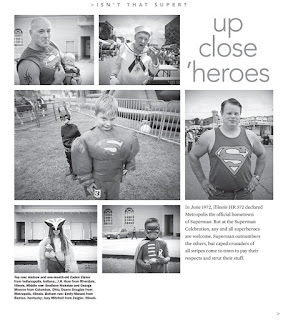
Awe and Wonder.
One of the ideas Joseph Campbell is famous for is his four functions of mythology: metaphysical, cosmological, social, and gastronomic. I may have gotten that last one wrong. But why wouldn't mythology help you digest food properly?
Anyway, the metaphysical function, according to campbell, is all about demonstrating to humanity that life is worth living, that creation is a beautiful thing, and all that. Then we get Dave Gibbons, artist who drew Watchmen, most famously, but also a little Superman story called "For the Man who Has Everything." Both written by Alan Moore. In an interview he said,
"Again, my personal view is that they should make it lighter, with that sense of wonder that Superman has always had. Not to make it childish or puerile but to make it something that has a bright sense of adventure and possibility."
He's talking about what a new Superman movie should feel like. He's not the only one. The internets are awash with fans speculating, hoping, decrying, and dismissing a movie that has no script, director, actor, or even basic idea. It's interesting. Part of this is the age we live in, an age of endless discussion not only of what might be and what might have been but what should be, in everyone's own opinion.
While every work has its fanatics and devotees, I wonder if there's something in particular about Superman that makes this speculation appropriate. I won't bother linking to every quotation in which Superman is called a myth, but doesn't that status mean it's different from a lot of other "properties" out there?
It's particularly appropriate to film versions of the character. Film, more than television or comic books, has the ability to instill that sense of awe and wonder. It's bigger than life, and until a couple of decades ago it had to be viewed in something resembling, if not a religious ritual, then at least a public dream. Everyone sitting quietly in a darkened room, slightly leaned back, dazzled by images of things they previously could only imagine. Compare that to sitting at home, phone ringing, neighbors screaming, cars driving by, etc...It's why the rudeness of modern theater goers is such a sad state of affairs.
Where'd that rant come from? I don't even go to the movies more than once a year anymore.
Subscribe to:
Posts (Atom)