Since having kids, I've been reading hundreds of kids' books each year. I remember some of them from when I was a kid (Where the Wild Things Are, Little Black), but a great many of them are completely new to me. And some of them blow my mind. So today I wanted to write a bit about the writer and artist who is perhaps my favorite kids' book creator. His name is David Wiesner.
I first came across his book Tuesday, which is about a bunch of frogs that start flying on lily pads. They cause some trouble in a little town, then head back to their swamp. It's told entirely through pictures--not a word beyond a few time stamps--and it's brilliant.
A while back Paul McCartney composed some music for for a twelve minute animated short film based on this book. It can be found on McCartney's Music and Animationdvd. It's classical music. Lots of strings. Really good stuff.
Wiesner has done some truly outstanding work with visual images. His books include Art & Max; June 29, 1999; and Sector 7, and others. I haven't read them all yet, but I intend to.
Then Miss Carol at the local Barnes and Noble recommended Wiesner's Mr. Wuffles, and I quickly became convinced that this is the greatest book of all time. Behold:
Yes, Mr. Wuffles is a cat...
...a cat who battles tiny aliens.
There are words, but the majority of them are in alien-speak and bug-speak. Trying to get my son to practice writing, I have him write sentences based on the panels and what he thinks the characters are saying in each one. He comes up with some pretty neat stuff. We're going to do this with some other books, too, I think.
Wiesner has an interesting website. He has a section devoted to his creative processes, so you get to see some of the sketches that became the paintings in the books as well as some of the model work Wiesner did in order to envision the aliens. I love seeing the creativity behind the creation. It's part of what drives contemporary folklore studies, learning how people come up with the things they create.
I think I'd want to own Wiesner's books even if I didn't have kids.
So these six guys grow up together, go through school together, and then separate to make their fortunes. Decades later, the men return to their home town to enjoy their retirement. That summer, they get in the habit of going to the park every Saturday to sit on a bench, feed the pigeons, and watch the world go on around them. The find the perfect bench--it fits all six of them, just right.
Soon autumn sets in, and then the first snowflakes fall. The next Saturday, the men all show up bundled in puffy new winter coats. But when they sit down, they discover that the bench will only hold five of them.
"Oh, no!" cries the one left out. "The bench...it must have shrunk because of the cold."
"Well," says another man, "we'll just have to stretch the bench out so we can all fit on it again."
They set to it. With all the heaving and hoeing on the bench, the men become too warm. So they take off their coats and keep at it. After a while, they figure they must surely have stretched the bench enough to fit them all. So they sit down, and they all fit. Content once more, they resume their normal world-watching.
After another while passes, one of them says, "It's getting cold again. Let's put on our coats." The others agree, but once it's done, they discover that only five of them fit on the bench.
"Oh, no!" cries the one left out. "The bench...it has shrunk again."
**********************************
I hope you'll forgive me for telling my own version of this best story in the world. The one I learned just didn't have quite the right punchline. From the 1960s until the 1980s, the pre-eminent folklorist Richard Dorson edited a series of books that contained collections of folktales from around the world (France, Japan, China, Norway, Hungary, India, Egypt, and others), published by the University of Chicago Press. These are uniformly great books. Each contains a foreword by Dorson and an intro by the editor. The editors also provide some context for the stories. I first encountered "Six Men and a Bench" in Kurt Ranke's Folktales of Germany, from that series (translated by Lotte Baumann). In that book this story is called "Stretching the Bench"--Tale Type 1244, motif 211245--and according to the the notes it was recorded by Grete Horak, from an unnamed German. Ranke also notes that 26 different versions had been collected in German by the 1960s.
"Six Men and a Bench" is a numskull story. My dad has told me lots of these stories, though fewer in recent years. One of my favorites was about these two guys--one dumber than the other--who were running from the police after a botched bank job. They took to the roofs, jumping from building to building in the dark. They came to a gap too large to jump.
"I've got an idea," says the dumb one. "I'll shine my flashlight at the other building, and you can walk across it."
"What, you think I'm an idiot?" says the other dumb one. "You'll wait til I get half-way, then turn off the light."
A while back, Walt Simonson worked on the animated Return of the King film for Rankin/Bass productions. He drew to fit the style of the animation, which was based on the designs for the earlier Hobbit film by the same studio. Below, I've posted some of the drawings he did for that project along with some earlier drawings. It seems that Simonson read Lord of the Rings in college, while he was studying geology and first getting into drawing, so he did some illustrations. I've included all the drawings of the lord of the Nazgul, also known as the Witch-King of Angmar and the Black Captain. You can find all these and more on Simonson's Facebook gallery.
Sorry to report that I'll have to go into hiding until about Tuesday of next week. I'll pretty much just post Walter Simonson art for the next few days. Deadlines loom...
Let's just start with the story. Why not listen to it? It only takes a minute. Just head on over to the Digital Library of Appalachia website and hear Jane Muncy tell it to Leonard Roberts, in the 1940s:
Once there was a little boy who was rather lazy and who often played until past time to drive the cows home from the pasture. His father had often warned him that if he continued to wait until after dark to drive them in in, something would "get" him. However, the warnings did little good. One night the father decided to throw a scare into the boy, and, covering himself with a sheet, ran down the path by which the boy had to come, and sat down on a log to wait for him. A monkey, the family pet, had seen the man put on the sheet. And it draped the white tablecloth about it and followed him. When it reached the log on which the father was sitting, it climbed up beside him unobserved. Just then the boy came along driving home the cows. He saw both white figures, and at the same time the father glanced around and saw the monkey in the white table cloth. The father started running for home, and as he did so, the boy shouted in great glee, "Run, Big Fraid, little "Fraid'll get you!"
That was told by Dora A. Ward of Princeton, Indiana, to Paul g. Brewster, on July 20, 1938. Published in the journal Folklore, Volume 50, #3, pp. 300-301.
There's a version in Maria Leach's The Thing at the Foot of the Bed.
Elllis Credle wrote a book of this story, too, which I haven't had the chance to read yet.
And now things get more complex. See, Herbert Halpert collected a version in which the father from this story is actually trying to scare his "worker," who's black. John Minton, in his monograph on this very story (which is Tale Type 1676A, for those keeping track, also motif K1682.1) makes much of this variation. And with good cause. There's something worth exploring when you've got a white farmer wearing a white sheet trying to scare his black employee. And then the reversal--the monkey in the white sheet actually scaring the white man.
Minton's book is, well, it's for folklorists. There's a lot of material in it that critiques the notion of tale type and its value. He also argues that the "Big 'Fraid and Little 'Fraid" is an African-American tale. I don't necessarily agree.
That extra layer is just one reason I love this story. One of the more famous versions (at least for folklorists) is that told by J.D. Suggs to Richard Dorson in the 1950s. Suggs makes the man a train engineer, and he's just trying to scare some kids who annoy him when the monkey intervenes. He ties it into two other episodes.
It's worth noting that in some versions, the monkey gets so annoying that the owner decides to kill it. He does so by pretending to shave. The monkey grabs a razor, lathers up its face, and does the same. The man then runs the razor across his own neck, having first turned it so the blunt side is facing him. The monkey doesn't notice this switch, so it ends up slicing itself wide open.
So why is it one of the best in the world? As with "Leap of Faith," there's a beautiful simplicity. Short, funny, and rich in meaning. I think about this story all the time, in part because I wish it were true. I love stories that can do anything, that can fit into a variety of contexts and still work. This is one such story. The more you read about it, the better it gets.
And here's a version recorded for "Scary Spooky Stories" from the 1970s.
I think
John Cusack and Stephen Frears made as good a movie as one can possibly make when adapting Nick
Hornby’s High Fidelity.I like the movie
quite a bit.Once, when I was watching it with some friends who hadn’t seen it
before, one of them asked why the movie wasn’t over when Laura moved back in
with Rob.It’s a valid point.Most romantic comedies would have ended with
that.The only problem was that Rob
really hadn’t changed yet.He’d made
some realizations, and he’d promised to do better, but we haven’t seen him
capable of it.This is one element that
elevates this film:It doesn’t let Rob
off easy.It’s not too hard on him, in
the end, but he has to put forth a lot more effort than most leading men.
Another
friend who read the book said it was just exactly like the movie, only with
more Top 5 lists.This is mostly
true.There’s more to the book, of
course.There’s a lot more to Rob’s
relationship with Marie LaSalle in the book.She pops up again and again, though her role isn’t substantially
different.One of those times is Rob’s
birthday, when he organizes an ad hoc gathering of his “friends.”It isn’t successful—nobody involved seems to
have any fun, and all we really learn is that Rob doesn’t really have
friends.There’s nothing there that
would make for a good movie scene, and it was rightfully dropped.As were scenes where Rob goes to visit his
parents and all the stuff about the fourth breakup on his top 5 list.
There
are some things the movie does better than the book, such as the one-night
stand with Marie.In the movie, Rob says
he’s not going into details—“who did what to whom”—and he doesn’t.In the book he says this, then proceeds to
describe their awkward foreplay, a strange trip to the bathroom, and he sexual
neuroses.It’s actually kind of annoying
to read that part, simply because the movie handled it so nicely.But the book needs this sort of glimpse into
Rob.We know the Rob in the book much
much better than the Rob of the movie.And he’s more of an a-hole than the movie version at that.They’re mostly the same character, though the
movie version is softened a bit for our benefit.There’s one big difference in them:Rob in the book doesn’t commit because he’s
afraid of death.
His low
point in the story is when he leaves Laura’s dad’s funeral.He sits on a bench in the rain and realizes his
big problem.Both movie and book have
this tied overall to the fantasy presented by women he doesn’t really
know.He can imagine these women so
reality never ruins anything.But with
Laura he has the reality, and it can’t match up.In the book, Hornby's Rob has a strange realization
that he’s always been afraid that Laura would die and he’d be alone, though
he’d never realized it until then.It’s
strange and out of place and there’s absolutely no build-up to it at all.Even Hornby acknowledges this in a way with
the interjection “oh, right! He sleeps with other women because he has a fear
of death!—well, I’m sorry, but that’s the way things are.”
I
wonder…If I’d read the book before I saw the film, which omits it completely,
would I still think it’s strange?
Anyway,
all the best stuff between the characters is there in the book, and there’s
more of it.Even things like gestures
and body language are there in the prose, which was a bit surprising.The actors nail their characters.The script gets all the right parts in
there.There’s just more to the book,
and that is a good thing.Hornby is able
to give a bit more of the everyman philosophy and the feeling of grown up.The change of setting isn’t a big deal
(London of the book is Chicago in the movie).The only argument that the film is superior could come from the
delivery, from the actors, and direction.There’s not much of the cinematography to speak of, which is
appropriate.This is one of those cases
where the adaptation got everything right, and the novel is just going to be
superior.
There is no religion without magic any more than there is magic without at least a trace of religion. The notion of a supernature exists only for a humanity which attributes supernatural powers to itself and in return ascribes the powers of its superhumanity to nature.
Claude Levi-Strauss, The Savage Mind 221
I am the sum of all these people, and all their knowledge. I am all-seeing. I am everywhere and nowhere. That has often served as a definition of God.
John Boorman, Zardoz
He can neither believe nor be comfortable in his unbelief.
Nathaniel Hawthorne, describing Herman Melville
All astronomers are amateurs. When it comes to the heavens there's only one professional.
Curt Siodmek, The Wolfman
There's a blind man here with a brow
As big and white as a cloud.
And all we fiddlers, from highest to lowest,
Writers of music and tellers of stories,
Sit at his feet,
And hear him sing the fall of Troy.
Edgar Lee Masters, Spoon River Anthology 75
If we cannot comprehend God in his visible works, how then in his inconceivable thoughts, that call the works into being?
Edgar Allan Poe, "The Imp of the Perverse"
All great religions, in order to escape absurdity, have to admit the dilution of agnosticism. It is only the savage, whether of the African bush or the American gospel tent, who pretends to know the will and intent of God exactly and completely. "For who hath known the mind of the Lord?" asked Paul of the Romans. "How unsearchable are His judgments, and his ways past finding out!" "It is the glory of God," said Solomon, "to conceal a thing. "Clouds and darkness," said David, "are around him. "No man," said the preacher, "can find out the work of God..." The difference between religions is a difference in their relative content of agnosticism. The most satisfying and ecstatic faith is almost purely agnostic. It trusts absolutely without professing to know at all.
H.L. Mencken, Damn, A Book of Calumny 95
Sluggish and sedentary people, such as the ancient Egyptians--with the concept of an after life journey through the field of reeds--project onto the next world the journeys they failed to make in this one.
Bruce Chatwin, The Songlines, 230.
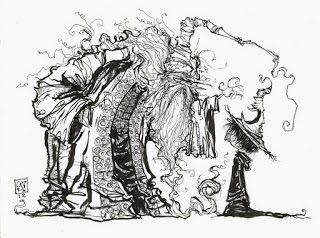
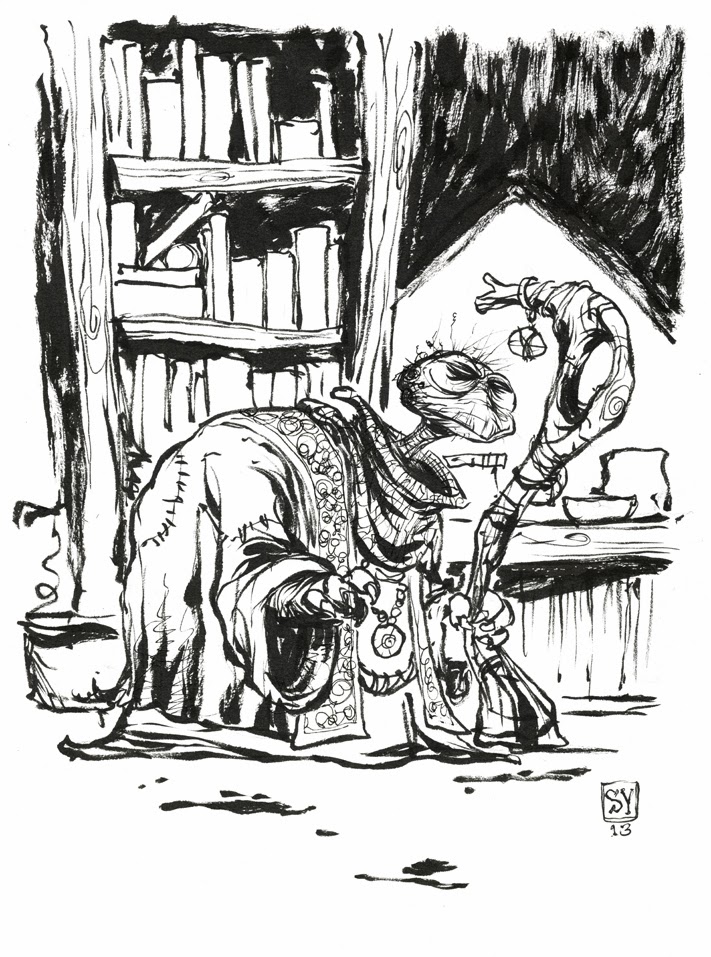
I first noticed Young's work on the Oz books Marvel's been putting out, written by Eric Shanower with amazing colors by Jean-Francis Beaulieu. I've loved all of them so far, though Young, at least, is done with the series. I'm not sure if it's going on without him. Young is currently doing a Rocket Raccoon series.
We should be glad that he is. I think I've got the series from the 80s somewhere in a comic box. Young works mostly for Marvel, doing lots of variant covers. He recently worked on Neil Gaiman's Fortunately, the Milk.
Young is a cartoonist in the classical and best sense of the word. He's got a tumblr where he posts a whole lot of stuff, including a daily sketch, which is my favorite part of it. There's a lot of stuff on his old blog, too.
I wanted to do a short gallery of all his wizards, because he gives them this great, cluttered, looming quality. But there's just too much good stuff to limit it to that. So first, some wizards.
This movie is one of the two or three musicals that I have watched many times. It’s just a brilliant movie in so many places, Gene Wilder makes it so. That's not a knock on director Mel Stuart or Dahl and David Seltzer's screenplay. I love the way Wonka's dialogue is peppered with so many quotations from songs and plays and whatnot. So shines a good deed in a weary world.
There's a certain comedy that I like to the whole film, from treating a chocolate sweepstakes as the most important thing in the world to the half-office Wonka works in at the end.
I'm just going to be upfront and say that I haven't seen the version with Johnny Depp. Tim Burton is a really good visual stylist, but for me there was no need to see that movie.
No thanks.
The book, titled Charlie and the Chocolate Factory, is not bad. It’s just not as good as the movie. For me, it all comes down to the end, where Charlie outlasts the other kids and wins the favor of Wonka. In Dahl’s book, Wonka turns around soon after Mike TV takes his leave and sees that Charlie is the only one left. He gets excited and declares Charlie the winner.
In the film, Wonka feigns indifference, even scorn because Charlie and Grandpa Joe drank some fizzy lifting drink against Wonka’s interdiction. He gives Charlie every reason to betray him to his enemy, Slugworth, but Charlie keeps true to his promise, thus proving himself worthy of inheriting the chocolate factory. Both book and movie keep Charlie’s character central to his victory, but the movie dramatizes it better. We might say that the book makes Charlie’s lack of action key to his triumph--he doesn’t do anything wrong or exhibit any real defect in his character--but the movie makes his action at the end count. That’s just better storytelling, if you ask me.
Then there are the songs. “There is just no way of knowing, where exactly we are going.” Insane. And "Pure Imagination" is simply perfect. And even in that song, Wonka's oddity shines forth. That part where he plucks a hair from Mike TV's head for no reason at all? It's wonderful. Throughout these "Better than the Book" posts, I've been stressing the effect music can have in making a movie superior to a book. This movie is the exemplary case. Should Willy Wonka have been on that list of perfect movies a few days ago? Probably.
Willy Wonka is one of my favorite movies, and I enjoy watching it again and again. I can’t say the same for the book. I’ve read it once, and flipped through it again for this post. Maybe I'd be more attached if I'd read it as a kid, which is when I first saw the movie. Nostalgia can do that, make something feel important, seem better than it is. But even if I had read the book first, I would no doubt still think the movie is better.
I studied folklore because I wanted to learn about the best stories in the world. So it's time to start putting them on this blog. I suppose posting about "Clever Hans" a few weeks ago got me thinking of these stories, but we'll come back to the Brothers Grimm another time.
I want to kick things off with a story that I first found in a book by the anthropologist Marshall Sahlins, Historical Metaphors and Mythical Realities, published in 1981. Sahlins is quoting some earlier writers, who tell about a British captain named Vancouver, who tried to "civilize" the inhabitants of the Hawaiian Islands in the 18th century. Here it is, written by Ebenezer Townsend, Jr., as quoted on page 9 of Sahlins' book:
Capt. Vancouver was very anxious to Christianize these people, but that can never be done until they are more civilized. The King Amma-amma-hah [Kamehameha] told Capt. Vancouver that he would go with him to the high mountain Mona Roah [Mauna Loa] and they would both jump off together, each calling on their separate gods for protection, and if Capt. Vancouver's god saved him, but himself was not saved by his god, then his people should believe as Capt. Vancouver did.
Vancouver declined.
Mauna Loa.
The basic premise of this story, which we'll call the "Leap of Faith," existed in the mythology and legend of the Hawaiian people prior to European contact. Stories tell of a priest named Paao, who's sort of a culture hero, who built his own house on the edge of a high cliff. Whenever a god came to him and demanded worship, Paao would simply reply that he would worship any god who could survive a leap from the precipice. Many failed, but Makuakaumana flew and became Paao's god.
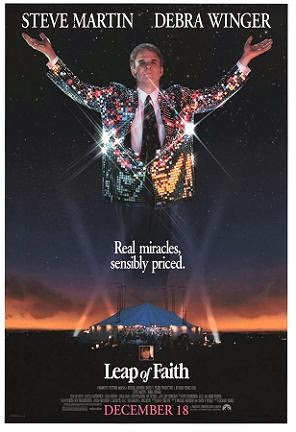
So what makes "Leap of Faith" one of the best stories in the world? Well, of course there's no real criterion that could make it so. Best is a subjective term, and I just like this story a whole lot. For one thing, it's funny. And I'm fascinated by stories about contact between different cultures. There's a certain theme of putting your money where you mouth is, so to speak, that appeals to me.
I wish there were variants of this from other cultures, in which indigenous peoples challenge the missionaries to other such leaps of faith. Vikings swearing that they would only worship Olaf Tryggvassen's god if he could slay a bear, or what have you. If there are versions from other cultures, I can't find them. There aren't any in the ATU Tale Type index, nor in Stith Thompson's Motif Index, not even in motif V350 Conflicts Between Religions, though the entries are pretty broad. It would most likely fall under V351 "Duel/debate to prove which religion is better." The interesting thing to me is that all the motifs listed under V350 involve one religion triumphing over another--"Leap of Faith" ends without either winning.
Sorry. I got lost in the Motif Index for a minute there.
There's a beautiful simplicity to "Leap of Faith" that masks the layers of cultural and historical context behind it. As with many of the greatest stories, the more you know about it, the more you appreciate it.
And also, I'm a big fan of early Tom Hanks comedies.
The idea of a "favorite" has been driving a lot of my thinking. What makes a movie or book or tv show or food someone's favorite? If asked right now, I would say my favorite food is barbecued ribs, but I haven't eaten those in four years and may never eat them again in my life. So how can they be my favorite? My favorite movie is The Wolf Man, but I can't even remember the last time I watched that. Do you have to repeatedly experience something in order for it to be your favorite?
I like a lot of movies, but my favorite parts of movies aren't always the big set-pieces or the memorable lines. So today I want to point out some of my favorite parts of some movies, even if they movies aren't my favorites. It's these little things that make the movies for me. You couldn't do these things in books. Comics? Maybe. Especially the last one below.
Let's start with Jurassic Park. Yeah, the dinosaurs are great, and the effects hold up better than most movies made last year. But you know my favorite part? When Wayne Night is having that clandestine meeting with the guy from Ingen, and the guy shows him the fake shaving cream canister rigged to hold the dinosaur eggs or whatever. Nedry/Knight/Newman laughs with glee when he finds out that the shaving cream actually works, and expels some onto his hand. Not knowing what else to do with it, he puts the shaving cream onto some poor schmuck's pie at the next table over. There's something about that dollop of shaving cream that's just right. It's also a great moment to set up Nedry's character. Jurassic Park rightly doesn't get much credit for its script (that monologue in which Alan Grant scares that kids about the raptors makes no sense), but that scene with Nedry and Dodgson is pretty great.
Dodgson! Dodgson! We've got Dodgson here!
Samuel L. Jackson saying "Hold on to your butts" is pretty great, too.
Then there's Cary Grant's socks in North by Northwest.
Why can't I find any good color pictures of those socks?
Then there's one specific shot towards the end of Fellowship of the Ring, when Boromir blows the horn of Gondor to call for help, and Aragorn takes off running to him. The shot starts out fairly low, but then the ground slopes away and you see the full scale of the battle taking place in the woods. There's a lot of movement and characters moving, and it's a full twenty seconds long. It was done with the camera on a wire, remote controlled. It's starts 8 seconds into this clip.
Let's end on a moment from Superman: The Movie. My favorite part is that few seconds after the balcony interview, when Lois goes back inside and Clark comes in to pick her up. At 26 seconds into this clip, Clark takes off the glasses, straightens his posture, and prepares to tell Lois who he is. Then Lois comes out of the other room, and he chickens out.
So the recent departure of Harold Ramis and my thinking about The Princess Bride have aligned to make me think of what movies are just about as perfect as can be. I think Raimis directed two of them, maybe a third.
Now, a perfect move, in my mind, doesn't mean that everybody loves it. It just means that there's no real possible way to make it better without making it an entirely different movie. I remember learning somewhere in film school that John Wu or somebody like that thought the movie Le Samourai, directed by Jean-Pierre Melville, was perfect. And it is pretty fantastic. It's not the sort of movie that I'd want to watch over and over again, but it's been a while and I'm thinking of revisiting it.
People used to ask me what my favorite movie was. I never really knew how to answer that question. But some of my thinking about favorites has gone into thinking about perfection. A favorite doesn't need to be perfect (my favorite movies often have huge plot holes--such as The Matrix, The Professional--seriously, have you seen the international version of this?--and others).
One thing a perfect movie does is lodge into your head, and it does this in part through the strength of the dialogue. Here's a list of movies that could possibly be considered perfect. This shouldn't be taken as listed in order of preference or anything. Anyway, I've listed some below with one of the best quotes from them. Some of them could just have been transcribed whole.
He's just like every other man, only more.
I cut myself shaving.
Who knows what they're saying in this movie? It's all in French.
You're right. No human being would stack books like this.
I've come to the end of me, Rita.
Stop snoring. You'll wake up the lice.
Never start a land war in Asia.
What heart?
We all go a little mad sometimes.
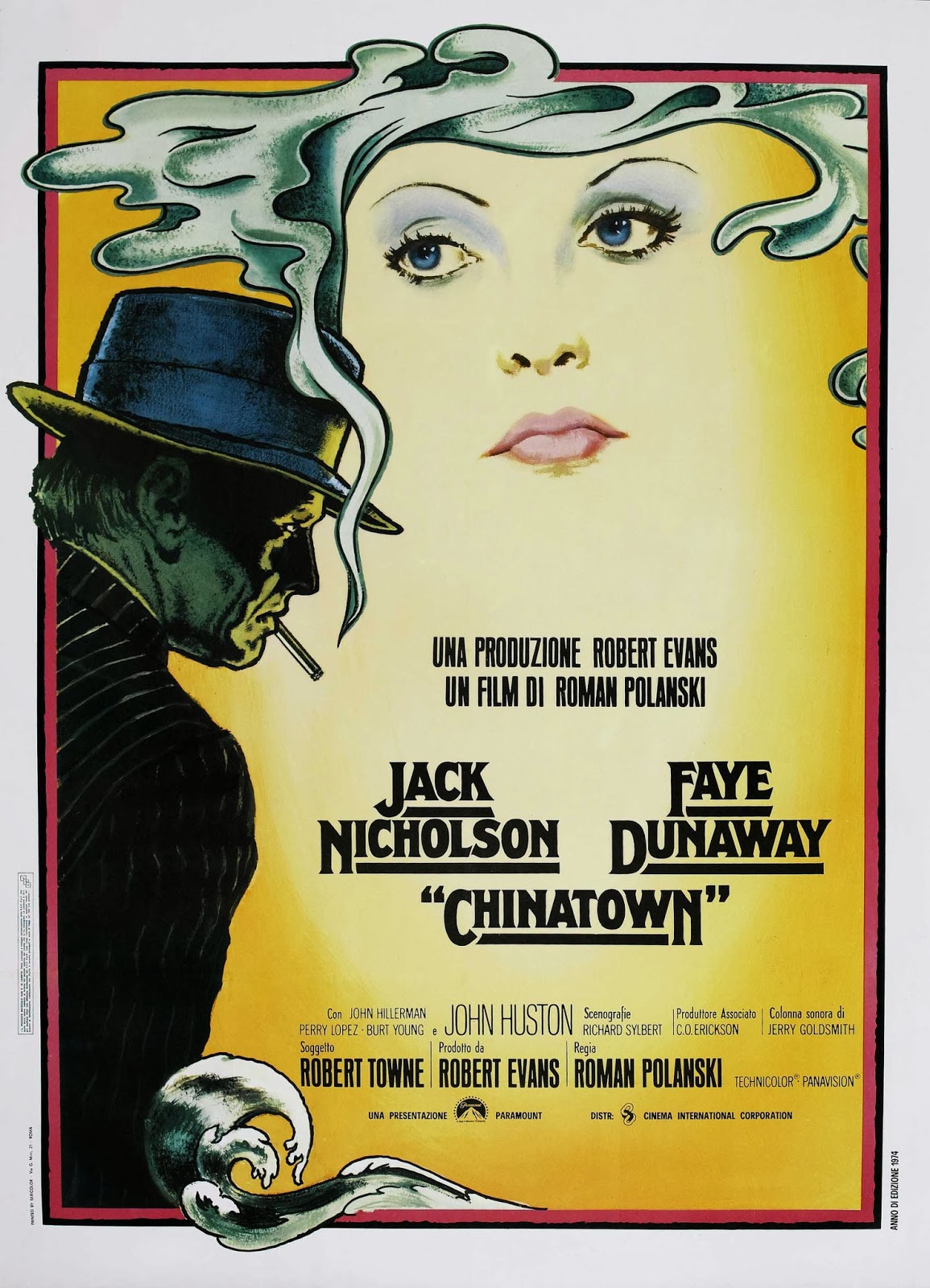
My theory is that everyone is a potential murderer.
I'm tempted to put Vertigo on this, but it just drags a bit in the middle (Citizen Kane is the same, and besides The Lady from Shanghai is better). Would that be too much Hitchcock? Sorry there's no Nicholas Ray on here, I suppose. And also The Wolfman, but Lon Cheney's American accent needs to be accounted for first. I also want to say there's a Jackie Chan movie out there somewhere that deserves to be here, but I can't figure out which one.